
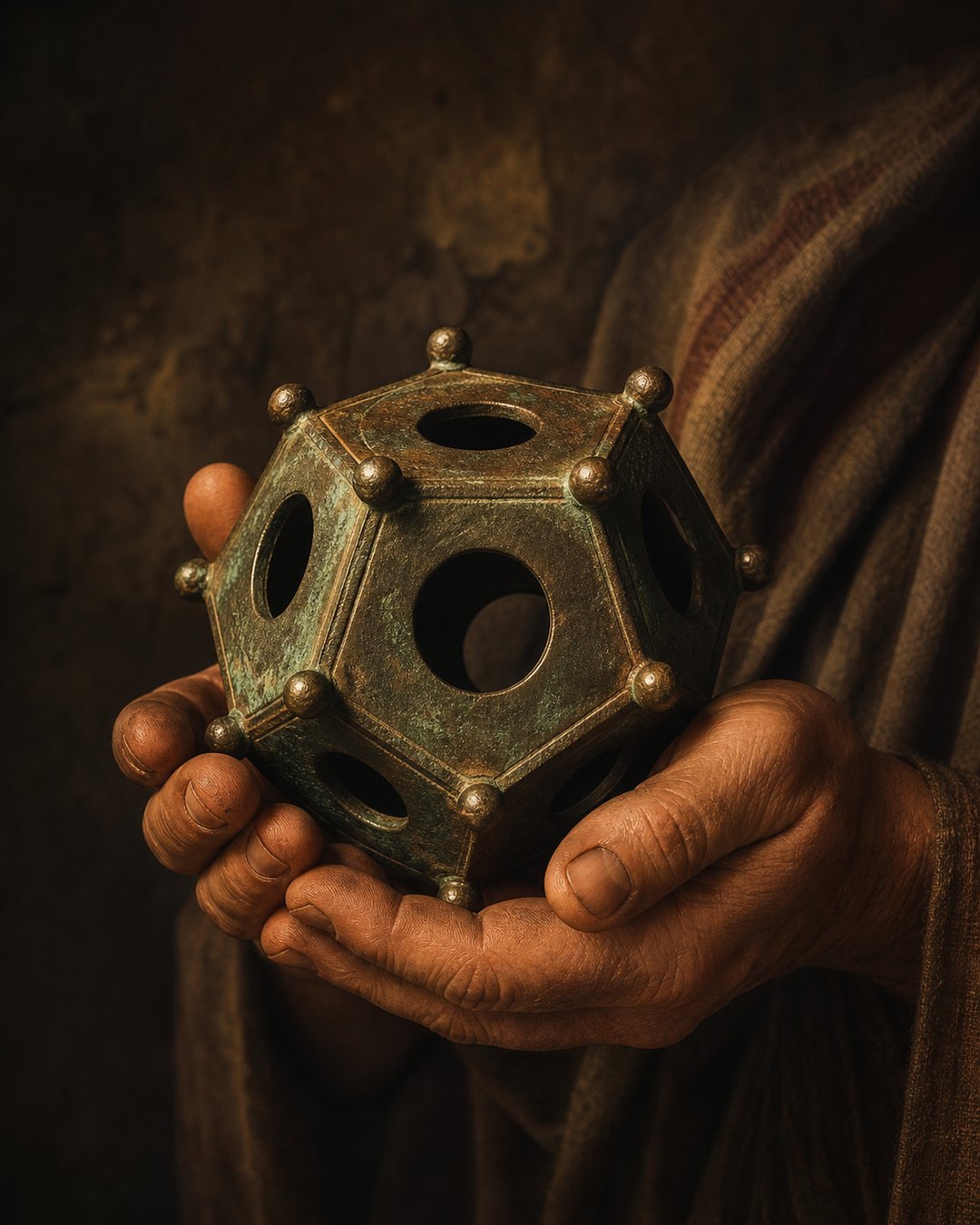
The object fits in two hands and seems designed to provoke measurement. Twelve flat pentagonal faces meet in a hollow bronze shell. A circular opening pierces each face, but the holes are not all the same diameter. Rounded knobs sit at the corners. Every surface suggests a rule; none supplies the missing instruction.
More than a hundred Roman dodecahedra have been reported, concentrated in the north-western provinces rather than spread evenly across the empire. They are sophisticated cast objects, often small enough to carry, yet no surviving Roman text clearly names them. No ancient picture securely shows one being used.
That combination has produced theories involving surveying, range-finding, calendars, candle holders, knitting and ritual. The theories are revealing, but the object’s strongest lesson is methodological. Archaeology can recover a thing with extraordinary precision while losing the gesture, spoken explanation and social setting that once made it ordinary.
Geometry Makes the Silence Feel Deliberate
A regular dodecahedron has twelve pentagonal faces, twenty vertices and thirty edges. Roman examples turn that geometry into hollow copper-alloy bodies. Circular holes occupy the centres of the faces, and projecting knobs mark the corners. The shape looks too organized to be accidental and too elaborate to dismiss as scrap.
The London Museum’s collection record describes a cast copper-alloy dodecahedron with ringed circular openings of different diameters. English Heritage notes the carefully made Corbridge example displayed from its collection. Individual objects vary in size and detail, but the family resemblance is strong enough for an excavator to recognize the type immediately.
That repetition proves transmission. Metalworkers did not independently improvise the same twelve-faced shell dozens of times by chance. Someone knew what features mattered, customers recognized the form, and makers could reproduce it. Shared knowledge existed even though the words carrying that knowledge have vanished.
The paradox separates the dodecahedron from the Lycurgus Cup’s visible optical effect. The cup changes colour when light moves through its glass, so the surviving material still performs its wonder. A dodecahedron remains inert until a lost human action gives the holes and knobs a purpose.
A Lincolnshire Find Preserved the Object Almost Whole
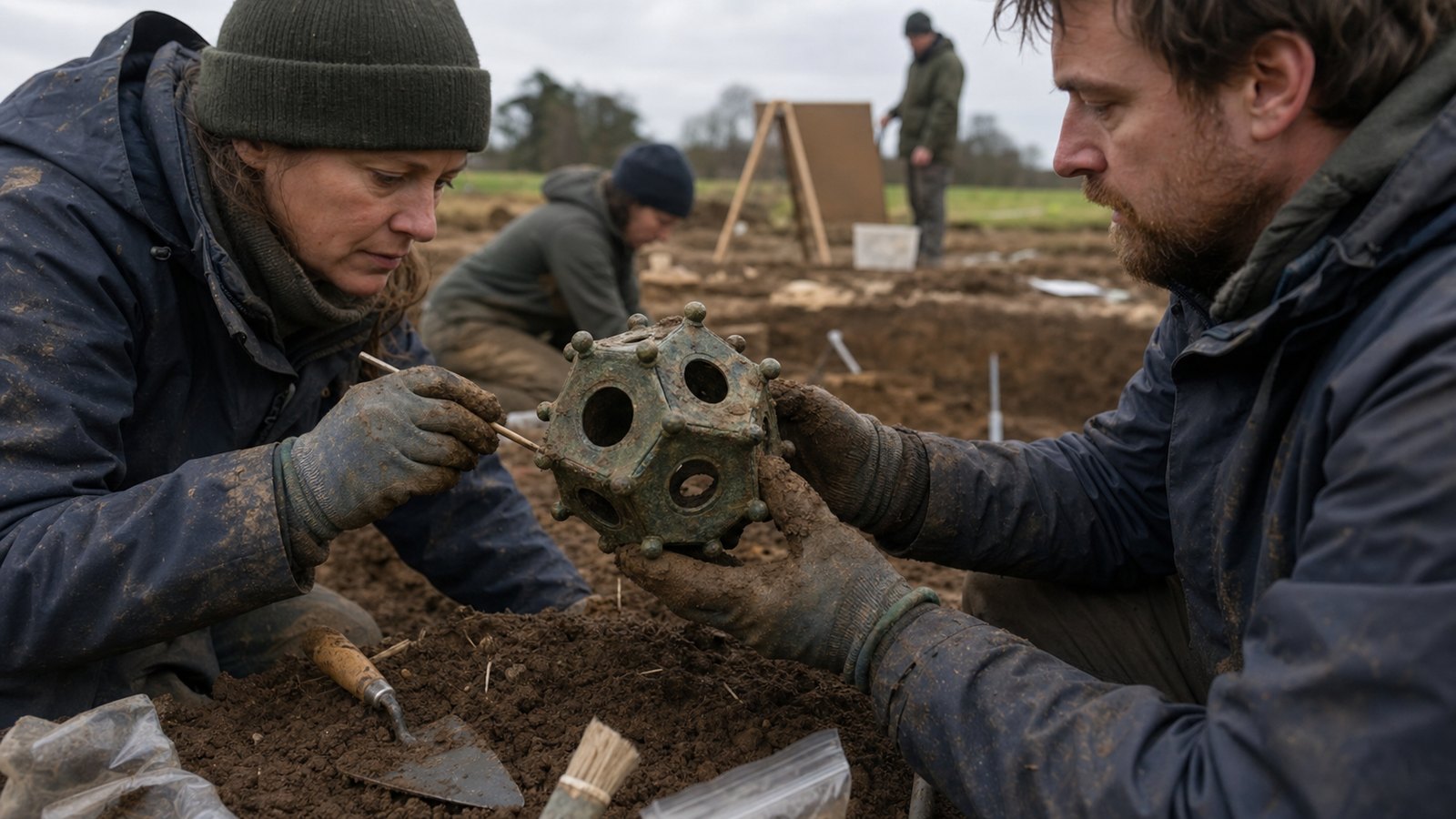
In 2023, excavators associated with the Norton Disney History and Archaeology Group found a dodecahedron in Lincolnshire. Newcastle University’s account describes the object as complete and unusually large, discovered during work at a Roman site. Its survival drew attention because many copper-alloy finds reach the present as fragments or recycled metal.
The find came from a place with Roman activity rather than an antiquities market stripped of context. Context does not automatically reveal function, but it narrows the questions. Soil layer, nearby features and associated finds can help establish date and site character. A documented excavation also lets later specialists revisit records rather than relying on a collector’s story.
The Norton Disney object has twelve pierced faces and corner knobs like other members of the class. Its condition makes casting seams, surfaces and wear available for technical study. Researchers can ask where fingers polished the metal, whether residues survive and whether any openings show repeated contact.
Completeness also sharpens the mystery. Nothing obvious is missing that would convert the shell into a familiar mechanism. There is no surviving handle, pointer, numbered scale or fitted companion piece. The object does not look puzzling because archaeology recovered only half of it. The puzzle is substantially intact.
The Map Is Uneven, and That Matters
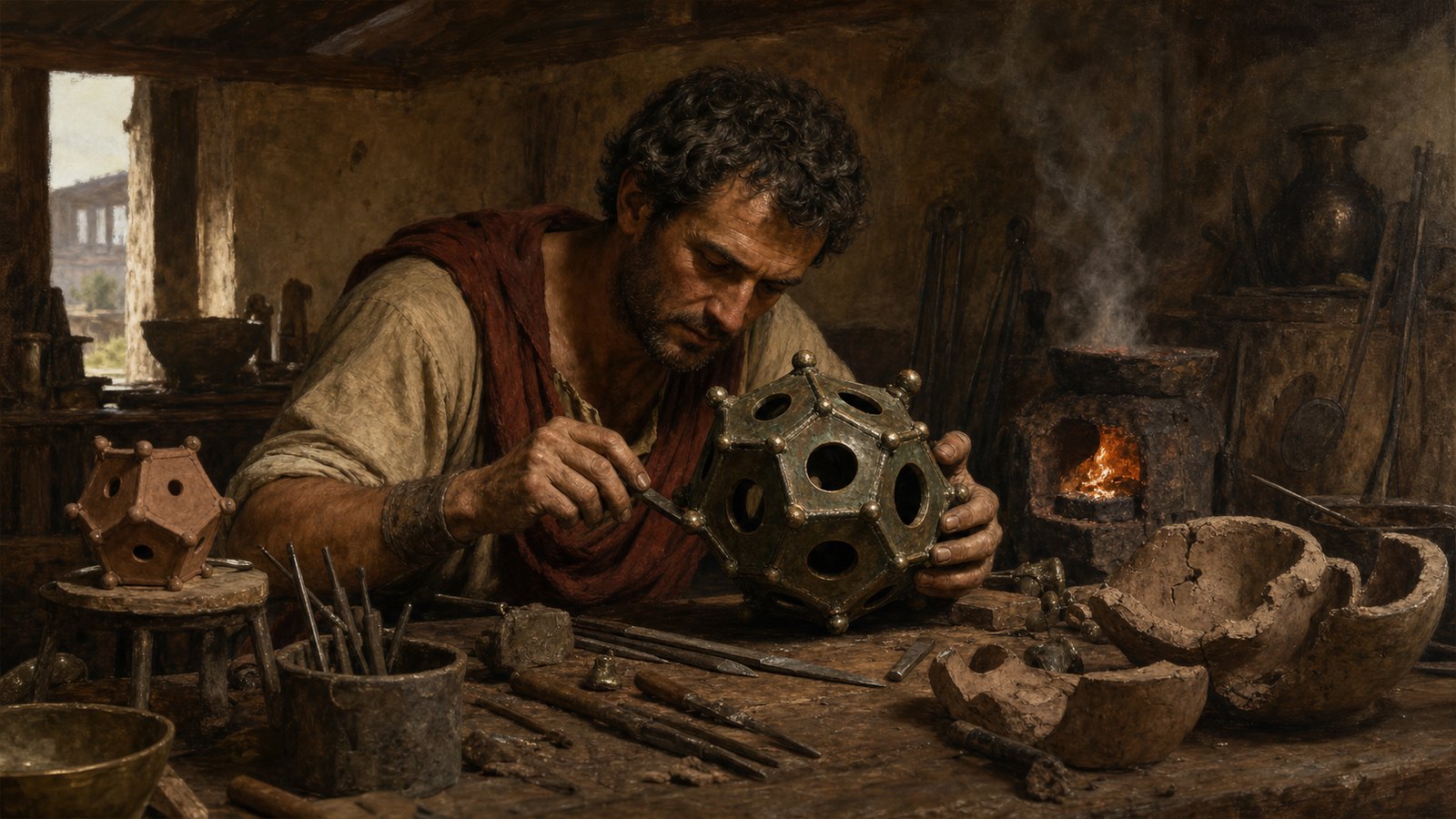
Roman dodecahedra cluster in Britain, Gaul, Germany and neighbouring parts of the north-west. They are not a universal object found in equal numbers from Syria to Spain. English Heritage emphasizes this provincial concentration when presenting the Corbridge example from the frontier zone near Hadrian’s Wall.
An uneven map can be evidence of regional practice. Military communities, local religious traditions, craft networks and frontier exchange all crossed provincial boundaries without filling the whole empire. The object’s distribution therefore cautions against imagining one standardized Roman purpose merely because the artefacts date to Roman rule.
At the same time, distribution alone cannot choose between practical and ritual use. Soldiers measured, repaired and played; civilians traded, worshipped and manufactured. Frontier regions were not culturally simple camps. A bronze object could move between a workshop, household, shrine and military settlement during its life.
The problem resembles the reconstruction work around the Corbridge armour hoard, but with a crucial difference. Armour fragments can be compared with bodies, fastenings and representations of soldiers. Dodecahedra lack that external reference system. Their shape repeats; their operation does not.
Every Neat Theory Meets an Awkward Detail
The varying holes encourage optical theories. Look through two opposite openings, measure the apparent size of a distant object and perhaps distance could be calculated. Yet examples differ, no ancient calibration marks survive and a useful instrument would require known dimensions or tables. Demonstrating that a replica can measure something is not the same as proving Romans used it that way.
Knitting demonstrations use the corner knobs to form tubes of yarn, sometimes described as glove fingers. The results can look persuasive. The difficulty is evidence: no ancient instruction, associated yarn, worn pattern or depiction links the bronze objects securely to textile work, and simpler tools could perform related tasks.
Candle-holder proposals point to wax reported in at least one object and to the stable knobs. Wax can indicate a lamp-like use, but it can also arrive through later reuse, deposition or conservation history. A single trace cannot automatically explain an entire object class whose holes, sizes and find contexts vary.
Calendar, gaming and ritual theories face the same discipline. Twelve faces tempt association with months or signs; rarity and careful casting tempt association with status or ceremony. These are possible starting hypotheses. Without a repeated contextual pattern or contemporary explanation, elegant symbolism remains elegance supplied by the modern observer.
Not Knowing Is an Archaeological Result
The dodecahedron often appears in lists of ancient mysteries, where uncertainty is treated as a challenge that one clever experiment should solve. Archaeology asks a harder question: what evidence would distinguish a workable modern use from the historical use? A replica can knit, measure shadows or hold wax because human ingenuity can recruit almost any shaped object for multiple jobs.
Wear analysis, metallurgical study, residue sampling and secure excavation contexts offer better routes. If many openings carried matching abrasion, if residues repeated across objects, or if finds clustered consistently in shrines or workshops, confidence could grow. Variation is evidence too. Different alloys, dimensions and decorative choices may reveal separate production groups or uses.
The absence of a written name is not surprising in itself. Most ancient people did not compose technical treatises about every object around them, and only a fraction of texts survived. Materials also disappear unevenly. A bronze shell endures where a wooden gauge, leather strap, wax tablet or oral instruction does not.
This makes the object a record of lost familiarity. Its makers solved moulds, joins, thickness and geometry. Its users presumably did not stare at it as an insoluble enigma. They knew where to hold it, what to place through it or where to set it down. Modern viewers inherit the durable answer to a question whose wording is gone.
The temptation to force closure says as much about us as the artefact. Twelve faces imply order; repeated holes imply procedure; knobs imply contact. We expect organized form to yield organized explanation. When it does not, the gap feels like a failure rather than information about what the archaeological record cannot preserve.
The Roman dodecahedron remains useful precisely because it resists a final caption. It proves that craft knowledge moved across provinces, that customers valued a difficult bronze form and that material regularity can outlive cultural meaning.
We can count every face, measure every opening and map every discovery. The missing action still sits between those observations. Archaeology has not recovered an object without evidence; it has recovered evidence of a practice whose most explanatory parts were made of context, memory and human hands.