
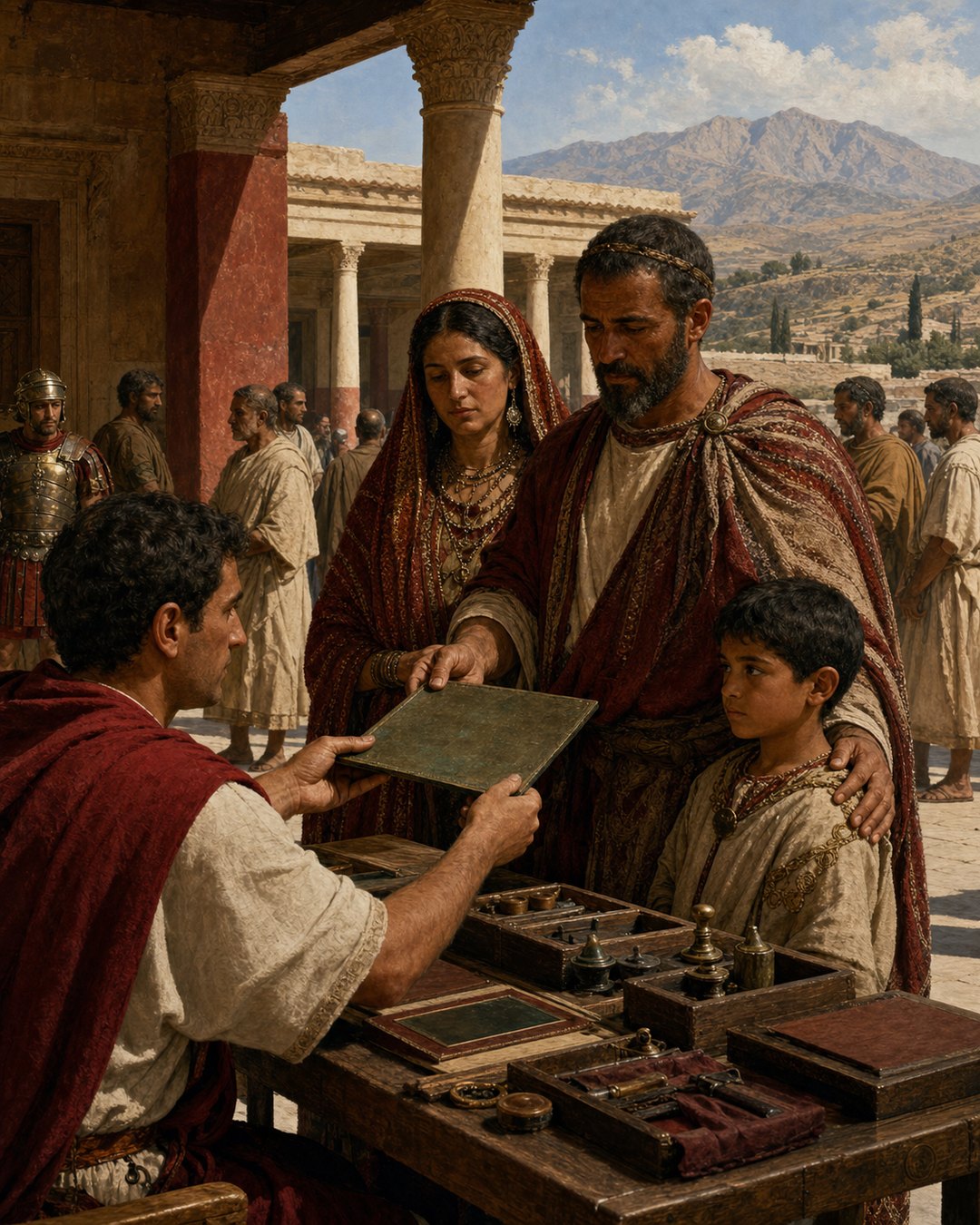
Citizenship reached a family in Roman Morocco through a sequence of hands. A local notable petitioned. A provincial governor supported the request. Emperors answered. A freedman checked the central register in Rome. Twelve senior men authenticated the copy. At Banasa, the result was cut into a bronze sheet large enough to make private favour publicly durable.
The tablet now called the Tabula Banasitana was found in June 1957 near the east baths of ancient Banasa in Mauretania Tingitana. It preserves three Latin documents dating from about 168 to 177 CE. Together they concern two generations of leaders among the Zegrenses and the citizenship granted to wives and children as well as to the men who petitioned.
The surprise lies in the qualifications. Rome did not say that new citizenship dissolved the family’s existing place among the Zegrenses. The grants used the formula salvo iure gentis—while preserving the law or right of the people—and the later record kept taxes and public dues intact. Bronze therefore records addition rather than simple replacement.
A Tablet Near the Baths Had Once Faced the Forum
The plaque is substantial: about sixty-four centimetres high and forty-two wide, with a polished inscribed face. It was excavated in a dependency of Banasa’s east-baths complex, only a short distance from an apsidal building opening onto the forum’s eastern portico. William Seston and Maurice Euzennat argued that it probably came from that public area before later movement or collapse carried it toward the baths.
That setting changes the document’s force. The grant began with a family request, but a monumental bronze copy did not belong in a private box. Display near the civic centre let magistrates, neighbours and future officials see that the claim rested on an imperial answer and an authenticated extract. The object transformed status into something a community could consult.
The first modern publication followed in 1971, although the find had already supported preliminary study a decade earlier. The tablet is now in Rabat’s Museum of History and Civilizations. Its journey from forum precinct to museum preserved far more than names: it kept three stages of Roman administration together on one surface.
The layout itself asks the viewer to read the three records as a dossier. The earlier imperial letter establishes the family precedent. The later letter shows a successor requesting comparable treatment. The register extract supplies names, ages, date and authentication. No single component tells the whole administrative story; their deliberate combination lets each document support the others.
Julianus Needed Merit, a Governor and an Exception
The first text copies a letter from Marcus Aurelius and Lucius Verus to Coiedius Maximus, governor of Mauretania Tingitana. It reports that the emperors read the petition of Julianus of the Zegrenses attached to the governor’s letter. Their reply admits that Roman citizenship was not normally granted to members of these peoples except when very great services called forth imperial favour.
Maximus had described Julianus as one of the leading men of his people and exceptionally faithful in prompt service to Roman interests. The emperors also hoped that honouring his household would stir others to imitate him. They therefore granted citizenship to Julianus, his wife Ziddina and four sons: Julianus, Maximus, Maximinus and Diogenianus.
This was personal imperial patronage, not automatic mass admission. The governor translated local standing into a recommendation legible at court, and the imperial reply translated service into status. The recently scheduled bronze speech on admitting Gallic senators shows an emperor arguing for provincial inclusion before the Senate. Banasa preserves a quieter route, one household at a time.
A Second Household Forced the Procedure into View
The next document belongs to the reign of Marcus Aurelius and Commodus. Another Julianus, now princeps of the Zegrenses and probably the son named in the earlier grant, petitioned for his own wife and children. The emperors told the new governor, Vallius Maximianus, that they had read the request and considered both the testimony of his predecessor and Julianus’s merits.
They granted citizenship to the wife and children, but then demanded details before the decision entered the official records. The governor was to investigate each person’s identity and age and write back. That instruction is revealing. Imperial favour did not complete itself at the moment of assent; names, kinship and ages had to be fixed accurately enough for registration.
The record lists Faggura as twenty-two, Juliana as eight, Maxima as four, Julianus as three and Diogenianus as two. These are not decorative family details. They identify the exact people to whom the legal decision applied. The children’s ages turn a broad phrase such as “his family” into a register entry that another official could later verify.
A Freedman Checked the Register and Twelve Men Sealed the Result
The tablet’s third part is an authenticated copy from the imperial commentarius of people granted Roman citizenship. It names a long succession of emperors associated with the register and fixes the relevant act at Rome on 6 July 177, during the consulship of Commodus and Marcus Plautius Quintillus. The local bronze thus points back to a dated entry in a central documentary system.
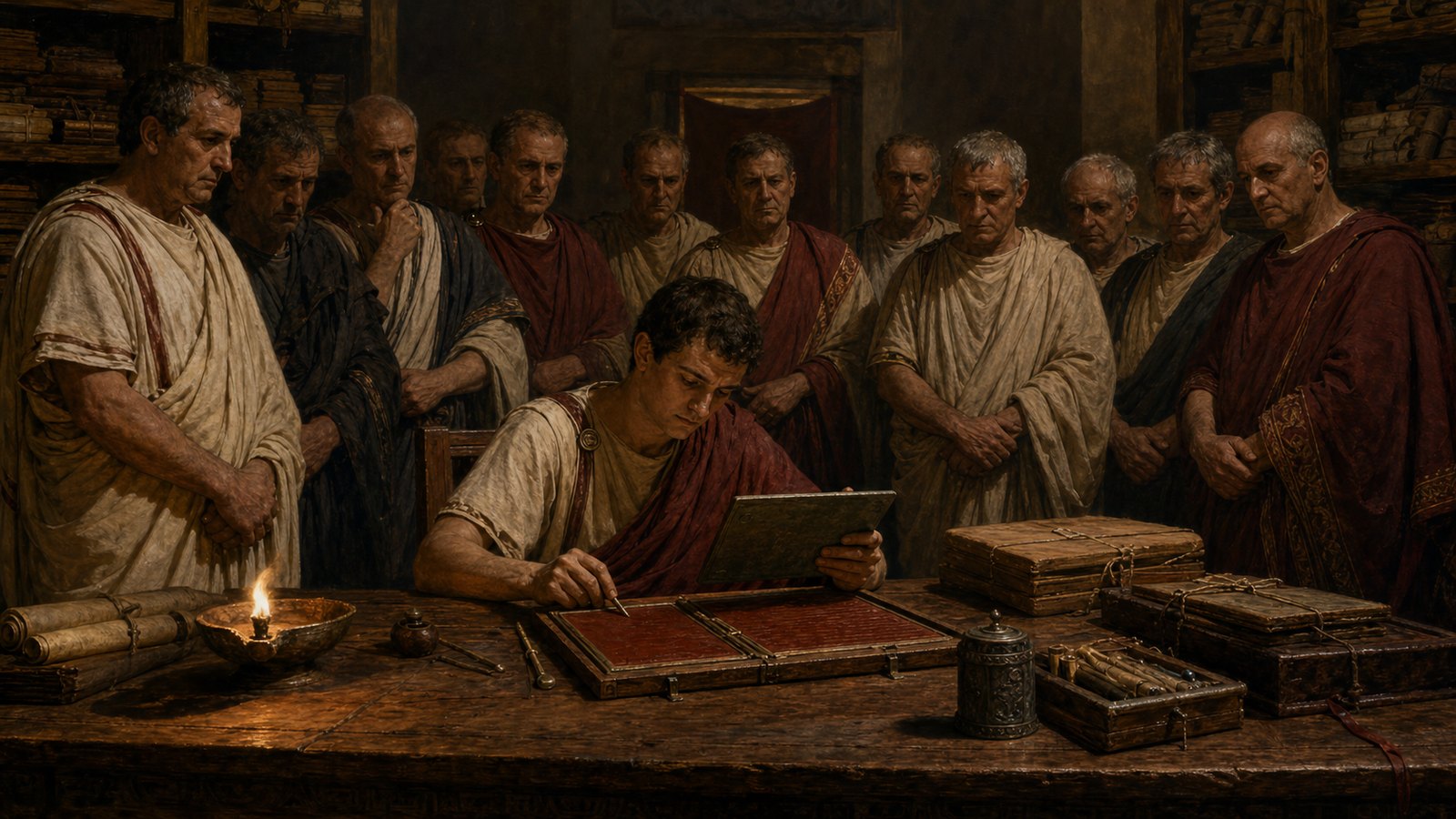
An imperial freedman named Asclepiodotus produced and checked the extract. The phrase recognovi marks his recognition of the copy, and the tablet then says that witnesses sealed it. Twelve names follow, including senators and equestrians. Their status did not mean that all twelve debated whether Faggura deserved citizenship; their presence certified the reliability of the transcript used for the provincial display.
This chain resembles the procedural caution visible in Pliny and Trajan’s exchange over trials in Bithynia, but the medium is different. Letters carried questions and rulings between governor and emperor. The Banasa plaque adds the later steps: register extraction, formal recognition, witnesses and a durable copy far from Rome.

Roman Status Arrived Without Cancelling Zegrensian Law
Both imperial grants preserve the recipients’ relationship to their own people with the phrase salvo iure gentis. The later register extract is more explicit: citizenship was given without reducing taxes and dues owed to the Roman people and imperial treasury. The honour expanded legal status, but it was not a fiscal exemption and did not require the new citizens to abandon local authority.
That qualification explains why the tablet should not be flattened into a victory certificate for inevitable cultural absorption. Julianus remained princeps of the Zegrenses. The emperors valued precisely his ability to lead within that community and assist Roman rule. Erasing his local position would have weakened the mechanism that made him useful to the province.
Names display the same layered result. Aurelius Julianus carries an imperial Roman nomen while his wife is Faggura and the earlier wife is Ziddina. Their household entered Roman law without becoming culturally blank. Citizenship could travel across the empire because the centre was willing to attach a new status to existing families, obligations and communities.
The grant also created a precedent that the next generation could cite. The later Julianus did not approach the emperors as an isolated stranger; his petition carried examples and the recommendation of provincial officials. Family memory, local rank and Roman paperwork reinforced one another. The first exceptional favour became evidence in the procedure for the second.
The bronze sheet makes that compromise unusually visible. A petition that began at the edge of the empire returned as an emperor’s favour, a register entry and a witnessed copy. What arrived in Morocco was not a vague badge of belonging. It was a carefully delimited legal addition—public, hereditary in consequence, locally grounded and still taxable.