
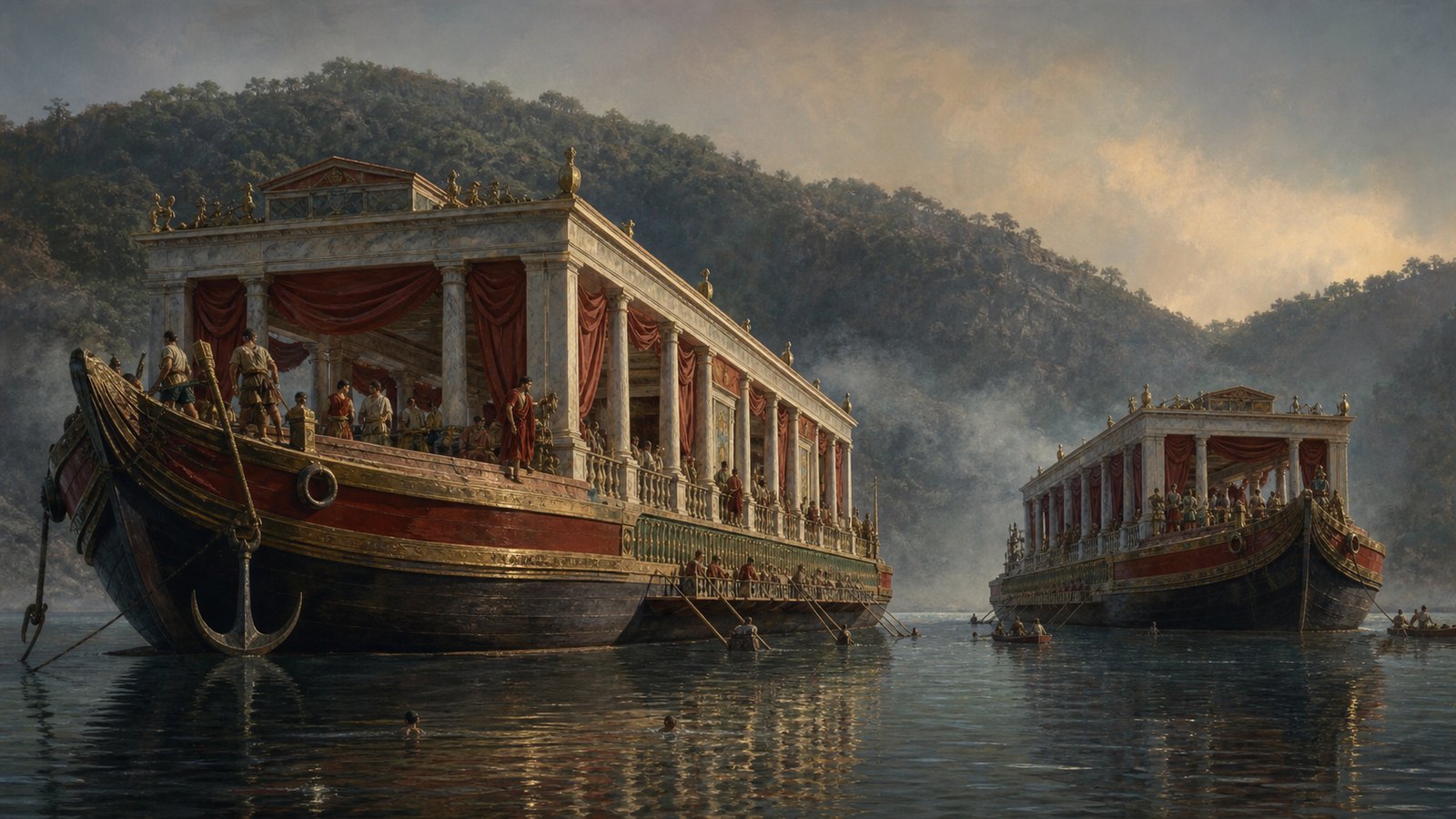
Lake Nemi is small enough to see across, yet Caligula placed two vessels on it longer than many modern houses are deep. One hull measured about 71 metres, the other 73. They carried marble, bronze roof fittings, pumps, anchors and elaborate architecture on water that offered no practical route to anywhere else.
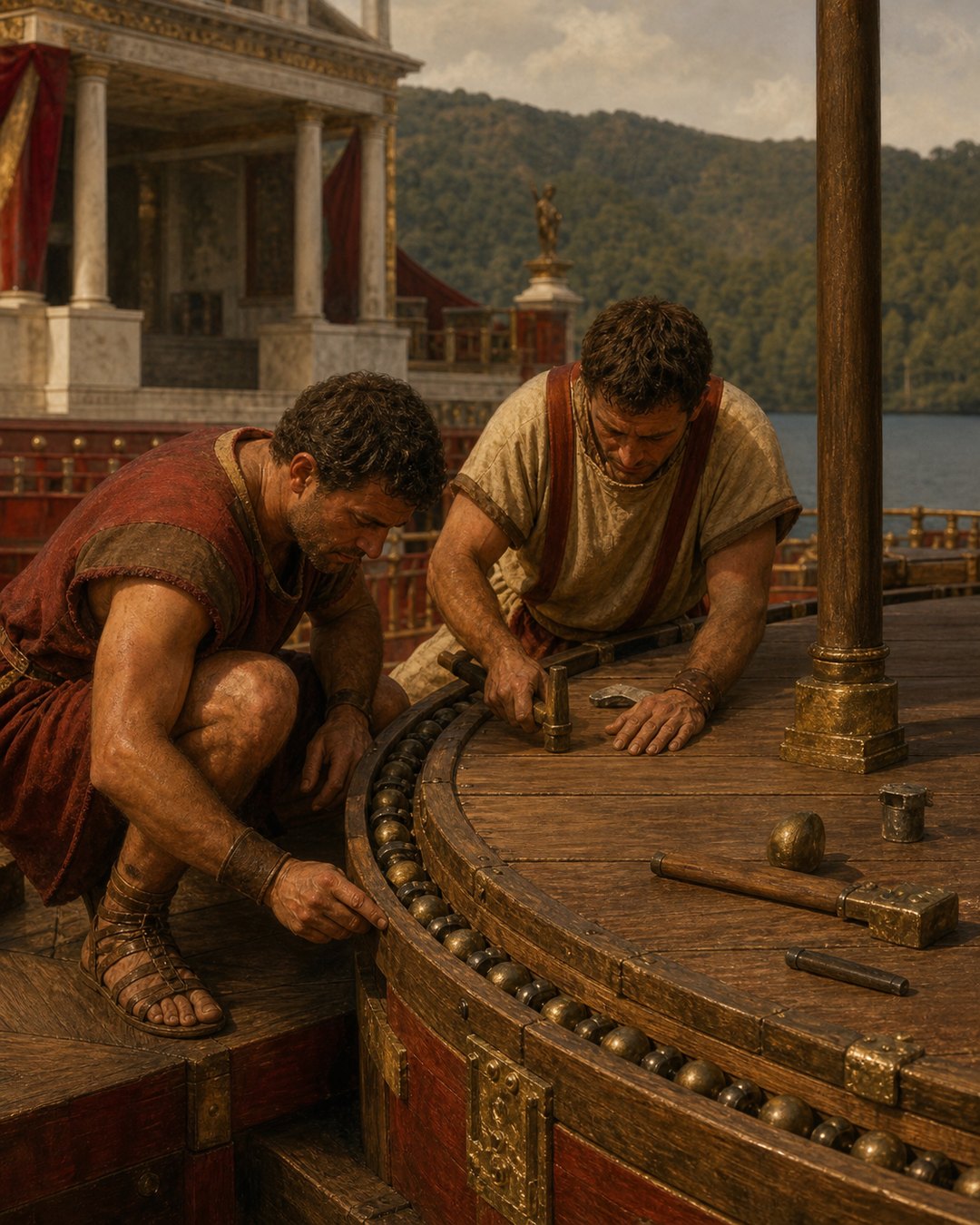
Among the mechanical remains were bronze balls and rollers associated with circular wooden platforms. Their job was to let one heavy surface turn against another with less friction. The comparison to a modern bearing is useful, but only if it does not erase the ancient materials, uncertain purpose and specialized setting of the device.
The ships emerged after engineers lowered the lake between 1929 and 1931. Then fire destroyed both hulls in 1944. What survives is a broken kind of evidence: components, photographs, measurements, models and excavation reports. The bearings now tell two stories at once—how Roman makers enabled rotation and how modern loss changes what can still be proved. Even the shape of a missing platform must now be tested directly against records made before researchers could ask today’s questions.
Two Hulls Filled a Sacred Lake
The vessels were built during Caligula’s reign, from 37 to 41 CE. The surviving dimensions are enormous: roughly 71.3 by 20 metres for one hull and 73 by 24 metres for the other. Lake Nemi lies about thirty kilometres south-east of Rome and has no outlet that would turn these ships into ordinary transport.
The official museum identifies them as imperial barges and displays evidence for extravagant structures. Finds and early documentation include lead sheathing, marble floors, roof tiles of bronze, anchors, pumps, blocks and decorated metal fittings. The decks supported buildings rather than a cargo arrangement designed around repeated commercial voyages.
Purpose remains debated. Later summaries often distinguish a luxurious residence from a vessel connected with cult, sometimes naming Isis or Diana. The lake belonged to the sacred landscape of Diana Nemorensis, but no surviving onboard inscription gives a complete program. Floating palace, ceremonial platform and temple interpretations overlap rather than settle into certainty.
The scale nevertheless proves planning. Large timber frames had to carry concentrated architectural loads while floating on a volcanic lake. Plumbing, pumps and deck installations required cooperation between shipwrights, carpenters, metalworkers and builders. Imperial spectacle rested on workshops, not on imperial desire alone.
Wooden Discs Needed Metal Between Them
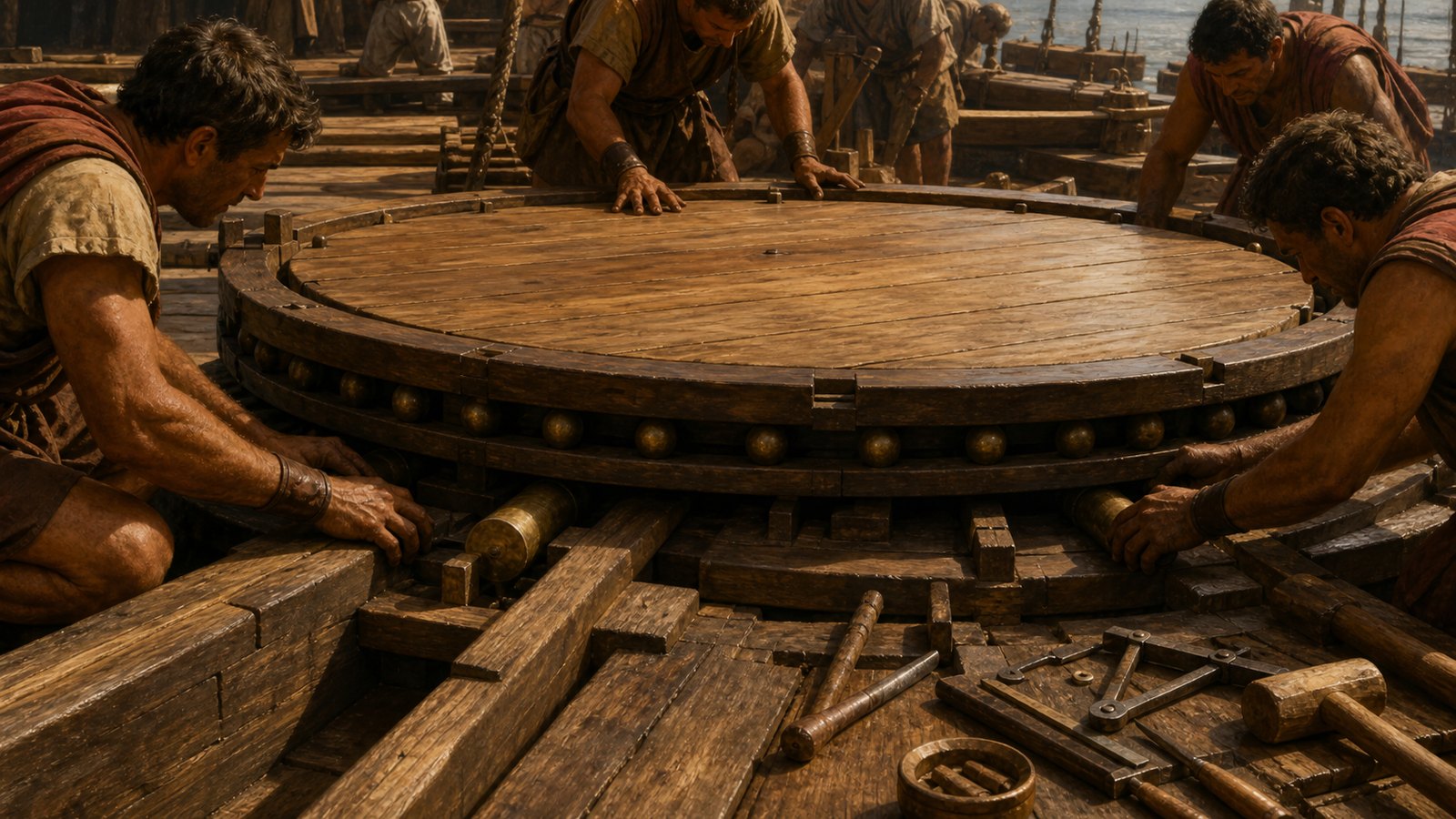
The bearing assemblies used two circular wooden tracks separated by moving bronze elements. Surviving groups include spherical balls and cylindrical rollers. As one disc turned, the metal pieces rolled instead of forcing the wooden faces to scrape directly across each other. Reduced sliding friction made a loaded platform easier to move.
This is the same broad mechanical problem that makes bearings useful today, but the resemblance should not be exaggerated into identity. Modern bearings depend on standardized races, hardened materials, close tolerances and controlled lubrication. The Nemi devices were large composite constructions in wood and bronze, designed for a particular platform rather than mass-produced as interchangeable parts.
A reconstruction displayed by the Museum of Roman Ships makes the geometry visible: a platform sits above the ring of moving elements. The archaeological components therefore support the basic interpretation of facilitated rotation. The exact load above the original mechanism is harder to establish because the surrounding superstructure did not survive intact.
The principle belongs beside Roman cranes that exchanged one kind of motion for another. In both cases, the striking result depended on managing contact, load and force. The cleverness lay not in defying weight but in arranging materials so that human effort met less resistance.
Rotation Served Architecture, Not Speed
Scholars have proposed that the platforms supported statues, furniture or another element meant to rotate on deck. A turning dining surface is frequently imagined in popular retellings, partly because ancient literature describes spectacular imperial dining rooms elsewhere. No recovered tabletop, statue base or label fixes one use beyond dispute.
The mechanism’s environment narrows the possibilities. It occupied a vessel intended for display, ceremony or luxury rather than a fast warship. A slowly rotating installation could change views, present an image, organize service or animate ritual space. High rotational speed was unnecessary; stable movement under weight was the valuable achievement.
Technical studies of the surviving bronze examine manufacturing, dimensions and likely performance. They also acknowledge unresolved questions about implantation and use. That restraint is important. Mechanical reconstruction can demonstrate that a device could turn and estimate how it carried load, but capability alone does not identify the ancient operator’s purpose.
The Nemi evidence therefore separates mechanism from story. Balls and rollers make reduced-friction rotation a strong conclusion. The object placed above them remains uncertain. Good history preserves both levels instead of letting a vivid banquet scene harden into an excavated fact.
Engineers Lowered the Lake to Raise the Ships
Knowledge of the wrecks never entirely disappeared. Renaissance salvage attempts used hooks, ropes and early diving equipment, often damaging timbers while recovering pieces. Systematic examination eventually established that two ships lay beneath the water. Bringing whole hulls into view required a project on the scale of the vessels themselves.
Beginning in 1928, engineers reactivated an ancient drainage conduit and added pumps. The falling water exposed the first hull in 1929, and recovery continued into 1931. The operation transformed a lake bed into an excavation while forcing archaeologists to stabilize huge waterlogged structures that had been protected by sediment.
A purpose-built museum rose between 1933 and 1939 around the ships. The building was unusual because its dimensions and halls answered to objects that could not simply be carried through a normal gallery door. Architecture became part of conservation, much as the original hulls had once served as foundations for architecture afloat.
The rescue was also political theatre under Mussolini, who presented Roman engineering as ancestry for the modern state. That context does not make the measurements or artefacts unreal. It does require separating the archaeological achievement from the regime’s claim to inherit ancient greatness. Recovery can produce evidence while simultaneously recruiting it for propaganda.
Fire Left the Mechanism Without Its Machine
In 1944, during the Second World War, a fire destroyed the two ancient hulls inside the museum. The loss removed the largest connected structures and much of the physical context that future researchers might have re-examined with new methods. Original timber relationships became photographs, drawings and written observations.
Some metal objects survived elsewhere or could be reconstructed from records. The museum today displays anchors, pumps, decorative fittings, models and a platform on ball bearings, while a full-scale reconstruction evokes part of one stern. These exhibits are not replacements for the burned ships. They are arguments assembled from what remains.
The contrast with the mechanics of Roman ship pumps is useful. Pumps can be understood from repeated surviving types and clear operational needs. The Nemi bearing platform is rarer and its superstructure vanished, so interpretation carries a larger burden of analogy and reconstruction.
The bronze bearings survive as evidence of competent, specific problem-solving. They show Roman makers placing rolling elements between wooden surfaces to move a heavy platform, without proving every modern claim made on their behalf. Their most durable lesson is archaeological: technology is never just an ingenious part. It is the relationship among part, machine, setting and record—and at Nemi, fire severed much of that relationship.