
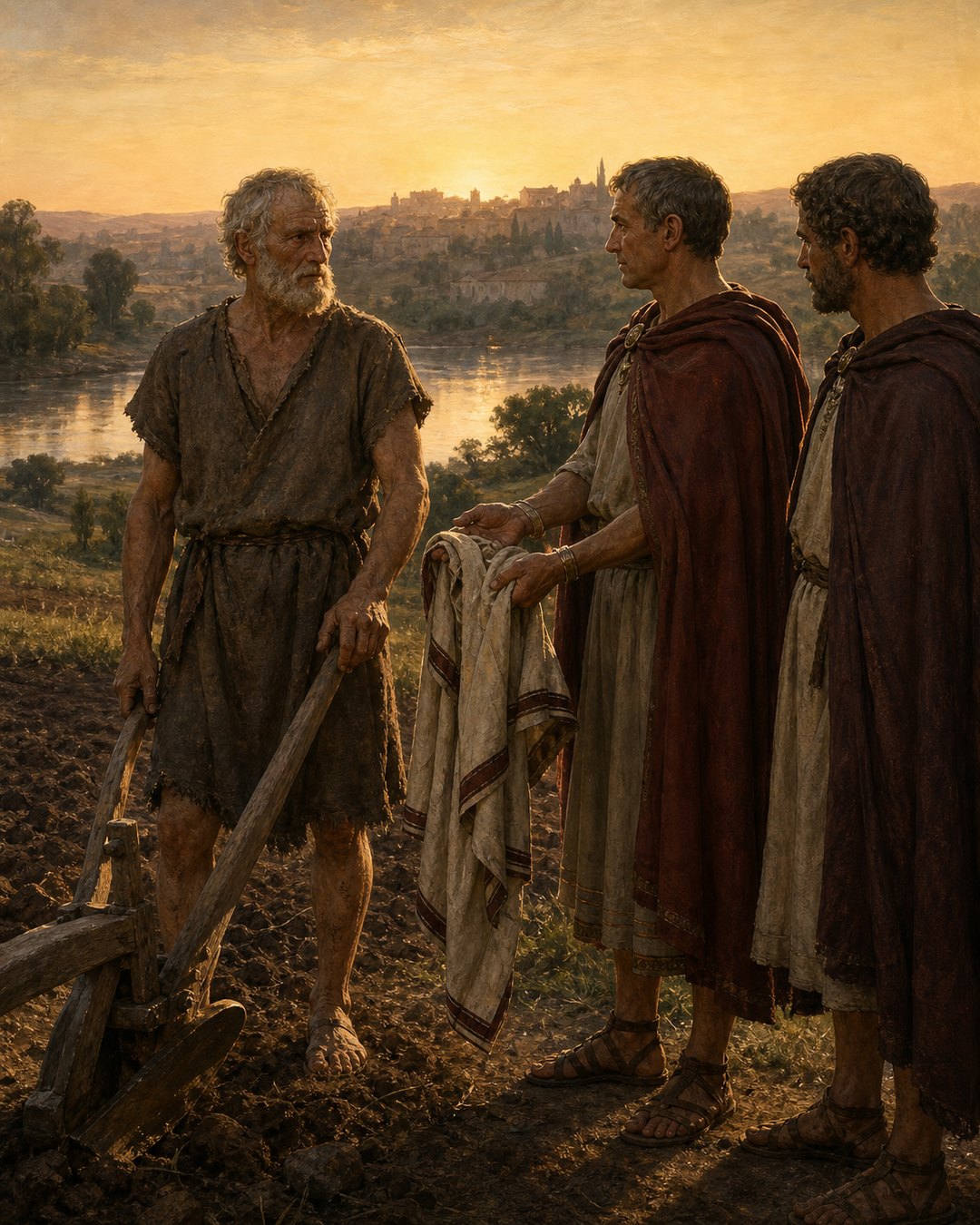
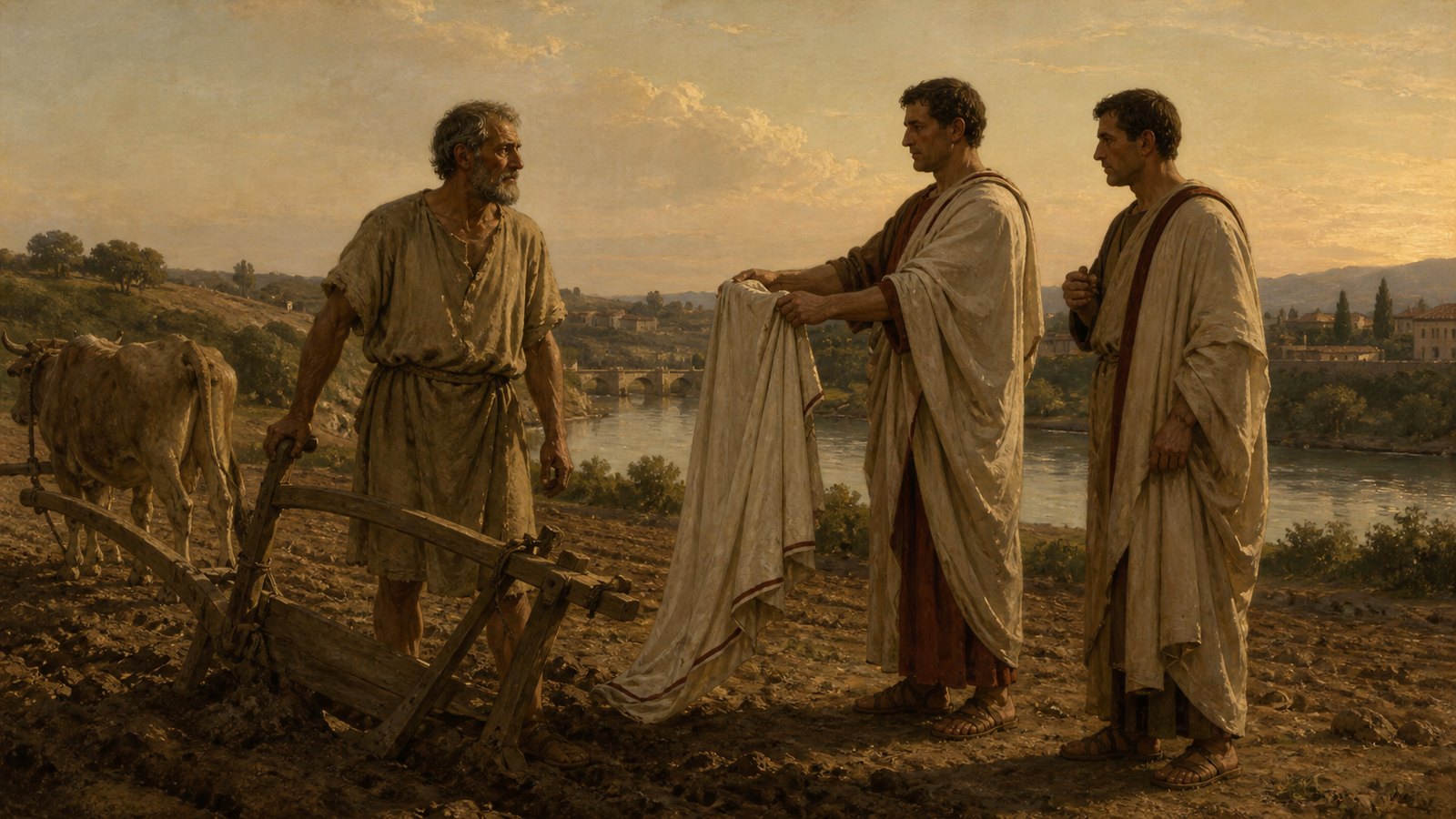
The envoys found Lucius Quinctius Cincinnatus working land across the Tiber. In Livy’s telling, the farm was only four iugera, and the former consul was either digging a ditch or ploughing when Rome’s messengers asked him to put on his toga and hear instructions from the Senate. Dust and sweat were replaced by formal dress before the message was even opened.
The contrast is so polished that it has often swallowed the rest of the episode. Cincinnatus leaves a poor farm, accepts dictatorship, rescues an army and returns to the plough. Yet the ancient narrative does not praise him simply for rural simplicity. It builds an emergency through offices, messengers, a night levy, earthworks, surrender terms, a triumph and a resignation counted against a six-month legal maximum.
Livy wrote about four centuries after the conventional date of 458 BCE. His scene cannot be read like a dispatch from the camp at Mount Algidus. It can, however, be read precisely as Roman political memory: a story designed to show what concentrated command was supposed to accomplish, what limited it, and why surrendering power could be staged as a victory equal to defeating an enemy.
A Trapped Consul Turned Delay into Danger
The crisis began outside Rome. The Aequi had renewed war and a consular army under Lucius Minucius had been trapped near Mount Algidus. Livy portrays Minucius as hesitant and his opponents as quick to exploit that weakness. The Roman camp was enclosed, while a small group of horsemen escaped through the enemy line and brought the alarm to the city.
An army under a consul was not merely losing a battle; it risked disappearance. Rome still had another consul, but the Senate judged the emergency severe enough to require a dictator, a magistrate appointed for a specific crisis with authority that exceeded ordinary collegial command. The surviving consul, Quintus Fabius, named Cincinnatus.
That appointment matters more than the later romance of the field. Cincinnatus did not march into Rome and seize command. The story roots his power in a constitutional response to reported danger. Extraordinary authority begins with nomination, a public message and acceptance—not with a successful general retroactively claiming that necessity had made him ruler.
The episode belongs beside the way lictors made Roman office physically visible. Livy says Cincinnatus crossed the Tiber and was met by relatives, friends, senators and lictors. The man from the farm entered the city inside the signs of office, turning a private citizen into the single commander of an emergency.
Every Soldier Carried Food and Twelve Stakes
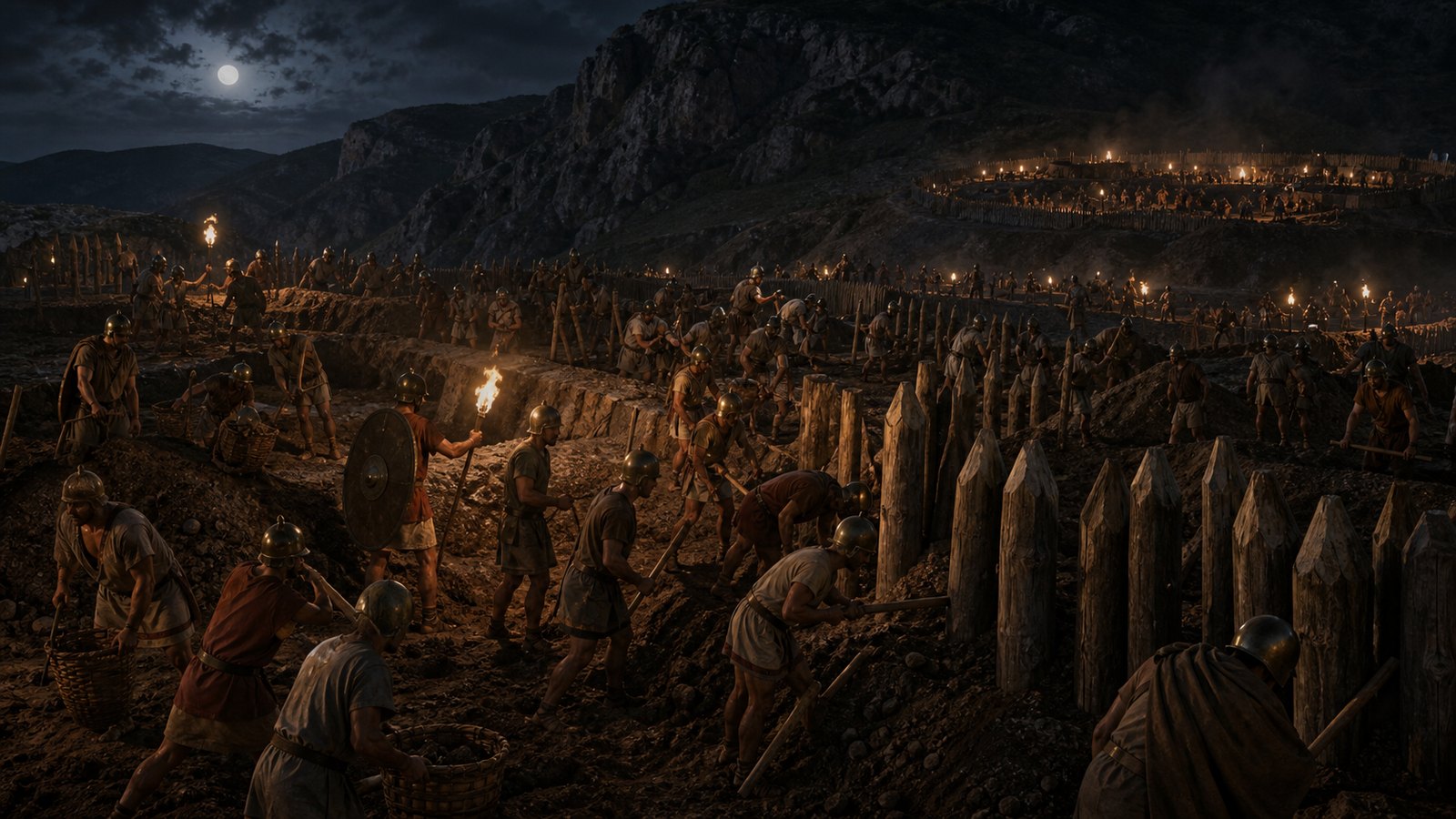
Cincinnatus did not spend days building a political coalition. He ordered shops closed, suspended ordinary business and required men of military age to assemble before sunset on the Campus Martius. Each soldier was to bring cooked food for five days and twelve stakes. Men too old for field service were told to prepare food while the soldiers secured the wood.
The order reveals the operation before Livy names it. Food for several days made immediate movement possible; twelve stakes per man turned the levy into a mobile stock of fortification material. The army marched at a pace intended to reach the trapped consul while darkness still offered surprise.
Near Algidus, Cincinnatus arranged his men in a long line around the Aequian position. At a signal they shouted and began digging a ditch while driving in the stakes. The sound reached both the enemy and the trapped Romans. Minucius understood that relief had arrived and attacked outward, preventing the Aequi from concentrating against the new ring.
The scene is less a duel than a coordination problem. One Roman force pressed from inside, another built and fought from outside, and the Aequi were caught between them. Livy’s twelve stakes give the victory a physical texture: timber on shoulders, earth lifted at night, a shout crossing the camp and a perimeter becoming a weapon.
Victory Ended in a Yoke, Not a Massacre
By the next phase of the narrative, the Aequi asked for terms. Cincinnatus demanded that they surrender their leaders and pass under a yoke. Three spears created the humiliating frame—two fixed upright and one laid across them. Defeated soldiers went beneath it without their weapons, their bodies made to display submission.
The Roman consul and his trapped army were not allowed to pretend that rescue had been unnecessary. Livy says Cincinnatus rebuked Minucius and reduced him from consul to lieutenant before releasing his soldiers. The rescued troops nevertheless awarded Cincinnatus a golden crown and acclaimed him as their patron, the person who had preserved them.
The treatment separates punishment, theatre and utility. The enemy army was disarmed and humiliated rather than annihilated. Its leaders were retained for the victor’s triumph. The failed Roman commander lost standing. Cincinnatus used the result to restore an army, discipline its consul and present a visible hierarchy of competence.
Rome later made such rankings portable through objects like the folding curule chair that marked magistracy. At Algidus, rank was staged through movement instead: one army passed beneath a yoke, one consul stepped down, and one dictator travelled home at the centre of a triumph.
The Triumph Settled an Argument at Home
Cincinnatus returned to Rome with captured standards, spoils and enemy leaders. The rescued soldiers followed and feasted outside houses along the route. Livy’s urban scene turns a night of earthwork into a public account of deliverance. The city could see who had commanded, who had been saved and what had been taken.
The dictatorship also intersected with a domestic prosecution. Marcus Volscius had given testimony connected to the exile of Cincinnatus’s son Caeso. Cincinnatus brought the case to judgment, but Livy takes care to say the dictator did not pronounce sentence personally: the popular assembly convicted Volscius. Even an admiring narrative preserves a line between driving the proceeding and replacing the body that judged it.
This part makes the exemplary story less clean. Cincinnatus had a family grievance and used his period of power while that grievance remained politically live. Later readers need not erase the conflict merely because Roman moral tradition celebrated the outcome. A bounded office can still concentrate leverage in the hands of someone with private interests.
The political value of the story lies partly in exposing that danger and then resolving it through departure. Victory did not remove every reason to keep power. Cincinnatus had supporters, prestige, lictors and a completed triumph. Resignation mattered because retaining command could always be justified by unfinished business.
Sixteen Days Became the Point of the Story
A Roman dictator could be appointed for a term of up to six months, depending on the task and later legal understanding. Livy says Cincinnatus resigned on the sixteenth day. The number turns virtue into something countable: not merely that he eventually went home, but that he surrendered the office while most of its possible duration remained.
The farm then closes the narrative. Cincinnatus’s poverty is presented as old Republican austerity, but the landholding society behind that praise was neither equal nor gentle. The same tradition that admired a patrician leaving command also remembered fierce conflict between patricians and plebeians, debt and the political struggles surrounding Cincinnatus’s own family.
This is why the tale should not be flattened into proof that every detail happened exactly as Livy wrote it. Rome’s historians used early Republican figures to think with. The field, toga, stakes, yoke, triumph and sixteen days create a moral sequence about emergency rule. Dionysius of Halicarnassus preserves a related tradition, showing that the example circulated beyond one Latin historian even when details and emphasis could vary.
Cincinnatus’s strongest legacy is therefore not the claim that farming automatically makes a ruler safe. It is the harder sequence represented by the office: authority was formally granted for a defined danger, action was rapid, success was made publicly legible, and command ended before law forced the holder out. The rescue at Algidus won a battle. Sixteen days made the commander an argument about power.