
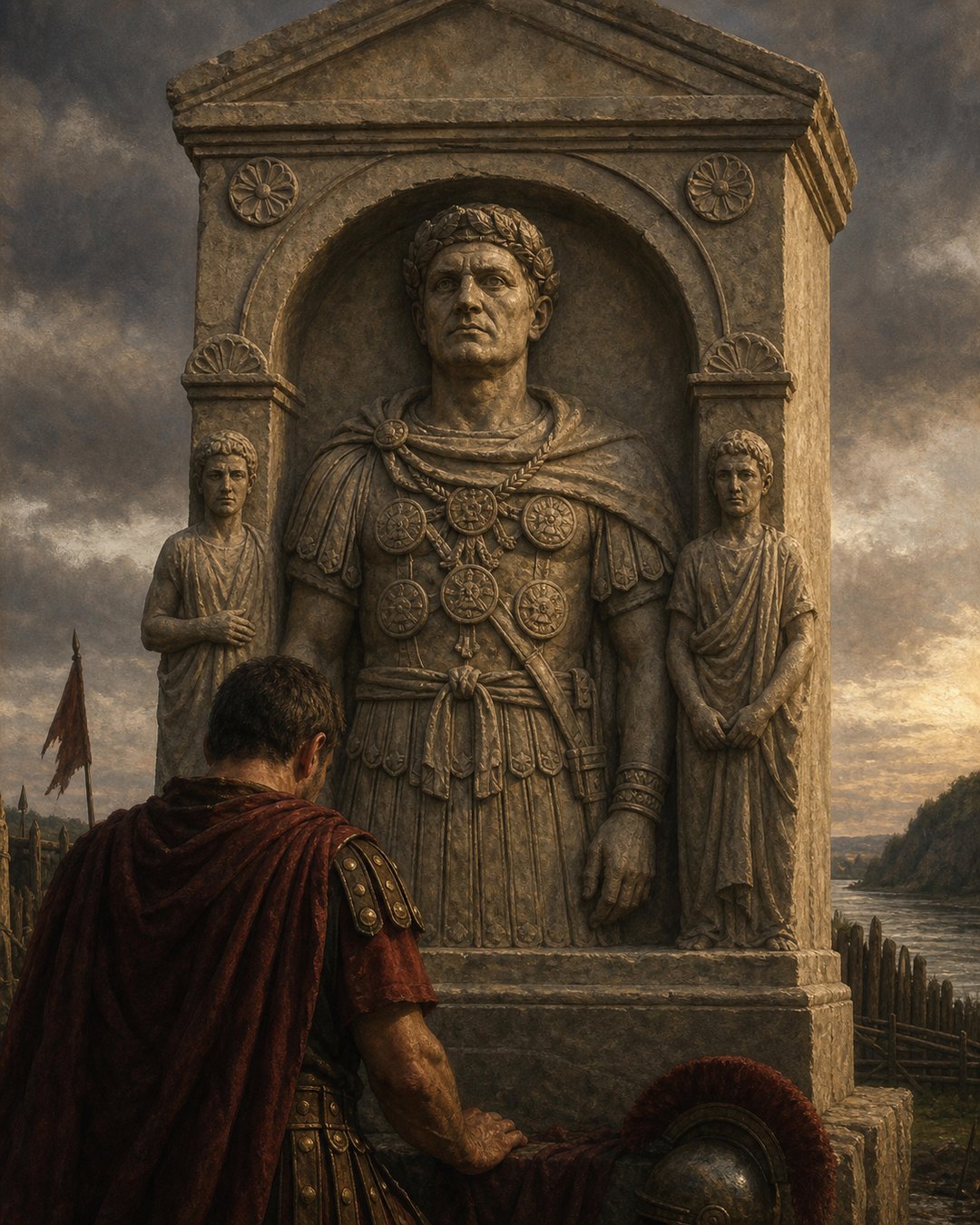
Marcus Caelius stands in stone wearing the rewards of a long military life. A civic crown rests above his face. Two torques lie at his shoulders, bracelets circle his wrists, and five round phalerae fill his chest. Beneath that confident portrait, however, his inscription admits a problem no decoration could solve: the body was not there.
The monument says that Caelius fell in the Varian War at the age of fifty-three and a half. It then adds four carefully chosen Latin words, ossa inferre licebit: his bones may be brought in. The grave remained open in language to a recovery that had not happened. A cenotaph could preserve a place for a man lost with an army.
His brother Publius erected the stone. Its inscription identifies Marcus’s origin, voting tribe, rank and legion before naming the disaster. Those lines did more than console one household. Because they place the first centurion of the Eighteenth Legion in the Varian War, they became direct evidence for one of the units destroyed in the Teutoburg catastrophe.
A Brother Built Around an Absence
The inscription begins with the conventions of identity. Marcus was the son of Titus, enrolled in the Lemonian voting tribe and from Bononia, modern Bologna. He had travelled far from northern Italy by the time death found him beyond the Rhine. The sequence places citizen, family and hometown before office, legion and war.
At the end, Publius Caelius identifies himself with the same father and voting tribe and calls Marcus his brother. That repetition proves more than shared sentiment. It makes the commemorator legible to anyone reading the stone and binds the dead officer to a living family capable of commissioning a substantial monument far from Bononia. Marcus’s civic identity therefore survived as a matched set of family particulars, not merely as a soldier’s name.
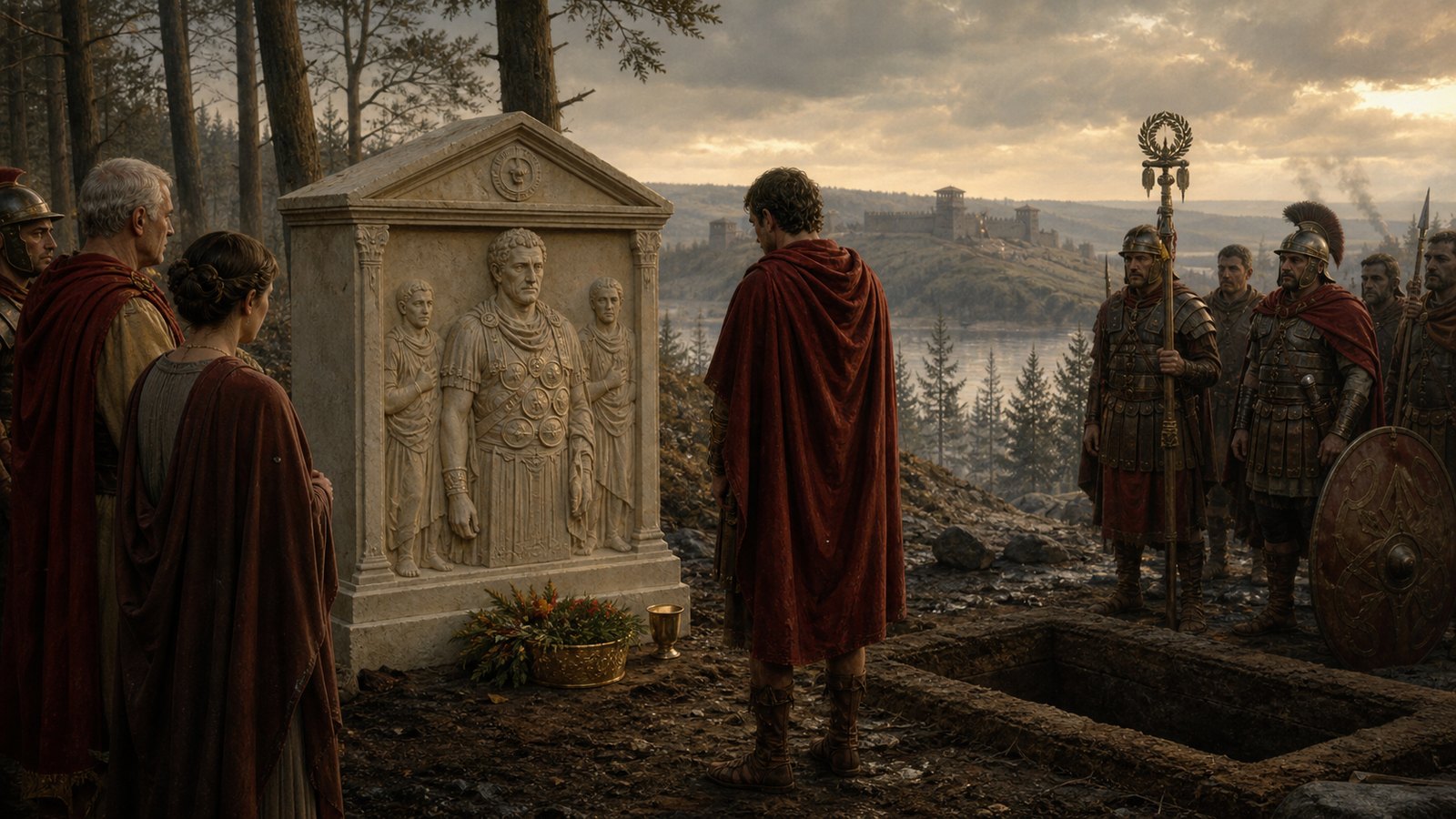
A body normally gives a tomb its physical centre. Here, absence shaped the wording. The permission to bring in the bones was conditional and future-facing. It did not pretend recovery had occurred. Instead, it reserved the monument’s funerary function in case remains later emerged from a battlefield whose dead Rome had failed to retrieve.
The distinction between tomb and cenotaph matters. This was not merely a biography carved beneath a portrait. It was a prepared destination for missing remains and a public acknowledgement that the family’s work was incomplete. Publius could supply stone, names and memory; only an uncertain future could supply his brother’s bones.
Rank and Origin Travelled onto the Stone
Caelius’s title identifies him as the first centurion of Legio XVIII. The office placed him at the senior end of the legion’s centurionate, not among anonymous rank and file. His age, fifty-three and a half, also makes the monument unusual. A man who had entered young had already spent decades inside military institutions.
Livius notes that service at such an age was uncommon even when reserve obligations extended a career. The stone cannot tell us every posting or explain why Caelius remained. It does show that the Varian disaster consumed experienced command as well as new recruits. The loss reached into a legion’s accumulated practical memory.
His birthplace and tribe kept his civic coordinates visible at a northern frontier. Bononia and the Lemonian tribe were not decorative details. They located the officer within Roman systems of citizenship at the moment the war had removed his body from family control. The inscription reconstructed administratively what the battlefield had scattered physically.
That personal trajectory complements the larger shock of Teutoburg and its lost standards. An eagle can stand for a whole formation. Caelius’s stone lowers the scale to one senior officer, one brother and one unresolved burial.
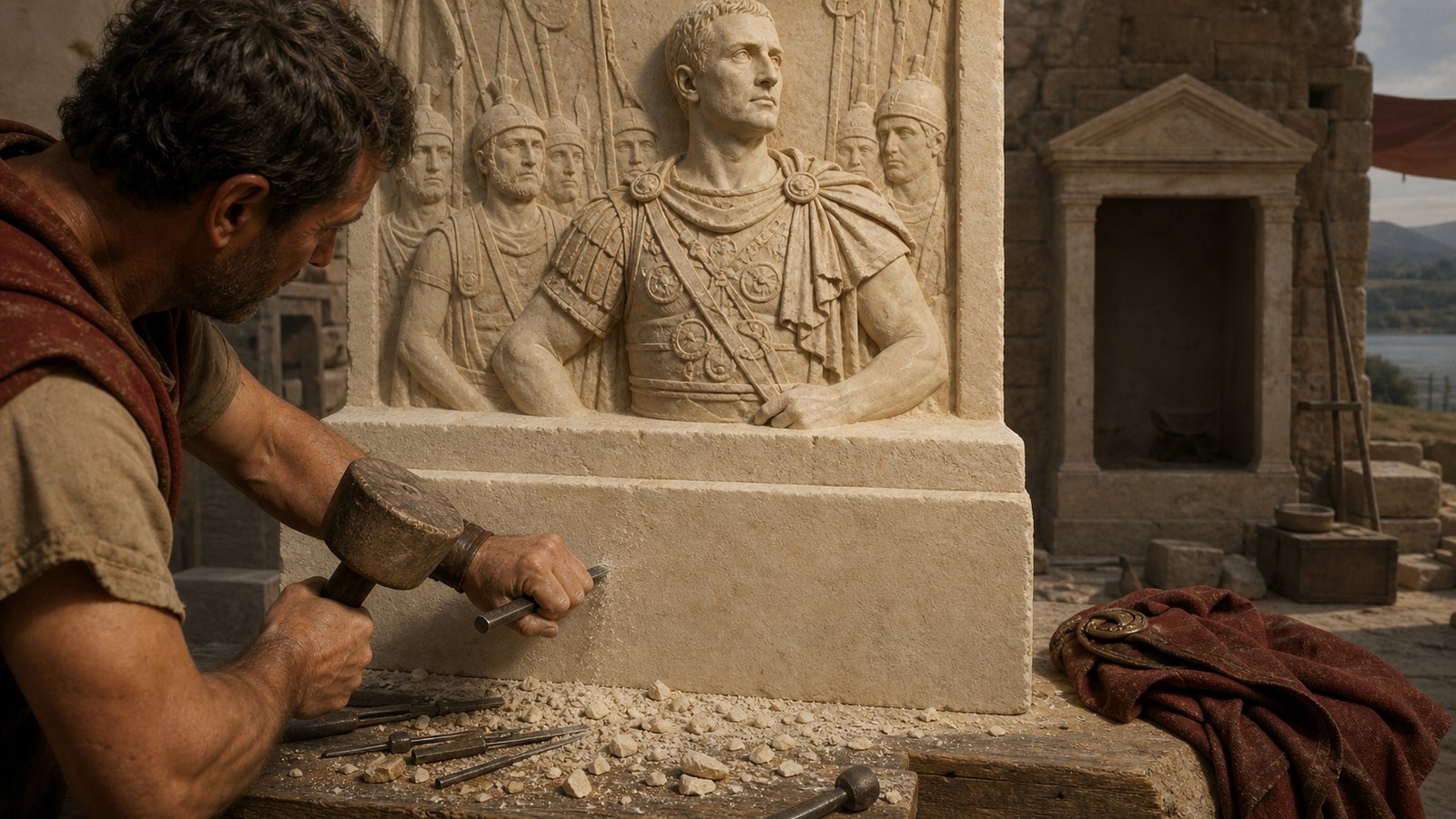
Metal Awards Became a Stone Biography
The relief presents a corona civilis, the civic crown awarded for saving a citizen’s life. Two torques appear on Caelius’s shoulders, armillae at his wrists and five phalerae across his chest. The stone translates objects once worn on the body into a permanent inventory of recognised service.
Those decorations create a visual argument before a viewer reads Latin. Caelius appears frontally, heavily marked by honours and office. His missing remains could no longer wear anything, but the portrait rebuilt his decorated body on the monument. Military distinction survived as carved arrangement rather than portable metal.
The relief should not be treated as a photograph of the last day. It is a commemorative composition, selecting insignia that made standing visible. Yet the specificity is valuable. Crown, torques, bracelets and discs distinguish this man from a generic soldier and explain why his family represented him through achieved rank rather than through the circumstances of death alone.
Damage removed part of the monument’s lower zone, but the main relief and inscription remain legible. Survival therefore has its own unevenness. The ancient body vanished, the stone broke, and portions of the original composition disappeared. Enough endured to preserve a face, a decorated chest and a sentence waiting for bones.
Two Freedmen Shared the Monument’s Edge
The monument also includes two smaller male figures, identified as the freedmen Privatus and Thiaminus. Their presence widens the social unit represented by the stone. A senior centurion’s household was not composed only of freeborn relatives; people who had passed from slavery into freed status could remain attached to his name and memory.
The scale and placement maintain hierarchy. Caelius dominates the centre in military display while the freedmen occupy subordinate positions. Even so, inclusion mattered. Their images were not hidden in a private record. They entered the public monument beside the man whose household had structured part of their lives.
We should resist inventing their feelings or roles in the Varian campaign. The stone securely gives their names and status, not a narrative of companionship. Its evidence is architectural and epigraphic: Publius’s commission arranged brother, officer and freedmen within one commemorative field, while preserving unequal rank among them.
This is why Roman funerary inscriptions can recover relationships as well as careers. Names on stone do not restore a complete household, but they prevent Privatus and Thiaminus from dissolving into the generic entourage of a decorated commander.
One Line Confirmed a Lost Legion
The phrase cecidit bello Variano states that Caelius fell in the Varian War. Combined with his identification as first centurion of Legio XVIII, it provides direct epigraphic evidence that the Eighteenth belonged among the destroyed formations. The proof comes not from a battle chronicle but from a brother’s memorial formula.
The cenotaph was discovered at Birten in 1620 and is now held in the Rheinisches Landesmuseum in Bonn. If the find location reflects its ancient setting, it may connect the legion with the base near modern Xanten. That inference must remain conditional; a monument’s recovery place is evidence, not an automatic map of every posting.
Its date of discovery gave the stone a second history. Long before modern battlefield archaeology transformed discussion of Teutoburg, readers could see a named officer, a numbered legion and an explicit war. The monument fixed three coordinates—person, unit and event—inside a single damaged object.
Yet its deepest force remains domestic. Publius did not carve an abstract lesson about imperial overreach. He made a place where Marcus’s bones could still arrive. They apparently never did. The clause stayed open while the stone closed around everything else: Bologna, rank, honours, freedmen, legion and the war that left a family without a body.