
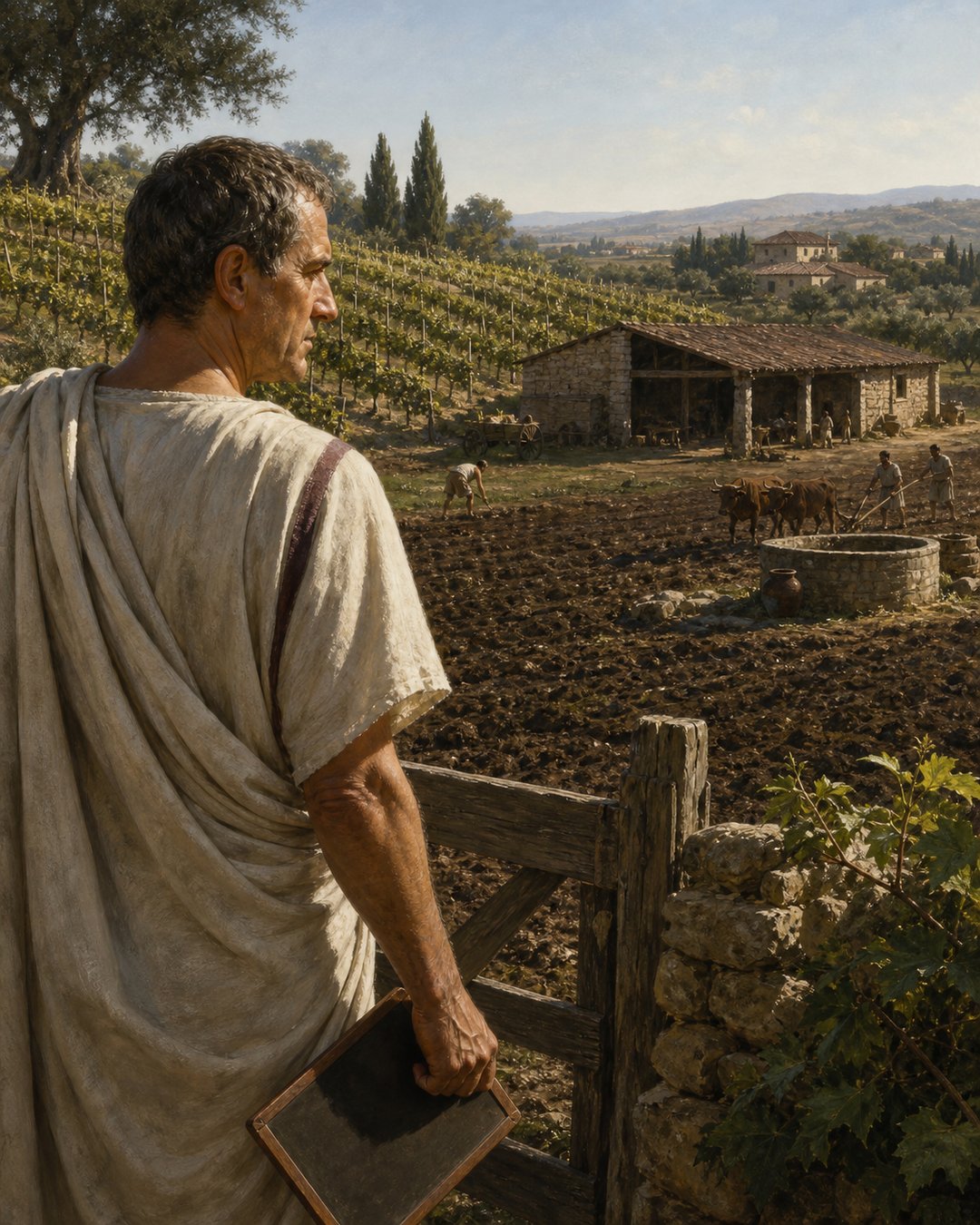
Cato the Elder begins his farming handbook by slowing the buyer down. Do not be over-eager to purchase, he warns, and do not consider one inspection enough.
A good farm should become more convincing with each visit. The neighbors’ properties, the direction of the slope, water, workers, roads, town and equipment all had to support the same story.
Cato’s method treats enthusiasm as a risk. Land could look attractive in one moment while climate, access, maintenance or extravagance quietly consumed its value. Repetition made those contradictions harder to hide.
The First Rule Was to Come Back
Cato tells a prospective buyer not to spare effort in examination. The warning joins two dangers: haste in paying and laziness in looking.
One walk across a property could reveal boundaries and buildings, but it could also reward whatever the seller had prepared for that day. A return visit changed the buyer from guest into observer.
Cato phrases the test positively. However often the buyer visits, good land should please more each time. Quality should survive familiarity rather than depend on surprise.
That rule makes inspection cumulative. The first visit supplies an outline; later visits check whether water, exposure, roads and buildings still fit the initial impression.
He also gives a sharp instruction: enter with eyes open so that you can find your way out. The line makes attention practical. A buyer must retain enough orientation and judgment to leave an unsuitable bargain.
An article on Roman boundary stones and political land explains how edges made possession durable. Cato begins before possession, when the more important boundary is the one between examination and commitment.
Neighboring Farms Became Evidence
Cato asks the buyer to notice how neighbors maintain their properties. In a good district, he says, nearby farms should be well kept.
The advice expands inspection beyond the parcel offered for sale. A prepared house or freshly cleared field might flatter one estate, but the surrounding landscape revealed conditions shared across owners.
Neighboring upkeep could reflect soil, security, access, labor and habits of management. Cato does not isolate which cause matters most. He uses the pattern as evidence that deserves attention.
He also prefers districts where farms do not change owners frequently and where sellers regret having sold. Stability becomes another indirect measure of value.
That standard does not make every reluctant seller honest or every stable district profitable. It shows Cato looking for behavior that is costly to imitate. Owners remaining in place over time offered stronger testimony than a sales claim made at the gate.
The same logic appears in his preference for buying from a good farmer and good builder. The seller’s past decisions remain embodied in drainage, structures, planting and repair.
Slope, Water and Roads Had to Work Together
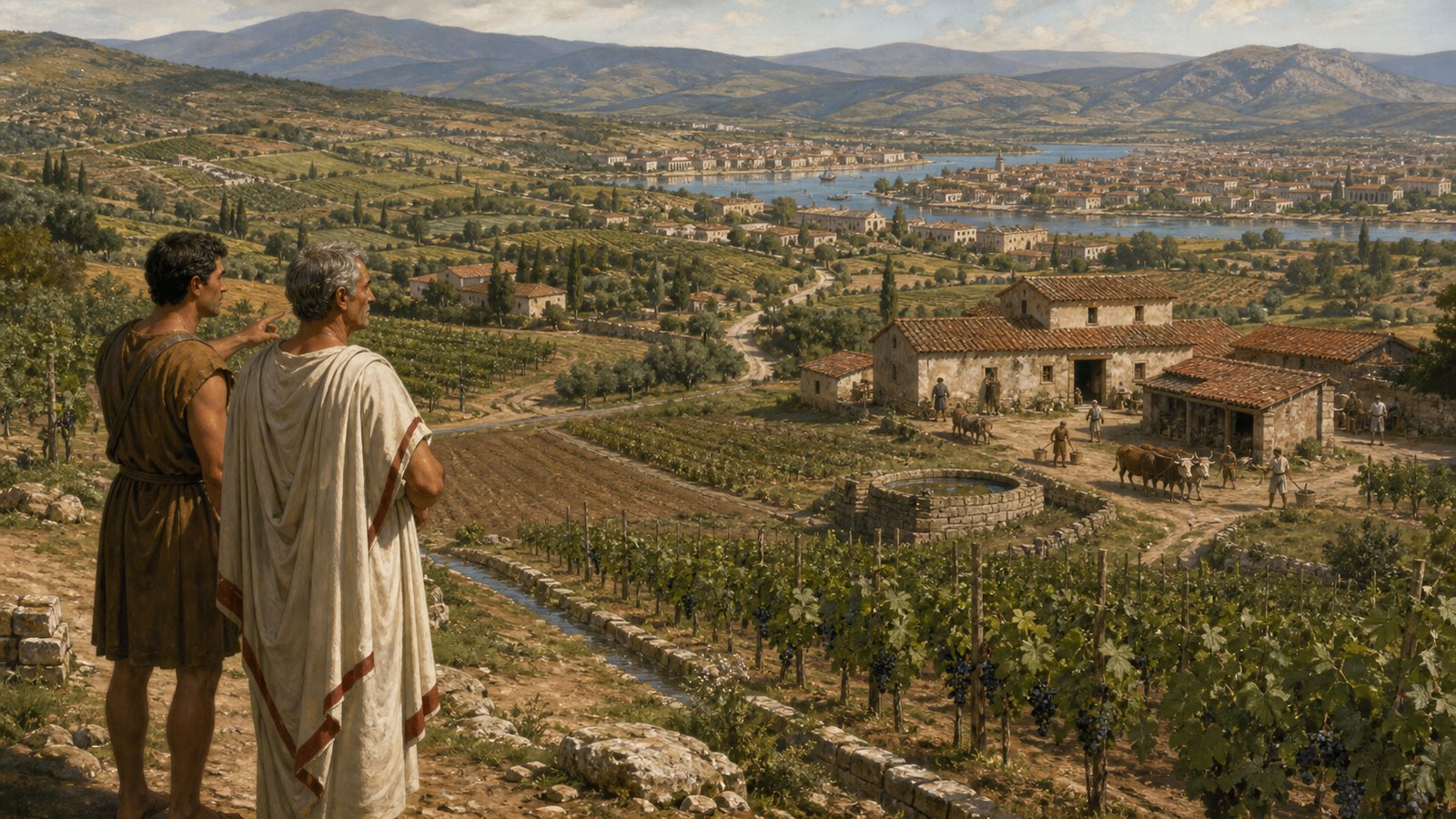
Cato’s preferred setting combines natural and human geography. If possible, the farm should lie at the foot of a mountain and face south.
It should have a healthy climate, avoid destructive storms, possess naturally strong soil and be well watered. No single feature replaces the others.
He also requires access to labor. Productive land without people available to work it could not turn fertility into harvest, repair or sale.
Market connection enters through alternatives. A flourishing town, the sea, a navigable river or a good well-travelled road should lie nearby.
The list recognizes that farms did not end at their fences. Tools, workers and information had to arrive; wine, oil, grain or other produce had to leave.
The discussion of Rome’s eight-day countryside market cycle follows rural goods and news into town. Cato’s buyer asks the reverse question at the property: which route makes that outward movement possible?
A south-facing foothill with water but no practical access might remain isolated. A busy road beside exhausted soil would move little worth selling. Cato’s checklist seeks agreement between site and circulation.
Presses and Vats Tested the Yield Story
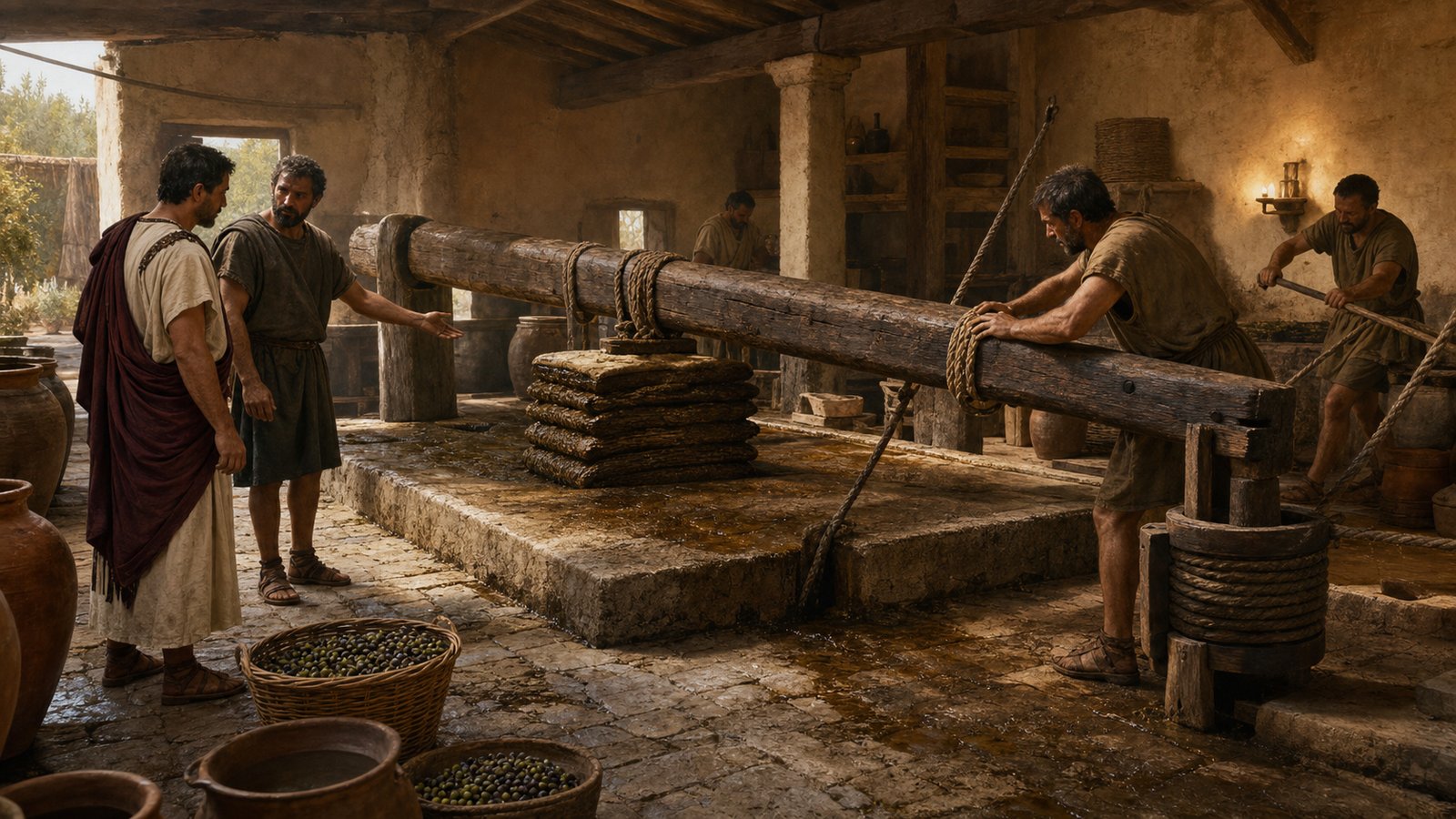
At the farmstead, Cato tells the buyer to count oil presses and wine vats. If there are few, he says, the likely yield is correspondingly small.
Equipment becomes a trace of production. A seller could praise orchards and vines, but processing capacity showed what earlier owners expected to handle.
The inference is not a modern audited yield statement. Presses could be lost, shared or neglected. Cato still treats their number as a useful check against appearance.
Buildings should be adequate and well furnished, but he warns against despising other people’s management too quickly. Existing arrangements may embody experience the visitor does not yet understand.
At the same time, the estate should not require great equipment. Cato wants economic provision, not machinery and buildings that make the farm expensive to own.
The article on Roman screw presses turning rotation into pressure shows what one processing tool could do. For Cato’s buyer, the important question comes earlier: does the amount of equipment make sense for the land’s believable output?
A Farm Could Earn Much and Leave Little
Cato compares a farm to a person: however great the income, extravagance leaves little behind. Revenue alone cannot define success if the estate consumes it through excessive demands.
That warning joins the earlier observations. Repeated visits expose maintenance; neighbors reveal district patterns; roads reveal access; presses and vats reveal expected processing; economical equipment reveals whether production can leave a remainder.
Cato then ranks types of farm for a holding of one hundred iugera. A productive high-quality vineyard comes first, followed by a watered garden, osier bed, oliveyard, meadow, grain, woodland, an arbustum and a mast grove.
The ranking should not be turned into a universal price table. It expresses the priorities of Cato’s text and depends on the good situation he has already required.
The sequence from inspection to ranking matters. He does not begin by saying “buy a vineyard” and stop. The favored crop still needs the climate, labor, water, transport, buildings and economy that make its output usable.
Cato’s buyer therefore reads relationships rather than collecting attractive objects. A mountain, road, press or town has value through what it enables elsewhere on the property.
The instruction to return is the controlling habit. On each visit, one claim can be checked against another: strong soil against neighboring upkeep, promised harvest against vats, market talk against the actual road.
Even regretful former owners become part of the pattern. If people who sold wish they had not, their reaction joins physical evidence without replacing it.
The chapter is terse because it assumes the buyer will do the work. Cato offers no decorative tour of rural peace. He supplies reasons to pause, compare and walk the ground again.
Roman farming depended on unequal labor relations that Cato’s handbook often treats as management inputs. His call for a good supply of laborers belongs inside that system and should not be softened into a modern image of a family farm.
That historical distance makes the inspection method more revealing, not less. The text shows an elite purchaser evaluating land as a productive organization of soil, people, equipment and routes.
The last defence against a bad bargain is consistency. If every visible part supports the rest, the farm may improve under repeated attention. If the story weakens each time the buyer returns, Cato has already supplied the answer: keep the ability to find the way out.
His ranking of farm types comes only after the buyer has tested situation and economy. The order therefore cannot rescue a badly placed estate. Even Cato’s preferred vineyard has to produce plentiful wine of good quality, wording that ties the crop’s prestige to actual performance rather than to the name of the planting alone.
Sources
Cato the Elder, On Agriculture 1.