
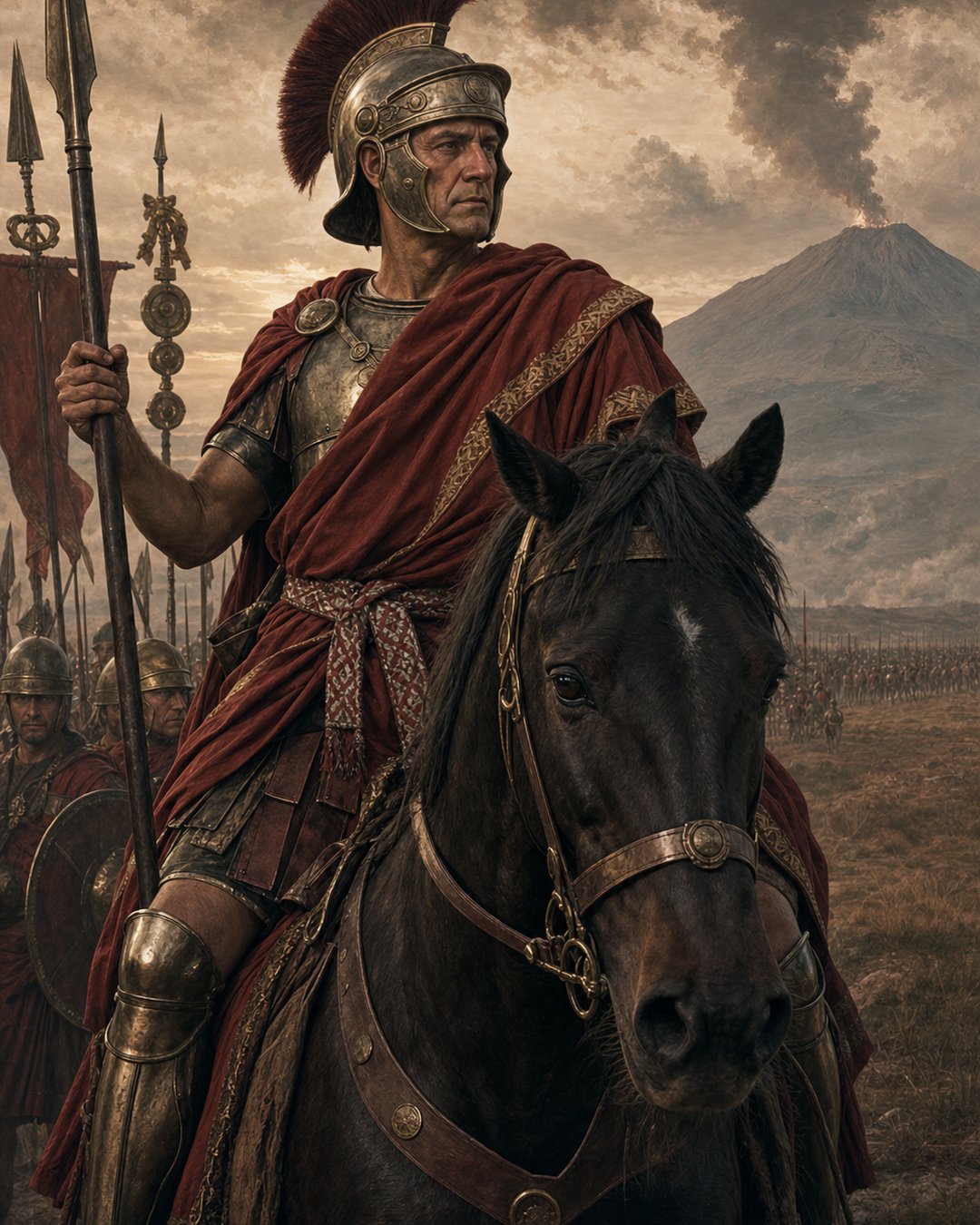
Publius Decius Mus did not begin his last charge by lowering a spear. He first covered his head, pressed a toga-wrapped hand against his chin and stood upon a spear while a pontiff supplied the words. Only after the formula had been spoken and his colleague had been notified did the consul tighten his clothing, mount and ride toward the Latin line.
Livy’s account of the battle near Veseris is often remembered as a burst of heroic self-sacrifice. Read in sequence, it is more controlled and more unsettling. Decius’s body became part of a public religious transaction, yet the army did not abandon tactics for inspiration. One consul entered the enemy formation; the other continued to decide when exhausted troops should give way and when the fresh triarii should finally rise.
The warning appeared before the left gave ground
Livy locates the battle near the foot of Mount Vesuvius, where the road ran toward Veseris. Before the armies advanced, both consuls sacrificed. The inspection of the victims produced an asymmetry: Decius received an indication of his own death, while the remaining signs were favourable; Titus Manlius’s sacrifice was satisfactory.
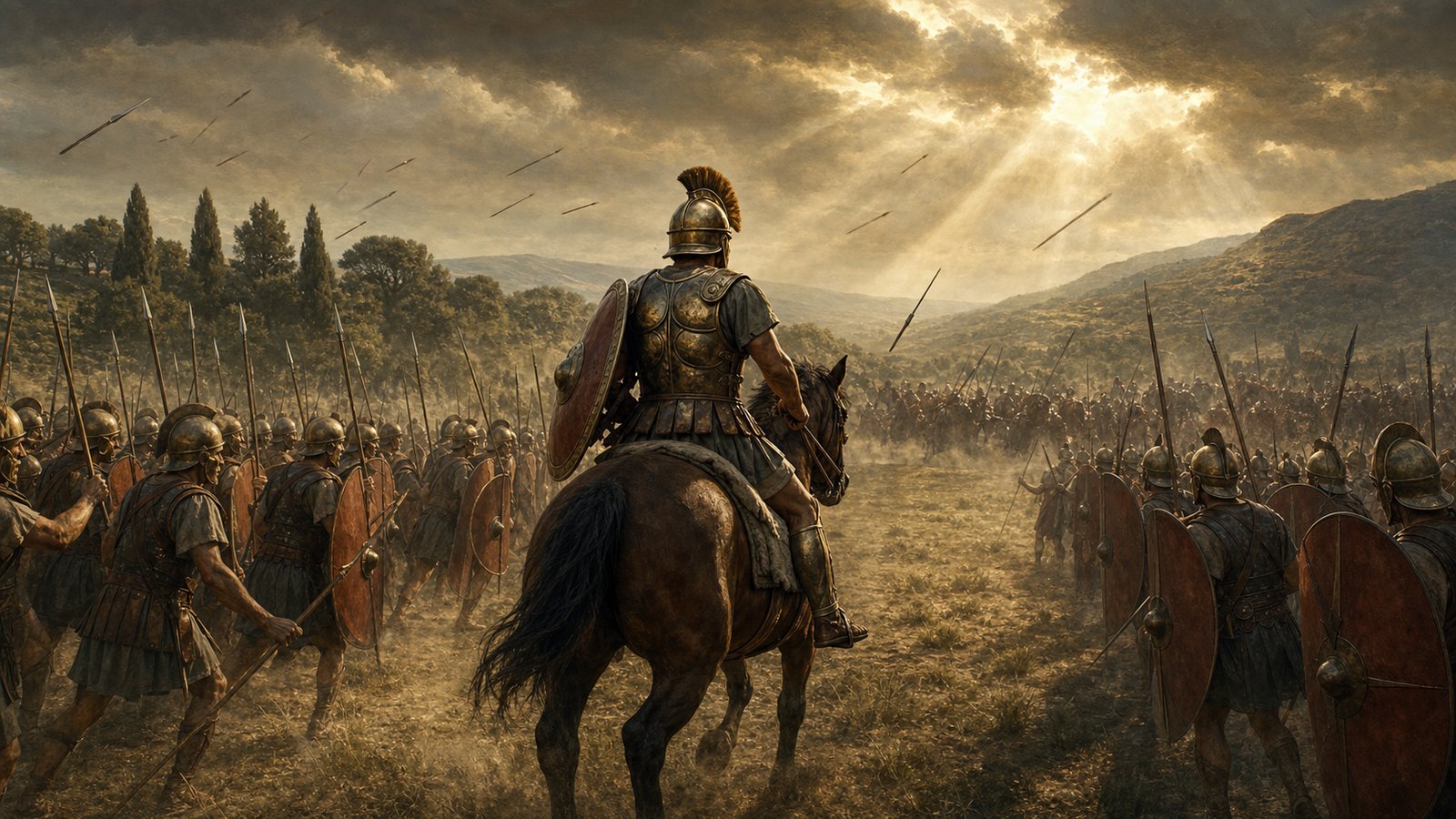
Decius did not treat that warning as an order to charge immediately. Livy has him accept the good signs granted to his colleague, and the army moved into its arranged formation. Manlius commanded the right, Decius the left. At first the fighting was even. The crisis came when the hastati on Decius’s side could no longer hold the Latin pressure and retired behind the principes.
This timing matters. The sacrifice had framed the danger, but the devotio answered a visible battlefield failure. Decius acted when the forward line on his wing had lost its position and confusion opened between formations. Religion supplied a formal response to a military emergency; it did not erase the emergency’s tactical shape.
The archive’s study of omens before a Roman battle shows how signs could structure decisions without functioning like simple predictions. Veseris makes that relationship concrete. A sign attached danger to the consul, then retreat on his wing created the moment in which he chose to make that danger useful.
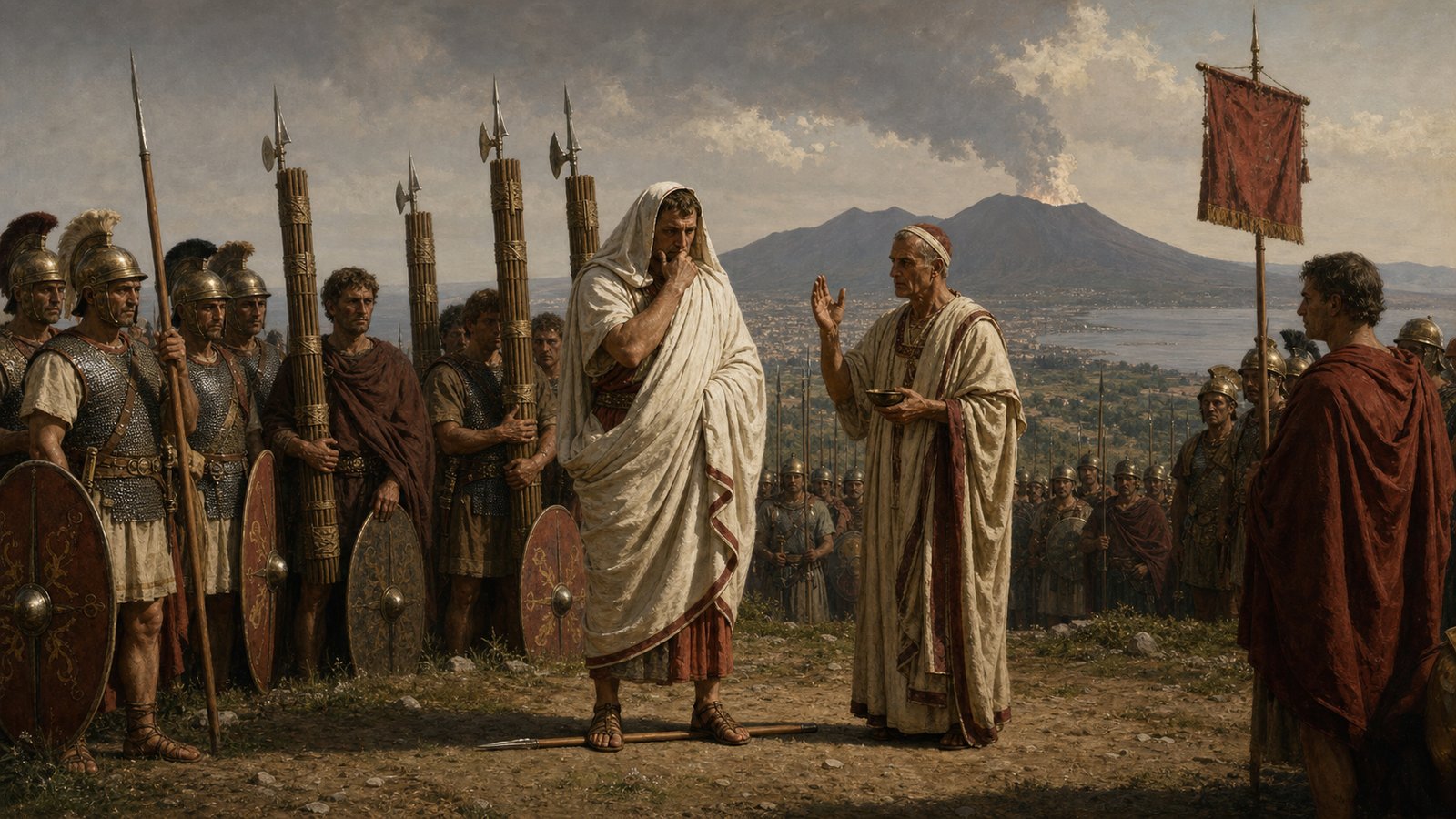
A pontiff controlled posture and language
Decius called to Marcus Valerius and asked the pontiff to dictate the words by which he could devote himself for the legions. The request is an admission that courage alone was insufficient. The act needed a competent voice to supply a valid sequence.
The physical instructions were exact. Decius veiled his head with the bordered toga. He placed a hand, covered by the toga, against his chin. He stood upon a spear. None of those actions resembles the free movement of combat. For a brief interval the commander became a fixed ritual figure while fighting continued nearby.
The formula then widened the audience far beyond the soldiers who could hear it. Livy’s list invokes Janus, Jupiter, Father Mars, Quirinus, Bellona, the Lares, the Novensiles and Indigetes, and the Divine Manes. The wording asks victory and strength for the Roman people while directing fear, dread and death toward their enemies.
Its final exchange is the core of the rite. Decius devoted the enemy legions and auxiliaries together with himself to the Divine Manes and Earth. He was not merely promising to die bravely. In Livy’s presentation, he formally included his own life in the destruction requested for the opposing force.
The lictors preserved command before the horse moved
After speaking, Decius ordered his lictors to go to Manlius and report what he had done. This short step prevents the episode from becoming a private compact between one man and the gods. The other consul had to know that his colleague had removed himself from ordinary command and had made the devotion on behalf of the army.
Only then did Decius adopt the Gabinian arrangement of his clothing, put himself in full armour, mount and ride into the enemy. Livy describes the watchers in both armies perceiving him as something dreadful and more than human. That is Livy’s literary account of their reaction, not a measurable report of every soldier’s thoughts. The observable result in the narrative is that the Latin front became confused and the disturbance spread.
Decius fell under a mass of missiles. The Latin cohorts withdrew from the place and left a broad gap. On the Roman side, Livy says religious fear lifted and the fighting renewed. The episode therefore joins communication, spectacle and physical impact: a message went backward to the surviving commander while one armoured body moved forward into the enemy’s weapons.
The formal launch differs from the declaration examined in Rome’s blood-tipped fetial spear. Both acts use spoken ritual and a spear, but one begins a public war and the other dedicates a commander during a battle already underway. Similar materials do not make them the same mechanism.
Manlius still had to win the remaining battle
Livy does not end the battle when Decius dies. Manlius heard the news and mourned, but he continued to manage depth and exhaustion. In some places Latin numbers still pressed the Romans. The surviving consul considered using the triarii, then kept them fresh and sent the accensi forward first.
The Latins mistook that movement for Rome’s final reserve and committed their own triarii. After those troops had tired themselves and damaged their spears, Manlius ordered the real Roman triarii to rise. He addressed them as fresh soldiers facing a worn enemy and explicitly recalled the dead consul.
This sequence gives Decius’s sacrifice a boundary. His charge created disruption and meaning; it did not replace reserves, timing or command. Manlius exploited the state of the enemy and the morale of his own troops. Livy distributes credit between two forms of action: one consul gathered the threatened divine danger upon himself, while the other managed the battle that remained.
The body itself was not recovered before night. Searchers found it the following day under a heap of javelins, with enemy dead around it, and Manlius conducted the funeral rites. The material end of the formula was neither clean nor symbolic. It was an armoured corpse difficult to locate inside the debris of close fighting.
The rule survived beyond the man
Livy follows the narrative with procedural details that make the rite larger than Decius. A consul, dictator or praetor could devote an enrolled legionary rather than himself. If the selected man died, the requirement was fulfilled. If he survived, an image at least seven feet tall had to be buried and an expiatory victim killed; Roman magistrates were then forbidden to step on that place.
A commander who devoted himself and survived faced a different consequence. Livy says he could no longer perform religious functions for himself or for the state, though he could dedicate his arms to Vulcan or another god. Survival would not simply restore the old office. The spoken transfer had altered the commander’s religious capacity.
Even the spear under his feet carried continuing risk. If it passed into enemy hands, a suovetaurilia had to be offered to Mars. The formula therefore left obligations attached to man, image, ground, weapons and public office. Devotio was not a synonym for recklessness. It was a regulated way to turn a life into an offering while accounting for the possibility that the expected death might fail to occur.
At Veseris, the rite worked in Livy’s story because every stage had a place: adverse sign, collapsing line, pontifical instruction, bodily posture, named gods, notification, charge, tactical reserve and burial. Remove the sequence and only a dramatic death remains. Keep it intact and the episode reveals a Roman commander making himself part of the machinery through which religion and battle were coordinated.
Sources
Livy, History of Rome, 8.9–10