
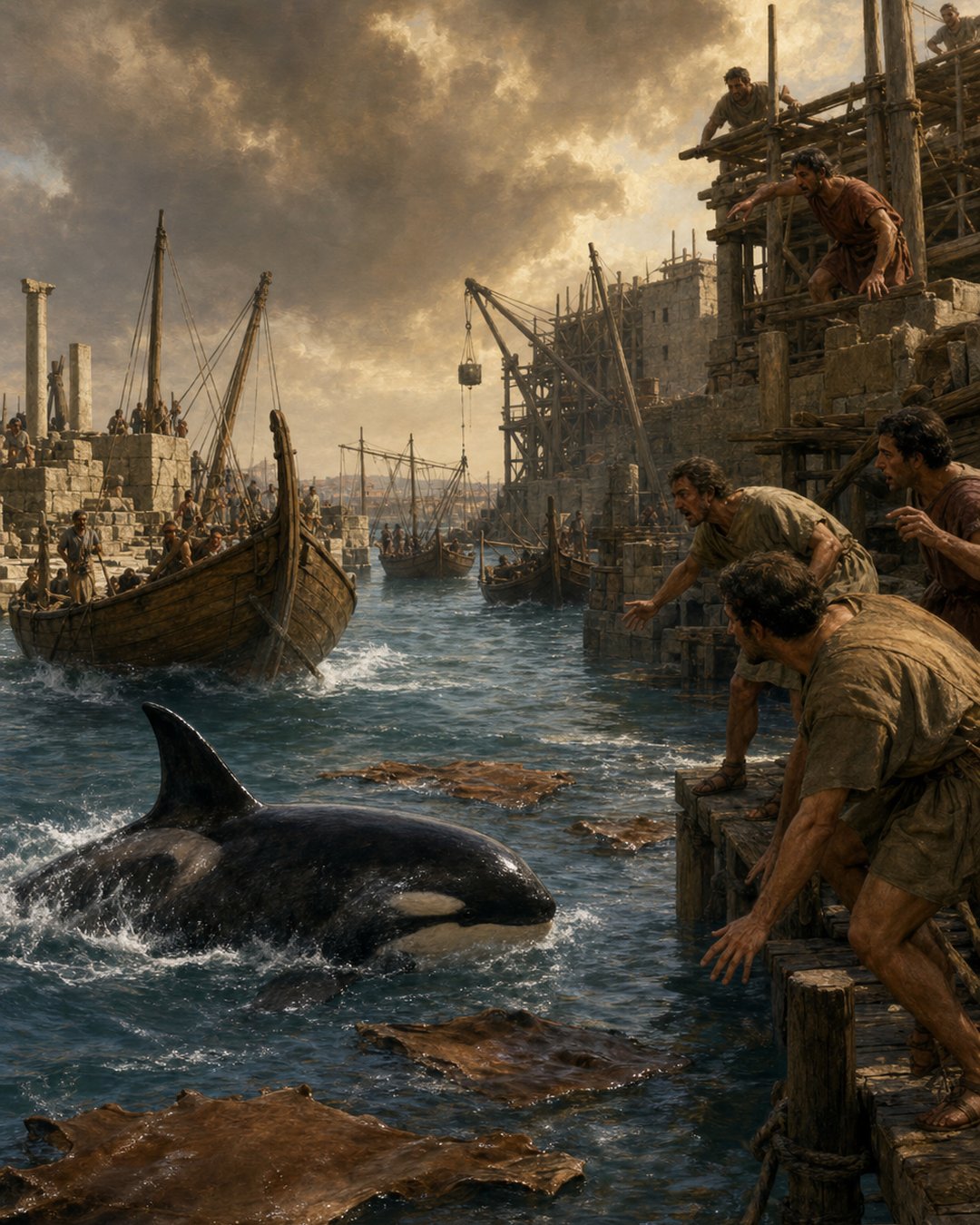
A cargo accident brought an orca into Claudius’s new harbour at Ostia.
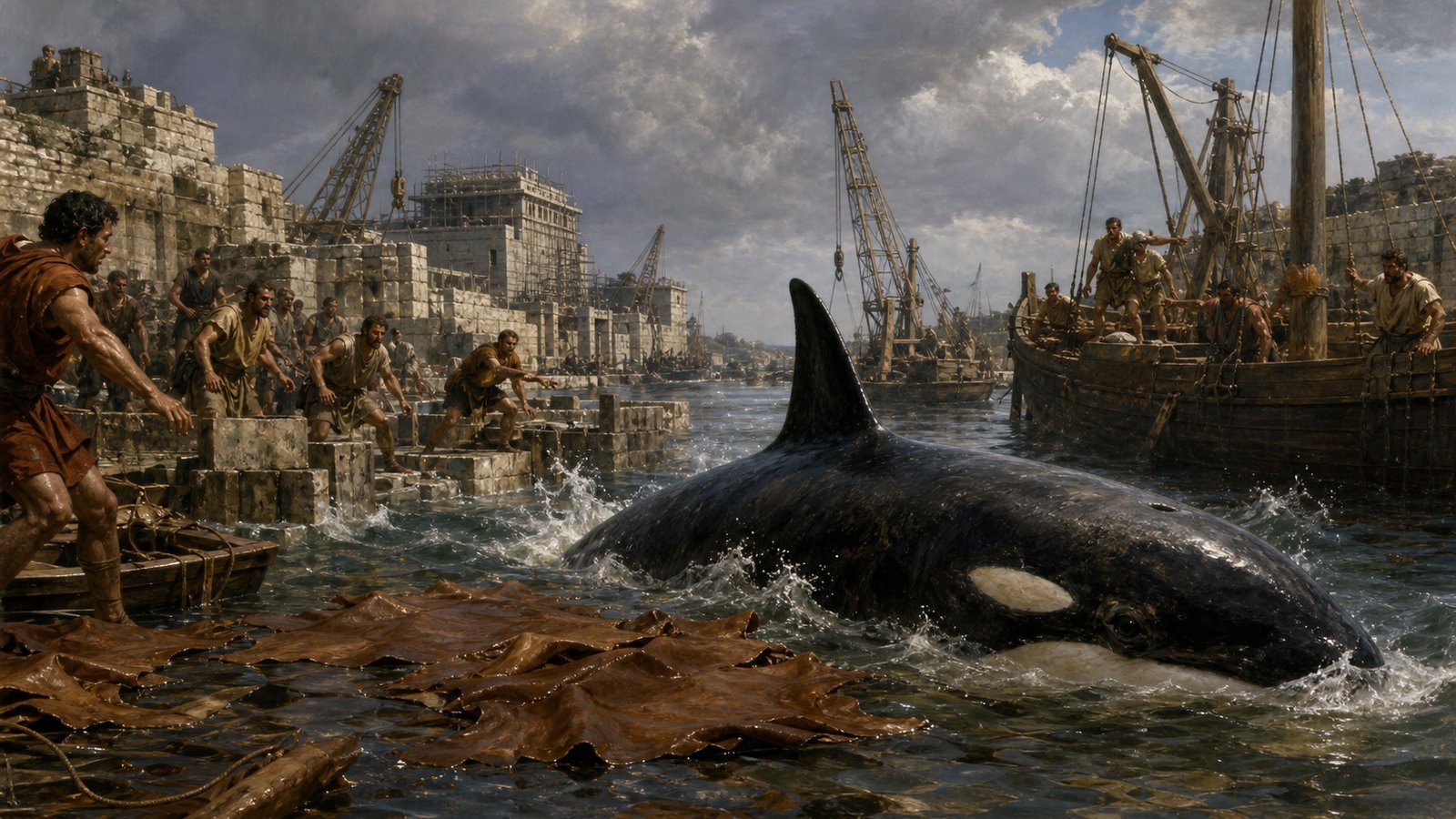
Pliny the Elder says hides shipped from Gaul fell overboard while the harbour was under construction. Their smell or presence drew the animal into shallow water, where it fed for several days. Then wind shifted the sand around the channel it had made. The orca could no longer turn around.
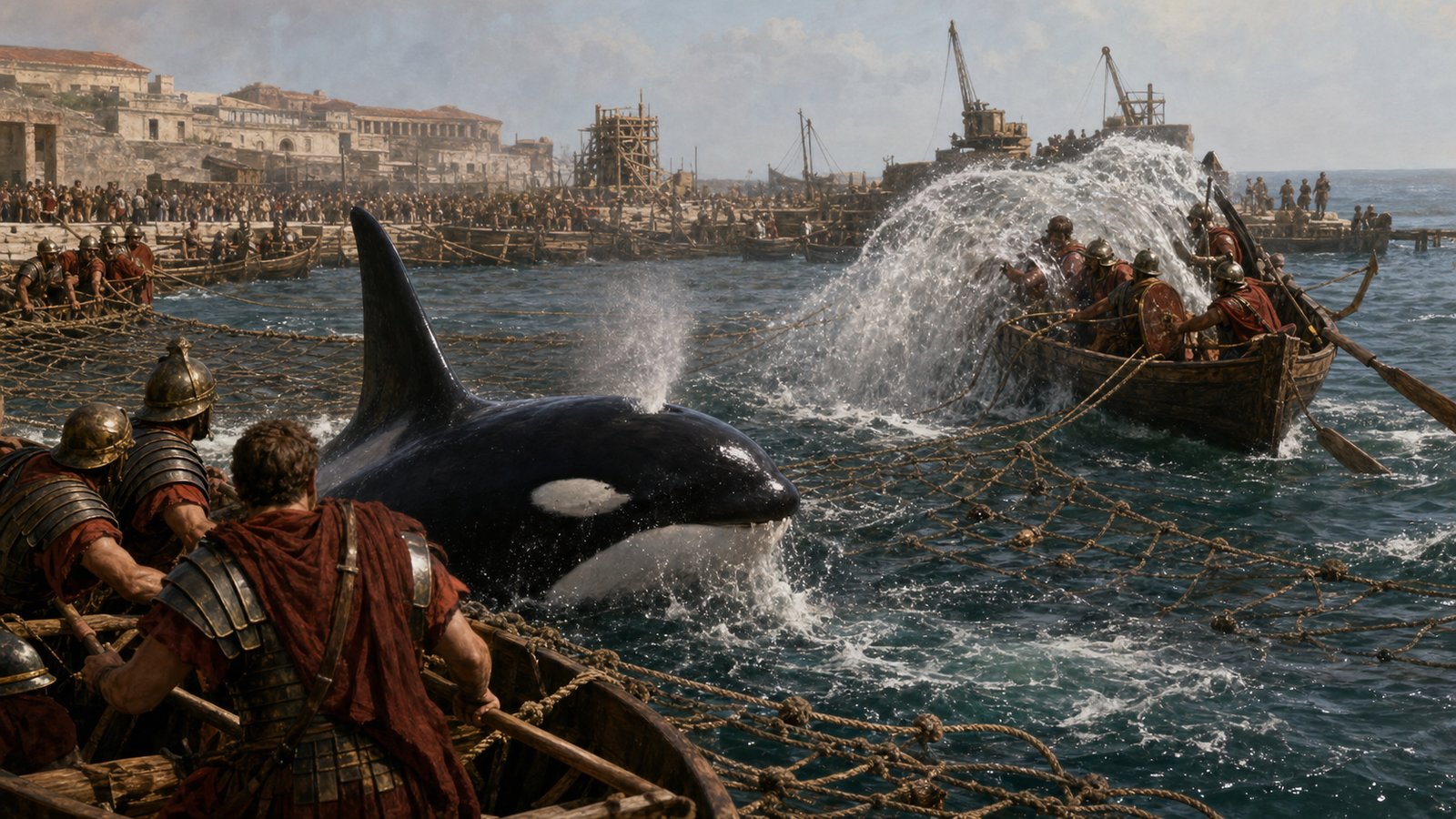
Its back rose above the surface like the keel of an overturned ship. Claudius ordered nets stretched from shore to shore across the harbour mouth. He arrived with praetorian cohorts, boats moved in, and soldiers threw lances. What began as a marine animal following discarded cargo became an imperial spectacle.
Pliny places himself inside the scene. He says he saw one of the boats sunk by the water the orca showered down as it breathed. The unfinished port did not merely frame the event. Its hides, shoals, new channels and moving sand produced the trap that made the performance possible.
The animal followed cargo into a changing construction zone
Claudius’s harbour was being built to alter Rome’s relationship with the sea. The coast near Ostia offered access to the capital through the Tiber, but exposed anchorages and shifting conditions made arrival uncertain. Large works attempted to create a more reliable basin for shipping.
Pliny’s orca entered before reliability had replaced instability. The immediate bait was ordinary commercial material: hides carried from Gaul. Some fell into the water. The animal remained to feed on them, a reminder that imperial supply chains shed smells, scraps and opportunities into the environments they crossed.
The detail matters because it connects distant province, cargo vessel, harbour building and predator in one sequence. Gaul was present at Ostia not as a map label but as wet leather in the shallows. The port gathered objects from far away even while its own boundaries were still being made.
The archive follows the monumental side of the same project. A gigantic ship associated with Caligula’s obelisk became part of Claudius’s harbour foundation. Pliny gives the basin a different scale. Alongside ships, concrete and imperial planning, hides drifting overboard could redirect a living animal.
The orca fed for several days and became glutted. This was not a quick sighting in open sea. Repeated feeding tied it to a shallow route inside the works. Its success in reaching the cargo helped create the conditions of its confinement.
That duration gave observers time to notice a pattern rather than merely glimpse a fin. Pliny’s sequence depends on persistence: the hides remained available, the animal returned or stayed, and the channel through the shoals became its route. The same days that filled its body also let coastal conditions alter around it. Feeding and entrapment were not separate episodes; each continued while the other developed.
Wind and sand closed the route behind it
Pliny says the animal had made a channel through shoaly water. That phrase evokes a body repeatedly forcing its own passage across a shallow bottom. The channel was useful only while enough room remained for the orca to move and reverse direction.
Wind then drove sand into the area. The accumulation became so great that the animal could not turn around. Waves pushed it toward shore while it pursued its food. The trap was therefore neither a cage prepared by fishermen nor a simple stranding on an empty beach.
Several forces met: appetite pulled inward, waves drove shoreward, sand altered the channel, and the animal’s size removed the option of pivoting. Its back appeared above the surface and looked, to observers, like a ship’s keel turned upside down. In a harbour full of hulls, Pliny described the unfamiliar body through the shape everyone knew.
This physical sequence keeps the story from becoming only an emperor-versus-monster anecdote. Claudius did not first capture the orca through superior planning. He encountered a creature already compromised by the basin’s changing edge. Construction had rearranged the meeting point between sea, cargo and shore.
Ostia’s infrastructure is often explained through storage after ships arrived. Warehouses helped turn maritime deliveries into a food reserve for Rome. The orca episode catches an earlier and messier threshold, where incoming material, unfinished protection and coastal sediment had not yet settled into routine.
Claudius sealed the harbour mouth and staged an attack
Once the orca’s back was visible and its movement constrained, Claudius ordered a great number of nets across the entrance from one shore to the other. The nets prevented the harbour mouth from becoming an escape route if water or panic freed the animal from the shallows.
The emperor came with praetorian cohorts. Pliny explicitly calls what followed a spectacle for the Roman people. Boats attacked, and soldiers aboard them cast lances. The military presence converted a dangerous obstruction into a display of organized force under imperial supervision.
It is tempting to picture a polished amphitheater performance transplanted to the sea. Pliny’s details resist that neatness. The arena was a work site. The barrier was made from nets. The target was not trained or transported for entertainment; it had entered after cargo fell into the water and become trapped by sand.
The imbalance did not make the operation safe. An orca is powerful at the surface, and close boats had to approach within range of its body and breath. Pliny says the water expelled during respiration showered down upon one boat and sank it. His sentence gives the animal a final ability to disrupt the choreography.
The nets also reveal the scale at which Claudius answered the problem. They ran across the harbour entrance rather than around a small pen. Boats and shore positions had to cooperate across water whose depth and sand had already proved changeable. Imperial command could assemble that response quickly, but it still depended on ordinary flexible material, crews holding position and soldiers willing to approach the trapped animal.
We should not add modern measurements or identify the exact biology beyond Pliny’s term and description. He records an orca, an imperial response and an eyewitness moment. Those claims are vivid enough without estimating length, weight or casualty numbers that the source does not supply.
An eyewitness turned harbour disorder into natural history
Pliny embeds the episode in his discussion of large marine animals. Before Ostia, he describes orcas attacking whales and driving them into narrow places, shoals or rocks. At Claudius’s harbour, the predator found itself trapped by a similar geography of confinement.
His own presence changes the texture of the account. Much ancient natural history gathers reports from books, travelers and inherited authorities. Here Pliny says, in the first person, that he saw the boat sink. The observation anchors the most startling consequence to a named witness.
That does not transform every detail into a modern incident report. Pliny writes for effect, and his comparison of the visible back to an overturned keel makes the scene legible to readers. Yet the account preserves an unusually specific chain: Gallic hides, several days, shoaly water, windblown sand, nets across the entrance, praetorians, lances and a swamped boat.
The harbour promised control over maritime uncertainty. This event displayed control only after uncertainty had done most of the work. Cargo was lost, an animal arrived, sediment shifted, and waves pushed. Claudius then gathered people and force around the accident.
Seen this way, the orca was not a decorative interruption in the history of a great port. It exposed the unfinished harbour as an active environment. Rome could build walls into the sea and summon soldiers to the water, but hides, wind, sand and breath still wrote the sequence of the day.
Sources
Pliny the Elder, Natural History 9.5