
The crown weighed exactly what Hiero expected. That was the problem.
The king of Syracuse had supplied gold for a costly votive crown. When the finished work returned, it was beautifully made and matched the assigned weight. Then a report alleged that part of the gold had been removed and replaced with silver. The suspected object had passed the obvious test.
Vitruvius says Hiero turned to Archimedes. The investigation had to discover composition inside a worked form, not merely weigh it again. In the famous account, a bath supplied the missing comparison: immersion made water leave a full vessel, and the quantity lost corresponded to the volume entering it.
The insight mattered because silver and gold of equal weight do not occupy equal space. A crown adulterated with silver could keep the correct weight while becoming bulkier than the same weight of pure gold. Overflow gave the hidden substitution a measurable consequence.
The workshop had defeated the first inspection
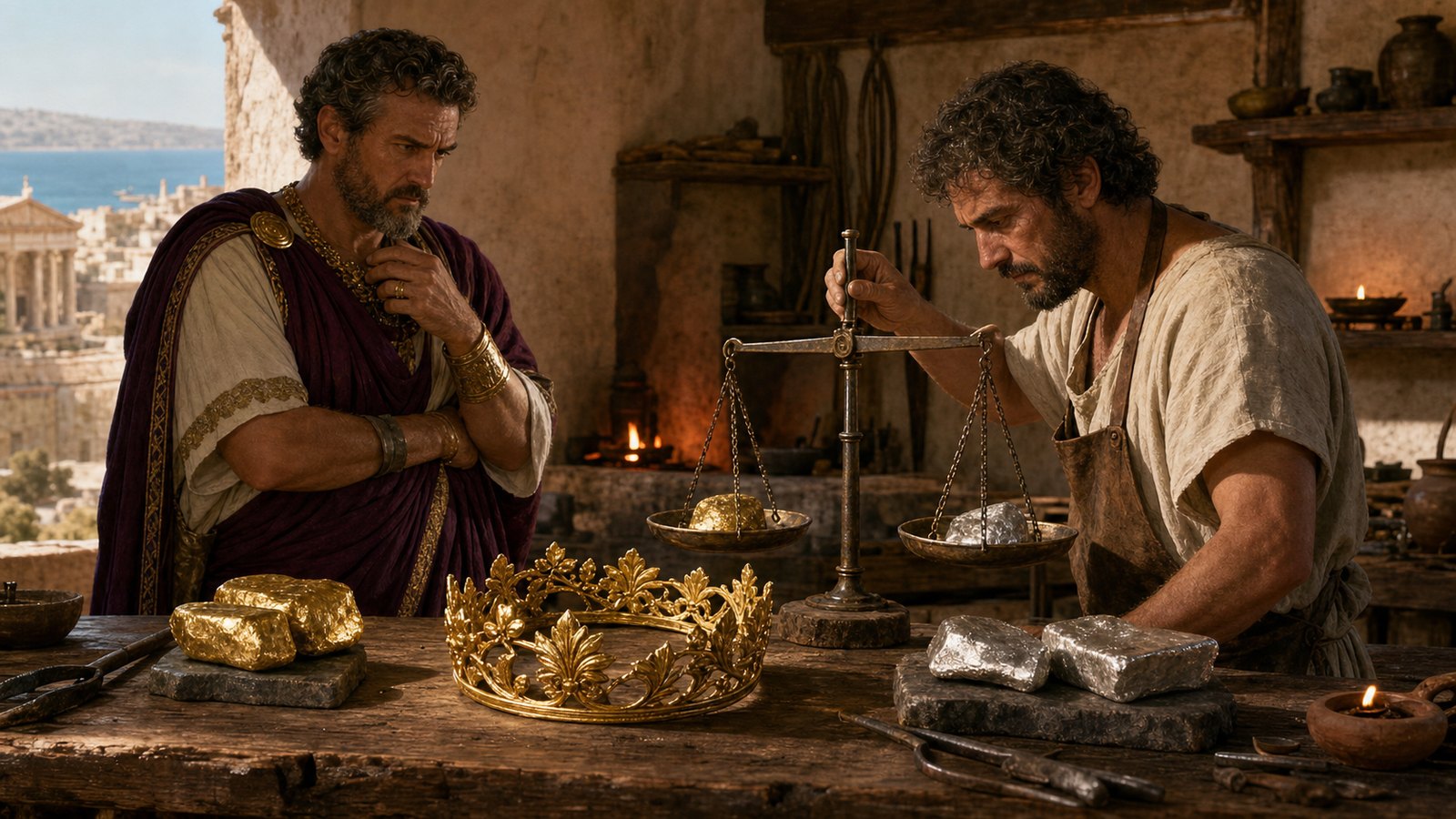
Vitruvius frames the crown as a sacred commission. Hiero had obtained royal power and ordered a valuable gold crown for dedication in a temple. He assigned the manufacturer a specified weight of metal, making accountability appear straightforward.
The completed crown looked successful. It was finely worked, and its weight corresponded to the gold that had been handed over. If inspection stopped there, the maker had satisfied both visible craftsmanship and numerical control.
The accusation exposed the weakness of that arrangement. Replacing some dense gold with less-dense silver could preserve total weight if enough silver were added. The object could answer one measurement honestly while lying about its material.
Melting the crown would have destroyed the workmanship and turned a votive object back into raw metal. Vitruvius does not explicitly present a catalogue of rejected tests, so there is no need to invent one. His narrative nevertheless defines the challenge: identify the theft in the completed crown.
Roman steelyards made weight visible through balance and leverage. Hiero’s case demonstrates the limit of weight alone. A good measurement can still answer the wrong question.
A bath converted immersion into evidence
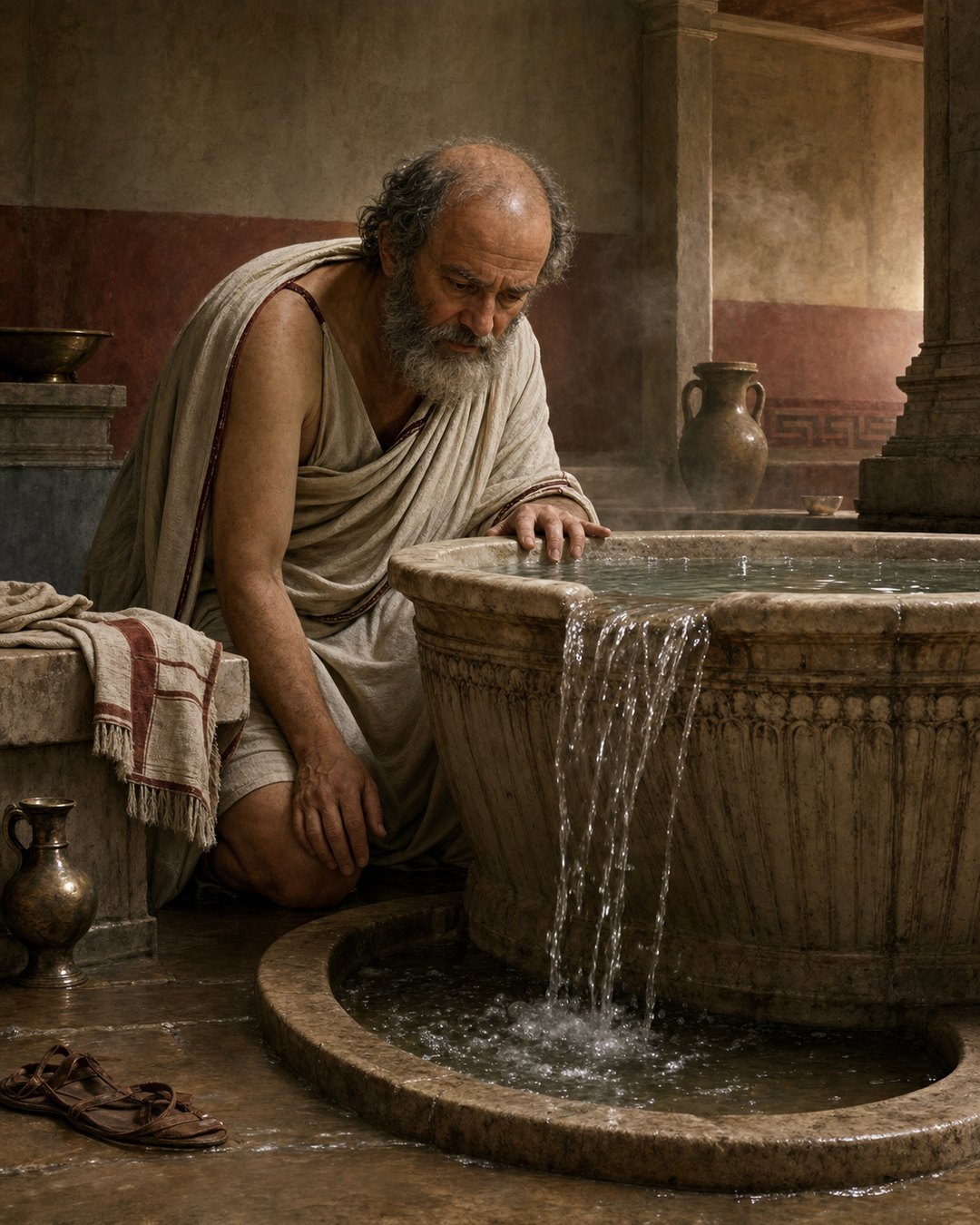
Archimedes entered a bath vessel and noticed water running over as his body became immersed. Vitruvius presents the observation as sudden recognition. Archimedes leapt out and hurried home, repeatedly crying the Greek word usually rendered “I have found it.”
The dramatic naked run has dominated later memory, but the useful part of the scene is quieter. A brim-full container created a visible boundary. Any body entering below that boundary forced water out, allowing volume to be compared through what the vessel could no longer hold.
The bath did not reveal gold or silver by colour. It translated the size of an irregular object into a quantity of water. That translation was valuable precisely because a crown could not be measured easily as a simple block.
Vitruvius embeds the story in a preface praising discoveries that serve humankind. Around it he discusses geometrical demonstrations and practical measurement. The anecdote therefore functions as more than colourful biography. It shows thought moving from an ordinary physical effect toward a repeatable procedure.
The story’s status also deserves care. Vitruvius wrote centuries after Archimedes, and his account is a literary report rather than a surviving laboratory notebook. Modern discussions have questioned how precisely the described overflow method could work. Those questions should remain visible. The historical claim here is what Vitruvius says the comparison accomplished and why it made sense to his readers.
Equal weights produced unequal overflow
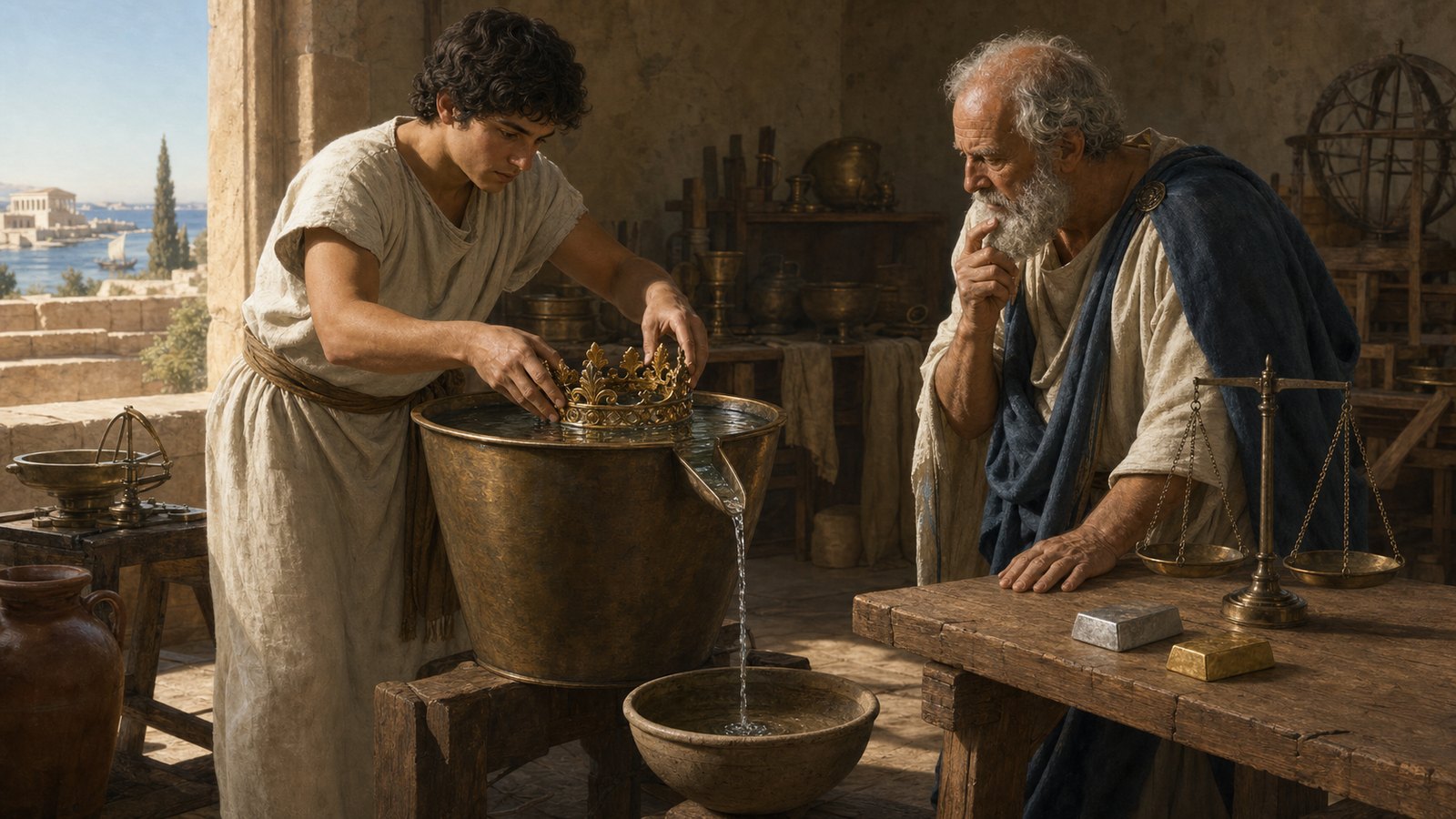
Vitruvius gives the experiment three objects. Archimedes prepared a mass of silver equal in weight to the crown, a mass of gold also equal in weight to the crown, and the crown itself. Equal weight held one variable steady while material and form changed.
He filled a vessel to the brim and immersed the silver. Water ran out. After removing the mass, he replaced the missing water by measure. That step turned a wet impression into a quantity that could be recorded and compared.
He repeated the operation with gold. The equal-weight gold mass caused less water to overflow because it occupied less space than the silver. The two reference materials established opposite points: how much volume that weight required in pure gold and how much in pure silver.
Finally the crown entered the full vessel. It displaced more water than the equal-weight mass of gold. The crown therefore occupied more volume than pure gold of its weight should occupy. In Vitruvius’s account, calculation from that excess established how much silver had been mixed in.
Roman dividers made comparison useful by carrying one span to another. Archimedes’s vessels performed a related intellectual move with volume: not naming an object by appearance, but comparing its physical effect against known references.
The fraud became a mismatch between properties
The maker’s deception depended on treating weight as identity. If the crown balanced against the original allotment, it could be accepted as the same gold transformed by skill. The water test separated those propositions. Same weight did not mean same material.
This is the story’s durable mechanism. Fraud often survives inside the assumptions of a control. The workshop knew what would be checked and preserved that feature. Archimedes, as Vitruvius tells it, introduced a second property that the substitution could not preserve at the same time.
The experiment also linked royal authority, temple wealth and craft knowledge. Hiero could command precious metal and punish theft, but authority alone could not see inside the crown. The manufacturer could produce a form impressive enough to pass visual inspection. Detection required understanding how materials behaved.
The crown’s ornate shape ceased to be an obstacle once immersion reduced it to displaced volume. Water touched every submerged projection and hollow external contour without needing the investigator to calculate each curve separately. The method made irregular craftsmanship answer a simple comparative question.
The order of testing mattered. Silver and gold were not decorative demonstrations added after the crown. They established what equal weight did in the same kind of vessel. Only against those reference effects could the crown’s overflow become meaningful. A spill by itself says that an object has volume; a measured difference says that its volume does not behave like pure gold.
Vitruvius’s account therefore contains two moments of discovery. The bath suggested that immersion could reveal volume, but the controlled sequence made that insight usable. Inspiration did not replace measurement. It created the question that comparison could answer.
Vitruvius ends the episode with the fraud made manifest. He does not narrate the craftsman’s punishment, the crown’s later fate or an independent confirmation. A careful retelling should end where his evidence ends.
What remains is stronger than the shout of “eureka.” The bath supplied an observation; the equal-weight masses supplied controls; measured refilling supplied comparison. An object that had passed the scale failed the water because hidden silver could imitate gold’s weight, but not its compactness.
For Vitruvius, that chain justified celebrating investigators alongside athletic victors. A strong body could win one contest; a method could travel into other acts of making and checking. The crown story gave his Roman readers a compact example of knowledge disciplining both craft and royal suspicion without asking appearance to prove what only matter could reveal.
Sources
Vitruvius, On Architecture, Book 9, preface 9–12