
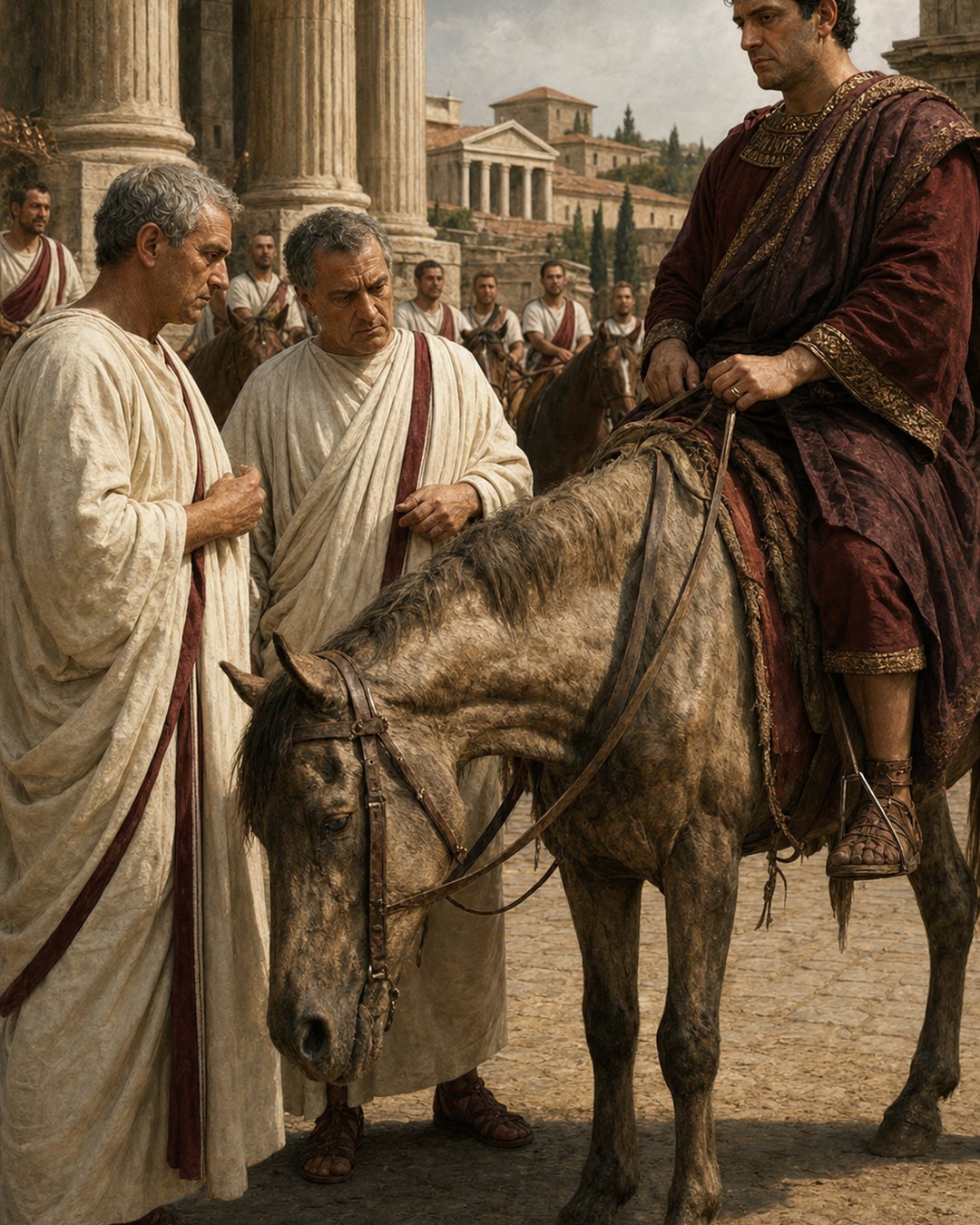
The censors did not need an account book. They had the horse and the rider standing beside each other.
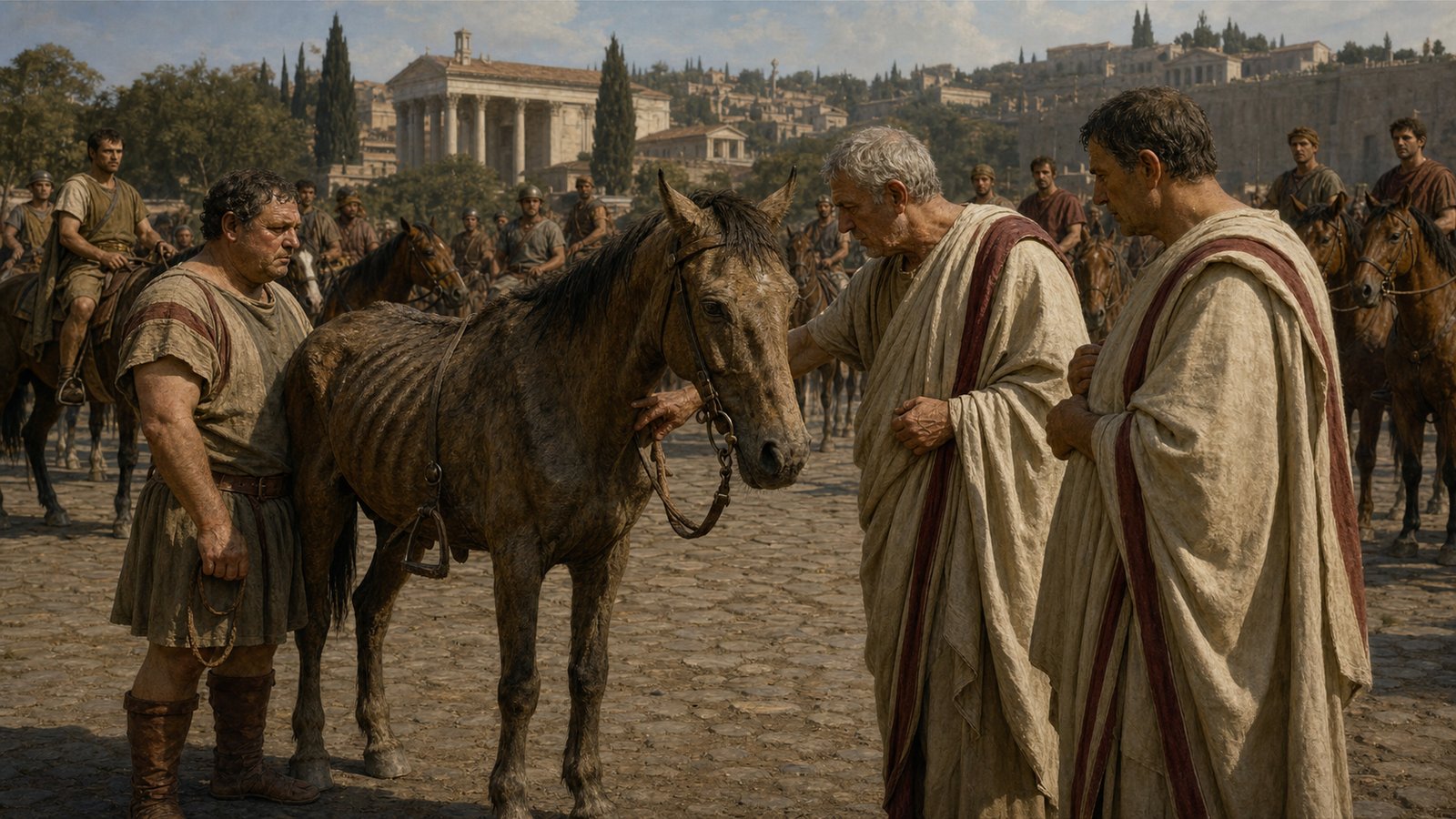
Aulus Gellius preserves a story from Masurius Sabinus about an equestrian review conducted by Publius Scipio Nasica and Marcus Popilius. One mount was thin and poorly kept. Its rider was plump and thriving. The contrast made a question unavoidable: why had the man received better care than the animal attached to his public standing?
The rider answered that he took care of himself, while a “worthless” enslaved man named Statius took care of the horse. The attempt at wit failed. The censors judged the reply disrespectful and reduced him to commoner status.
The anecdote is short, but its machinery is precise. Roman rank became inspectable through an animal. Delegation could explain who performed stable work; it did not remove responsibility from the person who appeared in the review. By blaming Statius, the knight exposed the unequal household power behind his excuse without persuading the magistrates to detach privilege from neglect.
The equestrian review made condition into evidence
Gellius includes the episode among examples of censorial strictness. The censors did more than enumerate citizens. They evaluated conduct, status and the visible performance of obligations. A review of knights gave that moral jurisdiction a physical stage.
The horse mattered because equestrian identity was mounted identity. A knight appeared not as an abstract name on a list but with the animal through which wealth, readiness and public distinction could be displayed. Poor condition therefore reached beyond private housekeeping.
Gellius supplies no veterinary diagnosis. The source says the horse was very thin and ill-kept. It does not say whether age, disease, bad fodder or overwork caused the condition. The censors respond to the observable mismatch, and a careful retelling should remain at that level.
The rider’s own body intensified the evidence. He was plump and in the best condition. Had both horse and man looked depleted, hardship might have suggested itself. Instead, resources appeared to have reached the status-holder while failing to reach the mount for which he was answerable.
Roman censors made reputation part of public classification. This review shows how quickly classification could become concrete. Grooming, flesh and bearing carried information before anyone spoke.
A joke tried to send responsibility into the stable
The censors asked a comparative question: why are you better cared for than your horse? The wording joined two bodies in one standard. The knight’s answer separated them again. He cared for himself; Statius cared for the animal.
As an account of labour, that answer may have been literally plausible. Elite riders did not necessarily feed, curry and stable their own mounts. Household work was delegated, and much of it was forced from enslaved people. The problem was not the bare existence of a caretaker.
The rider added contempt. Statius was “worthless,” according to the quotation preserved by Gellius. Blame moved downward toward a person whose position gave him little power to answer in the censorial exchange. The man who possessed rank presented himself as the successful manager of himself and the victim of someone else’s failure.
That distinction was too convenient. If Statius truly neglected the horse, the knight had still permitted the neglect to continue until public inspection. If resources were withheld, the excuse concealed the rider’s own choices. In either case, naming the subordinate did not restore the mount.
Gellius says the answer seemed insufficiently respectful. Tone therefore mattered alongside condition. The review tested whether a knight understood the magistrates’ authority and his own accountability. Flippancy converted a visible deficiency into an open failure of judgement.
The episode sits uneasily beside modern instincts because the enslaved caretaker appears only through an insult. He receives no speech, motive or outcome. The source preserves elite discipline correcting another elite man, not justice for Statius. That limit should not be disguised.
Losing rank answered neglect with classification
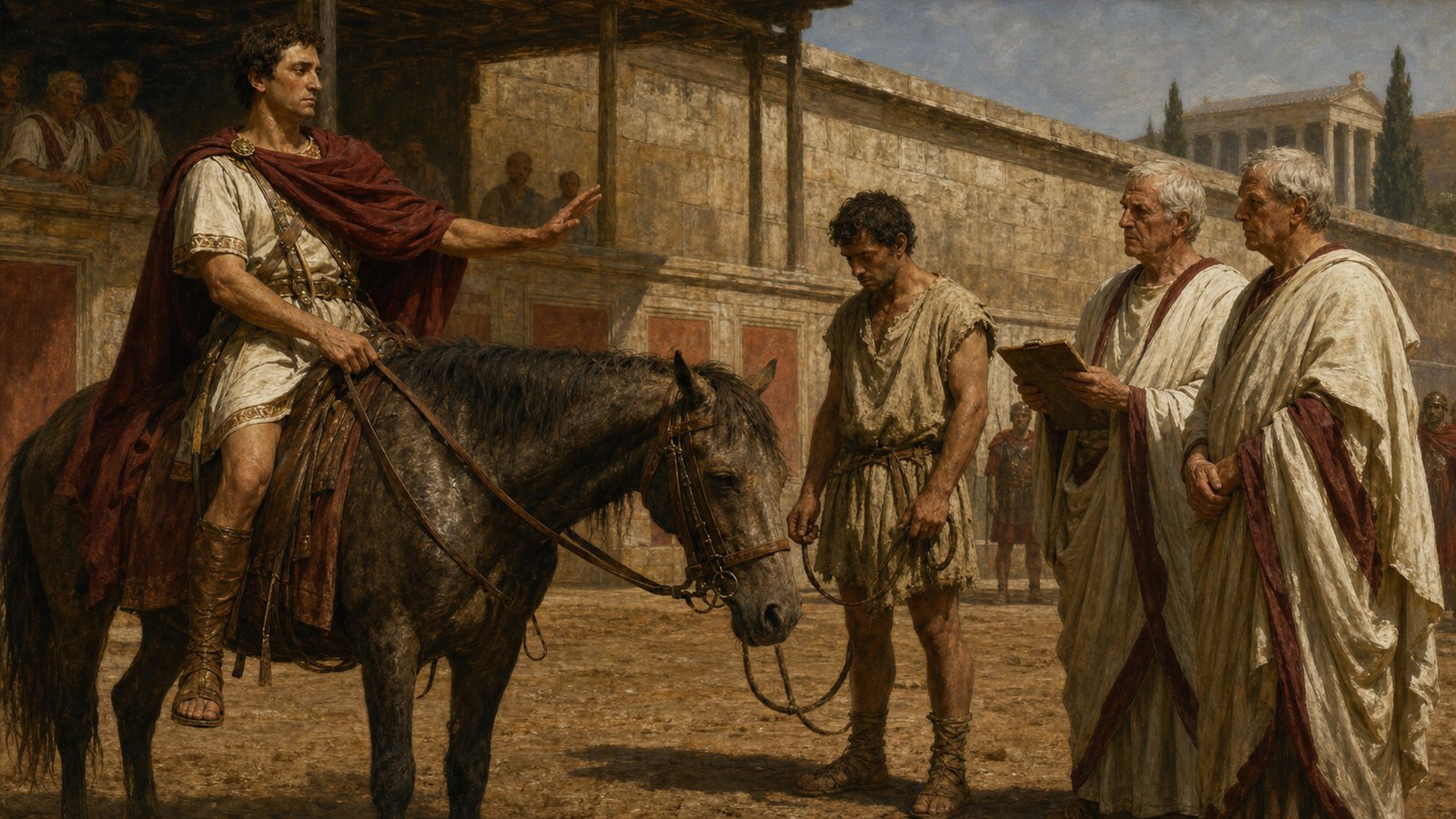
The censors reduced the rider to a commoner according to custom. Gellius does not narrate a fine, beating or prosecution. The punishment targeted the identity being reviewed. A man who failed the mounted standard ceased to occupy the mounted order.
This was not a claim that common citizens lacked dignity. In the logic of the review, however, removal marked loss of privilege and public standing. The punishment made the category conditional rather than hereditary in appearance. Rank had to survive inspection.
The Roman census placed citizens inside a political hierarchy. The horse story shows hierarchy moving in both directions. Classification granted distinction, and censorial judgement could withdraw it when the display supporting that distinction failed.
The paired bodies also made the sanction legible to bystanders. Other knights waiting with their horses could see what condition was being compared and hear the answer that failed. Punishment taught through spectacle without requiring a long written rule.
Gellius frames the action as severity, and readers should keep that framing. Censorial power could be intrusive, moralizing and dependent on elite interpretations of respect. The anecdote does not provide the rider’s later defence or any appeal. Its value lies in showing what Roman authors thought such authority could reach.
The outcome also exposes a boundary of delegation. Roman households relied on chains of command, but public status was attached to the person at the top. The knight could delegate grooming; he could not delegate the consequences of presenting an ungroomed horse.
Statius’s name reveals the hierarchy inside the punchline
After the punishment, Gellius pauses to explain the name. Statius, he says, was widely used for enslaved men in earlier times. He mentions the comic poet Caecilius, who had been enslaved and was once called Statius before the word became part of the name by which he was known.
That linguistic note prevents the stable worker from dissolving into a generic servant. The rider’s line depended on a social signal recognizable to Gellius’s readers. “Statius” located responsibility in a subordinate category even before the insult made contempt explicit.
The censors did not answer by investigating the enslaved man. They disciplined the knight who spoke. In that narrow sense, the attempt to use hierarchy as a shield turned hierarchy against its beneficiary. The person with public standing remained the person whom public authority could demote.
Still, the story should not be polished into a humane parable. The horse’s welfare mattered because it indexed equestrian responsibility, and Statius remained enslaved. Censorial severity protected the credibility of rank more clearly than it protected either vulnerable being for its own sake.
Gellius wrote long after the reported review and quoted an earlier memoir. The dialogue has the neatness of an exemplary anecdote: sharp question, sharper answer, immediate reversal. It may preserve remembered moral theatre as much as administrative detail.
That theatre explains its endurance. A well-fed rider tried to present neglect as someone else’s fault. The censors looked at the thin horse, heard the contempt in the excuse and judged that the visible benefits of rank had outrun its responsibilities. The body that seemed safest—the rider’s prosperous body—became the most damaging evidence in the field.
The review also made care a repeated obligation rather than a last-minute costume. A horse could be brushed before an appearance, but thinness and long neglect were harder to conceal. The censors inspected a condition accumulated across days of feeding, shelter and supervision. Public display therefore reached backward into the household’s routine.
For the other riders waiting nearby, the lesson was practical. A mount was not an accessory that mattered only when war or ceremony demanded it. Its everyday state could determine whether the owner remained entitled to equestrian recognition. The stable, usually kept outside elite political storytelling, entered the machinery of citizenship through the animal’s visible ribs.
Sources
Aulus Gellius, Attic Nights 4.20.10–12