
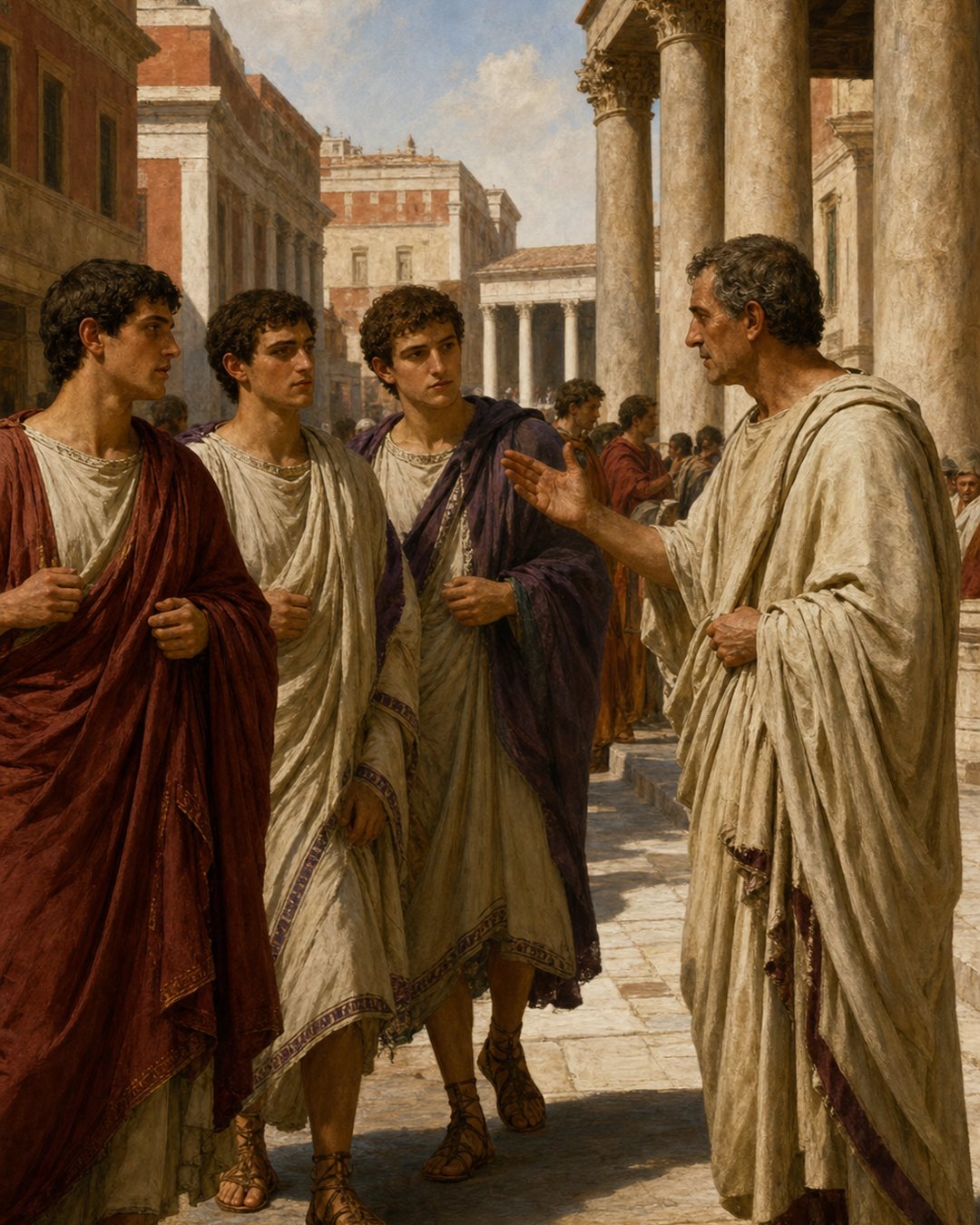
The rhetoric lesson began after the students had left their formal clothes behind.
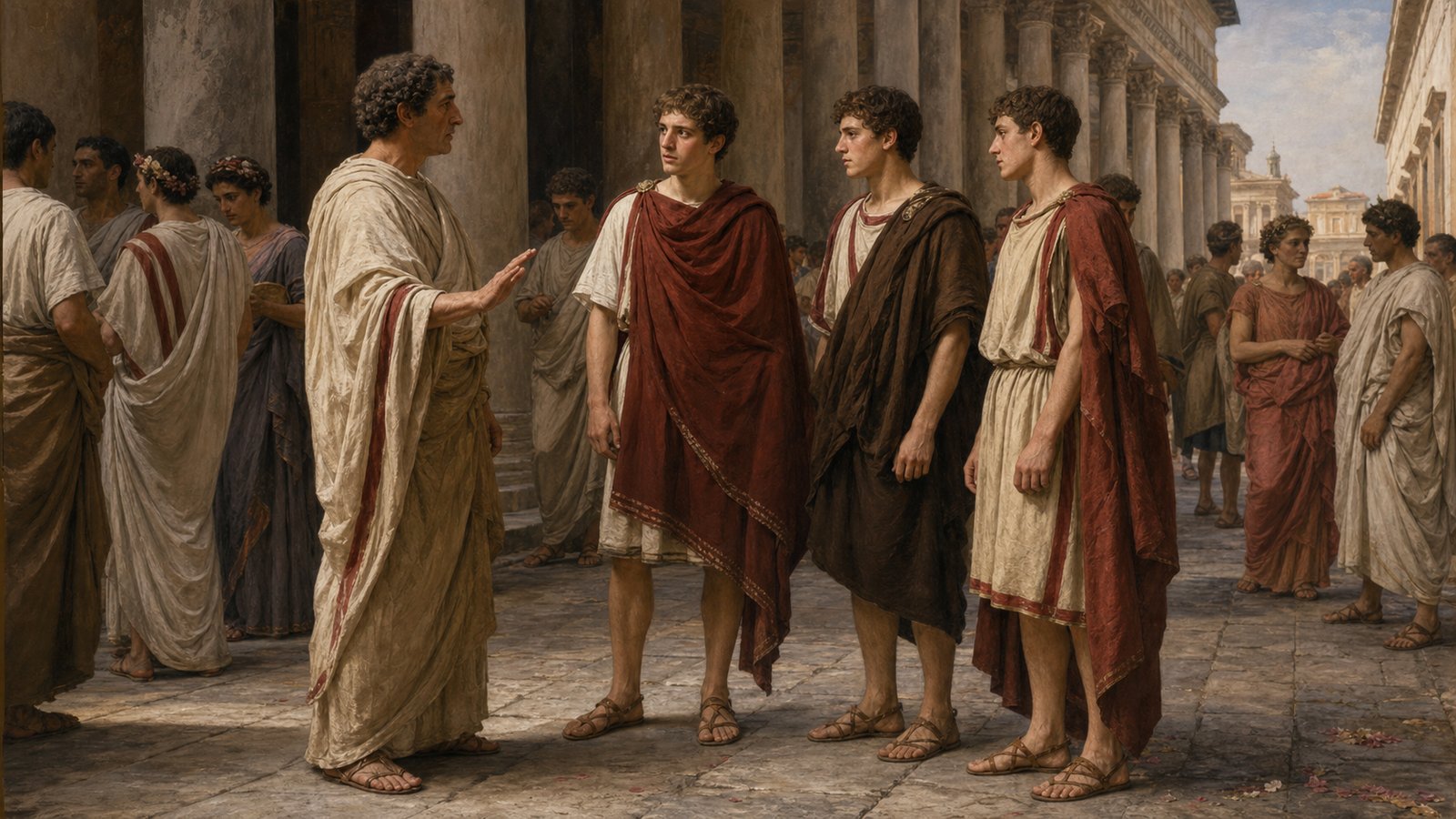
Aulus Gellius says his teacher Titus Castricius encountered several pupils who had become senators. It was a holiday, and they crossed Rome in tunics, cloaks and open Gallic slippers. Castricius stopped them.
Long custom might excuse the relaxed garments, he conceded. Yet senators of the Roman people should not pass through the city streets in sandals. Office remained visible when court or senate was not in session, and a public body could not become entirely private by changing shoes.
Gellius then turns the rebuke into a second lesson. Listeners argued over what the slippers should be called. Moral judgement gave way to straps, soles and the history of Latin words. Decorum depended not only on seeing that clothing was wrong for the moment, but on naming exactly what the students wore.
A holiday relaxed dress without erasing rank
The students were not anonymous youths caught in poor clothes. Gellius identifies them as senators and as pupils of Castricius. Their age, education and office met in one street encounter. A teacher could still address men who now held public standing.
The holiday matters because it supplies the strongest defence. Tunics and cloaks were established relaxed clothing, and Castricius acknowledged that long custom might make the outfit pardonable. He was not pretending every day required the same garment or that leisure itself was disreputable.
His objection was narrower. The students walked through the streets of the city as senators. Rome remained an audience even when formal business paused. Clothing that might be acceptable within a house or private gathering acquired another meaning in shared civic space.
The toga made Roman public identity into a demanding garment. Castricius’s pupils illustrate the opposite pressure. Removing formal weight could offer comfort, but comfort had to be balanced against the expectation that rank present itself recognizably.
Gellius does not say that the men were stripped of office, fined or prosecuted. This was correction by shame and instruction. Castricius used his authority as a teacher to remind them that seemliness operated before law needed to intervene.
Castricius carried classroom authority into the street
Gellius introduces Castricius as a leading rhetoric teacher at Rome, influential and dignified. Hadrian valued him for character and learning. Those details explain why his rebuke could reach senators rather than dissolve into unsolicited criticism from a passer-by.
Rhetoric training was not confined to arranging speeches. Elite education formed judgement about how a public person should sound, move and appear. Students practised persuasion because they expected to act in courts and politics; their teacher could therefore treat appearance as part of civic communication.
The scene also shows that education did not end cleanly when a pupil acquired rank. Castricius still recognized a duty to correct former or continuing students. Their advancement made the lesson more urgent because a senator’s choices carried wider symbolic weight.
Gellius says the teacher spoke with “Roman austerity.” That is his admiring characterization, not an objective measure. The phrase places Castricius inside an old moral style in which restraint, seriousness and public dignity were guarded against luxury or carelessness.
Castricius invoked Cicero as precedent, recalling someone whom the orator had reproved for comparable attire. The exact force lies in continuity: improper clothing had already been made available as political criticism. A garment could be evidence in an argument about character.
The teacher did not need a prepared lecture. He read the students as they crossed his field of vision and converted the mismatch into an example. The city street became an extension of the school because elite conduct supplied its own exercise.
Open slippers exposed more than the foot
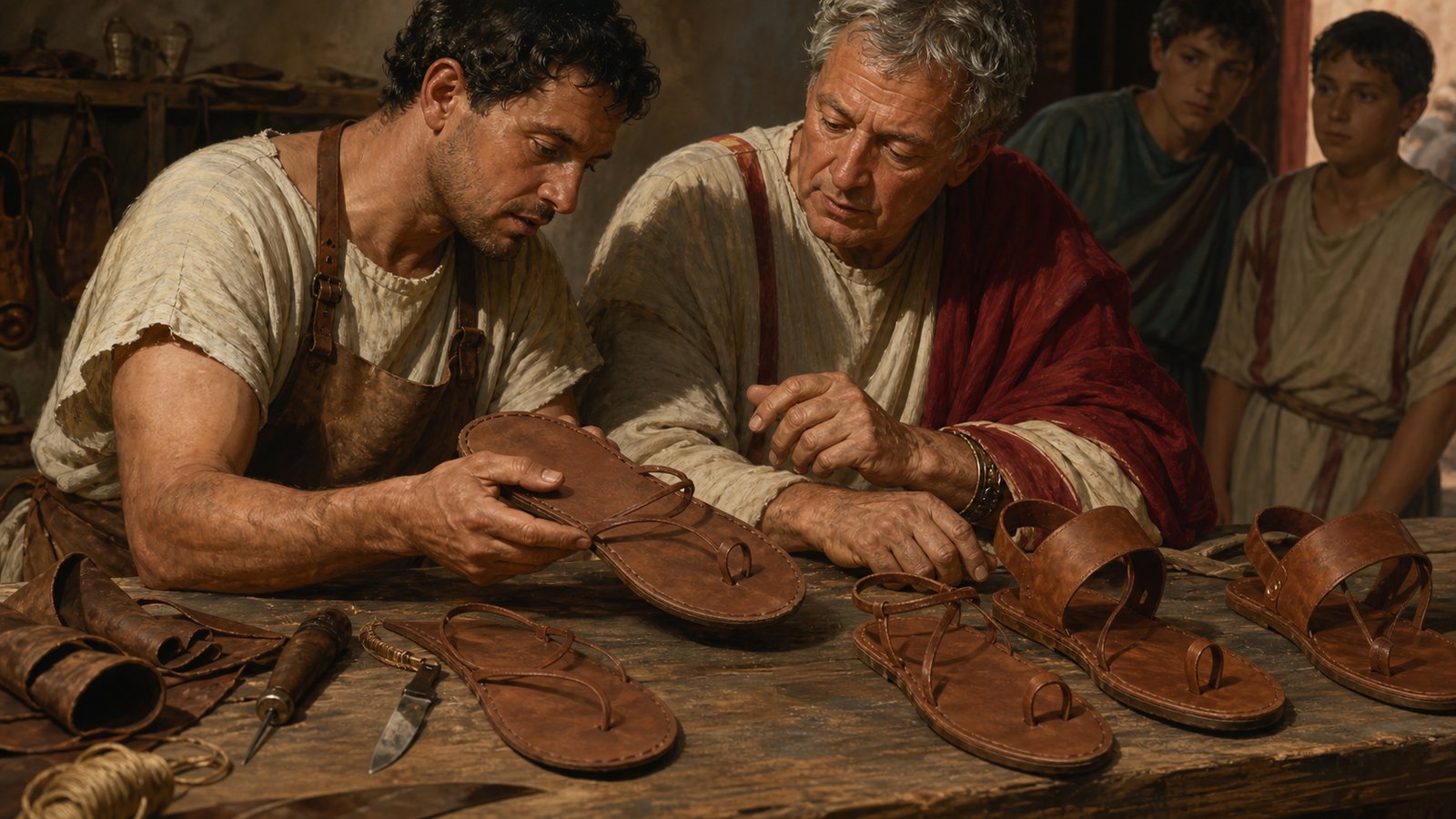
Castricius focused on sandals even after allowing the tunic and cloak some protection from custom. Open footwear carried a stronger sense of informality. It covered the sole while leaving much of the foot visible and was secured with narrow thongs.
The source does not say the slippers were dirty, damaged or expensive. The problem was categorical rather than material. A perfectly made pair could still communicate the wrong relationship between wearer, place and office.
Split-toe socks from Roman Egypt show how garments were adapted to open sandals. Gellius approaches footwear through social language instead. Construction explains why several names overlapped, while context explains why a teacher cared which kind senators displayed.
Feet are low in the visual field, but they affect the whole silhouette. A formal garment paired with casual slippers could unsettle the intended presentation. Here the senators wore an entire relaxed ensemble, making the footwear the clearest endpoint of their withdrawal from official appearance.
The rebuke depended on visibility. Had the students travelled in a closed carriage or remained inside a private home, Gellius’s remembered confrontation might not have occurred. Walking put every strap before the public and before a teacher trained to interpret presentation.
The argument moved from decorum to shoe anatomy
After Castricius spoke, some listeners challenged his word. Why had he called men wearing gallicae “sandal-wearers,” or soleati, when their footwear was not named soleae?
Gellius defends his teacher. In broad usage, he says, footwear that covered mainly the bottom of the foot and was attached by slender thongs could be called soleae. The physical structure justified the category even if another fashion name was also available.
He adds the Greek-derived crepidae and diminutive crepidulae. A maker of such shoes could be called a crepidarius sutor, and Gellius cites the historian Sempronius Asellio for that expression. A rebuke about senators opens into the occupational vocabulary of cobblers.
Gallicae, by contrast, seemed to Gellius relatively new. He could find it in Cicero’s attack on Antony but not in writers of much earlier authority. Fashion had imported or popularized a label, while older and broader terms remained available around it.
This philological tail is not a distraction. The listeners had tried to weaken Castricius by treating his terminology as inaccurate. Gellius answers that the teacher understood both the social category and the object. The sandals were unsuitable, and the word applied.
The episode thus contains two standards of precision. Senators should match dress to public role. Critics should match words to actual construction and usage. Both failures begin in carelessness: one toward civic appearance, the other toward language.
Senatorial dignity had no complete day off
Modern readers should resist turning this scene into a universal Roman dress code. It records one admired teacher’s response, filtered through Gellius’s memory and values. Romans disagreed over luxury, comfort, tradition and the proper display of rank.
Nor does the chapter tell us how the young senators answered. They may have accepted the criticism, resented it or changed nothing. Gellius preserves Castricius’s authority and the later vocabulary dispute, not the pupils’ voices.
Even with those limits, the encounter reveals how office could attach to the body. A senator did not represent the state only while speaking in the curia. Recognition followed him through streets, holidays and accidental meetings with former teachers.
The clothing was not politically dangerous in itself. Its force came from contrast. Men elevated into a public order appeared in an ensemble associated with ease, while someone who had trained their speech insisted that the city still read them as senators.
Castricius’s concession makes the lesson sharper. He did not deny custom; he decided that custom stopped short of fully excusing the shoes. Decorum was therefore not a rigid list of banned objects. It was judgement about wearer, place, occasion and the degree of public exposure.
Gellius remembered the scene because the teacher joined severity with exactness. First he made slippers carry the burden of rank. Then his student defended the vocabulary by looking closely at soles and thongs. A holiday outfit became evidence that Roman public life could reach all the way down to the foot.
Sources
Aulus Gellius, Attic Nights 13.22