
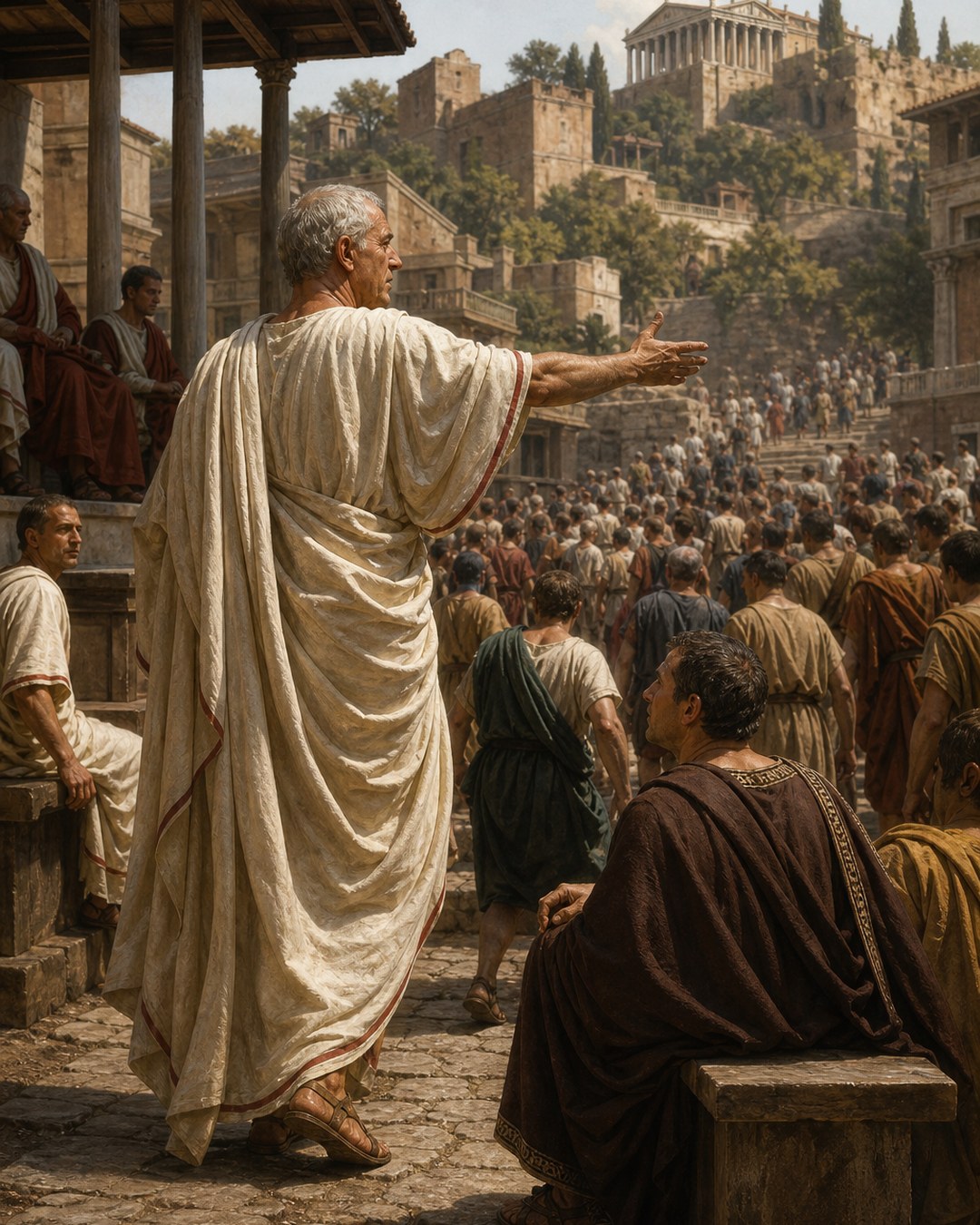
At dawn, the tribunes took their places on the Rostra. Scipio Africanus arrived through the Forum with friends, clients, and a crowd drawn from every social rank. He was not entering Rome in a triumphal chariot. He was appearing as a defendant, summoned to answer accusations involving money, influence, and his conduct around the war with Antiochus.
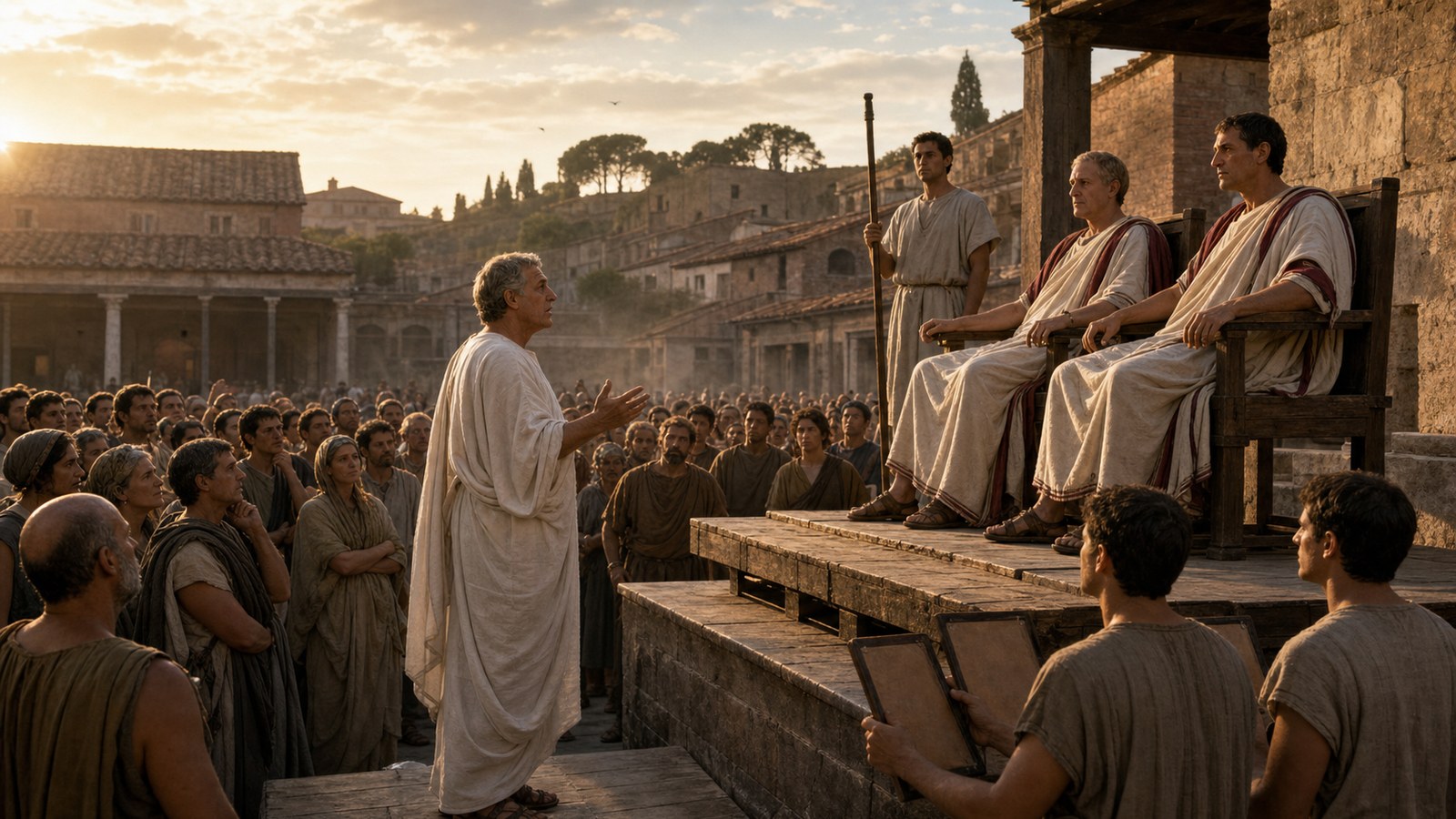
When silence came, Scipio changed the meaning of the date. This was the anniversary, he said, of the day he had defeated Hannibal and the Carthaginians in Africa. Instead of continuing a quarrel before the people, he would climb to the Capitoline and thank Jupiter, Juno, Minerva, and the other gods. Anyone free to do so could follow.
The meeting moved. Livy says even the clerks and messengers abandoned the tribunes, leaving them with their slaves and the herald who had called the accused. A legal assembly had not voted to acquit Scipio. It had simply walked away behind him. The scene was an audacious use of memory, ritual, topography, and personal authority—and it did not settle the prosecution as cleanly as the cheering suggested.
The Charge Asked Whether Fame Could Stand Above Law
Livy does not pretend that every Roman viewed the prosecution in the same way. One side saw an ungrateful republic turning against the commander who had broken Carthaginian power. The comparison with Hannibal was painful: defeated Carthage had driven its general into exile, while victorious Rome appeared ready to hound its own victor.
The opposing argument was constitutional rather than merely hostile. No citizen, however eminent, should become too great to answer under the laws. If public money and command could not be examined because the commander was famous, equal liberty had already yielded to personal supremacy. Livy gives that case real force before narrating how the crowd deserted the tribunal.
The specific allegations arrived through layers of hostile tradition. Livy says Valerius Antias named two prosecutors, each called Quintus Petillius. They revived older complaints about Scipio’s luxurious headquarters at Syracuse and the violence associated with Pleminius at Locri. They alleged that Antiochus had treated Scipio as though peace and war rested in his hands, and they pointed suspiciously to the return of Scipio’s captured son without ransom.
Aulus Gellius preserves a variant in which Marcus Naevius brought the accusation and charged Scipio with accepting money from Antiochus for easy peace terms. These differences warn against treating every detail as a courtroom transcript. Both authors, however, preserve the same central confrontation: political accusers demanded an account, and Scipio answered by invoking the public memory of victory.
A Calendar Date Became Scipio’s Strongest Witness
The chosen day carried evidence that no document could match in emotional force. Scipio told the citizens that on this date he had fought successfully against Hannibal and Carthage in Africa. Livy’s narrative places the trial in 187 BC, years after the battle, but the anniversary compressed that distance. The accused man before the Rostra became the victorious commander remembered at Zama.
Scipio did not merely mention the past as part of a defence speech. He argued that the date itself was unsuitable for trials and disputes. It belonged to thanksgiving. This shifted the question from whether his conduct deserved scrutiny to whether Rome would spend a day of victory listening to accusations against the victor.
He also recalled the unusual speed of his career. From his seventeenth year, he said, the Roman people had advanced him to honours before ordinary age might have allowed, while his deeds had anticipated those honours. The statement bound crowd and commander together. His elevation had not been private theft; Rome had repeatedly chosen him because emergencies demanded results.
That appeal drew on the same military reputation that later Roman readers attached to discipline in the field. Scipio’s daily construction of marching camps at Numantia belonged to a later generation of the family, yet it shows why the name could signify command performed in visible routines. At this trial, Africanus made one remembered result outweigh a morning of allegations.
The Route to the Capitol Removed the Court’s Audience
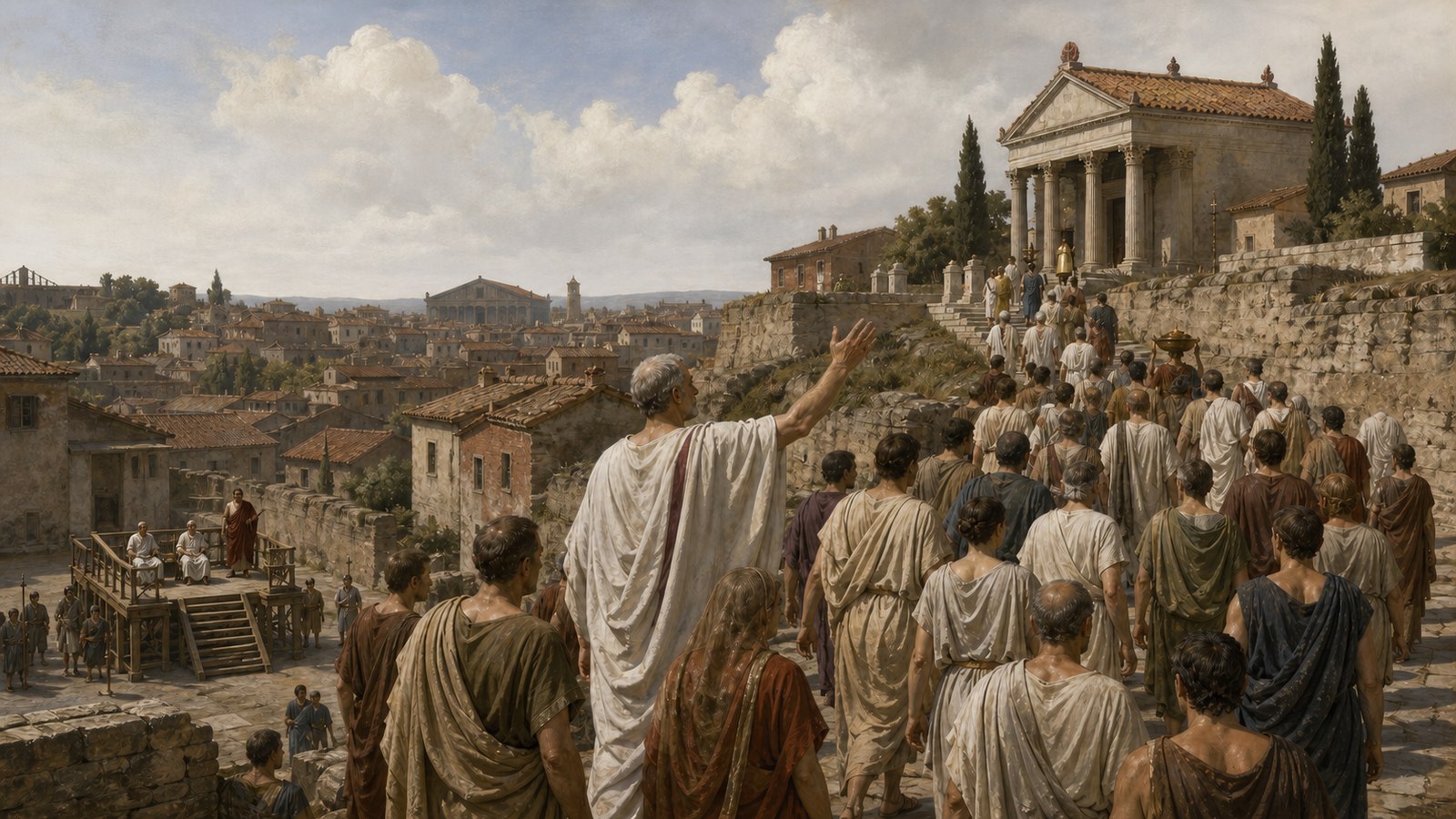
Words alone did not empty the Forum. Scipio turned and began to walk. The Capitoline stood close enough to transform the invitation into immediate movement, but high and sacred enough to change the destination’s meaning. The crowd was no longer gathered to judge a defendant below the Rostra. It was climbing with a commander toward Rome’s chief divine protectors.
Livy names Jupiter Optimus Maximus, Juno, and Minerva. He then expands the route beyond the Capitoline, saying Scipio visited temples throughout the city with the Roman people attending him. The procession therefore occupied public space for longer than a single ascent. Each stop repeated the claim that military victory belonged within a relationship among commander, citizens, and gods.
The physical withdrawal mattered to procedure. A public tribunal depended on heralds, clerks, magistrates, speakers, and an assembled citizen body. Rome had developed structures that made collective choice visible, including voting passages that organized citizens as they cast ballots. Here organization failed in the opposite direction: the people remained a coherent crowd, but they cohered around Scipio instead of the magistrates conducting the case.
Livy sharpens the humiliation with small details. The tribunes kept their slaves and the herald whose task was to summon the accused. The officials still possessed office, place, and formal voice. What they lacked was the audience that made those things effective. Scipio had not seized the Rostra or ordered the tribunes away. He made their stage irrelevant by creating a more compelling one a short walk uphill.
The Procession Won the Day, Not a Verdict
It is tempting to end with the climb, as Aulus Gellius nearly does. In his account, the people escort Scipio to the Capitol and then home with the joy appropriate to a festival. He even notes that a speech attributed to the day circulated, while critics who doubted the speech’s authenticity still accepted the core words about Hannibal and thanksgiving.
Livy continues, and the continuation changes the episode. The trial had been displaced rather than resolved. Scipio later obtained an adjournment and withdrew to his country property at Liternum, intending not to return to plead. When the next summons was proclaimed, his brother Lucius cited illness. The prosecutors described the earlier march as arrogance: Scipio, they said, had led the people away and then abandoned them in turn.
The intervention that protected him came from an enemy. Tiberius Sempronius Gracchus had a feud with Scipio, yet ruled that the illness plea should be accepted. He said he would not allow prosecution in Scipio’s absence and would protect him if the commander returned. Compelling the conqueror of Africa to endure insults from younger men, Gracchus argued, would shame Rome more than Scipio.
The Petillii eventually allowed the case to fall silent. Scipio remained at Liternum, and Livy presents the trial as the last bright public day of his glory. That ending keeps the story from becoming a simple celebration of charisma. His authority could empty a tribunal once. It could not make the underlying tension disappear: a republic needed commanders capable of extraordinary action, but it also needed a language for asking those commanders to account for themselves.
Memory Worked Because the Crowd Had Helped Make It
Scipio’s manoeuvre succeeded because Zama was not only his private achievement. The crowd could hear the date as part of its own survival and status. Victory had ended a war that placed enormous pressure on Roman communities, armies, finances, and households. Thanksgiving offered citizens a role more flattering than that of spectators to an accusation: they could appear as the grateful public whose earlier judgement of Scipio had been vindicated.
That is also why the episode could alarm defenders of equal law. Collective memory made a powerful witness, but no opposing advocate could cross-examine an anniversary. The route to the temples wrapped one man’s defence inside civic religion. Anyone who remained by the tribunes risked appearing ungrateful to the gods or indifferent to the victory over Hannibal, even if the demand for an accounting was legitimate.
Livy’s divided opening preserves both readings. Scipio’s accusers could look petty, ambitious, and reckless with Rome’s greatest living reputation. Scipio could look too proud to submit to the same procedures as another citizen. The procession did not prove the bribery allegations true or false. It proved that the memory of service could interrupt the machinery designed to test them.
The most revealing object in the scene may be the herald left behind. He still had the words that called a defendant to the Rostra. Scipio had a date, a hill, a set of temples, and a moving crowd. Formal summons met embodied memory, and for one morning memory won. The unresolved case and retirement to Liternum show the price: a performance could command Rome’s streets more easily than it could restore trust between exceptional fame and republican judgement.
Sources
Livy, History of Rome, Book 38, chapters 50–53.
Aulus Gellius, Attic Nights, Book 4, chapter 18.