
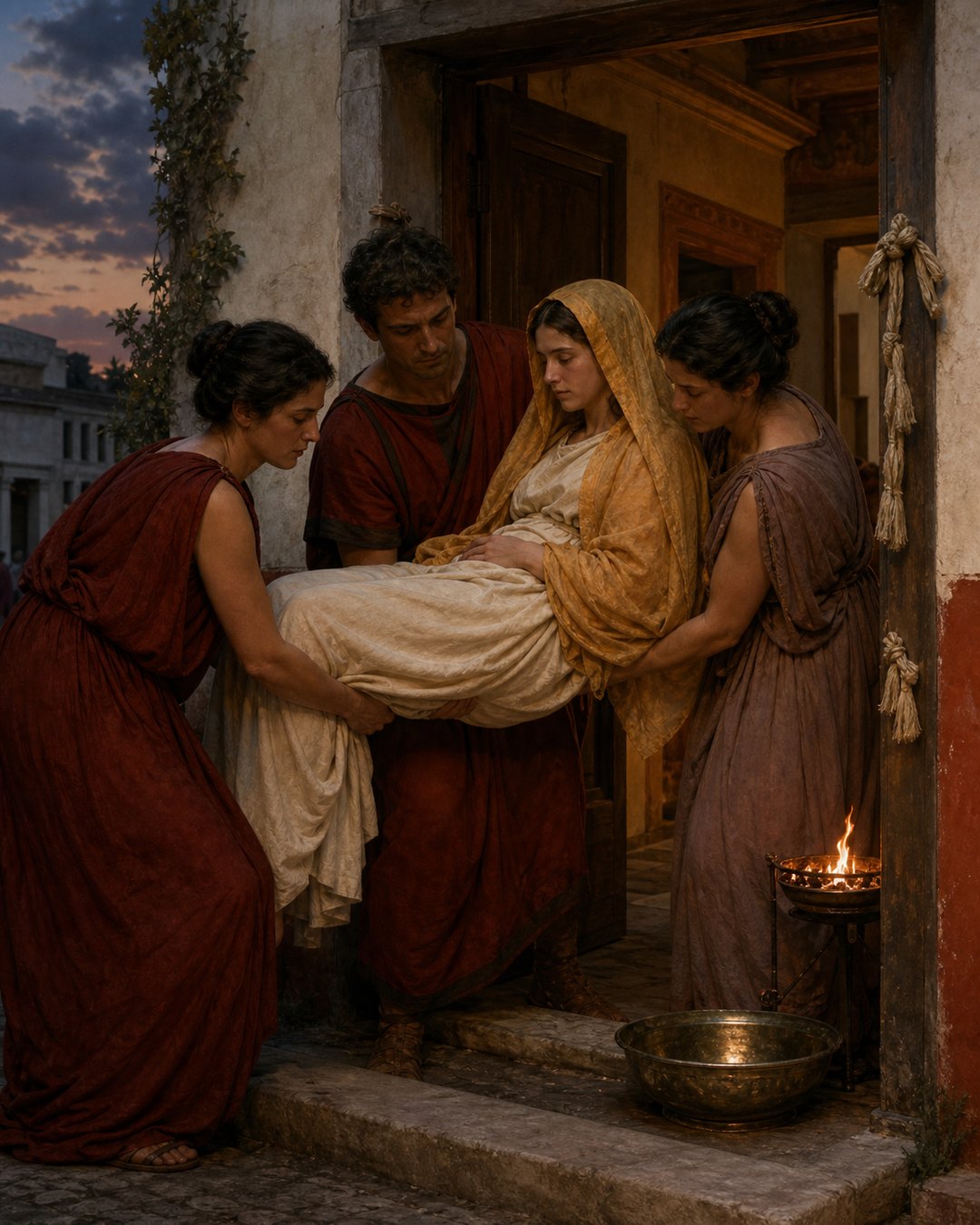
A Roman bride arrived at a door already crowded with meaning. Fire and water waited to be touched. Five torches had lit the procession. Escorts lifted her so that she did not cross the threshold under her own power. A formula joined the names Gaius and Gaia. Fleece lay beneath her; distaff and spindle travelled with her; wool marked the door.
Plutarch preserves these details because he was asking questions, not because he possessed a single official handbook. For each custom he offers several possible explanations. Fire might purify, represent a masculine principle, or stand for the little a couple must still share in hardship. The lifted crossing might recall violence, modesty, or permanent attachment to the new home.
The uncertainty is part of the evidence. Roman wedding actions outlasted agreement about where they came from. At the threshold, movement, words, light, liquid, fiber, and tools made the bride’s transfer between households visible to everyone present.
Fire and Water Reduced a Household to Its First Needs
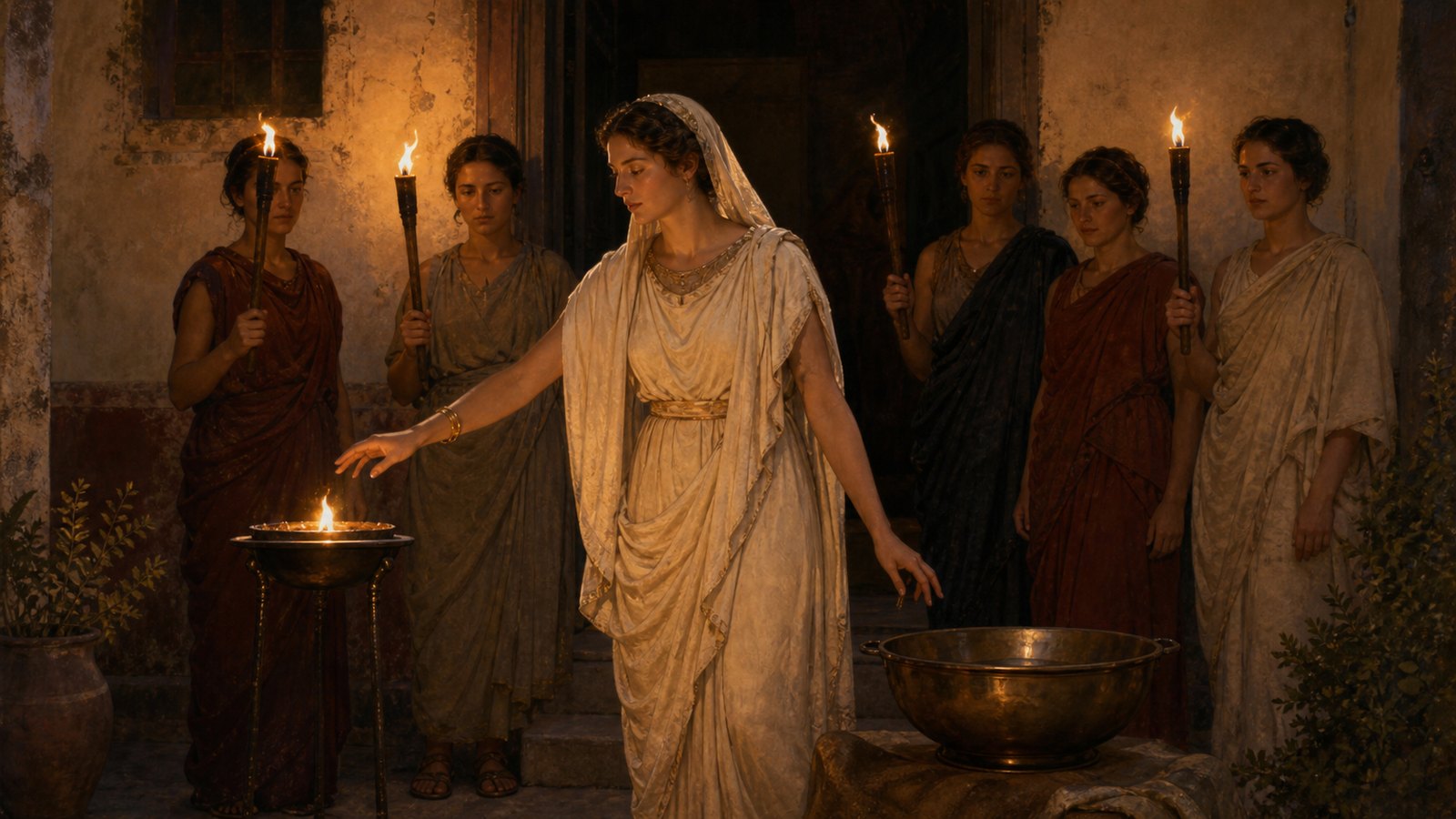
Plutarch begins his Roman Questions with the bride touching fire and water. He does not say exactly which vessel held the water, who presented either element, or how long the contact lasted. He does show that the pairing demanded explanation.
His first proposal treats the two as basic principles: fire masculine and initiating movement, water feminine and supplying material. Another answer is practical and moral. Fire purifies; water cleanses; a married woman should remain pure and clean.
A third explanation depends on interdependence. Fire without moisture is dry and unsustaining, while water without heat remains inactive. Joined, they can sustain productive life. Plutarch then offers the sharpest domestic image: spouses should share every fortune, even if they have nothing except fire and water to share.
None of these is presented as a verdict. They are layered readings of a surviving gesture. The elements can mean gender, cleansing, physical cooperation, or the minimum resources of a common life.
The five wedding torches carried similar interpretive surplus. Plutarch calls them cereones and asks why there were exactly five. Perhaps wedding parties took them from aediles, who had a right to more torches than praetors. Perhaps five united the first even and first odd numbers. Perhaps light symbolized birth, or five deities were thought necessary: Zeus Teleios, Hera Teleia, Aphrodite, Peitho, and Artemis.
A procession therefore did more than illuminate a street. Controlled light carried the couple toward a house where fire and water compressed married life into handled objects.
The Bride Reached the Threshold but Did Not Step Across It
At the doorway, escorts lifted the bride. Plutarch’s wording emphasizes that she was not allowed to cross the threshold herself. Modern retellings often turn this into a simple good-luck custom. His alternatives are more difficult.
One explanation looks back to Rome’s legendary seizure of the Sabine women: the first brides had been carried by force, so later brides repeated the movement. A second treats the carried entrance as a display of reluctance before entering a house where the bride would lose her virginity.
A third makes the direction of force matter. If she entered only under constraint, she should not later leave the household without comparable constraint. Plutarch compares a Boeotian practice in which the axle of the bridal carriage was burned at the door, destroying the vehicle of departure.
These explanations should not be blended into one confident origin story. Plutarch records possibilities, some tied to foundation legend and some to social expectations in his own interpretive world. Yet each makes the threshold more than a strip of stone.
The doorway divided old household from new. By stopping ordinary walking and replacing it with a carried passage, the ceremony slowed the decisive instant. The group escorting the bride controlled the movement, witnessed it, and transformed it into public memory.
A Roman doorway already organized legal and sacred boundaries: who belonged inside, which gods guarded an entrance, and what actions marked a legitimate arrival. The wedding used the smallest architectural division in the house to stage the largest change in the bride’s social location.
Gaius and Gaia Turned Arrival into a Household Formula
Movement was joined by speech. Plutarch says the bride was prompted to declare, “Where you are Gaius, there am I Gaia.” These were generic Roman names rather than necessarily the couple’s personal names, much as legal examples could use stand-in figures.
He interprets the formula as entry on fixed terms: where the man was lord and master, the woman would be lady and mistress, sharing everything and jointly controlling the household. That reading does not erase the unequal structures of Roman marriage. It does show that the entrance included a compact spoken as reciprocity rather than a silent transfer.
Plutarch also connects Gaia to Gaia Caecilia, described as the wife of one of Tarquin’s sons. A bronze statue preserved her memory, while her sandals and spindle were said to have been dedicated as signs of domestic virtue and industry.
The formula worked because Gaius and Gaia could be exemplary names. Every couple could inhabit them for the instant of entry. The words converted a particular doorway into a repeatable household claim.
Roman domestic status often depended on formal phrases delivered at the right moment. Here the sentence accompanied visible actions instead of replacing them. The bride had touched elements, travelled by torchlight, and been carried across stone; now she spoke a relation between two names.
The sequence gave witnesses several ways to remember what had happened. If a formula blurred, objects remained. If later writers disputed why the objects mattered, the spoken pair still summarized the intended conjunction of lives and household authority.
Fleece, Spindle and Door-Wool Made Work Part of the Entrance
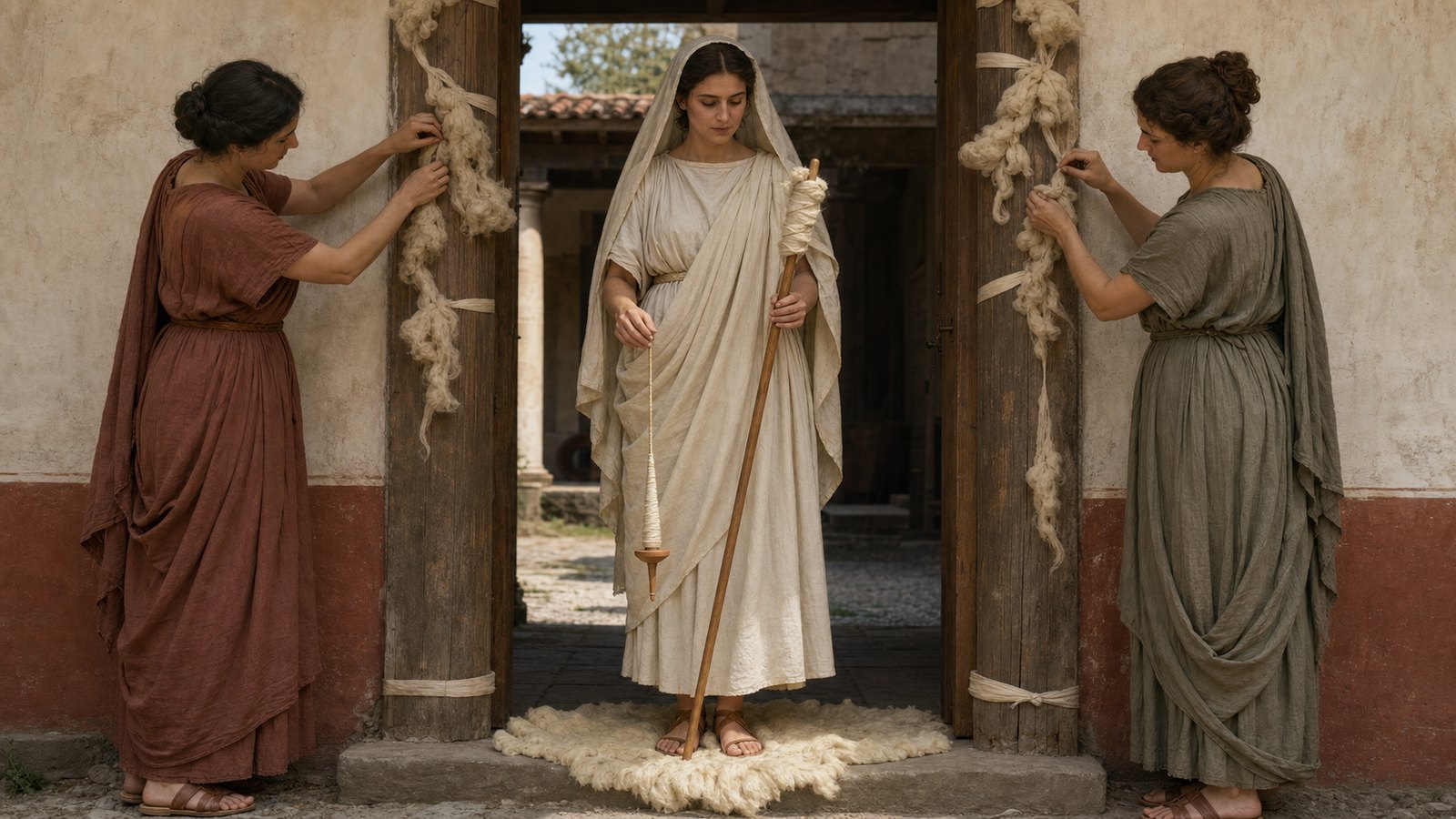
The entrance ended amid wool. Plutarch says a fleece was spread beneath the bride. She brought a distaff and spindle and wreathed her husband’s door with wool. The implements were not generic decorations: they belonged to the long sequence that turned prepared fiber into thread.
A spindle whorl kept thread twisting after the spinner’s fingers released it. Distaff, spindle, fleece, and door-wool therefore linked raw material, skilled motion, and finished household productivity in one visual cluster.
Plutarch uses spinning to explain the wedding cry “Talassio.” One derivation connects it with talasia, spinning, and with a word for wool-basket. Another invokes a legendary young man named Talasius. During the seizure of the Sabine women, retainers supposedly protected one captive by shouting that she was being brought as Talasius’s wife. Because his marriage was happy, the acclamation continued at later weddings.
Again, the alternatives compete. One makes the cry a language of work; the other makes it a remembered name from a violent foundation story. Plutarch does not allow us to select between them with certainty.
The physical wool is less elusive. It lay underfoot, travelled in tools, and circled the door. The threshold displayed an economic expectation in a form every guest could see. Household cloth did not begin in a market stall. It began with fiber preparation and repeated skilled labor.
The bride’s equipment also echoed the story of Gaia Caecilia’s spindle. Spoken household partnership and visible textile work reinforced one another. Domestic industry was not hidden after the procession; it was staged at the entrance.
That staging mattered because weddings carried economic and legal consequences as well as emotion. Roman dinner laws singled out wedding days when regulating expenditure, another sign that marriage drew public rules into household celebration.
The Door Preserved a Sequence Even When Explanations Drifted
Plutarch wrote centuries after Rome’s legendary beginnings, in Greek, for readers who could compare Roman customs with Greek ones. His questions reveal an antiquarian mind testing etymology, symbolism, history, ritual logic, and analogy.
That makes him a difficult source if we demand one origin for every custom. It makes him an excellent source for something else: the visible sequence Romans and observers still associated with bridal entry.
Fire and water offered elemental and practical meanings. Five torches organized the approach. The lifted crossing interrupted ordinary movement. Gaius and Gaia supplied reciprocal language. Fleece, distaff, spindle, and wool placed productive labor at the door. Talassio added a cry whose derivation was already disputed.
Together, these were not random superstitions piled onto a party. They marked stages of transition. The bride approached, touched, was carried, spoke, stood on prepared material, brought tools, and altered the doorway itself.
The ceremony also distributed participation. A bride touched and spoke; escorts lifted; a procession carried torches; household members presented objects; witnesses heard the cry. The new domestic relationship appeared as a group-managed event rather than a private decision invisible to the community.
We cannot recover one “true meaning” behind the whole arrangement, and Plutarch warns us not to pretend otherwise by giving several answers. The stronger conclusion rests in the choreography. Romans made a change of household legible through common materials and abnormal movement.
A front door could be crossed in one step. Wedding ritual refused that simplicity. It filled the boundary with flame, water, words, bodies, fleece, and tools until no witness could mistake the crossing for an ordinary arrival.
Sources
Plutarch, Roman Questions, 1–2 and 29–31.