
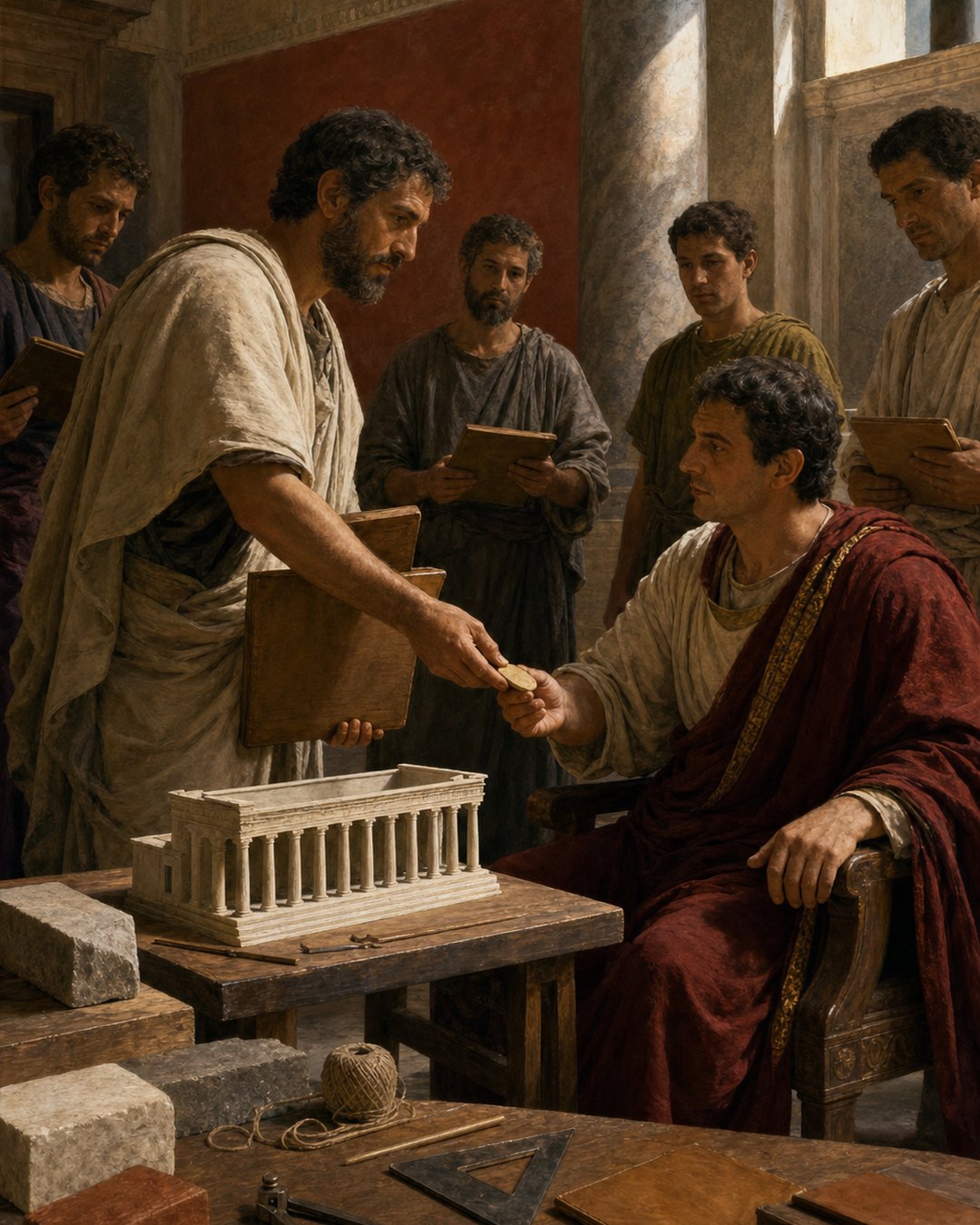
An architect in Ephesus did not merely announce what a public building ought to cost. In the ancient rule reported by Vitruvius, he handed his estimate to a magistrate and put his property behind it. The estate remained security until the work was finished. Only then could the forecast be judged against the completed bill.
The rule did not pretend that construction could contain no uncertainty. It allowed the treasury to cover an excess of up to one quarter without punishment. Beyond that boundary, however, the money needed for completion came from the architect’s property. Accuracy could earn decrees and honours; a larger failure could reach into the professional’s own estate.
Vitruvius placed this story at the opening of Book Ten, where he turned from buildings to machines. That position makes the Ephesian rule more than a curious penalty. It is his compact model of accountable planning: state the cost, lodge the estimate, secure the promise, measure the result and decide who carries the overrun.
The magistrate received more than a hopeful number
Vitruvius calls the law ancestral and describes it as severe but not unjust. Its first important act was administrative. When an architect accepted a public work, he had to promise its cost. The estimate then passed into a magistrate’s hands rather than remaining a private assurance between designer and patron.
That transfer gave the number an official life. A spoken prediction can be softened later by memory, revised expectations or arguments about what was originally included. A lodged estimate created a point against which the finished work could be compared. The magistrate represented the civic side of that comparison.
The architect’s property made the promise consequential. Vitruvius says it was pledged as security until completion. The mechanism did not punish a drawing, a speech or an unfinished stage in isolation. It held something of value while the public waited for the actual cost to become visible.
Public construction joined technical judgment to civic money. Materials had to be selected, labor organized and quantities anticipated before all conditions were known. The Ephesian arrangement did not remove those uncertainties. It forced the person claiming expertise to attach resources to the estimate produced from them.
One quarter separated tolerated uncertainty from liability
The law’s most striking feature is its band of tolerance. If final expenditure matched the statement, the architect received decrees and marks of honour. If the work required no more than one quarter above the estimate, the treasury supplied the addition and no penalty followed. Only an excess beyond that fourth activated personal liability.
This three-part structure matters. A rule demanding perfect prediction under every condition could make public work impossible or encourage estimates padded so heavily that accuracy lost meaning. Ephesus, at least as Vitruvius reports it, recognized a margin while still drawing a hard boundary around it.
The quarter was large enough for Vitruvius to express with a concrete example. A person able to spend four hundred thousand might, he says, continue when another hundred thousand was required because completion remained within reach. The arithmetic illustrates his idea of a painful but survivable addition, not a free license to spend without limit.
Beyond the threshold, responsibility changed. The treasury no longer carried the entire consequence of the forecast. The money required to finish came from the architect’s property. The same estate that secured the estimate at the beginning became the source of payment after the final comparison.
Honour and loss pulled calculation in opposite directions
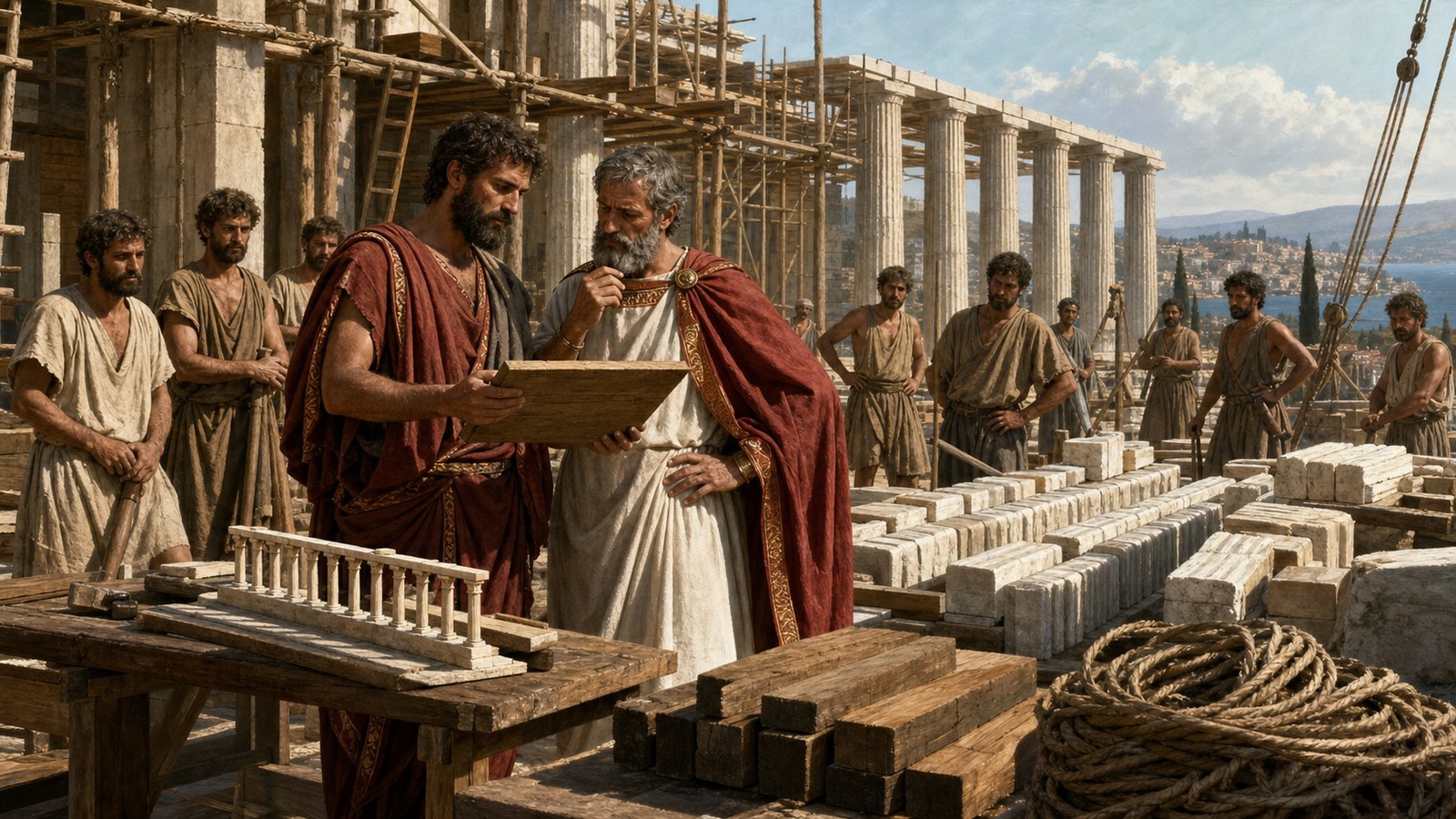
Vitruvius paired punishment with a reward. An architect whose final outlay agreed with the estimate was not merely left unharmed; civic decrees and honours acknowledged the result. The law therefore made cost control visible as a public accomplishment alongside the building itself.
At the other end, personal exposure was meant to discipline calculation. Vitruvius wished Rome had such a rule for private as well as public construction. He believed unskilled practitioners would no longer act with impunity and that architects trained in the complexities of their art would enter the profession.
His argument reflects professional advocacy. Vitruvius wanted architecture understood as exact knowledge, not casual confidence. Fear of the penalty, he claimed, would make architects more careful when calculating and declaring a limit. Patrons would then obtain buildings for the expected sum or only a little more.
The claim should not be mistaken for evidence that every Ephesian project ran neatly within budget. Vitruvius offers the rule as a reported model and then uses it to criticize Roman practice. What the passage securely reveals is the logic he admired: professional honour for accuracy, limited public tolerance for uncertainty and private exposure when a forecast failed badly.
Vitruvius pictured the owner trapped by an unfinished work
The architect’s liability answered a specific danger for Vitruvius. When costs rose by half or more, an owner could lose hope, sacrifice what had already been spent and abandon completion. The injury was not only the extra sum. Money already embedded in walls and foundations could become difficult to recover if the project stopped.
His language joins fortune and spirit. A large increase could break both. The owner had begun with an amount that seemed affordable and with the pleasure of expecting a finished building. Escalation replaced that expectation with a choice between pouring in still more resources and leaving the earlier investment stranded.
The Lost Eagles archive preserves a later provincial example of that danger in Nicaea’s cracked and sinking theatre, where Pliny asked Trajan what to do after immense expenditure. Another pair of works, Nicomedia’s abandoned aqueducts, shows how unfinished infrastructure could consume public money without delivering water.
Those cases do not prove that the Ephesian rule would have solved every failure. Ground conditions, changing designs, fraud and weak supervision are different problems. They do show why Vitruvius’s opening had force. A forecast mattered because an unfinished public object could lock civic resources into stone, timber and trenches that produced no intended benefit.
Festival machinery made deadlines part of the same problem
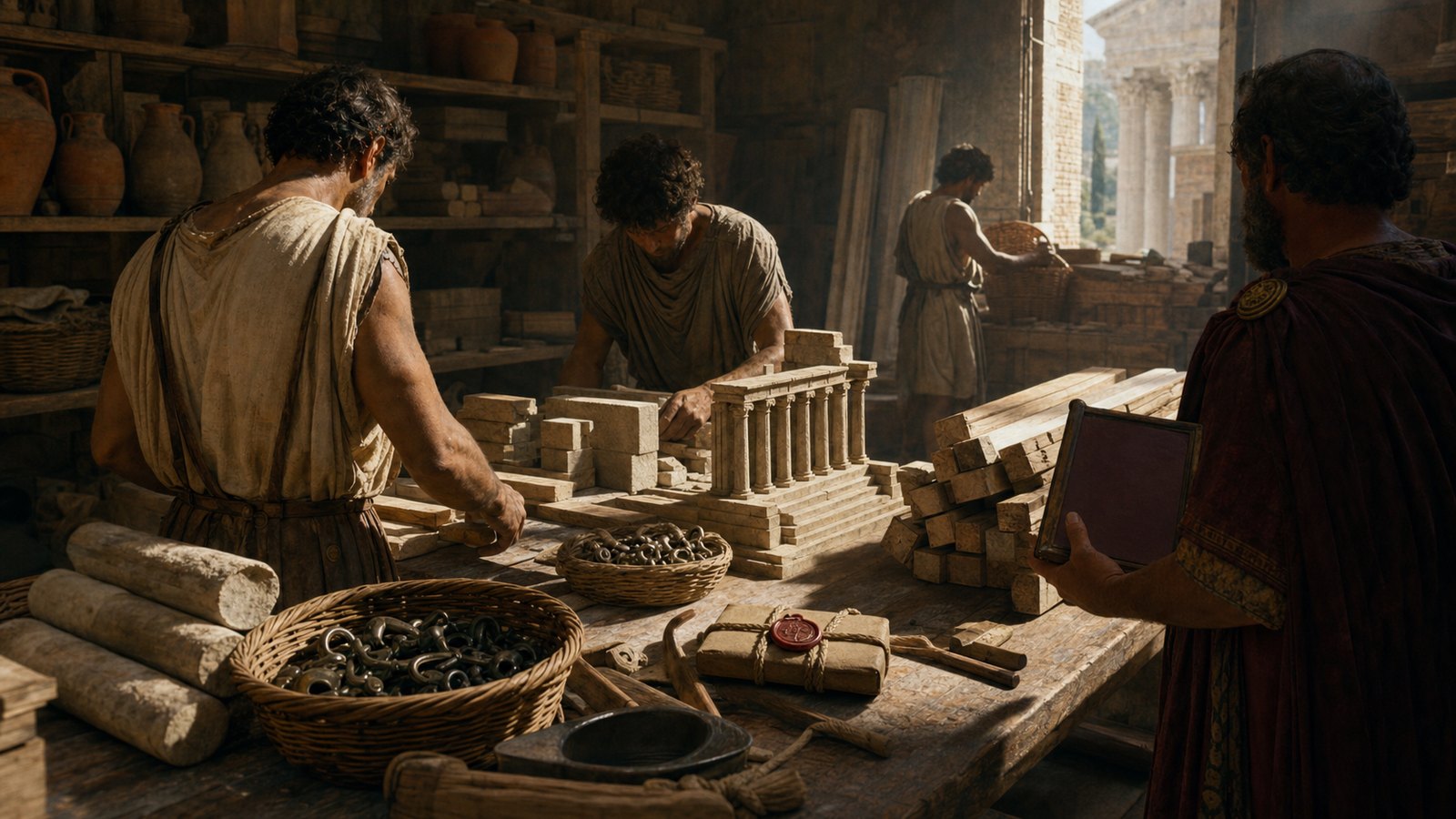
Vitruvius then widened the argument beyond permanent buildings. Magistrates also gave gladiatorial shows in the forum and theatrical performances. In those settings, delay or postponement was not acceptable. Audience seats, awnings and scene-changing mechanisms had to be ready on a fixed day so that the people were not disappointed.
The deadline changed the risk. A building might limp onward while money was found, but festival apparatus missed its purpose if completed after the crowd and occasion had passed. Planning had to coordinate temporary structures and machines under a calendar that the public could see.
The awning alone connected materials, rigging, labor and timing. The Colosseum’s velarium demonstrates how shade itself could become a large organized performance. Vitruvius’s concern is broader than any one arena: machinery for spectators and stage effects required forethought because custom demanded readiness, not eventual completion.
Praetors and aediles had to provide such machinery every year. Vitruvius used that recurring obligation to justify the final book of his treatise. Since neither Roman law nor custom compelled the kind of estimate discipline he admired, instruction would have to carry some of the burden. He would explain the principles of machines before officials needed them.
The Ephesian rule thus becomes a hinge between architecture and mechanics. A public work had a price boundary; a public show had a time boundary. Both required calculation before materials were committed. Both could expose the city to waste when confidence outran preparation.
Vitruvius did not give Rome the law he wanted. He gave readers a memorable test instead. Put the estimate in official hands, let a defined allowance absorb ordinary uncertainty, and ask who pays when the promised limit is crossed. In Ephesus, his answer was secured before the first overrun: the architect’s own property was already waiting behind the number.
Sources
Vitruvius, On Architecture, Book 10, preface.