
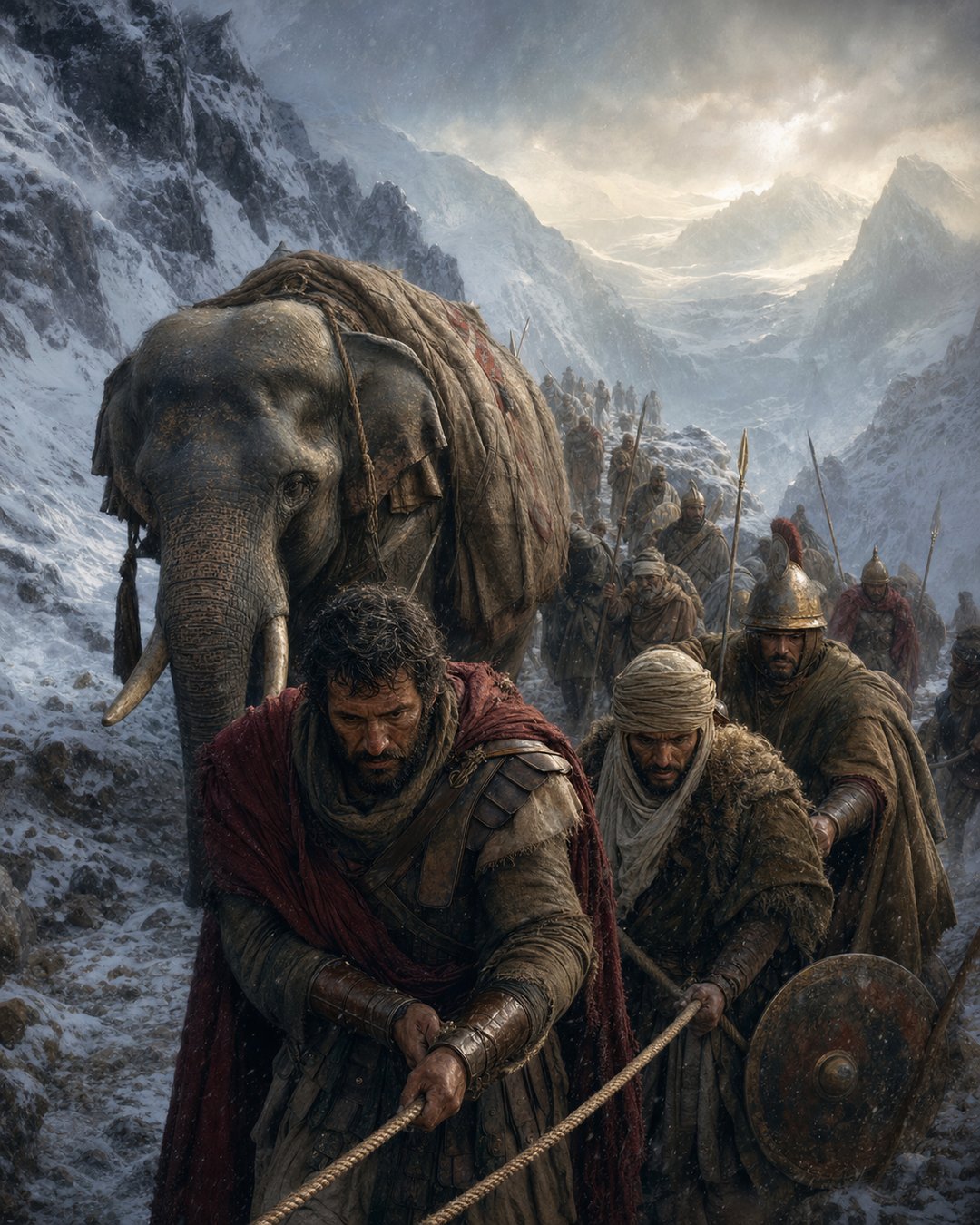
The elephant is the part everyone remembers. It is huge, strange, and easy to imagine against snow. But the real miracle of Hannibal’s Alpine crossing was not that elephants appeared in the mountains. It was that a general brought any army through that ordeal and still reached Italy with enough force, discipline, and confidence to frighten Rome.
In 218 BC, during the opening year of the Second Punic War, Hannibal crossed the Alps into Italy. Ancient writers knew the scene was astonishing. Polybius and Livy both describe a march pressed by cold, cliffs, local attacks, ruined tracks, and panic among men and animals. The elephants made the story memorable, but the deeper Roman problem was logistical. Hannibal had moved war across a barrier Romans did not expect to become a road.
The Alps turned command into survival
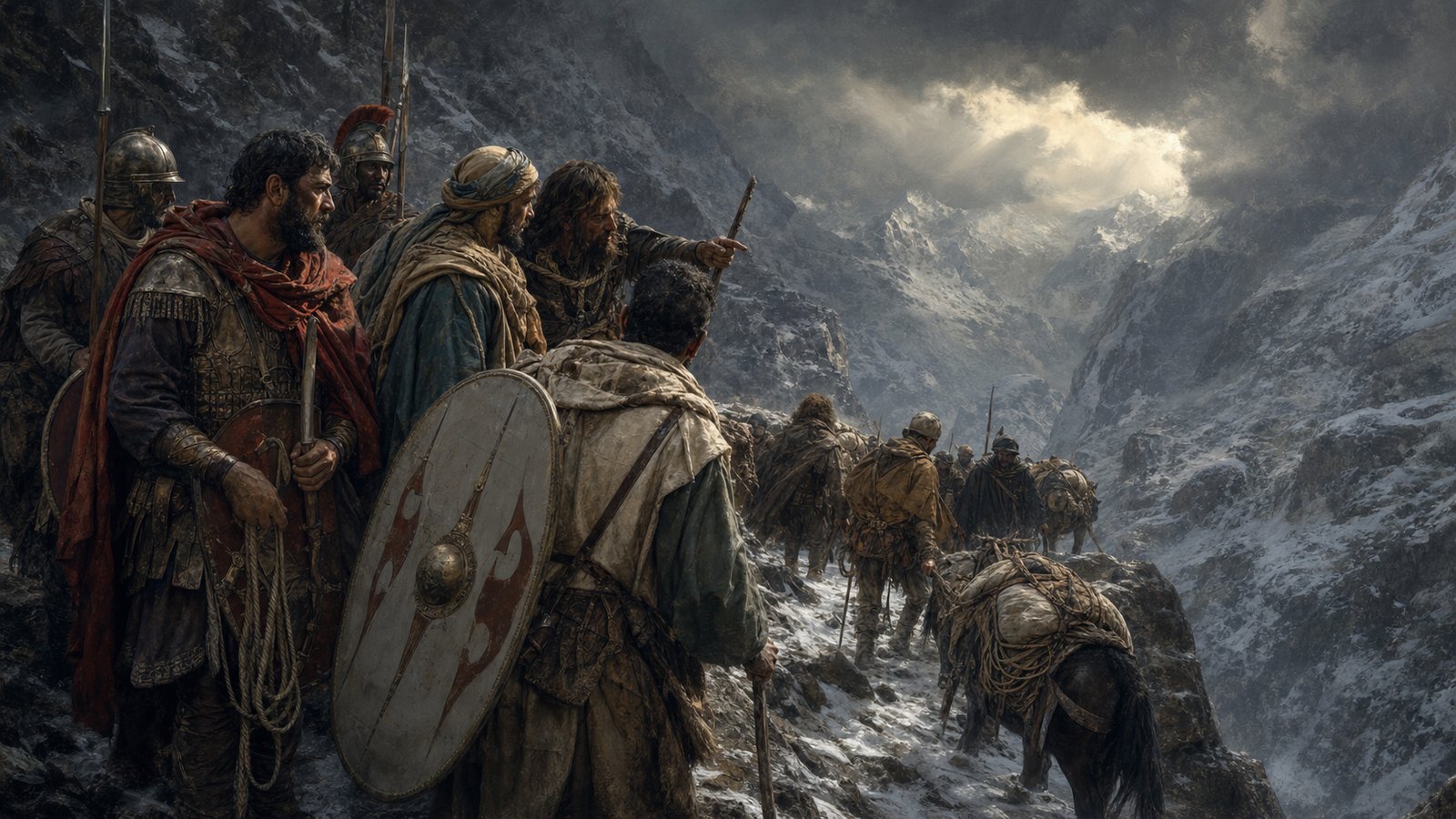
A battle has a visible enemy. The Alps gave Hannibal several enemies at once. There was weather, hunger, height, fear, narrow footing, baggage, cavalry, and the uncertainty of guides and local peoples. A commander could not simply order courage and be done. Every mile threatened to break the army into pieces.
Polybius makes the danger physical. Men faced places where the track failed, where animals stumbled, and where panic could spread faster than orders. Livy’s account, written later and shaped by Roman memory, makes the crossing almost theatrical with cliffs, snow, and exhausted bodies. Even if some details sharpen the drama, the basic military truth is solid: an army is not only soldiers. It is food, animals, equipment, trust, and rhythm.
The elephants were symbols, not the whole weapon
War elephants mattered. They looked terrifying to men unused to them, and they announced that Carthage could bring an exotic kind of battlefield power into Roman calculations. But elephants were not a magic key. They had to be fed, guided, protected, and kept from causing chaos among friendly troops. In mountains, they were as much a burden as a threat.
The stronger point is that the elephants magnified the army’s audacity. If Hannibal could drag even these animals across hostile heights, what else might he dare? The Roman imagination had to absorb not only a tactical problem, but a psychological one. A commander from Carthage had appeared in Italy by doing something that sounded barely possible.
Arriving in Italy was the strategic shock
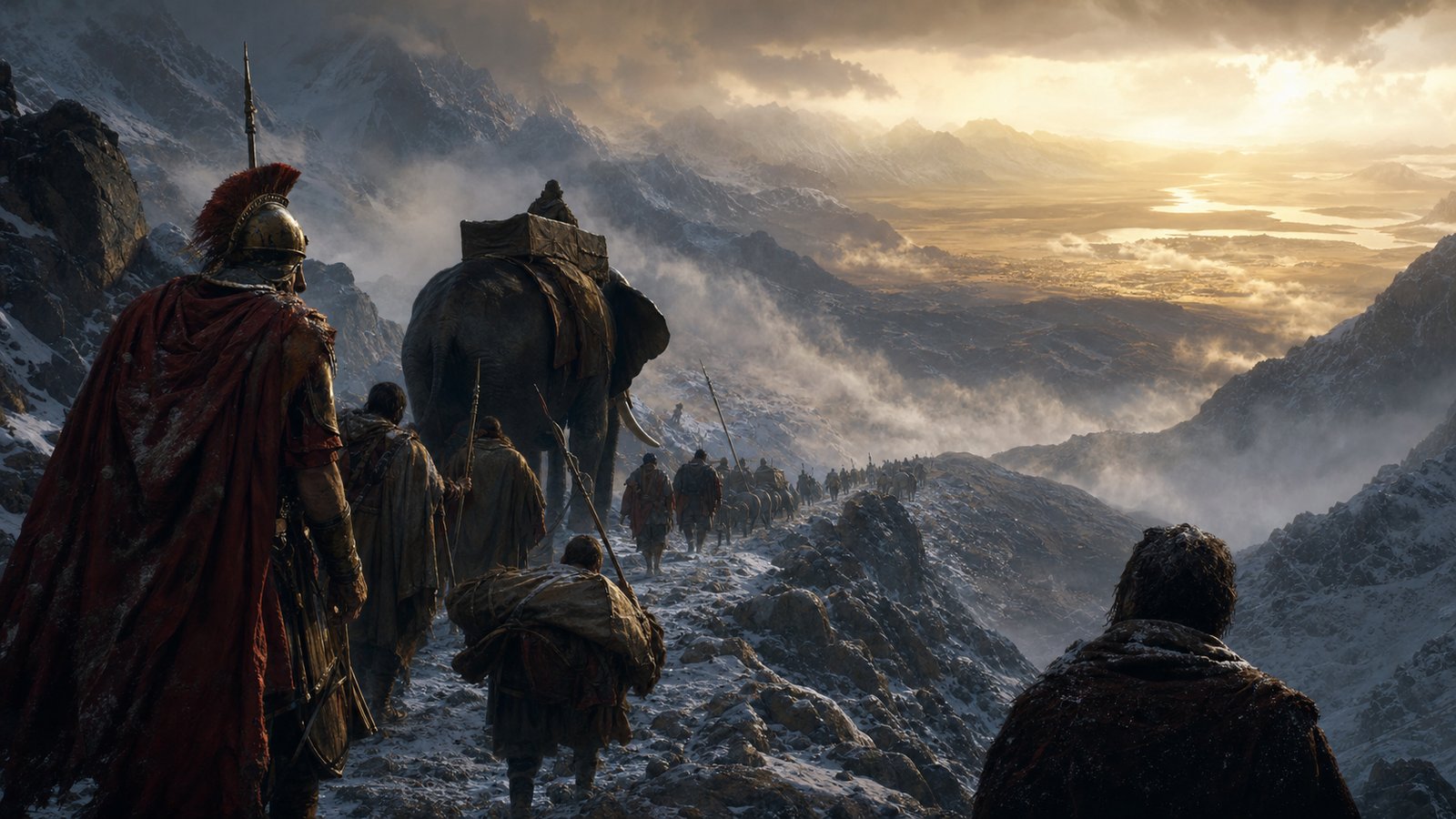
The crossing mattered because of where it ended. Hannibal did not merely perform a stunt in the snow. He descended into Italy and soon won at the Trebia in 218 BC and Lake Trasimene in 217 BC. Those victories proved that the Alpine ordeal had not consumed the threat. Rome was facing a general who had survived the mountains and could still make Roman armies pay.
That sequence explains why the legend endured. A failed crossing would have become a cautionary tale. Hannibal’s crossing became a nightmare because it worked enough. The army had suffered, but it was not broken. It had lost men and animals, but it retained a commander, a core of veterans, and a campaign plan.
Polybius shows a commander fighting fear
One of the most concrete details in Polybius is not an elephant but a speech. He presents Hannibal addressing frightened troops and trying to convert terror into purpose. That scene may be literary, but it captures a command problem every army understands. Men can endure hardship only if they believe the hardship leads somewhere.
Hannibal’s achievement was therefore moral as well as physical. He had to keep different peoples moving together: Carthaginians, Iberians, Gauls, Numidians, cavalrymen, infantry, handlers, servants, and guides. The mountain did not care about the politics of Carthage or Rome. It punished every weak link in the column.
The Roman fear was that distance had failed
Rome expected enemies. It did not expect every enemy to arrive by every route. Hannibal’s march made distance unreliable. Spain, Gaul, the Alps, and Italy suddenly belonged to one chain of danger. A war that might have seemed containable became immediate. Families, farms, allies, and Roman prestige in Italy were now inside the theater of war.
This is why the elephants should not be dismissed, but they should be put back in scale. They were the image that carried the story. The miracle was the system behind the image: planning, intimidation, persuasion, endurance, and luck. Hannibal made the impossible look just possible enough to change Roman history.
The legend is true in the way Romans feared it
Modern readers sometimes ask how many elephants survived, as if that number alone decides the meaning. The better question is why the story survived at all. Romans remembered Hannibal because he made their geography feel unsafe. He showed that Rome’s enemies could be bolder than Roman assumptions.
The elephant in the snow remains unforgettable. But the animal is only the emblem. The deeper story is an army forced through a mountain world of cold, rock, hunger, and alarm, then pointed toward Italy. Hannibal’s real miracle was not bringing elephants to the Alps. It was bringing fear down from them.
Rome had to fight the fact of his arrival
The most damaging part of Hannibal’s crossing was not a single tactical surprise. It was the proof that Rome’s strategic imagination had failed. An enemy commander had connected Spain, Gaul, the Alps, and Italy into one campaign space. That achievement changed the emotional weather of the war before the largest battles were even fought.
The march also gave Hannibal a story to tell allies and enemies alike. Soldiers who had survived the mountains could believe they had already passed through something worse than ordinary fear. Italian communities watching him descend could wonder whether Roman protection was less certain than Rome claimed. The crossing therefore produced a kind of political momentum. It made Hannibal look favored by daring, endurance, and perhaps the gods.
This does not mean the elephants were irrelevant. They helped make the memory visible. But the animal image should lead us back to the human system behind it: guides choosing paths, officers restraining panic, handlers managing beasts, hungry men dragging equipment, and a commander persuading a battered army that Italy lay just beyond the next cruel slope.
The important caution is that a famous Roman story should never be reduced to a single prop. Elephants, concrete, a rebel queen, or four emperors can become convenient shorthand, but shorthand is where the history starts rather than ends. The fact sheet forces the stronger reading: named people, dates, places, materials, and ancient testimony all have to carry the interpretation. That keeps the article from turning into a modern slogan placed on an ancient scene.
Seen that way, the episode becomes less familiar and more useful. It shows Roman power as something made from logistics, labor, fear, law, memory, and administration. Those forces were concrete enough to leave ruins and stories behind, but unstable enough to keep surprising the people who thought they controlled them.
Sources & Further Reading
- Britannica, Hannibal
- Polybius, Histories, 3.50-56
- Livy, History of Rome, 21.32-38
- Britannica, Second Punic War
- Polybius, Histories, 3.54
- Livy, History of Rome, 21.36
- Britannica, Battle of Zama