
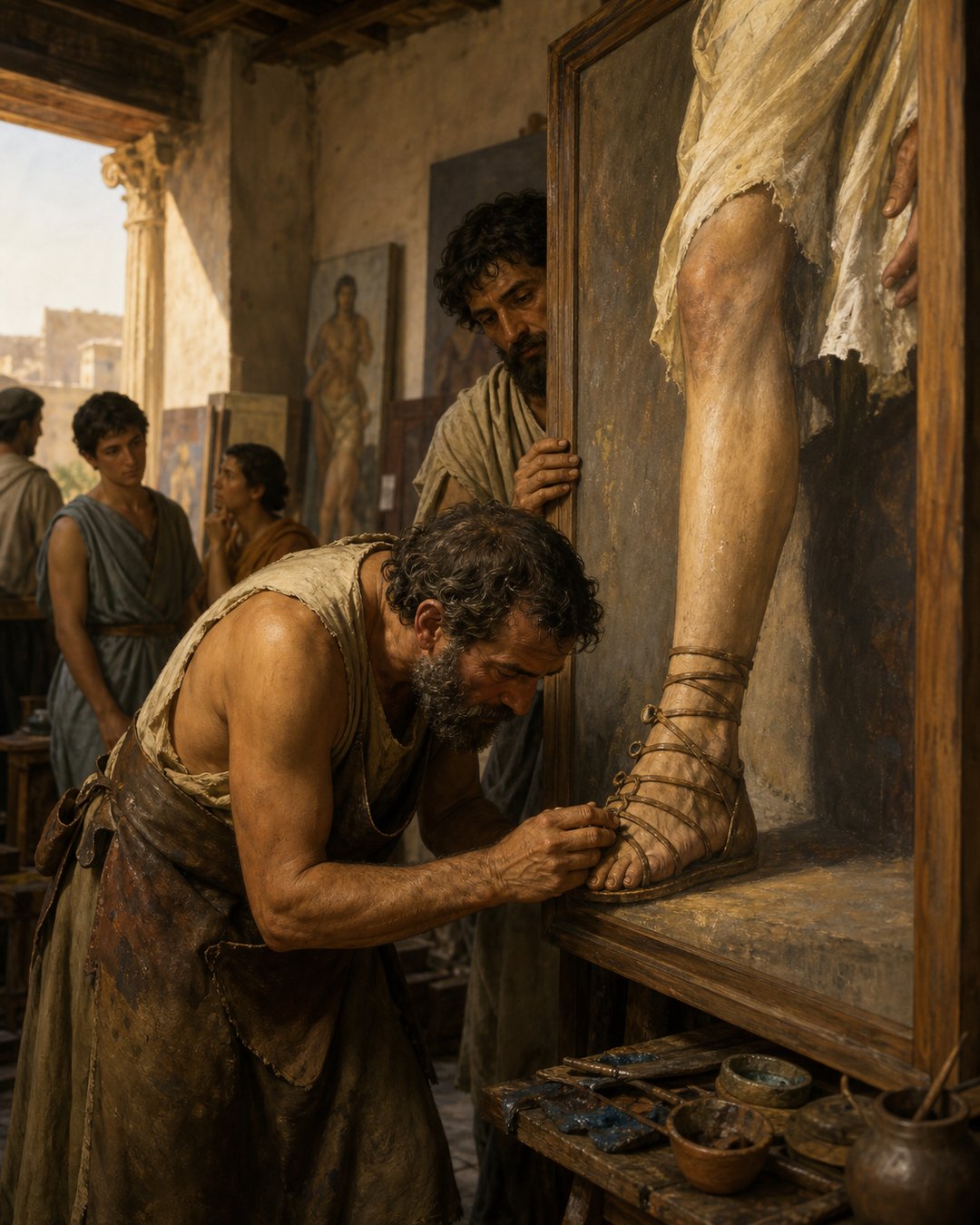
Apelles did not stand beside his finished picture waiting for praise. He placed it in a gallery where ordinary passersby could inspect it, then moved out of sight behind the panel. From there, the most celebrated painter associated with Alexander the Great listened for faults.
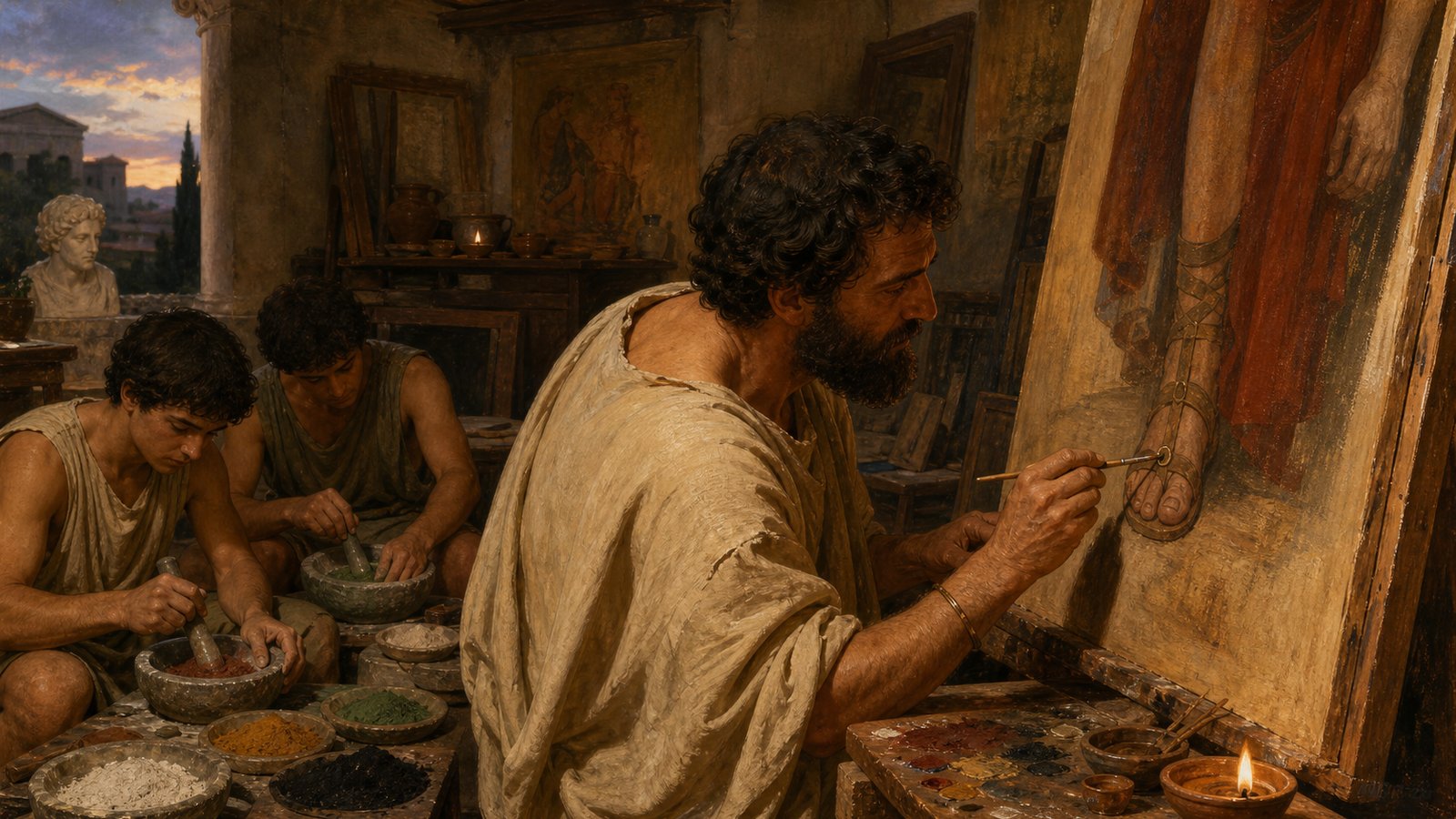
One observer had exact knowledge. A shoemaker counted the painted sandal’s fastening loops and noticed that Apelles had drawn one too few. The painter did not emerge to defend the composition or explain why the detail was unimportant. By the next day, the missing loop had been added.
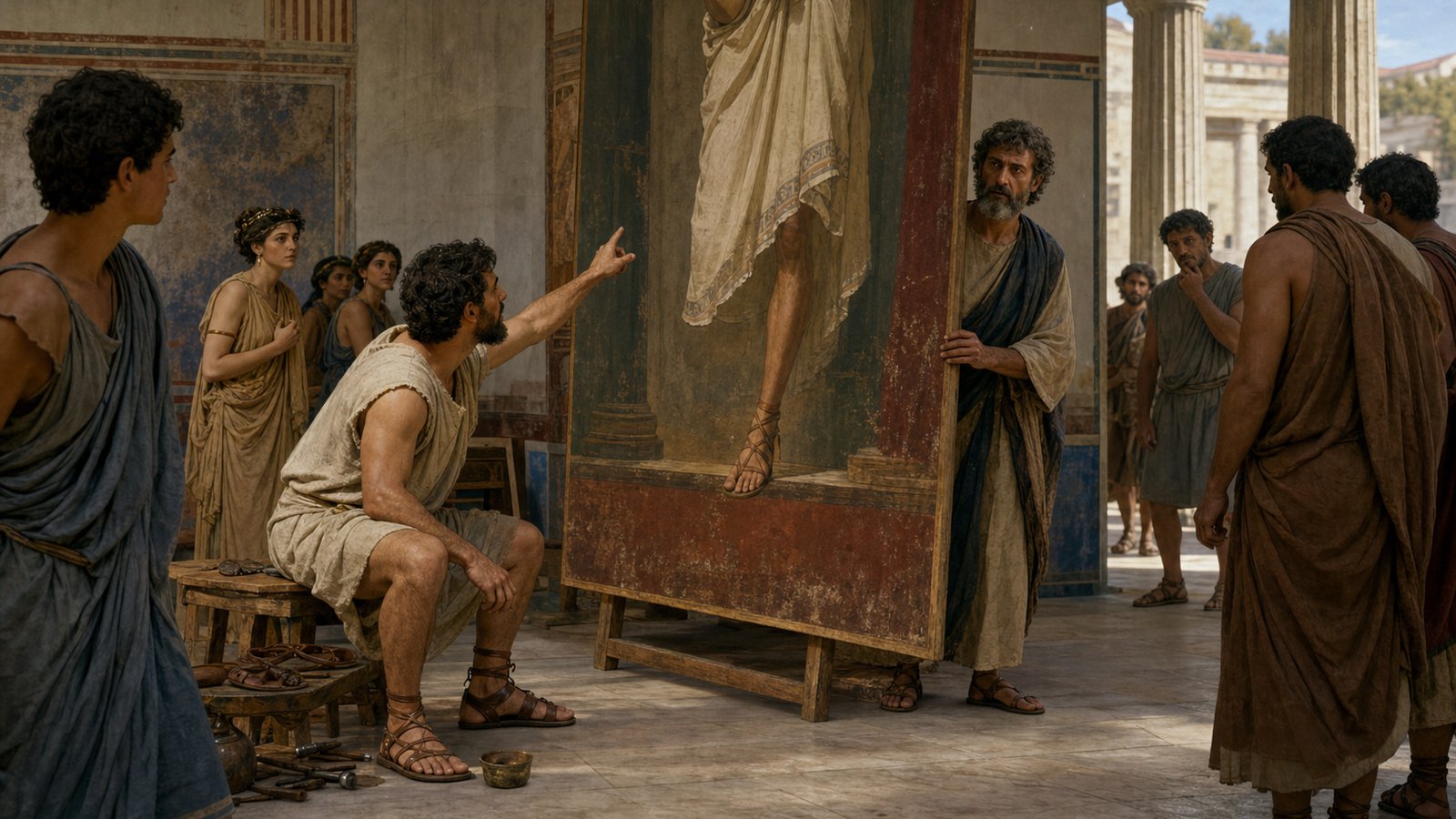
The shoemaker returned, saw that his criticism had changed the work and aimed higher. Now he found fault with the painted leg. At that point Apelles looked out from hiding and stopped him: the shoemaker should not judge beyond the sandal.
The rebuke became the famous part. Pliny the Elder says it passed into a proverb. Yet the line works only because the painter had listened first. Before Apelles marked the limit of another man’s expertise, he let that expertise correct his own hand.
The Finished Panel Entered a Second Workshop
Pliny presents the gallery display as a habit, not an accident. When Apelles considered a work finished, he put it where passersby could see it and concealed himself behind it. The public viewing became an extension of the studio: a place where the panel could still collect observations before its maker fully released it.
Hiding changed the quality of those observations. A viewer speaking directly to a famous painter might flatter, perform sophistication or remain silent. A viewer who believed the artist absent could attend to the object. Apelles sacrificed the immediate pleasure of being recognized in order to hear less guarded criticism.
Pliny goes further and says that Apelles rated the public a more observant critic than himself. That does not mean every passerby understood painting better than he did. It means a finished work could contain local errors that a maker, too close to his own process, no longer saw. Many eyes supplied kinds of attention the studio could not manufacture alone.
This is a different competitive mechanism from the encounter in which Apelles and Protogenes answered one another with increasingly fine painted lines. There, mastery is recognized by another master through execution. In the gallery, knowledge can arrive from a trade outside painting.
One Loop Carried the Weight of Real Expertise
The shoemaker’s first objection was narrow enough to test. The painting showed a sandal with one fastening loop too few. A person who made and repaired footwear could know how straps and loops met the foot, how tension was distributed and what details an artist might simplify incorrectly.
Pliny does not tell us the subject of the whole picture, the pose or the size of the panel. He keeps the focus on one construction detail. The omission could be counted. It concerned an object the critic handled professionally. Apelles’s revision by the following day confirms that he judged the objection valid.
The overnight change also shows why the picture remained in a working state despite public display. Apelles had not used the gallery merely as an exhibition hall. He preserved the ability to intervene. Listening without revision would have been theatre; revision made the concealed audit real.
Ancient sandals varied, and Pliny gives no diagram from which a modern reconstruction can recover the exact pattern. The important claim is limited: in this represented sandal, the shoemaker recognized one missing loop. We do not need to invent its shape to understand why his occupational eye found what the painter had overlooked.
Success Pushed the Critic Past His Evidence
When the shoemaker returned, he saw proof that Apelles had listened. Pride followed. The first judgment had been right, the artist had acted on it, and the critic now extended his confidence upward from the sandal to the leg.
That movement is the anecdote’s hinge. Nothing in shoemaking automatically made the man ignorant of anatomy, but the authority established in Pliny’s story came from footwear. He had supplied a specific, verifiable correction inside his craft. Criticism of the leg demanded a new basis that the story does not give him.
Apelles’s response therefore sets a boundary after evidence, not before it. He does not say that only painters may speak about paintings. If that were his rule, the sandal loop would have remained wrong. He says that the shoemaker must not travel beyond the sandal on the strength of being right about the sandal.
The order matters for any reading of the proverb. First comes exposure, then observation, then revision, then overreach, and only then rebuke. Removing the correction turns Apelles into a defensive celebrity. Keeping it reveals a craftsman sorting useful knowledge from confidence that had expanded too quickly.
Even Alexander Was Judged Inside the Studio
Pliny follows the shoemaker scene with another boundary of expertise. Alexander the Great often visited Apelles’s studio and had reserved his own painted portrait to this artist. Yet royal access did not make the king a painter.
Alexander talked at length about the art without understanding it. Apelles advised him politely to leave the subject alone because the boys grinding colours were laughing. The detail pulls rank downward through the workshop. Assistants doing the physical preparation could recognize empty talk even when it came from a king.
Pliny emphasizes the painter’s authority because Alexander had an irascible temper. Apelles could correct him without losing the ruler’s favor. Courtesy did not erase the line between patronage and practice. A king could command portraits and visit the studio; that did not give him automatic command of pigment, design or execution.
The scene also clarifies why the unnamed shoemaker was heard. Workshop hierarchy was not simply social hierarchy. Knowledge could sit with the person grinding colour, cutting leather or studying a panel from the street. Apelles’s task was to know when that situated experience reached the picture and when it did not.
Pliny introduces these habits by saying Apelles never let business occupy a day so completely that he failed to practise by drawing a line. That routine also became proverbial. Daily execution and public listening belong together: one kept the hand responsive, while the other prevented reputation from closing the eye.
A painter who revised for every passing remark would have no method. A painter who rejected every outside remark would protect errors. Apelles’s routine offers a middle structure. Practise constantly, display the work, listen without being seen, test whether the observer possesses relevant knowledge, and change what the evidence exposes.
That process differs from the trick that used a false fire alarm to reveal which sculptures Praxiteles valued most. Both stories obtain honest information by controlling what the observed person knows. But Apelles is not manipulating a rival’s attachment. He is removing his own fame from the conversation so the work can be judged more freely.
Pliny later credits Apelles with a final thin black varnish that protected pictures from dust and moderated brilliant colour. Whether discussing a nearly invisible surface treatment or one missing leather loop, the account repeatedly locates mastery in small decisions. Monumental reputation rests on details that can be overlooked at arm’s length.
The Proverb Preserved Both Correction and Refusal
The shoemaker’s mistake was not speaking. His first comment improved the painting. His mistake was treating one successful correction as a license without limit. Apelles’s mistake would have been the opposite: using fame to dismiss a material detail simply because its observer worked in another trade.
Pliny preserves both dangers in a scene that unfolds over two days. On day one, the painter needs the shoemaker. On day two, the shoemaker needs the painter’s boundary. Neither half can carry the argument alone.
The image of Apelles behind the panel is therefore more revealing than the insult shouted from it. Concealment made room for criticism before status could interfere. Stepping out made responsibility visible once criticism exceeded its foundation.
One missing loop brought an outsider into the workshop. One criticism of a leg showed why the workshop still required a master. Apelles’s discipline was not obedience to the crowd or contempt for it. It was the harder practice of deciding exactly where another person’s knowledge touched the work.
Sources
Pliny the Elder, Natural History 35.84–85, 35.97.