
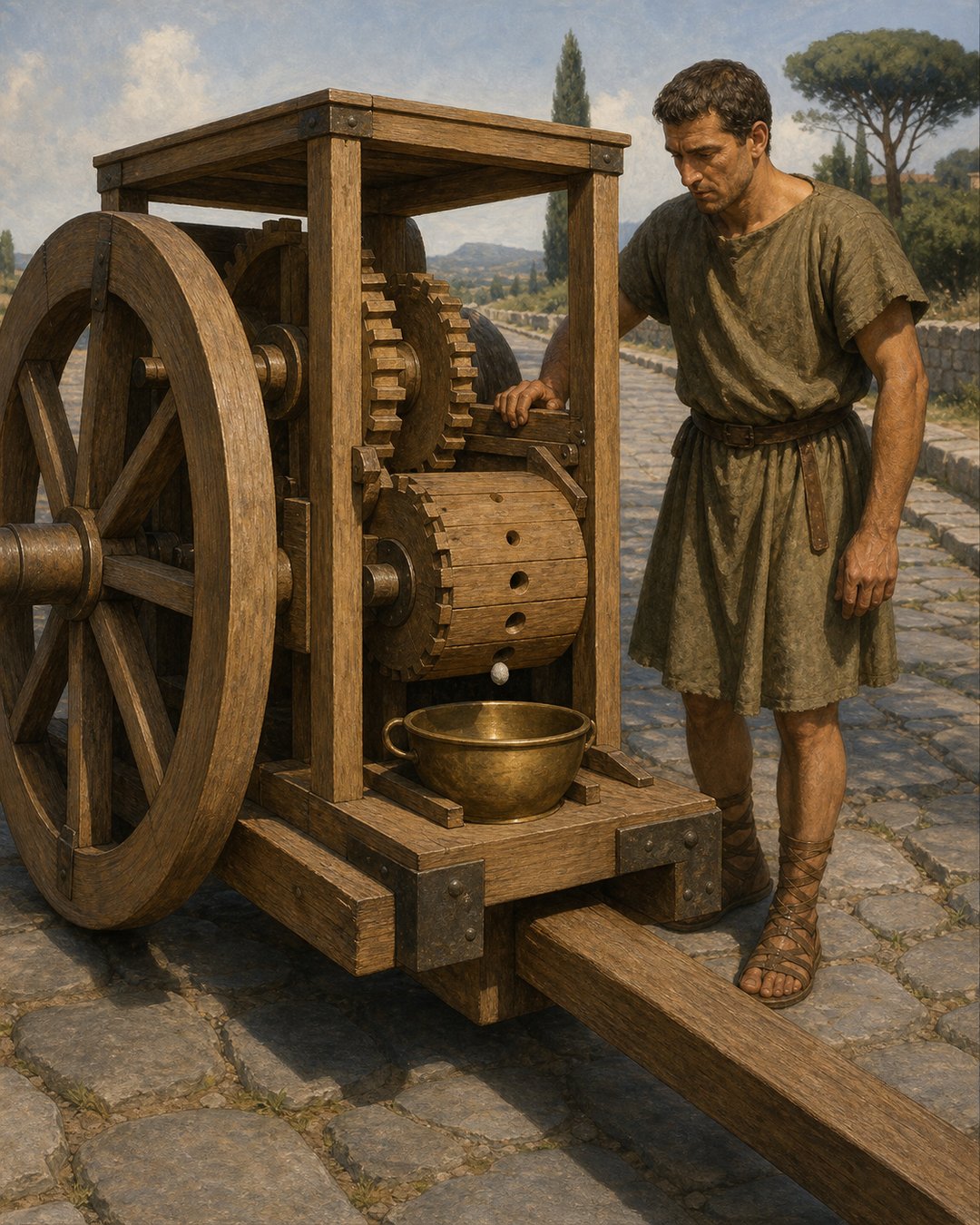
A traveler in Vitruvius’s road cart did not watch a dial. He listened for a small stone. Hidden inside the carriage, a wheel-driven train of drums delayed each movement until one pebble dropped through a pipe into a bronze vessel. At day’s end, the stones could be counted as miles.
The result sounds simple because the device pushed complexity upstream. A four-foot wheel converted road contact into repeated revolutions. A single tooth advanced a drum with four hundred teeth. One projecting tooth on that drum advanced another horizontal drum pierced with holes. Each alignment released one stone.
The mechanism turned continuous travel into separate objects that remained in a container after the cart stopped. Distance no longer depended only on a traveler’s memory, an estimate of time or markers surviving beside the road. Motion had produced a physical record.
The Wheel Supplied the First Unit
Vitruvius begins with geometry. Each carriage wheel was to measure four feet across. He calculated that one complete revolution carried the vehicle twelve and a half feet from the point where a mark began to the point where that mark returned to the road.
The wheel therefore served two jobs. It supported the cart, and it sampled distance through contact with the surface. Every full turn represented a recurring length. The odometer did not need to observe the whole road at once; it needed to register wheel revolutions reliably enough to accumulate them.
A drum fixed to the inner side of the hub carried a single tooth projecting from its face. One wheel revolution brought that tooth around once. Instead of trying to display every turn, the tooth delivered one controlled impulse into the gear train.
This makes the device a mechanical companion to Roman milestones beside the road, not a replacement for them. A milestone fixed distance to a public place. The odometer carried a private counting process with the traveler. One made a route readable from the landscape; the other made the cart’s own movement count.
Four Hundred Teeth Slowed the Journey Down
Above the hub, Vitruvius placed a vertical drum inside a case attached to the carriage. Its face carried four hundred teeth at equal intervals. The single tooth below engaged them. Each revolution of the road wheel nudged the large drum forward by one tooth rather than spinning it freely.
That ratio performed the crucial delay. Many quick, repetitive wheel turns became one slow revolution of the four-hundred-tooth drum. The machine did not need a person to remember how many turns had passed. The position of the gear preserved the unfinished count between one impulse and the next.
The large drum had its own single projecting tooth on the side. When the first reduction completed its cycle, that tooth engaged a third drum mounted horizontally above it. A second stage therefore translated a large bundle of wheel rotations into one step at the counter.
The arrangement belongs to the same world of shared mechanical load as Roman treadwheel cranes, but it sought a different outcome. Crane gearing multiplied force so a load could rise. The odometer’s gearing multiplied patience. It prevented the final indicator from moving until enough road had passed beneath the wheels.
A Falling Stone Stored the Answer
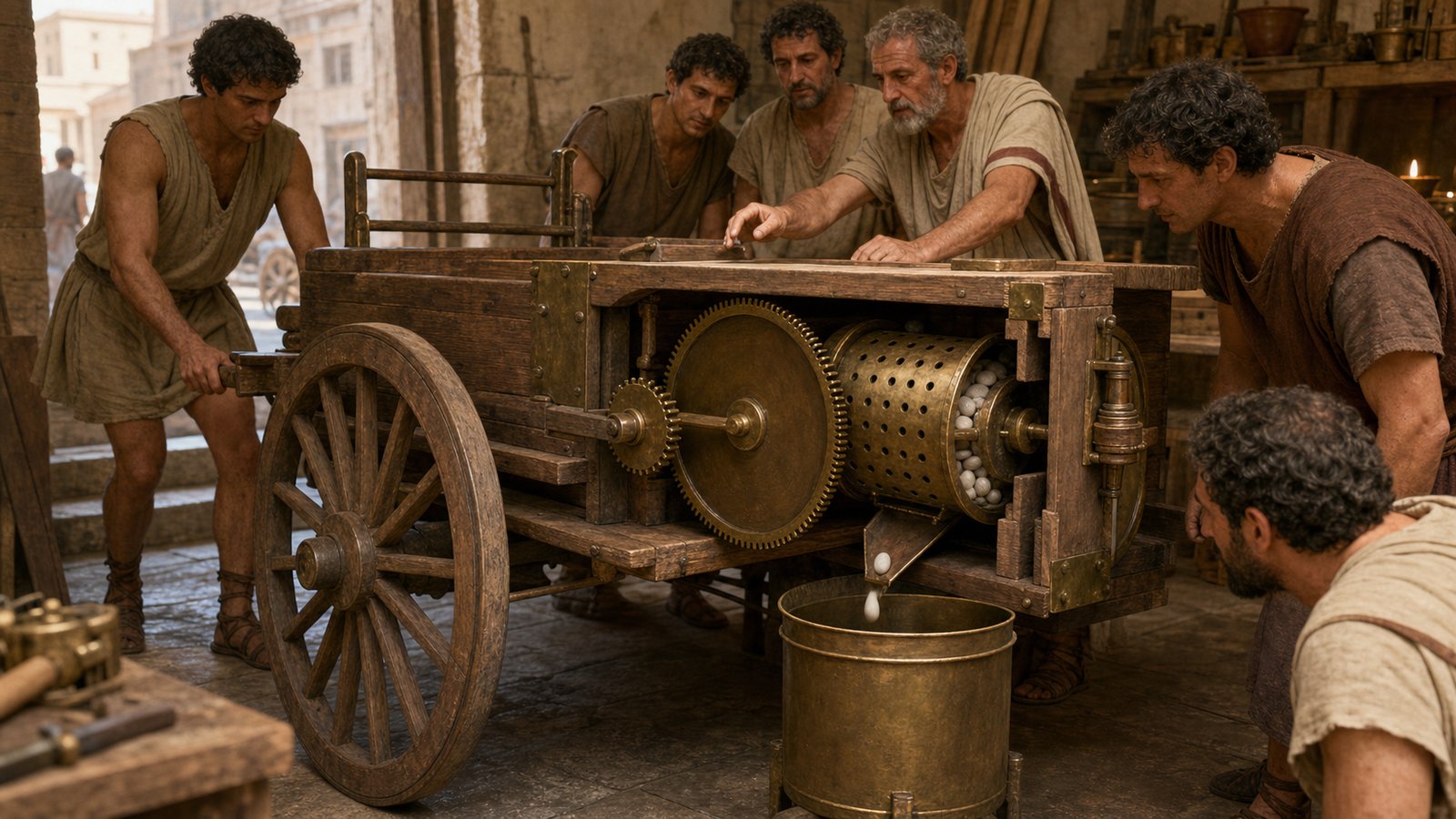
The horizontal drum contained as many holes as the maximum number of miles a cart might travel in a day. Vitruvius says the exact total did not matter. A small round stone sat in every hole. The enclosing case had one outlet fitted with a short pipe above a bronze vessel.
As the horizontal drum advanced, a filled hole eventually aligned with the outlet. Gravity then completed what the gears had prepared. One pebble left the rotating store, passed through the pipe and landed in the vessel below. The event was discrete: a stone had either fallen or had not.
That design gave the reading memory. A pointer would show only its current position and might be hard to inspect on a jolting cart. Fallen stones accumulated. After the journey, a person could remove the bronze vessel and count the contents without reconstructing the motion that produced them.
The sound may also have offered reassurance, although Vitruvius does not say travelers listened for it. We should resist adding an audible routine to the source. What is certain is the physical sequence he specifies: holes, round stones, one outlet, a pipe and a receiving vessel.
The Counter Needed Forward Motion to Mean Distance
The cart’s wheel supplied trustworthy information only while its rotation corresponded to forward travel. Vitruvius warned that backward movement would reverse the gearing and disturb the operation. A wheel could turn without adding new route. Mechanical counting still required correct use.
Slippage presented a related practical limit even though the chapter does not discuss it. If the wheel skidded, sank or spun, rotation and road distance could diverge. The four-foot diameter and tooth counts describe the intended relationship, not a guarantee that every surface behaved perfectly.
These limits distinguish the hodometer from magical precision. It was an ingenious model for translating movement, but its reading depended on wheel size, assembly, forward travel and engagement between teeth. Construction errors would accumulate just as surely as correct impulses.
Roman road building reduced some of that uncertainty by giving vehicles more consistent surfaces. The layered work examined in the account of Roman road construction mattered not only for speed and survival. A stable running surface also made a wheel-based measure more meaningful.
The Same Principle Could Leave the Road
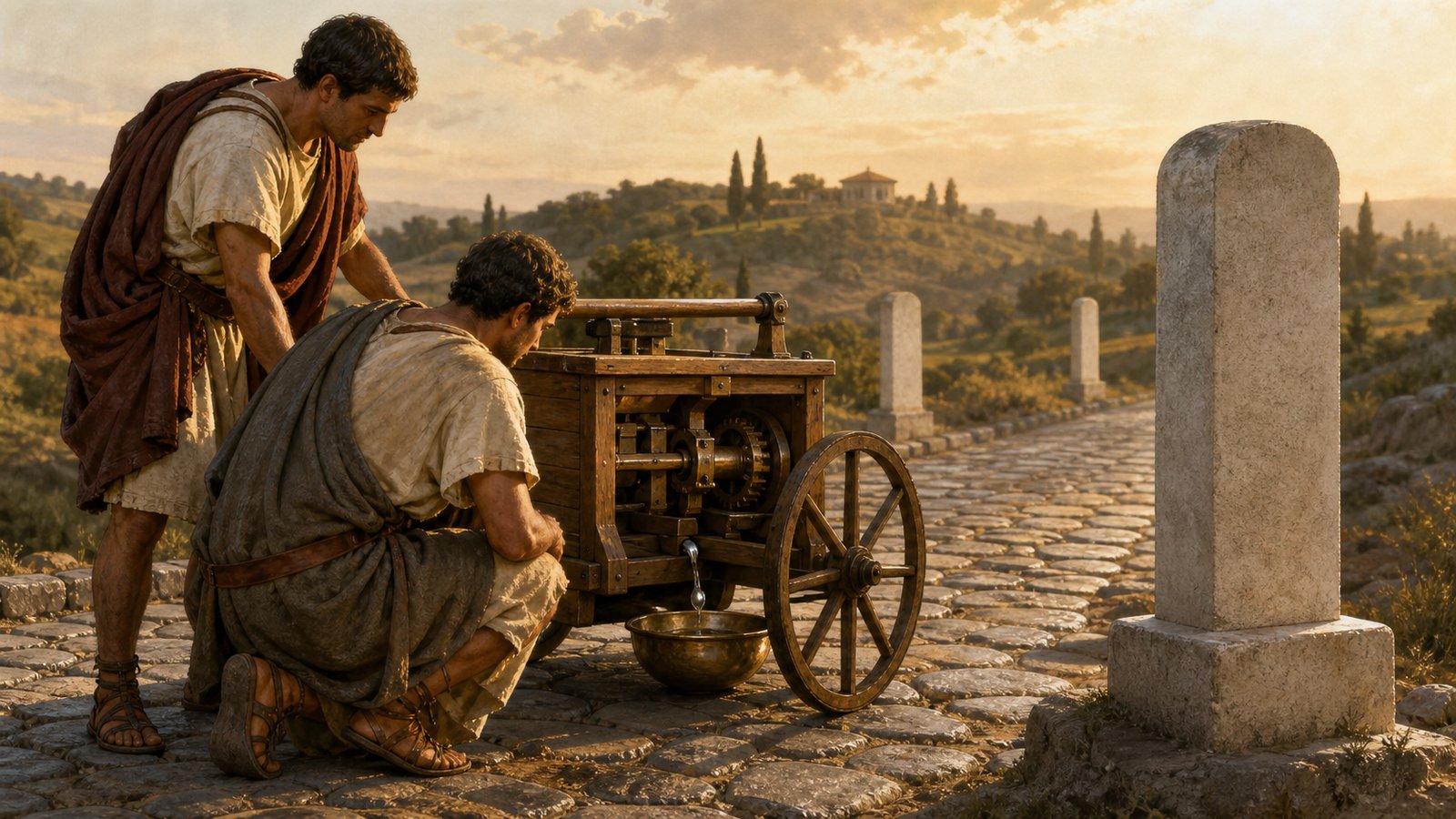
Vitruvius extended the mechanism to ships. There the machine could not press a carriage wheel against paving. Paddles at the sides entered the water and turned with the vessel’s progress, transmitting motion into an equivalent counting train.
Water introduced its own mismatch between rotation and true distance. Current, waves and paddle slip complicated the relationship. Yet the transfer shows what Vitruvius believed was essential. The road wheel was one input, not the invention’s entire identity. Repeated motion had to be reduced until a countable event occurred.
That abstraction explains the odometer’s lasting appeal. A journey is continuous, but administration prefers units. Supply calculations, route descriptions and travel planning become easier when distance can be expressed as a count rather than an impression.
The falling pebble sat at the boundary between those worlds. Before it dropped, distance existed as rotation distributed through teeth and axles. After it dropped, the traveler possessed one object in a bowl. At the end of the day, a handful of stones could stand in for a road already left behind.
Vitruvius does not claim to have invented the system. He calls it an ingenious device transmitted by predecessors, which places his chapter between preservation and instruction. The detailed tooth counts and order of drums let a reader follow the intended logic, but they do not prove that every Roman carriage carried such a machine. A technical text can preserve a workable design without describing ordinary equipment on every road.
The chapter’s value is therefore not dependent on imagining odometers as universal. It reveals a Roman engineering habit of decomposing an abstract problem into physical stages. The question “how far?” became wheel circumference, revolutions, gear reduction, hole alignment and stones retained. Each stage could be built, inspected and—if it failed—located.
Even the bronze vessel had an administrative virtue. It separated the record from the gear train. The traveler did not have to expose every tooth to read the result, and the accumulated stones could be counted by someone who had not watched the journey. Measurement became portable evidence rather than a private impression held by the driver.
Sources
Vitruvius, On Architecture 10.9.