
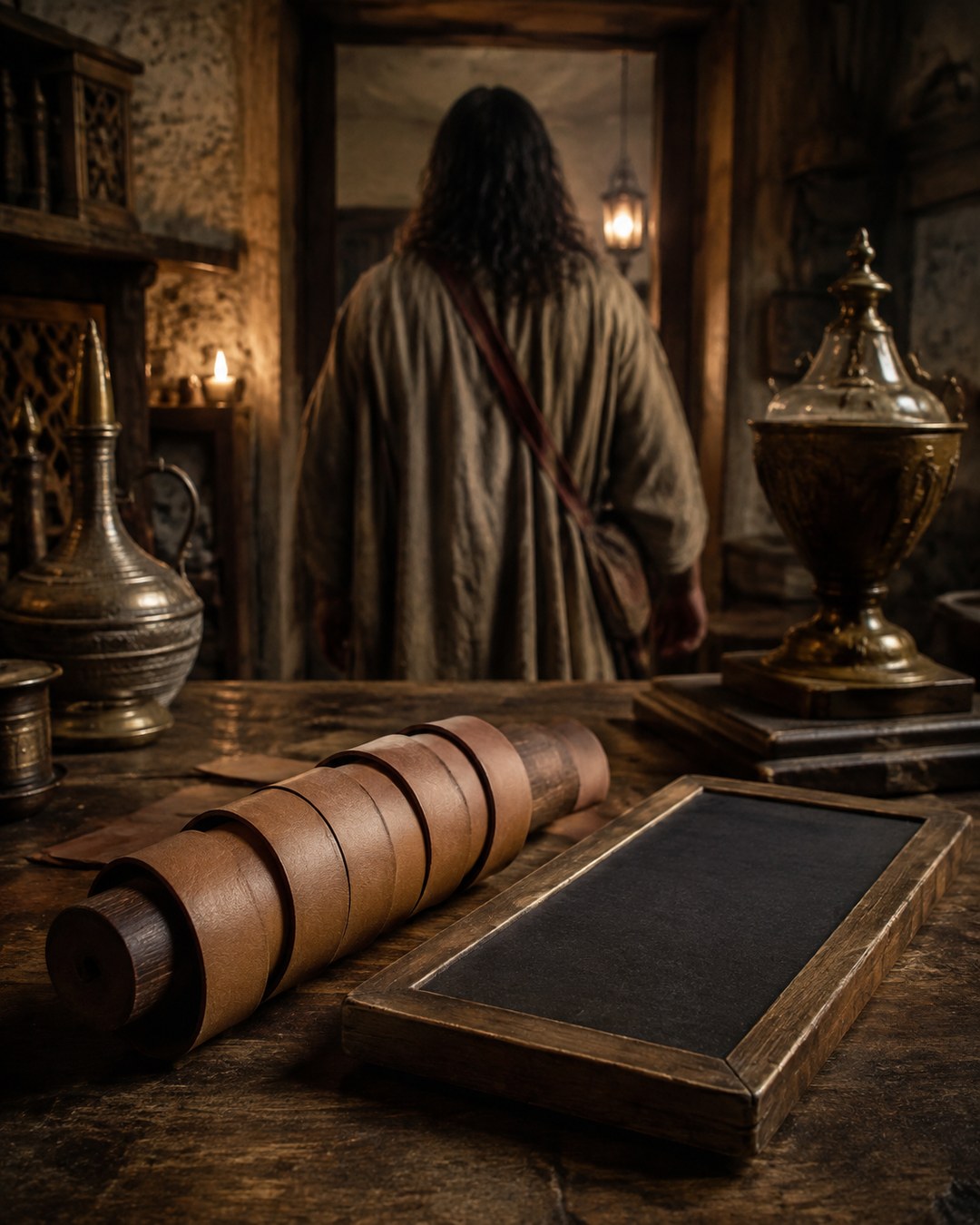
An interceptor unrolled the leather strip and found broken strokes scattered along its length. Another watcher inspected a wax tablet and saw nothing written on it. A third messenger crossed the road carrying no document at all. In each case, the secret was present, but the visible object refused to behave like readable writing.
Aulus Gellius collected these devices in Attic Nights 17.9. He moved from Caesar’s substituted letters to the Spartan scytale, then to a Carthaginian tablet cut beneath its wax and finally to a message tattooed on a shaved scalp before the hair grew back.
The examples are not one continuous history of cryptography. They are a cabinet of mechanisms. Each separates possession from understanding by placing a missing element somewhere else: in a prior agreement, a matching cylinder, the wood beneath a familiar surface or an instruction to alter the messenger’s body.
Caesar Moved the Secret into an Agreement
Gellius begins with volumes of letters sent by Gaius Caesar to Gaius Oppius and Cornelius Balbus, men who handled Caesar’s affairs while he was absent. In parts of that correspondence, individual characters appeared unable to form syllables or words. To an unprepared reader, they looked random.
The disorder had a rule. Sender and recipient had agreed that one letter would occupy the name and position of another during writing, then recover its own force during reading. Gellius does not provide the complete key in this chapter. His point is the shared arrangement that made nonsense reversible for the intended correspondents.
A grammarian named Probus later wrote what Gellius calls a careful commentary on the hidden meaning of letters in Caesar’s epistles. That detail shows two audiences separated by time. Oppius and Balbus needed the operational agreement; later scholarship treated the encoded correspondence itself as an object requiring explanation.
The method altered signs but left a visible text. Its defense was not invisibility. It was the hope that capture would not also deliver the agreed substitutions. The secret therefore lived partly in memory and relationship, outside the physical letter an enemy might seize.
A Matching Rod Reassembled the Spartan Dispatch
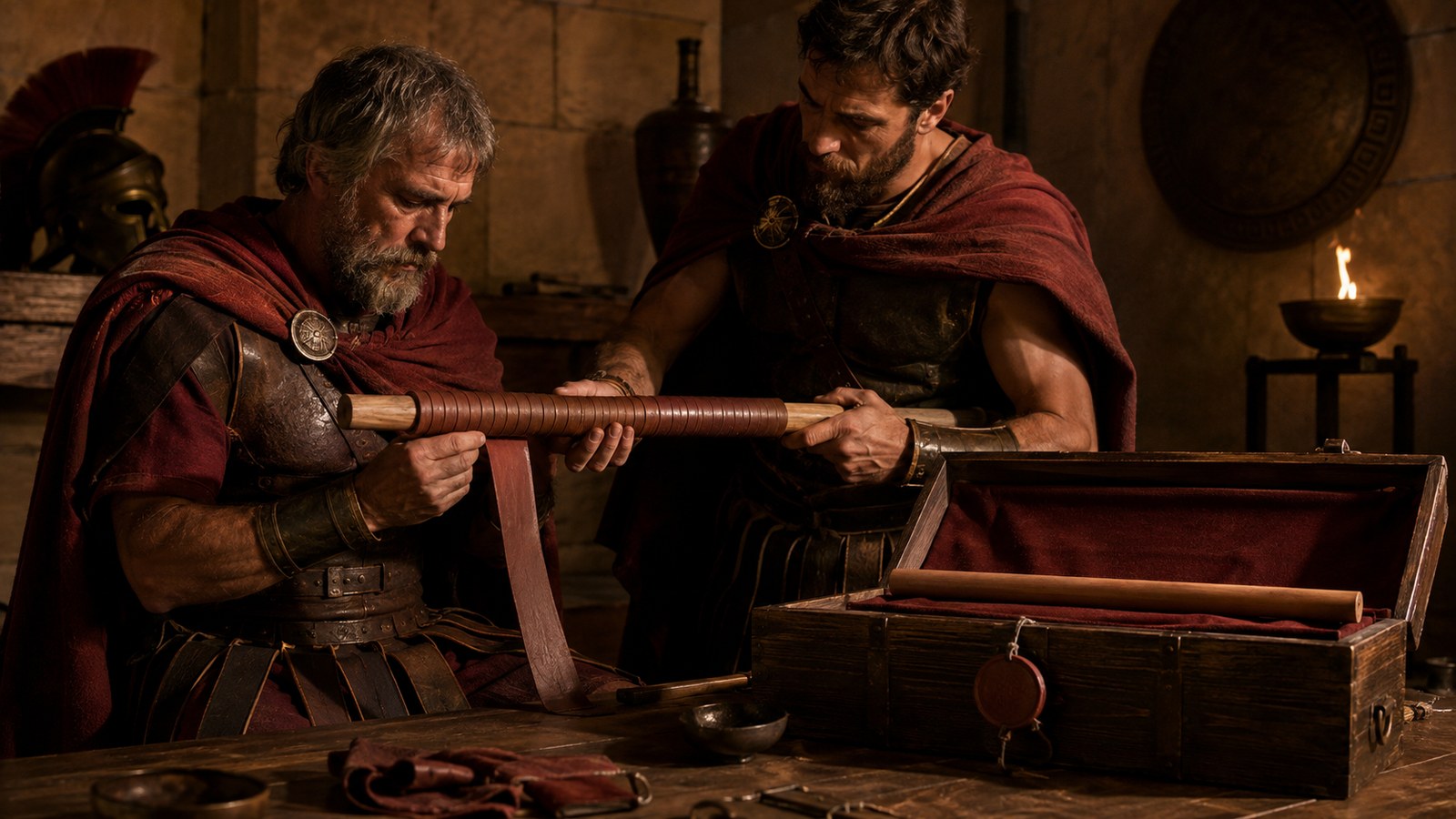
The Spartan device gave the key a measurable body. Gellius describes two thin cylindrical rods prepared to exactly the same length and thickness. One accompanied the general going to war. Magistrates kept the other at home under their control and seal.
When a secret public dispatch was needed, a leather thong of moderate thickness was wound around the staff in a simple spiral. Its edges met as the strip traveled along the cylinder. The writer placed the message across those adjoining edges while the leather still held that temporary shape.
Unwound, the strip disrupted the arrangement. Marks that had met across neighboring turns moved apart and appeared scattered. The courier could carry the leather, but the general needed the corresponding rod to restore its geometry. Wrapping it around a cylinder with the wrong dimensions would fail to align the divisions correctly.
Gellius says the Spartans called the device a scytale. It joins material standardization to secrecy: the two sides had to preserve a matching diameter, not merely remember a word. Control and sealing of the home rod mattered because copying the physical key could expose later dispatches.
The archive’s article on ten torches turning an alphabet into a battlefield signal solves a different communication problem. Torch combinations made letters visible across distance; the scytale allowed a message to travel physically while frustrating a reader who lacked its intended shape.
Fresh Wax Made Carved Wood Look Empty
Gellius next remembers an ancient Carthaginian history, although he cannot recall whether its famous protagonist was Hasdrubal or another man. That uncertainty belongs in the story. The mechanism is detailed even where the identity is not.
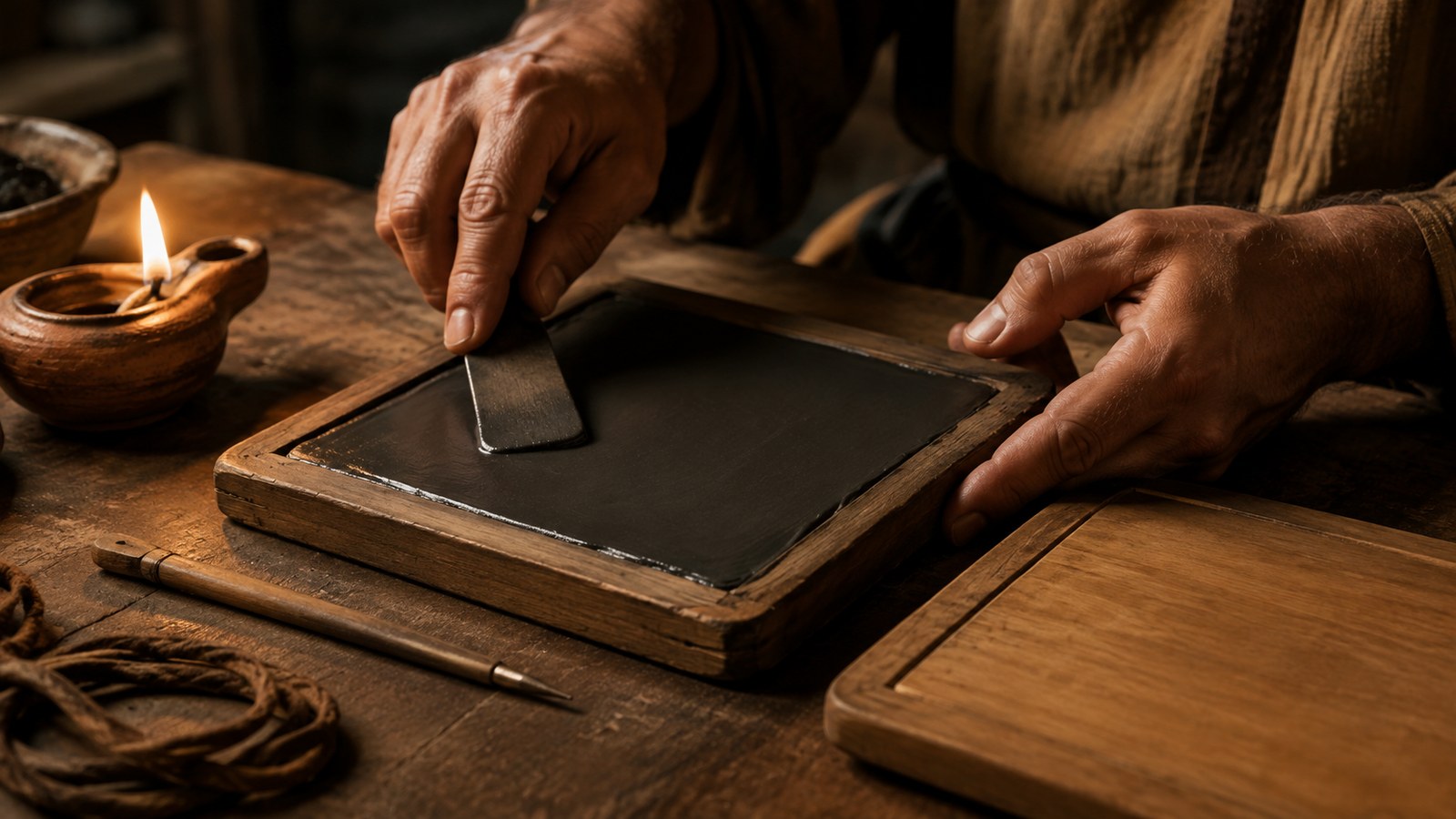
The sender took new tablets that had not yet received wax and cut letters directly into the wood. He then covered the tablet with wax in the ordinary manner. The finished object appeared ready for writing rather than already written. Its familiar surface performed the disguise.
The recipient had been told the plan in advance. He scraped away the wax and found the carved letters safe in the wooden layer below. Reading destroyed the blank appearance. Unlike Caesar’s substitution, no alphabetic conversion was required; unlike the scytale, no matching tool reconstructed separated strokes. The act was archaeological in miniature, removing one surface to expose another.
This depended on expectation. Wax tablets were designed to receive marks in wax, so an observer naturally examined the visible layer. The hiding place occupied the object’s structure rather than a separate compartment. Ordinary manufacture made the concealment plausible.
That material logic also distinguishes the story from the soot, gum and mixing behind Roman ink. Ink made words adhere to a chosen surface. The Carthaginian device used a normal writing surface to deny that words were already present underneath it.
Hair Added Time to Histiaeus’s Message
The final example placed concealment on a person. Histiaeus was in Persia with King Darius and wanted to communicate secretly with Aristagoras. He chose an enslaved man who had long suffered from weak eyes, shaved his head as though beginning a treatment and tattooed the forms of letters on the bare skin.
Then Histiaeus waited. Only when the hair had grown again did he send the man away. The delay was part of the mechanism, not an incidental pause. The message became safer as the body naturally covered it, but urgency had to yield to the pace of regrowth.
The messenger carried an oral instruction rather than a visible key. On reaching Aristagoras, he was to say that Histiaeus had ordered his head shaved again, just as before. Aristagoras understood that the odd command had a reason, followed it and exposed the lettering.
Gellius calls the method profound and difficult, but the violence and coercion should not disappear behind admiration for ingenuity. The messenger was enslaved, his body was used as a writing surface, and his weak eyes provided the pretext. Concealment was purchased with another person’s lack of control.
Every Device Hid a Different Cost
Placed together, the four methods reveal no single march from simple to advanced. Caesar’s correspondents traded security for the risk that a substitution agreement might become known. Spartan officials needed paired rods manufactured and protected with precision. The tablet recipient had to destroy the wax surface. Histiaeus accepted a delay long enough for hair to conceal tattooed forms.
They also answered different threats. A visible cipher expected the letter might be read without its convention. The scytale expected physical interception without access to matching dimensions. Hidden carving expected an inspector to trust an ordinary blank surface. The scalp message tried to prevent anyone from recognizing that a document existed.
Gellius’s anthology makes secrecy tactile. Leather had to be wound edge to edge. Wax had to be spread and scraped. Hair had to be removed, marked and regrown. The systems worked not because ancient materials were magical but because people approached those materials with habits that could be anticipated.
The cleverest part of each message was therefore outside the words. An agreement restored displaced letters; a rod restored alignment; an instruction authorized scraping or shaving. What looked like unreadable, blank or absent writing became legible only when the recipient supplied the missing action.
Sources
Aulus Gellius, Attic Nights 17.9.