
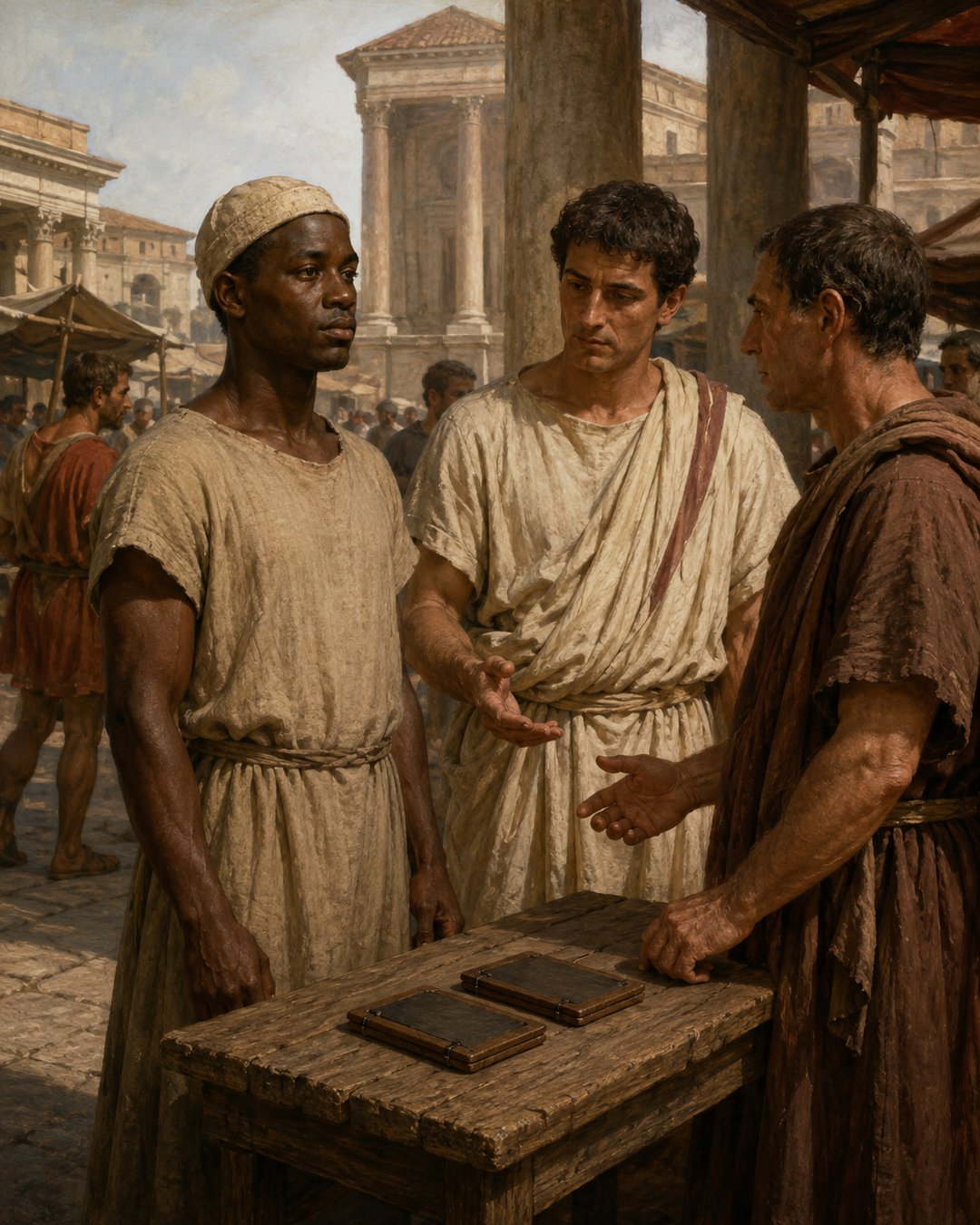
A buyer approaching a Roman sale did not always need to wait for a clerk to unroll or read the terms. One sign could sit directly on the head of the person being sold. According to the jurist Caelius Sabinus, a plain cap announced that the seller accepted no responsibility for that enslaved person.
Aulus Gellius preserves the explanation in Attic Nights 6.4. The cap was meant to prevent error or deception by making the condition of sale immediately apparent. Sabinus compared it with an older custom: captives taken in war were sold wearing garlands and were therefore said to be sold “under a crown.”
Gellius also knew another explanation. Perhaps the crown was not something worn at all, but the ring of soldiers guarding prisoners offered for sale. His short chapter moves from legal disclosure to disputed language, showing how a market signal could remain familiar even after people disagreed about where its name began.
The human reality must remain visible beneath the antiquarian puzzle. Roman law was arranging the sale of people. Caps, garlands, documents and guards did not challenge enslavement; they classified terms and origins for buyers. The signs made a brutal transaction easier to read.
The Cap Put a Warning Before the Written Contract
Gellius names Caelius Sabinus as a writer on civil law. Sabinus said it was customary to place caps on enslaved people when the seller assumed no responsibility for them. The garment was not described as protection from weather or an ordinary marker of occupation. In this context, it communicated a legal condition.
Sabinus explained the purpose directly. The law required people sold on those terms to be marked so that buyers would not make a mistake or be deceived. A prospective buyer could see the warning at once rather than waiting for the bill of sale.
That timing matters. Documents could state the transaction’s terms, but the market began before a document was consulted. People approached, inspected and compared. A visible cap inserted disclosure into that first encounter. It told the observer that ordinary seller responsibility did not accompany the offer.
The cap did not explain every possible problem, and Gellius does not list the reasons a seller might refuse responsibility in this chapter. Its function was narrower: it announced the allocation of risk. The buyer was warned that the person stood in a distinct sale category.
Roman market law could also require details on a ticket, as the debate over one missing tooth and the aediles’ disclosure rules demonstrates. There jurists argued over which bodily conditions counted as disease or defect. Here the message precedes that kind of classification. The cap says that the seller does not stand behind the sale.
Visibility Was Supposed to Prevent a Buyer’s Error
Sabinus’s language joins two concerns: error and deception. A buyer might misunderstand the transaction without deliberate fraud, or a seller might benefit from concealment. Marking the person was intended to make ignorance harder to claim and concealment harder to perform.
The solution depended on a shared visual code. Cloth alone cannot communicate legal terms. Sellers, buyers, officials and onlookers had to recognize what the cap meant in that setting. Once convention supplied the meaning, a small object could carry information before speech or writing did.
That immediacy also placed the warning on the enslaved person rather than only in the seller’s paperwork. The body became the display surface for the transaction’s risk. Roman law repeatedly turned human qualities and histories into market facts, but this practice made the structure unusually visible: the legal status was literally worn.
Gellius does not tell us how consistently the rule was enforced or what remedy followed if the cap was omitted. Claims beyond his description would be speculation. What survives is Sabinus’s explanation of normal practice and purpose: a conspicuous mark, immediate notice and protection against buyer error.
The rule protected commercial understanding, not personal freedom. It recognized the buyer’s need to know whether the seller accepted responsibility while leaving the enslaved person inside the category of property. Precision in disclosure could coexist with profound violence in the transaction itself.
Garlands Marked Captives as the Spoils of Defeat
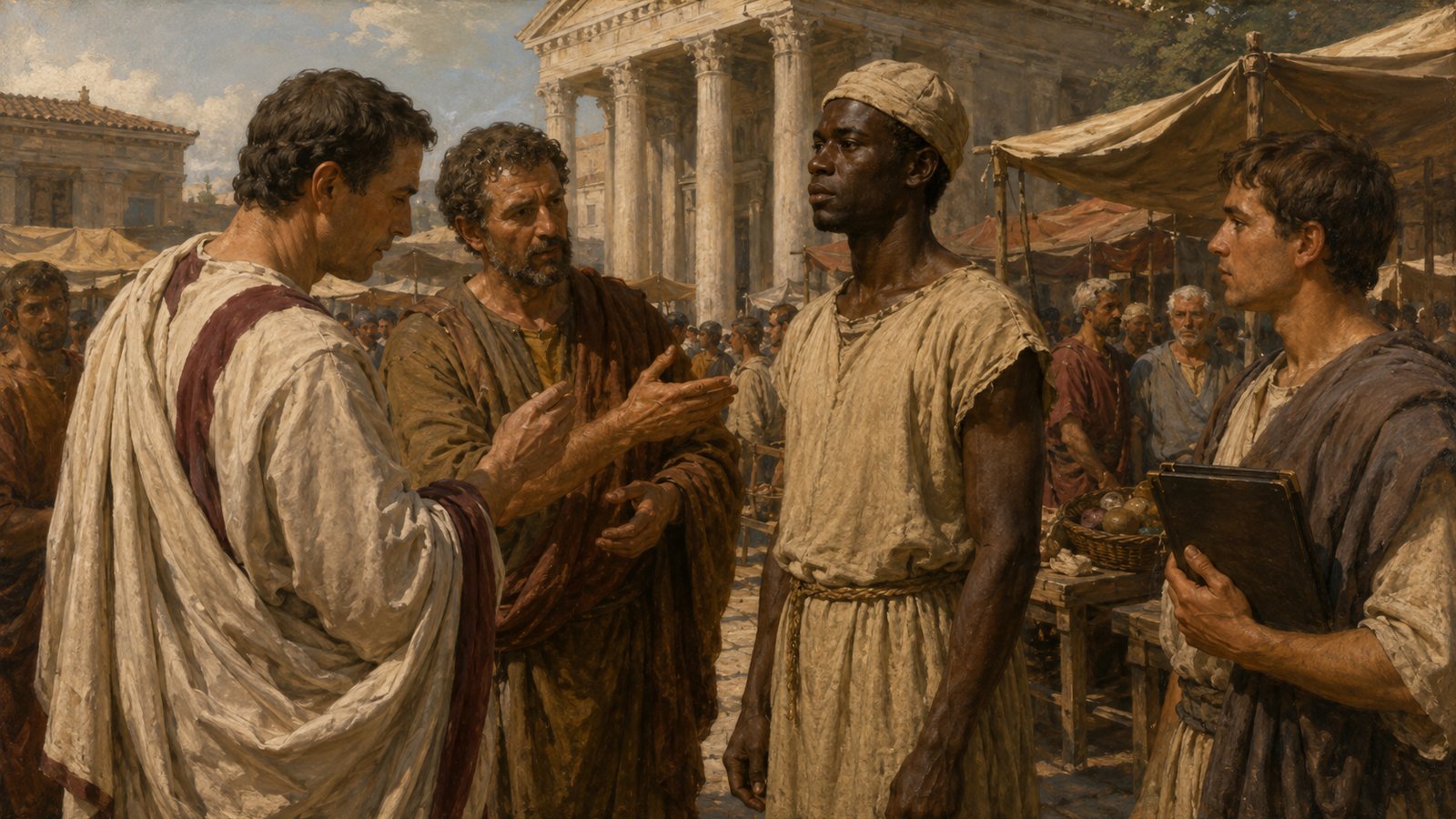
Sabinus explained the cap by comparison. In earlier times, he said, enslaved people taken by right of conquest were sold wearing garlands. The crown identified them as captives, just as the cap identified a sale without seller guarantee.
The comparison links two wearable signs but keeps their meanings distinct. One described the seller’s responsibility. The other described how the people had entered enslavement: they were captives produced by military defeat.
A garland normally suggests honor, celebration or religious observance. At a captive sale, that appearance became bitterly inverted. The person was crowned not as a victor but as someone made saleable by another community’s victory. Marcus Cato’s language, quoted later by Gellius, sharpened precisely that reversal.
The custom also made conquest legible after captives had been moved away from the battlefield. Buyers did not need to witness the defeat. The garland carried a claim about origin into the marketplace. Like the cap, it compressed information into a sign recognized at sight.
A Lost Eagles article on the grass crown awarded after a rescued siege follows crowning at the opposite end of military fortune. There, rescued soldiers honored the commander who saved them. In Gellius’s market phrase, the captive’s crown marked the person over whom victory had been exercised.
One Phrase Produced Two Different Crowns
From the garland custom came one explanation of the expression “sold under a crown.” The people wore crowns, so the sale took its name from the object placed on them.
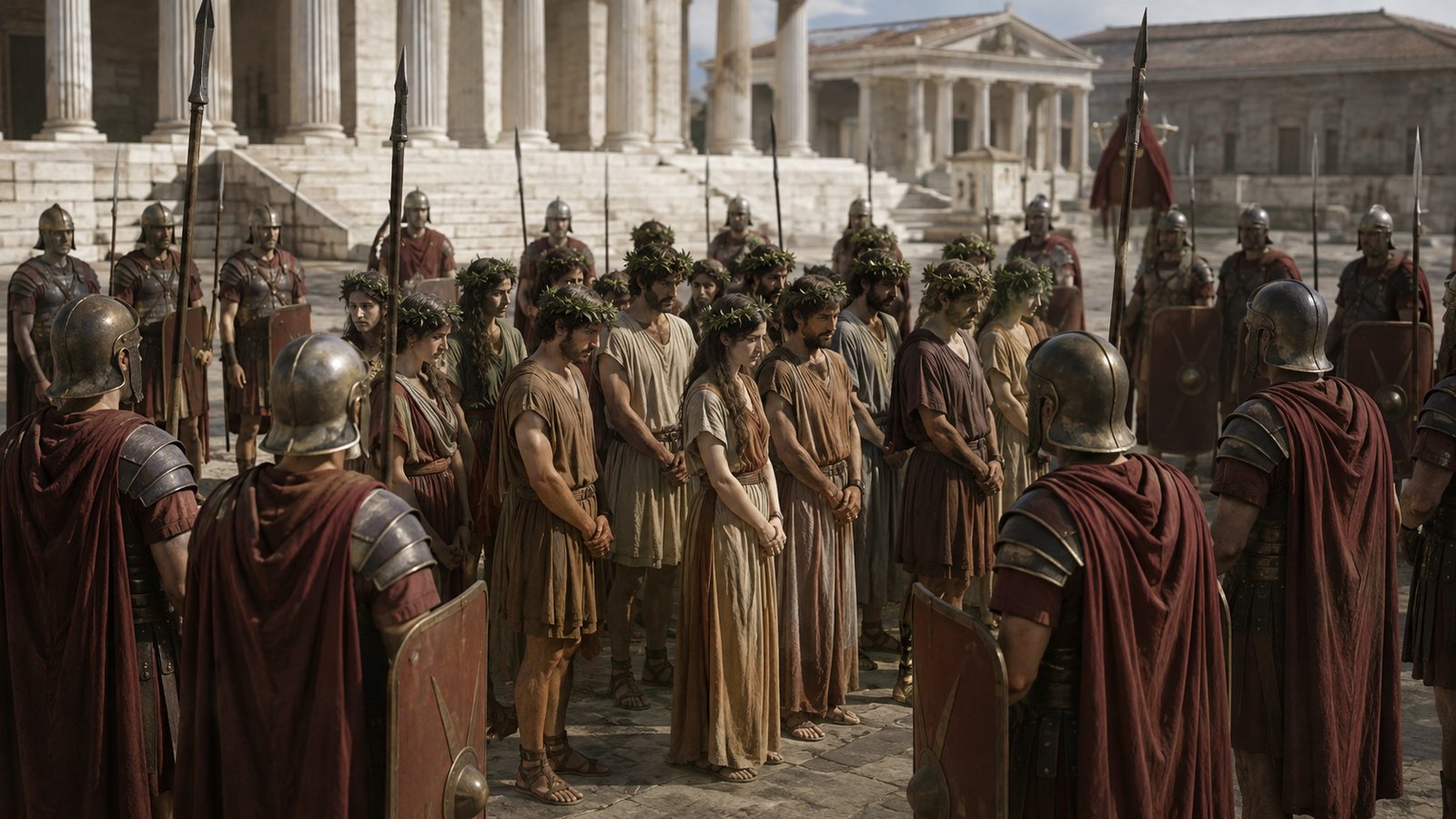
Gellius records an alternative that rearranges the entire scene. Bands of prisoners offered for sale were surrounded by a guard of soldiers. A circular formation or enclosing ring could itself be called a corona, a crown. Under this account, captives were sold within a crown of armed men rather than beneath the crowns on their heads.
Both explanations are visual. One looks inward to the garlands worn by captives. The other looks outward to soldiers enclosing the group. Both also connect the phrase to conquest, because either the wearable sign or the armed guard identified people whose sale followed defeat.
The competing accounts reveal the difficulty of recovering an old expression’s origin. A familiar phrase can survive while the practice that first made it obvious fades. Later scholars then reconstruct meaning from words, customs and remembered scenes.
Gellius does not pretend the alternatives are equal. He prefers the garland explanation. Yet preserving the other account matters because it shows the choice he was making: crown as an object on the captive, or crown as the shape of coercion around the captive.
Cato Made Crowning Turn on Victory or Defeat
To support his preference, Gellius quotes Marcus Cato’s work On Military Science. Cato contrasted people who crown themselves and give thanks after success won by their own efforts with those who are crowned and sold because they failed.
The opposition makes best sense if the defeated captives themselves wore garlands. Cato’s sentence turns on two outcomes expressed through the same action. Success allows people to crown themselves in gratitude. Failure allows victors to crown them for sale.
That verbal symmetry is why Gellius treats the passage as evidence. It does not merely mention prisoners and soldiers nearby. It places the crown on those who face sale. The object’s meaning reverses with military fortune.
The chapter therefore ends far from the apparently simple cap with which it began, yet the underlying mechanism remains consistent. Roman practices made status visible through controlled signs. A cap warned of absent seller responsibility. A garland marked captive origin. A ring of soldiers, in the rival explanation, made custody visible through formation.
Every version serves the people conducting, supervising or interpreting the sale. The buyer receives notice, the seller signals terms, the guard maintains control and the antiquarian explains the phrase. The enslaved people are present as marked bodies, but Gellius records no voice from them.
That silence gives the legal ingenuity its proper scale. The cap may have prevented one form of commercial deception. The garland may have explained one old formula. Neither reduced the violence of treating captivity as inventory. Rome made the transaction readable by putting its rules on the person and its power in a circle around them.
Sources
Aulus Gellius, Attic Nights 6.4; Caelius Sabinus, writings on civil law, and Marcus Cato, On Military Science, as cited by Gellius.