
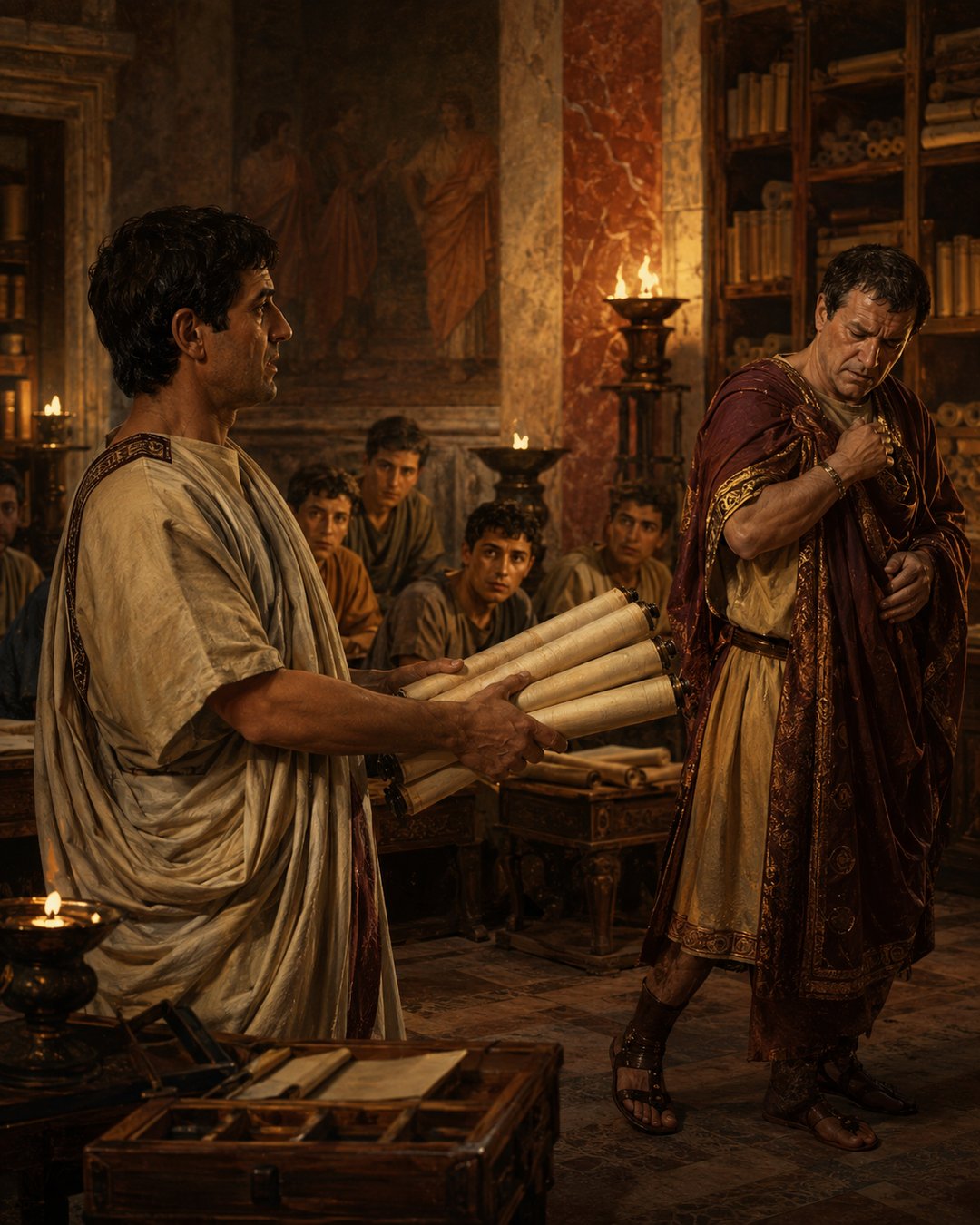
The grammarian had the highest reputation as a teacher in Rome. Aulus Gellius approached him with a question he considered sincere: what did the Latin word obnoxius mean, and where had it come from?
The teacher looked at him and laughed. The problem, he said, was so difficult that it must demand sleepless nights—then supplied what he treated as the obvious answer. A person was obnoxius when vulnerable to another who knew his noxa, his guilt. Why waste time on trifles?
Gellius did not reply with a rival definition. He opened a sequence of literary tests. Plautus used the word one way, Sallust another, Virgil in two more settings, Ennius in another. Each passage pressed against the teacher’s narrow formula until the famous expert found the one resource still available to him: he announced that he had no time and left.
The scene in Attic Nights 6.17 is funny, but its method is serious. A word’s history belongs to its uses, not to the confidence of the person defining it.
The Question Threatened a Teacher’s Rank
Gellius says he was not setting a trap. He asked from a desire to learn. The three parts of his question—meaning, origin and history—made it harder than the teacher admitted, because they required more than a familiar contemporary gloss.
The grammarian responded as a guardian of prestige. He ridiculed the inquiry, exaggerated its supposed insignificance and urged Gellius to ask something worthy of discussion. The performance placed the teacher above both the student and the subject.
His answer nevertheless sounded learned. It joined obnoxius to noxa, guilt, and explained the relationship as vulnerability to someone who knew that guilt. The weakness was not that this usage never existed. Gellius later concedes that the definition captured one real use. The weakness was treating one use as the whole word.
That distinction gives the episode more force than a simple contest between knowledge and ignorance. The teacher possessed a plausible fragment. Status allowed him to present the fragment as completion and to mock the request for anything deeper.
Gellius’s account of the cheap books he bought and copied at Brundisium shows the same appetite from another angle. There, accidental access produced notes. Here, a failed oral lesson sends authority back to written evidence.
Plautus Broke the First Definition
Gellius begins with Plautus’s Stichus. A character says he is utterly ruined, not merely or partly so—non obnoxie. Gellius points out that the contrast between complete and partial ruin does not fit the grammarian’s explanation about guilt known to another person.
The teacher’s response is formally clever and substantively empty. He claims to have defined the adjective obnoxius, not the adverb obnoxie. Gellius is astonished because the change of form does not create an unrelated substance and meaning.
This exchange exposes a common refuge for weak expertise. When evidence troubles a rule, the rule can be protected by drawing a distinction too small to answer the challenge. The grammarian does not explain Plautus. He moves the citation outside the boundary of the question.
Gellius refuses to become trapped in that side dispute. He grants, for argument’s sake, that they can leave the adverb aside. He then produces examples using the adjective itself.
The progression is deliberate. One citation might be dismissed as archaic, poetic or oddly formed. A chain of authors makes dismissal increasingly expensive. The question is no longer whether Plautus used one inconvenient adverb. It is whether Latin literature supports the teacher’s confidence.
The sources also vary in genre and scene. Comedy speaks through ruin and obligation; history supplies coercion; agricultural poetry describes field and moon; older verse tests freedom. Agreement does not depend on identical phrasing. Their value lies in showing how several relationships gathered around one word while refusing reduction to a single story about guilt.
Virgil Turned Obligation into the Central Clue
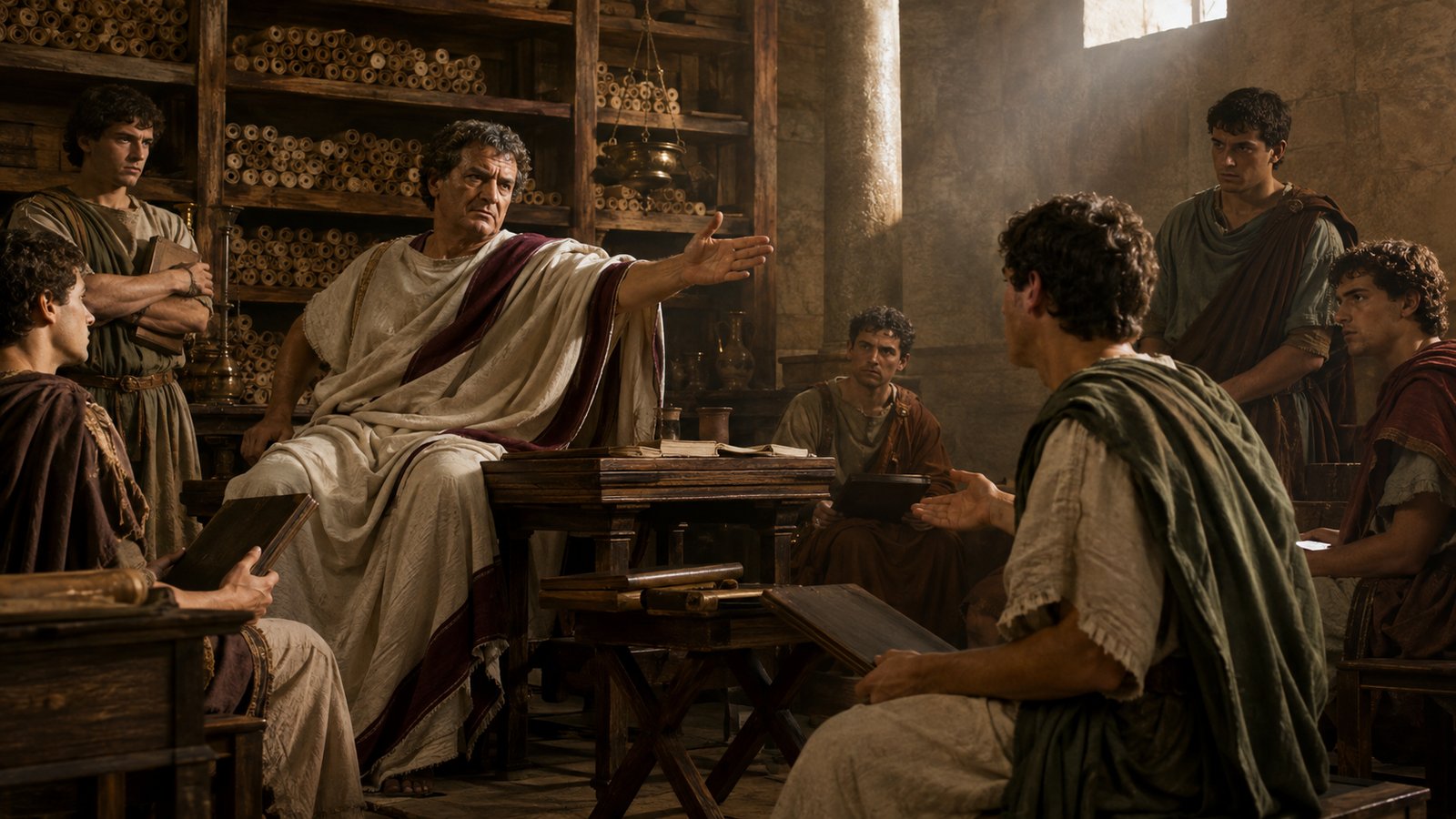
Sallust provides one use: a woman threatened with a sword is made submissive or subject to another. That can sit near vulnerability, but it does not require the other person to know a secret guilt. Power, rather than knowledge of wrongdoing, structures the relation.
Virgil pushes farther. In one passage the rising moon owes nothing to her brother’s rays. In another, fields owe nothing to the hoe or care of human beings. Neither moon nor field is conscious of guilt. The language points toward dependence, debt or obligation.
Gellius underlines the second example. Human care is generally a benefit to fields, not the injury demanded by the grammarian’s narrow definition. A field that is non obnoxia to cultivation is independent of that service; it does not stand bound to it.
The move from threatened person to moon and field widens the semantic range without dissolving it. In each case something stands, or does not stand, in a relation that limits independence. Guilt may create such a relation, but it is not the only source.
The attention to a boundary word resembles the Roman debate over whether midnight belonged to one civil day or the next. Both cases show apparently ordinary language carrying technical consequences that casual certainty can miss.
Five Authors Replaced One Elegant Guess
Ennius gives Gellius another pressure point. In the quoted lines, true freedom belongs to the person with a pure and steadfast heart; everything else is lesser, constrained or bound. The word again reaches beyond another person’s knowledge of guilt.
After Plautus, Sallust, two Virgilian passages and Ennius, the teacher stops arguing. He says he has no leisure and tells Gellius to return another time to learn what all those authors meant. The promise reverses the original posture. The man who mocked a trivial question postpones the answer because the evidence has made it large.
Gellius does not record a return visit. Instead, he continues the inquiry himself. Another Plautine passage, from the Asinaria, uses obnoxii for people bound or indebted for life by services rendered to them.
He also quotes Caecilius, where a speaker rejects the idea that payment makes him subject to another’s will. This use comes closest to the teacher’s domain of vulnerability, yet again the relation is obligation or subjection rather than secret guilt alone.
Gellius’s conclusion is measured: the grammarian noticed only one use of a word with manifold content. He does not replace the failed definition with a slogan equally narrow. The passages collectively reveal a family of dependence, debt, subjection and limited freedom.

Quotation Worked as a Public Audit
The story is staged as conversation, but the decisive participants are absent authors. Plautus, Sallust, Virgil, Ennius and Caecilius cannot answer the teacher directly. Their lines do so because Gellius has read and remembered them.
Literary education here is not ornament. It supplies counterexamples. A celebrated teacher’s status can dominate a room, but it cannot alter how a word functions in surviving sentences. Citation transfers the dispute from personalities to inspectable usage.
Gellius also makes himself vulnerable. He admits that he has often used obnoxius without understanding it fully. That confession contrasts with the teacher’s performance of effortless mastery. Uncertainty begins the investigation; certainty ends it too soon.
The humor lies in the retreat, but the lesson lies in the sequence. Ask for history, receive a neat etymology, test it against texts, and watch the definition expand. The word does not belong to the loudest person in the room.
By preserving the exchange, Gellius turns one failed lesson into a better one. Obnoxius remains difficult, but difficulty is no longer shameful. The shame belongs to authority that laughs before it reads.
Sources
Aulus Gellius, Attic Nights 6.17; Plautus, Sallust, Virgil, Ennius and Caecilius, passages quoted by Gellius.