
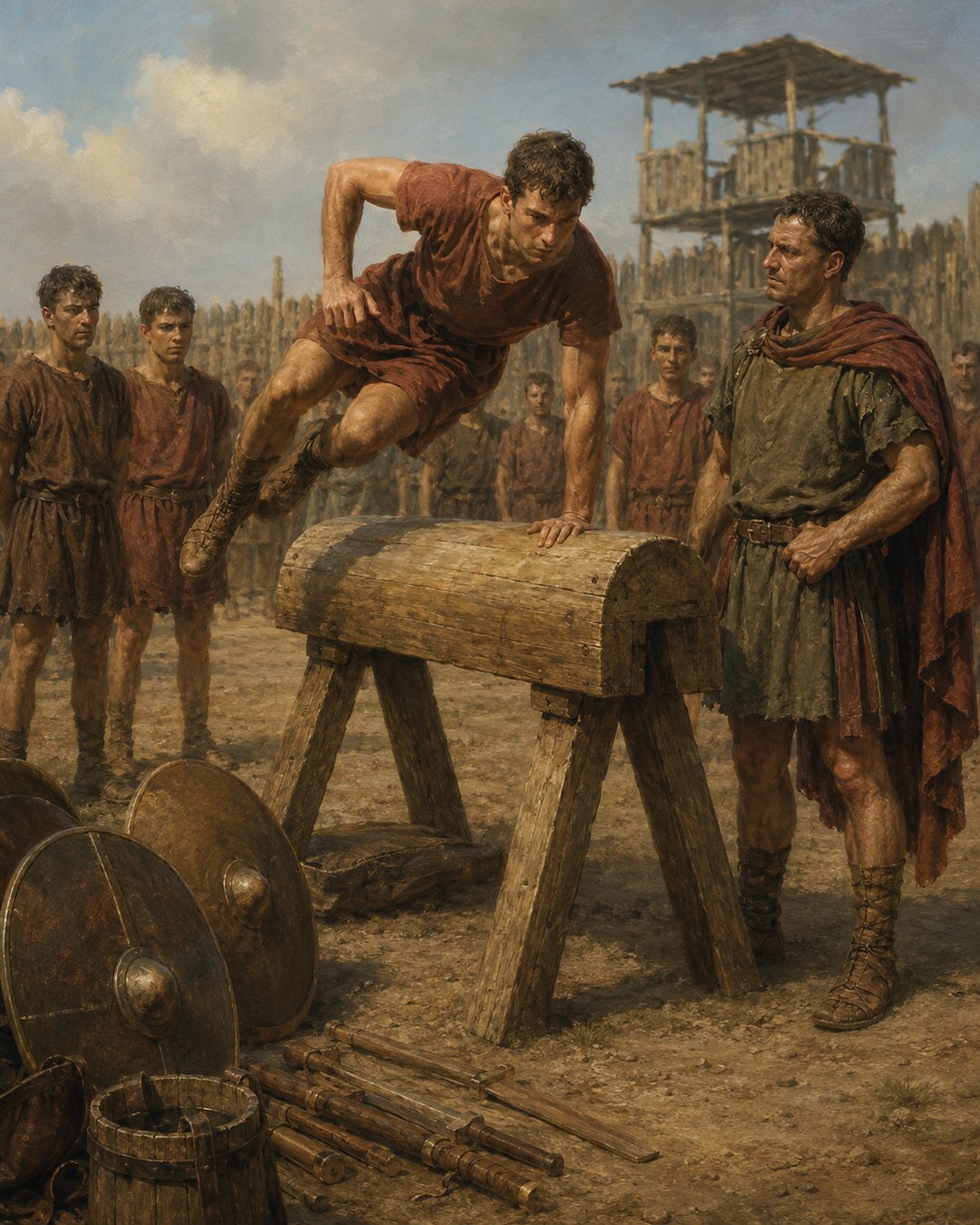
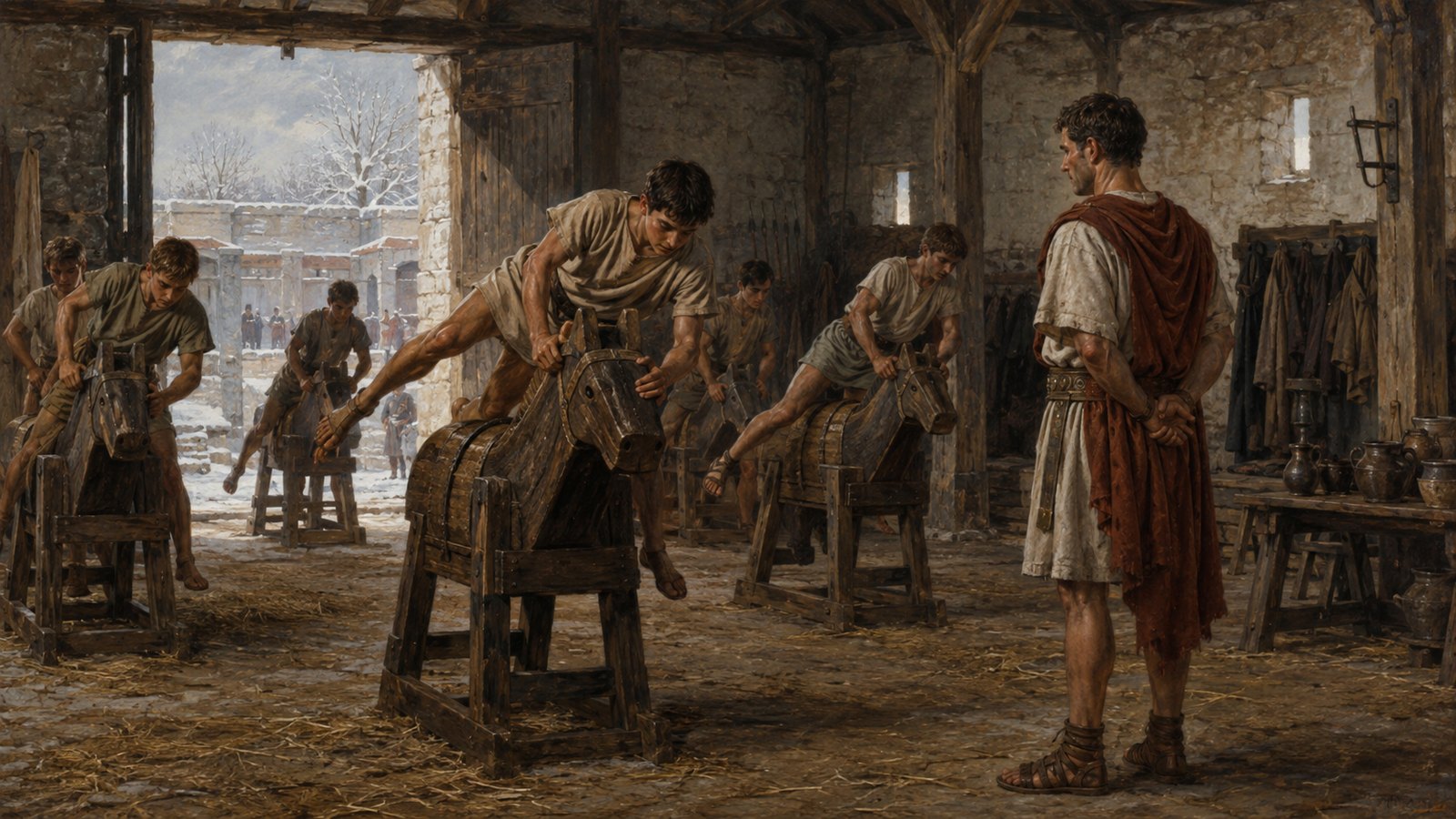
In winter the horse stood under a roof. In summer it moved onto the field. It did not eat, shy or tire because it was made of wood, and Vegetius expected Roman recruits to climb onto it again and again.
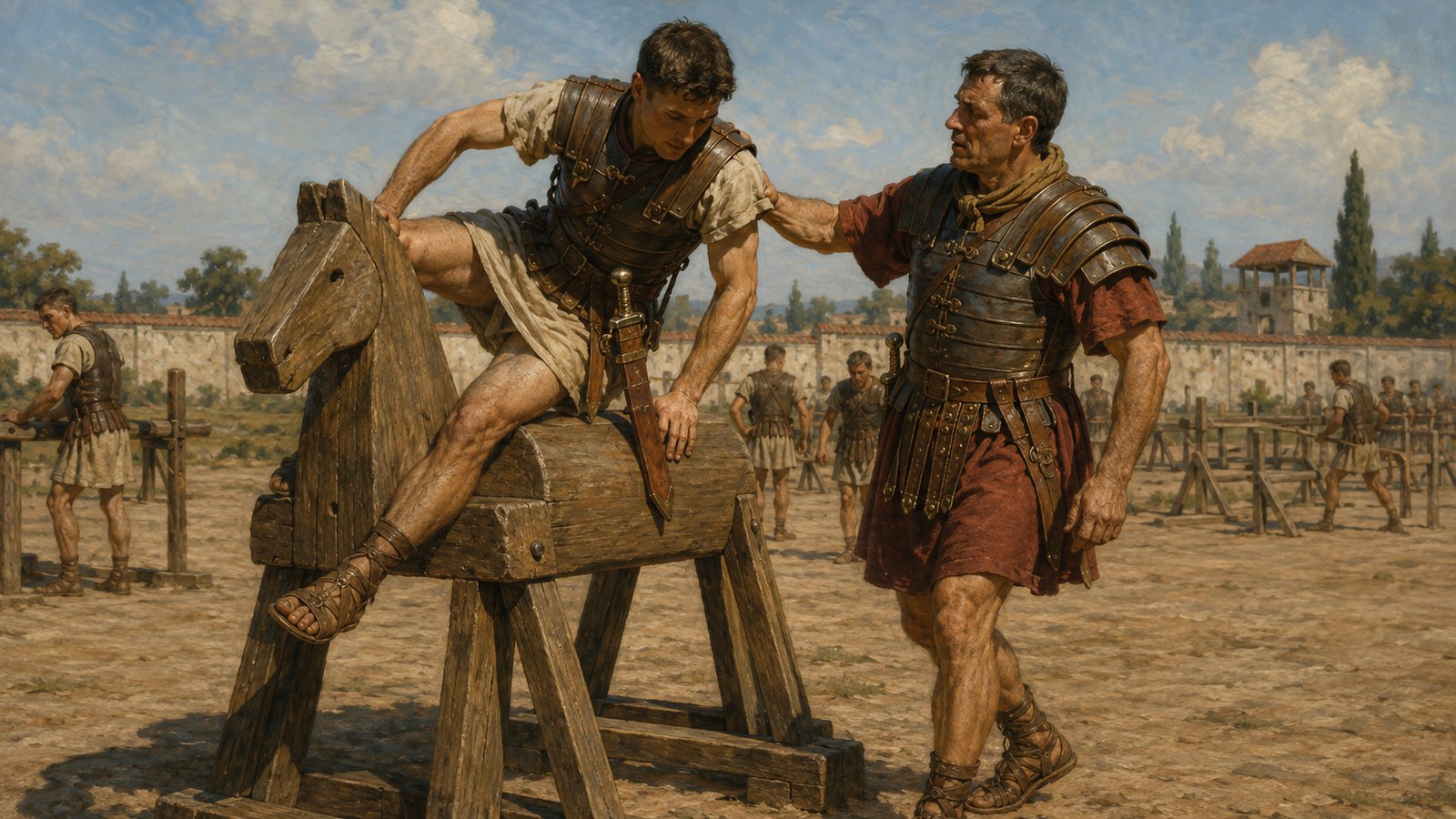
The drill was progressive. Young men began unarmed. As familiarity increased, they mounted while equipped. They learned to get on and off from the right and the left, even while controlling a drawn sword or spear.
Vegetius gives the practice a battlefield purpose. A soldier who rehearsed the movement carefully in peace should be able to mount without delay amid confusion.
The wooden horse was therefore more than a substitute for scarce animals. It was a machine for repetition. By holding one part of the problem steady, it let trainers vary everything else: season, side, speed and burden.
Timber Removed the Animal from the First Lesson
A living horse brings its own decisions into training. It shifts weight, reacts to noise and must be handled as well as mounted. A wooden frame isolates the recruit’s movement from those complications.
The trainee can approach the same height and broad shape repeatedly. An instructor can watch where hands land, how a leg clears the body and whether equipment strikes the frame. Failure does not waste an animal’s patience.
Vegetius does not describe the carpentry, dimensions or padding, so a precise reconstruction would go beyond the text. His term securely gives the material and function: these were wooden horses used for mounting practice.
That simplicity made the apparatus portable within the training calendar. Under cover it remained useful when winter weather made an open ground unpleasant. In summer it could stand outside where larger formations and ordinary camp routines continued around it.
The device turned an irregular opportunity into scheduled work. Soldiers did not need to wait until enough suitable mounts, handlers and fair weather aligned before practicing the physical entry into cavalry movement.
Recruits Earned Their Equipment in Stages
Vegetius begins the young men without arms. This removed weight and entanglement while they learned the path of the body. Only when habit advanced did the drill add military equipment.
The order matters. A sword, spear, shield or armour changes balance and occupies the hands. Adding everything at once could hide the cause of a failed mount. The staged method allowed a trainer to establish movement first and then expose it to burden.
Progress did not mean abandoning the earlier lesson. The armed mount remained the same action under harder conditions. Familiarity had to survive additional mass, restricted motion and the need to keep a weapon from injuring the trainee or someone nearby.
This logic resembles Vegetius’s better-known insistence on weighted practice at the stake. Readers can compare the wooden horse with the heavy practice weapons used to make ordinary arms feel manageable. Both drills alter a controlled environment so battlefield equipment no longer arrives as a surprise.
The following chapter extends the same principle to marching. Vegetius wants young soldiers accustomed to loads of up to sixty Roman pounds because arduous expeditions require them to carry provisions as well as arms. Read together, the chapters train transition: onto a mount, along a road and into action without shedding necessary weight.
Both Sides Had to Become Available
Vegetius explicitly requires mounting and dismounting from the right and the left. That symmetry is one of the passage’s most concrete demands.
A preferred side is comfortable only when space permits it. In a crowded camp, narrow road or battlefield disturbance, another horse, person or obstacle may close the familiar approach. A soldier trained on one side possesses a habit that the landscape can cancel.
Alternating sides makes the body solve a mirrored problem. The leading foot changes, hands exchange tasks and equipment shifts relative to the frame. Awkwardness becomes visible during drill rather than during urgency.
The rule also resists the idea that competence is one successful performance. A recruit has not mastered mounting merely because he can repeat it under his favourite conditions. Vegetius asks whether the skill remains when orientation changes.
That approach belongs to a broader Roman concern with preventing terrain from dictating helplessness. Recruits who learned to swim across the Tiber were being prepared for a river when no bridge was available. The wooden horse prepared a mounted soldier for the side that happened to remain open.
A Weapon Made Balance a Tactical Problem
The advanced recruit did not practice with empty hands. Vegetius specifies drawn swords or spears. The phrase raises the stakes of coordination.
A weapon extends beyond the body. Its point or edge must remain controlled while the soldier jumps, turns and settles. A careless arc could threaten a companion, strike the apparatus or prevent a clean mount.
The drill therefore joined mobility to discipline. Speed alone was not enough. A man who reached the seat quickly but lost his weapon, fouled his clothing or endangered the horse would carry a new problem into the fight.
Modern readers should not imagine a choreographed parade from the short passage. Vegetius gives no count of repetitions and no timed standard. What he supplies is the progression and its intended pressure: peace should contain careful preparation for tumult.
Because the horse was wooden, trainers could repeat the most dangerous coordination without combining it immediately with a frightened animal. Once body and weapon moved together predictably, the living mount presented fewer new variables.
Vegetius Wrote Against the Erosion of Habit
The author says mounting practice survived into his own age, but with neglect. His wooden horses belong to a work that repeatedly contrasts disciplined antiquity with present decline.
That framing requires caution. Vegetius was assembling an argument about military reform, not recording one timeless routine followed by every unit in every Roman century. The passage tells us what he prescribed and what he believed earlier practice had achieved.
Its practical intelligence does not depend on accepting every nostalgic contrast. Complex actions do become more dependable when they are divided, repeated and then recombined under burden. The apparatus embodies that training logic even if actual provision varied.
The final purpose is measured in delay. On a battlefield, a few moments spent choosing a side, shifting a weapon or recovering balance can separate movement from paralysis. Vegetius wanted those choices settled before danger.
The demand also joined infantry discipline to cavalry mobility. Vegetius does not reserve the exercise for a tiny circle of expert riders: he begins with recruits and says serving soldiers were still required to practise. The wooden frame made a basic mounted action available as a general standard that could be inspected, corrected and repeated.
Seasonal placement reinforced that continuity. Winter did not suspend the lesson; it changed the room around it. Summer did not require a new method; it returned the same apparatus to the open ground. A recruit who trained across both settings learned that readiness belonged to the calendar, not only to the weeks before a campaign.
His wooden horse made peace imitate one narrow demand of war without imitating war itself. A stationary frame, a watchful instructor and repeated jumps built a reserve of movement. When the real horse arrived amid noise, weight and urgency, mounting was supposed to feel like something the body already knew from either side.
Sources
Vegetius, Epitoma Rei Militaris 1.18–19.