
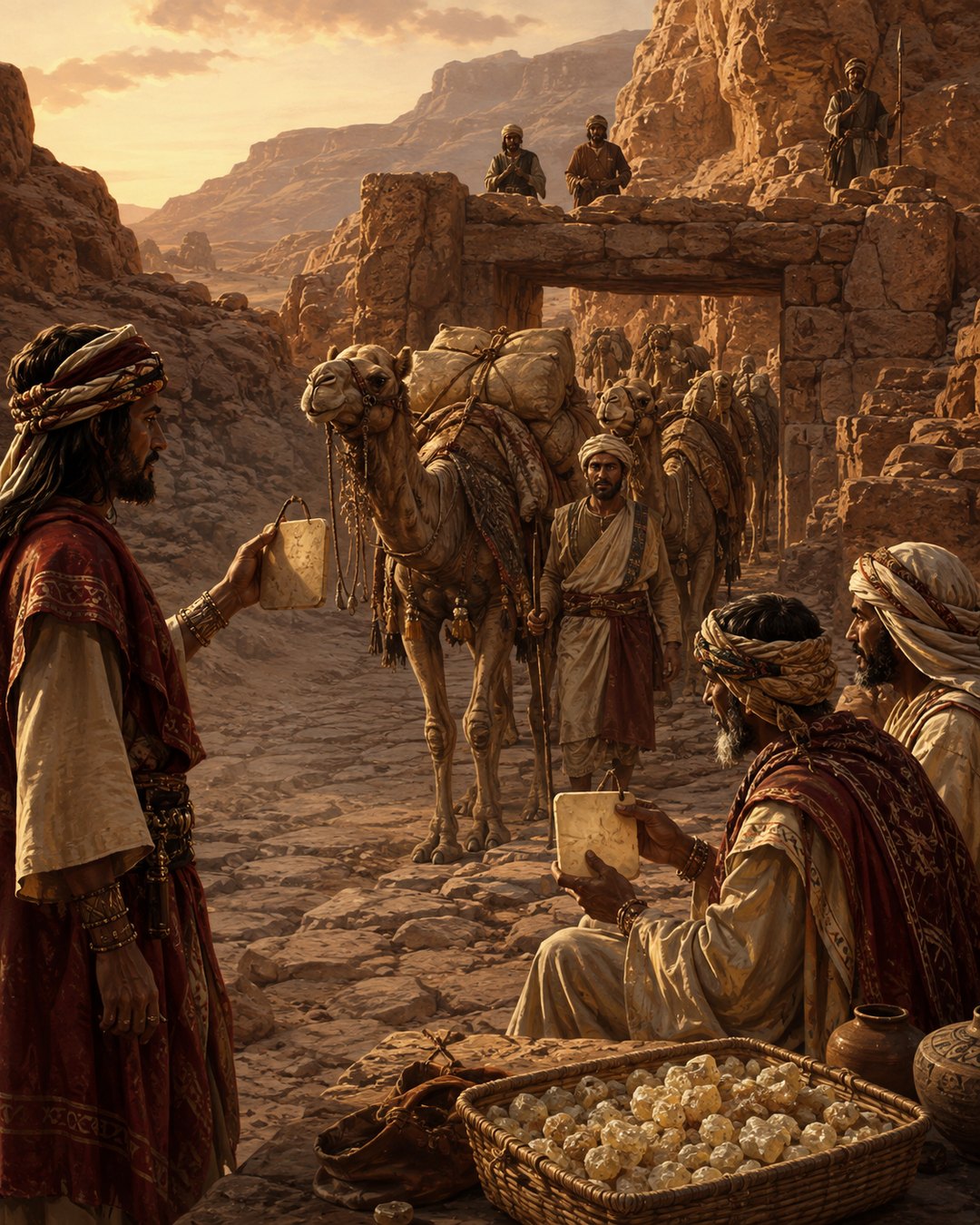
A camel carrying frankincense toward the Mediterranean did not carry one price. It accumulated prices. Pliny the Elder counted payments for water, fodder, lodging, gatekeepers, guards, royal officers and priests until expenses reached 688 denarii per camel before Roman customs took their share.
The resin began far from Rome in a restricted district of South Arabia. Trees were cut, drops hardened, harvests were sorted and loads moved through a route whose geography and permissions were as important as the fragrance itself.
On a Roman altar, frankincense vanished into smoke within minutes. Behind that brief transformation stood months of labour and a corridor of institutions extending from a pale rocky grove to the coast.
Pliny’s account is imperfect geography reported through traders and envoys, but its supply chain is unusually concrete. Sacred families, palm mats, sealed aprons, camel stages and measured tithes turned scent into revenue at every transfer.
The Trees Grew Behind a Narrow Commercial Door
Pliny begins by limiting the source. Arabia alone, he says, produced frankincense, and not all Arabia. He places the grove district of Sariba eight days from Sabota, capital of the Sabaei.
The landscape was described as difficult: high rocks, inaccessible cliffs, pale soil tinged red and only a few springs, themselves alkaline. Whether every distance in the report was exact mattered less to a buyer than the message of confinement. Supply came from a bounded place that outsiders could not easily inspect.
Transit passed through Minaean territory along one narrow track. A bottleneck transforms geography into authority. Whoever controls the route can count loads, enforce dues and decide which merchants continue.
Pliny reports that no more than three thousand families held hereditary rights in the trade. Their members were called sacred and were expected to avoid ritual pollution while making incisions in the trees. Commercial privilege and religious status reinforced one another.
The figure should be read as Pliny’s report, not a modern census. Yet it tells us how Romans imagined the market: access was inherited, scarce and protected by customs stronger than an ordinary bargain.
Two Harvests Began with a Wound in the Bark
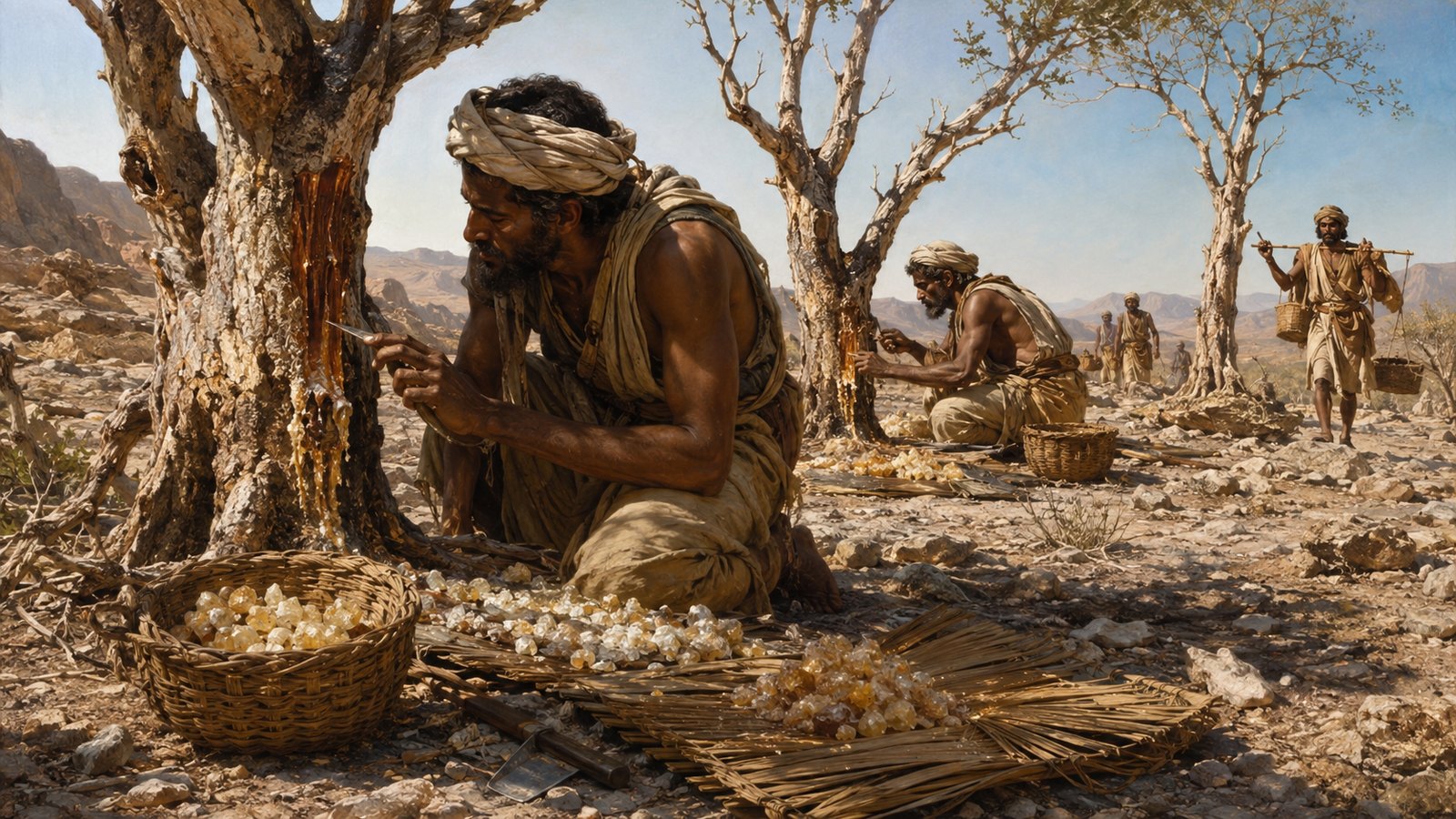
The earlier harvest started around the rising of the Dog-star, when summer heat was strongest. Workers chose places where bark seemed swollen with juice, struck and loosened it, but did not remove it entirely.
A greasy foam came from the opening. It coagulated and thickened on a mat of palm leaves where the terrain required one, or on a patch of ground rammed hard around the tree. Collection method affected the result: hardened ground gave purer resin, while mats increased weight.
Material adhering to the trunk was scraped off with an iron tool and therefore carried pieces of bark. Quality emerged before the caravan moved. The worker’s surface, timing and tool shaped what later buyers would grade.
The summer flow was collected in autumn and produced the whitest, purest kind. Trade demand had introduced a second harvest. Cuts made during winter yielded a redder spring collection that Pliny considered inferior.
This cycle resembles the patient conversion described in the workshop work of Roman perfume makers. In both cases aroma depended on repeated handling of substances whose value could be damaged by haste, contamination or the wrong stage of processing.
Honesty in the Grove Became Surveillance at Alexandria
Pliny contrasts two systems of trust. The forest was divided into definite portions, yet he says owners did not need guards after the trees were cut because neighbours did not steal from one another.
At Alexandria, where frankincense was prepared for sale, the atmosphere changed completely. Workers’ aprons were sealed. Close masks or nets covered their heads. Before leaving, they removed their clothes so that valuable pieces could not be carried out unseen.
The contrast may contain the moral theatre common in Pliny: distant growers embody inherited honesty, while a great commercial city requires intrusive control. Even so, the details show the problem created by a light, portable and costly commodity.
A nugget of resin is easier to hide than a stone block or wine amphora. Loss can occur grain by grain. Management therefore extended to seams, hair and the body itself.
Value changed the architecture of work. A grove could rely on visible family plots; a processing room relied on seals and searches. The same substance moved from communal reputation into an audited factory.
Every Stage Converted Passage into Payment
Loads entered Sabota through a designated gate. Priests took a tithe measured by volume for the god Pliny calls Sabis, and the incense could not enter the market before that share was removed.
Export then crossed the land of the Gebbanitae and incurred another royal payment. Pliny names Thomna as their capital and gives the distance to Gaza as 1,487 miles divided into sixty-five camel stages.
Along that journey, necessity created repeated toll points. Camels needed water and fodder. Drivers needed lodging. Guards, attendants, gatekeepers and officials expected portions or fees. No single charge explains the final expense; accumulation does.
The route can be compared with Palmyra’s bilingual customs tariff, where movement through a desert city became measurable public revenue. Frankincense passed through a longer chain, but the underlying opportunity was similar: traffic could be priced because it had to use specific services and gates.
Pliny’s total of 688 denarii per camel ends before the Mediterranean and before Roman customs. The number captures a load still in transit. It is an interim balance sheet, not the final Roman retail price.
Quality Tests Made an Invisible Route Legible
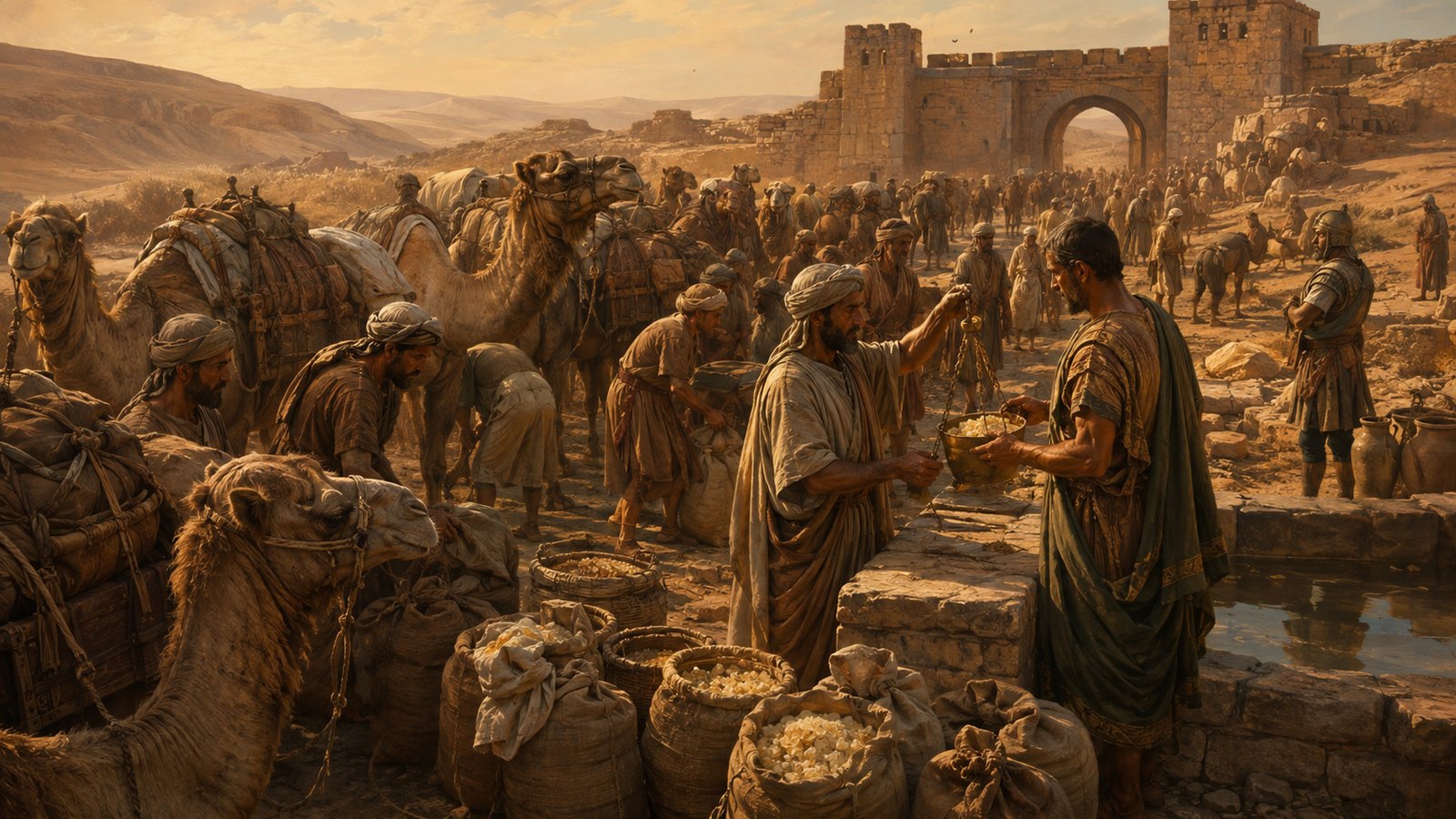
Once frankincense reached buyers, its distant history could not be inspected directly. They needed tests. Pliny lists whiteness, stickiness, brittleness and readiness to catch fire from a hot coal. Good material should resist the teeth and crumble into grains rather than yielding softly.
He prices three grades at six, five and three denarii per pound. The spread translated harvest colour and physical behaviour into market categories that a merchant could quote far from the grove.
Adulteration remained possible. White resin could resemble frankincense closely enough to be mixed with it. Sensory examination became a defence against losing the meaning of origin somewhere along sixty-five stages.
At Rome, the consumer encountered fragrance, whiteness and a stated grade. The caravan’s payments were hidden inside those qualities. Sacred status, hard soil, bark fragments, autumn timing, factory searches and camel fodder condensed into a small handful ready to burn.
The smoke made the material appear immaterial at the moment of use. Pliny’s route restores its weight. Frankincense had occupied sacks, trees, mats, gates and animals before it occupied the air. Its expense was not produced by rarity alone but by the long sequence of people able to say that the load could proceed only after their claim had been satisfied.
The stated retail grades also prevent a simple comparison between caravan expense and the price of one pound in Rome. A camel carried many pounds, while the 688-denarius total attached to the whole load before customs. Merchants still had to absorb losses, sort qualities, divide bulk cargo and move it through Mediterranean distribution. Pliny gives pieces of the account rather than a final profit calculation.
What his pieces reveal is a commodity repeatedly made legible. Incisions marked future resin, family rights marked access, the tithe measured a sacred share, stages divided distance and physical tests separated grades. Long before incense marked a Roman ritual, counting and inspection had marked almost every step of its journey.
Sources
Pliny the Elder, Natural History 12.30–33.