
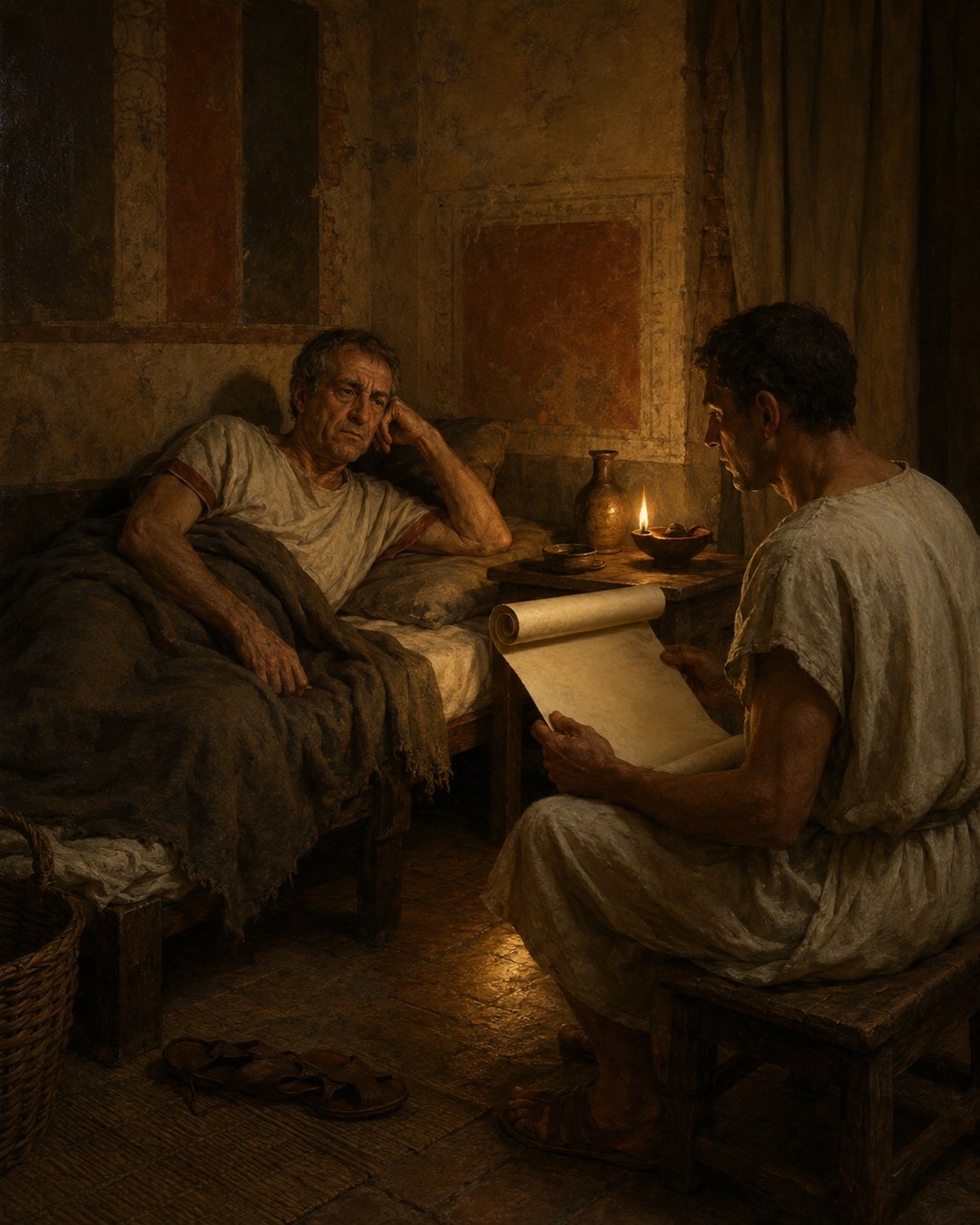
Augustus slept for about seven hours, according to Suetonius, but never as one unbroken night. He woke three or four times. When sleep would not return, readers and storytellers were summoned to speak beside the bed until their voices carried him back.
The ruler who reorganized Rome’s calendar could not simply order his own body to keep time. His household built supports around interruption: books at night, late rising after dawn, naps after meals, slow litter journeys and borrowed rooms near unusually early appointments.
Suetonius presents these details as biography, not medicine. They reveal habits selected to make an emperor recognizable at close range. Yet the routine is concrete enough to show how private vulnerability became a problem of staff, rooms and transport.
Augustus did not conquer sleeplessness. He arranged people and places so work could continue around it.
Seven Hours Broke into Three or Four Awakenings
The total sounds ordinary until Suetonius qualifies it. Augustus’s seven hours were not continuous. Three or four awakenings divided the night into short sections.
Fragmentation changes what a clock total means. Time in bed can be counted, but each return to wakefulness demands another transition. The difficulty lay not only in losing minutes but in repeatedly having to begin sleep again.
Suetonius connects this pattern with Augustus’s reluctance to rise early. If the final successful stretch came near dawn, daylight did not necessarily end the night. He could remain in bed beyond the hour expected by others.
The statement helps explain why his household needed options rather than one fixed cure. Some awakenings ended quickly. Others required voices, a delayed morning or rest recovered elsewhere.
Ancient biography often turns bodily habits into clues about character. Here irregular sleep neither proves virtue nor vice. It makes imperial discipline dependent on accommodation.
A Human Voice Became the Night’s Working Tool
When Augustus could not resume sleep by himself, he called for readers or storytellers. The distinction suggests that the useful element was not one treasured text. Continuous, controlled narration mattered.
A reader had to be available after ordinary household hours, with a lamp low enough for a bedroom and material suitable for sustained recitation. A storyteller could continue without making the emperor hold a scroll or focus his eyes.
The scene reverses public performance. In a forum or senate, Augustus’s attention was the prize. At night, another person spoke precisely so that his attention could loosen.
Reading often worked, Suetonius says. Sleep returned and could hold beyond sunrise. The household voice therefore bridged two vulnerable moments: wakefulness in darkness and the delayed start of morning.
Readers can compare this private use of recitation with the large-letter history Cato prepared for his son. Both remind us that Roman texts were physical and vocal tools, shaped around a particular listener rather than consumed only in silent solitude.
A Modest House Still Contained Specialized Refuge
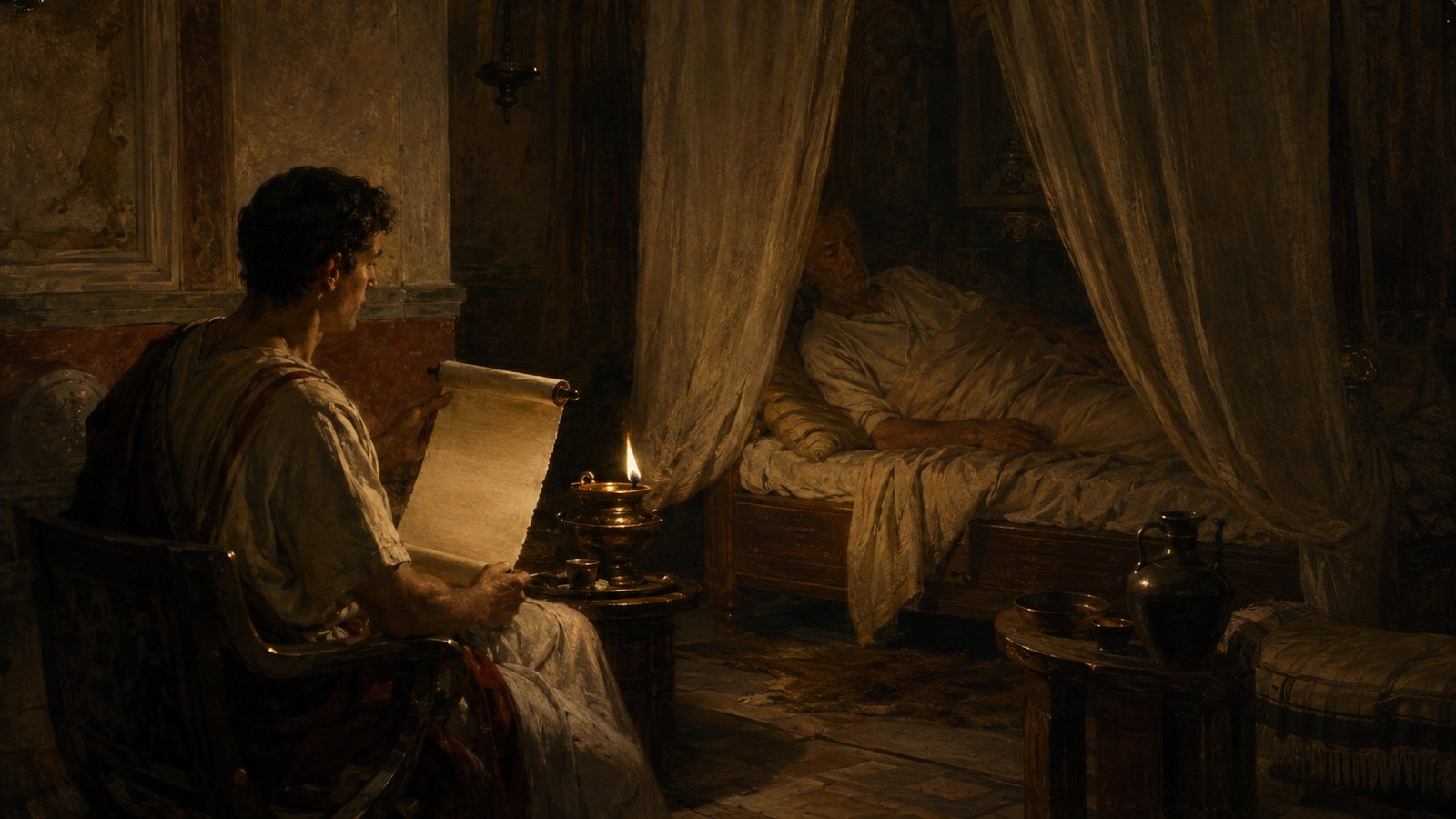
Suetonius locates the routine within a Palatine house he calls modest. Its colonnades were short, and its rooms lacked the marble display and elaborate pavements expected from imperial magnificence.
Augustus used the same bedroom in winter and summer for more than forty years. Repetition made the room a stable stage while public authority and the city around it changed.
Modesty did not mean absence of choice. When Augustus wanted privacy, he withdrew to an upper room he nicknamed Syracuse or his little workshop. He could also move to suburban houses or estates when illness or concentration demanded another environment.
The contrast matters. Imperial resources did not appear only as luxury surfaces. They appeared as access to controlled space, attendants who could be called at night and the ability to relocate a schedule.
A bedroom without marble could still sit at the center of an exceptional service network. The emperor’s apparent simplicity and his household capacity existed together.
Litter Curtains Turned Travel into Recoverable Rest
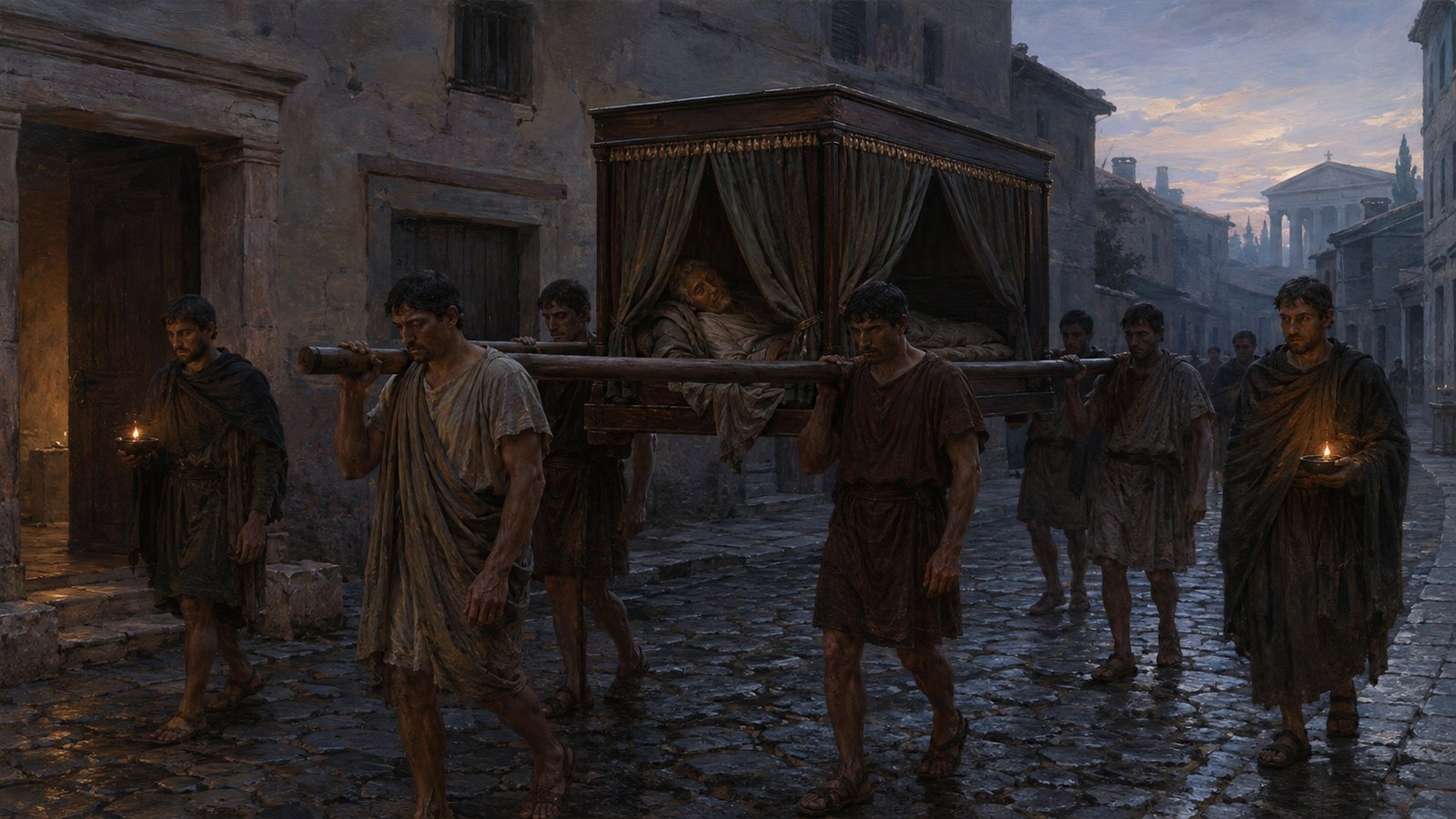
Night did not always find Augustus inside his fixed bedroom. Suetonius says he often slept while a litter carried him through the streets.
A curtained litter transformed travel time into a moving rest period. Bearers controlled pace; attendants managed passage; the passenger surrendered direction without surrendering destination.
If an interruption woke him, the journey could pause. The litter was set down until sleep returned. Movement became conditional on the sleeper rather than the sleeper adapting to traffic.
This arrangement exposes the labor beneath recovered minutes. Several people had to carry, guard and wait while one man slept. An emperor’s private solution redistributed wakefulness to other bodies.
The contrast is sharp beside Claudius’s board engineered to keep dice steady in a moving carriage. Both anecdotes turn transport into a managed interior, but one stabilizes play while the other protects sleep.
Early Appointments Could Move the Bedroom
Augustus disliked rising early, yet imperial business sometimes demanded it. For a duty set before his preferred hour, he could stay at the house of a friend close to the meeting place.
The solution did not change the appointment. It changed the preceding night. By shortening the morning journey, Augustus preserved more rest and reduced the chance that transport would make him late.
Such borrowing converted Rome’s social network into scheduling infrastructure. A nearby household supplied a room, attendants and access. Friendship operated through geography as well as counsel.
Suetonius also says Augustus napped after meals. Noise did not always prevent it; people might continue business nearby while he rested. Night demanded readers and careful recovery, yet daytime exhaustion could overcome surroundings that seem less suitable.
The difference is not necessarily contradiction. Sleep pressure changes across a day, and a person who struggles after a nocturnal awakening may fall asleep readily after food. Suetonius records behaviour, not a diagnosis.
Across the routine, Augustus used four resources: voice, space, motion and permission to delay. A reader filled wakefulness without stimulating public business. A familiar bedroom reduced change. A litter reclaimed travel. A borrowed house shortened the next morning.
These were practical adjustments, but they were available on imperial scale. Most Romans could not command a reader at midnight or stop a staffed vehicle until sleep returned. The ordinary problem of a broken night reveals extraordinary control over other people’s time.
Biographical intimacy can make power disappear behind a relatable habit. Suetonius does the opposite when read closely. Augustus’s sleeplessness was human; the network assembled around it was political. Rome’s day began only after a household had worked through its ruler’s night.
The routine also separated kinds of attention. Official papers, petitions and judgments demanded wakeful decision; stories at bedside were useful because they asked for less and could dissolve into sleep. The same culture of recitation served government by day and rest by night, but the listener’s purpose changed completely.
Nothing in the passage tells us which works were chosen, how loudly they were read or whether the same attendants rotated through the task. Those details should remain open. What Suetonius does preserve is the repeated human arrangement: wake, summon a voice, drift back, and let sunrise wait when necessary.
That sequence makes the bedroom part of imperial timekeeping. Court calendars and appointments might be fixed in public, but the household absorbed uncertainty before Augustus appeared. Readers, bearers, hosts and attendants turned a fragmented night into a day that could still look orderly from outside.
Sources
Suetonius, Augustus 72 and 78.