
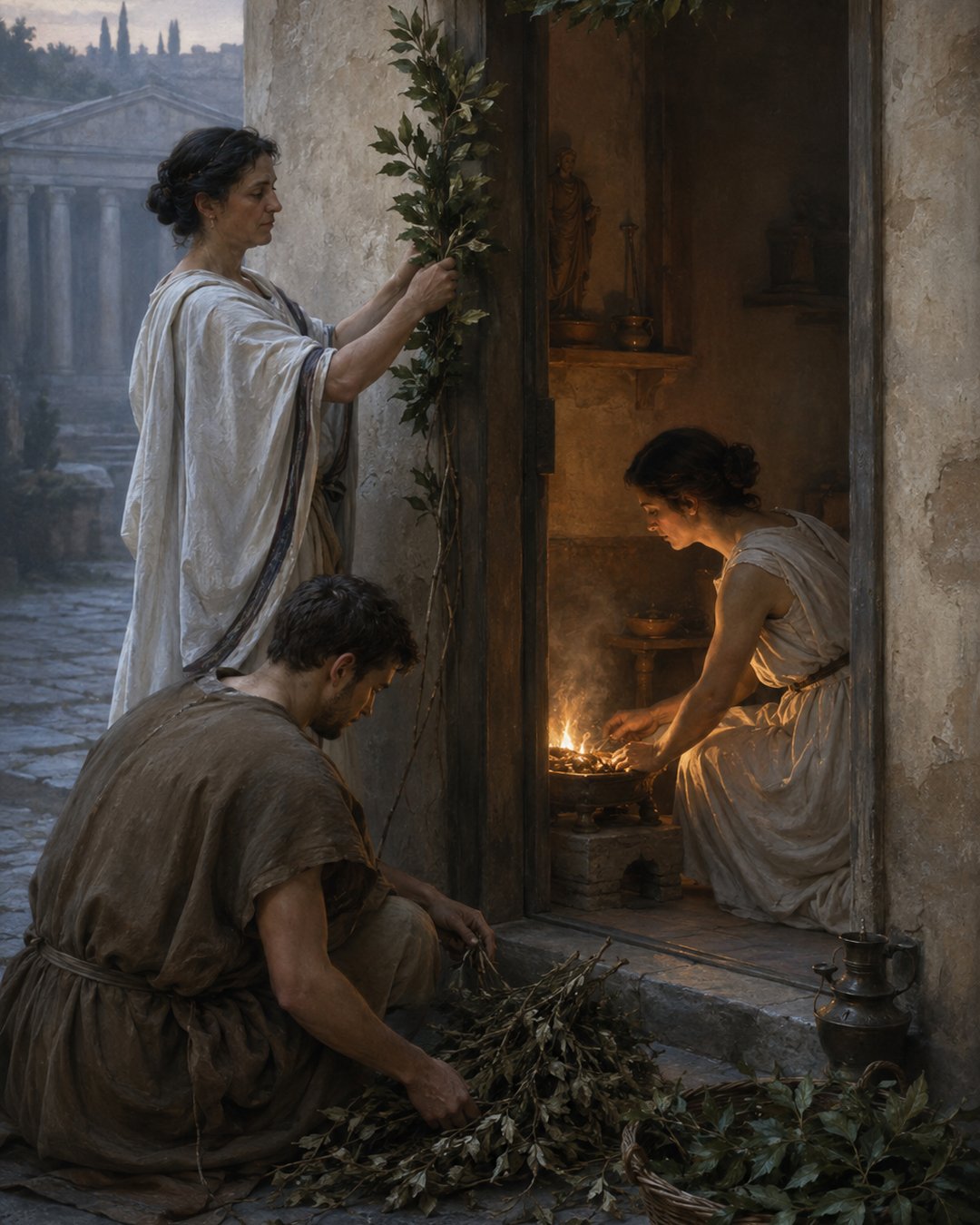
On the Kalends of March, year-old laurel came down from Roman sacred places. Fresh branches replaced it at the flamines, the doorway of the ritual king and an old curia. At Vesta’s hearth, dry leaves were removed and a new fire was kindled inside the shrine.
By Ovid’s lifetime, January already opened the civic year. Yet he treated these March renewals as evidence of an earlier order. Rome had moved its calendar boundary without stripping March of every ceremony that once made beginnings visible.
The poet adds clues from offices, festivals and month names. Anna Perenna, an annual goddess, received worship in March. Magistrates had once entered office then. Quintilis still called itself the fifth month, a number that works only if counting starts with March.
Ovid is not writing a modern institutional history. He is reading the city’s rituals like a layered site, where fresh greenery and a growing flame preserve a calendar beneath the calendar.
Old Leaves Had to Leave Before the Year Looked New
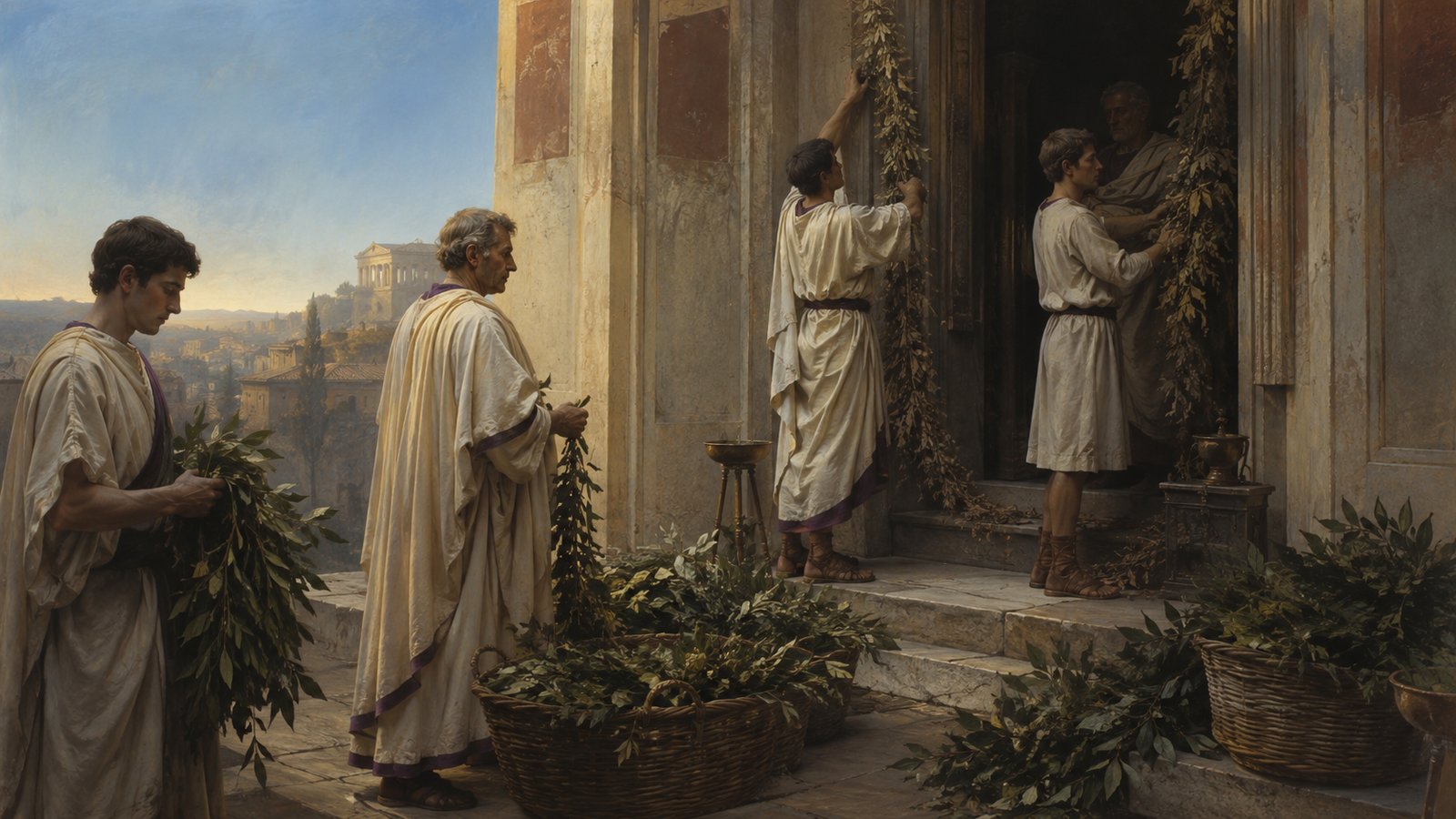
Laurel remained in place for a year, according to Ovid, then was removed on the March Kalends. The replacement happened at several locations rather than at one central monument.
Fresh leaves appeared with the flamines, priests attached to particular gods. They greened the door of the rex sacrorum, the ritual king. The Curia Calabra received the same treatment. Vesta’s hearth shed its withered branch.
The repetition made renewal a network. Different offices and sacred spaces participated in the same physical exchange: dry for green, last year for this year.
Laurel carried associations of purification, victory and Apollo, but Ovid’s argument here depends above all on duration. It had occupied its place through a cycle. Its visible age allowed removal to mark elapsed time.
A calendar number is abstract. A brittle branch under the hand is not. By changing materials, Rome let annual recurrence be seen and touched.
Vesta’s Flame Gained Strength Again
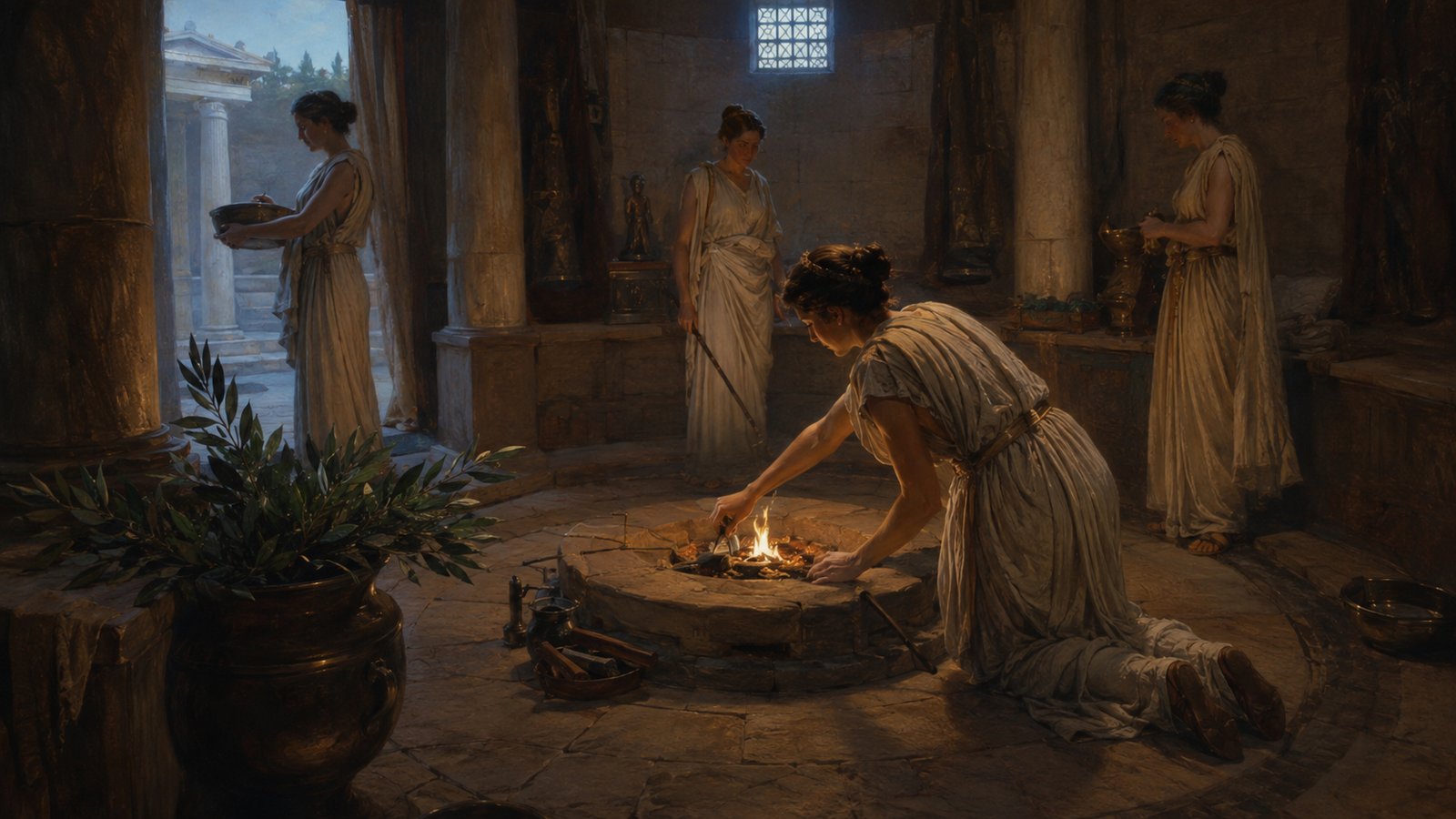
At Vesta’s secret shrine, Ovid says, a new fire was lighted and the rekindled flame gained strength. The image combines continuity with interruption. Vesta’s fire represented the enduring center of Rome, yet its ritual life included renewal.
The passage does not invite us to imagine the hearth abandoned. New fire was a controlled beginning inside an institution devoted to keeping sacred flame. Ending and continuity could therefore coexist.
Fire differs from laurel in one important way. A branch can be stored as an object; flame exists only through fuel and transfer. To renew it safely required prepared attendants, suitable material and a protected place.
Ovid places the act inside the shrine rather than turning it into a public spectacle. That privacy strengthens his antiquarian method. He points to ritual knowledge as evidence even when most Romans would not watch every stage themselves.
The repeated responsibility can be set beside the assistants who protected the exact performance of a public prayer. Roman ritual often made continuity depend on trained people preventing small procedural failures.
Month Names Betrayed the Older Count
Ovid’s strongest clues require no access to a sanctuary. They survive in ordinary names. Quintilis means fifth. Its position makes sense if March is month one: March, April, May, June, then Quintilis.
The same logic continues through the later numbered months. September, October, November and December preserve seven, eight, nine and ten while occupying later positions in the January-based year.
Names can outlive the system that produced them because changing every familiar word is costly and unnecessary. Once a label becomes ordinary, speakers no longer solve its arithmetic each time they use it.
Ovid exploits that inertia. The months become linguistic fossils, evidence that an earlier sequence remains embedded in daily speech.
His argument complements the Roman civil day that began at midnight. Both show that units of time depend on agreed boundaries. Sunrise feels natural, yet a legal day can start in darkness; January feels inevitable, yet month names remember another beginning.
Office and Festival Still Pointed Toward March
Ovid says magistrates were recorded as entering office in March until the era of war with Carthage. Political time had once reinforced seasonal and ritual time.
Changing an office date could move administrative practice more readily than it changed inherited ceremonies. Rome accumulated calendars for elections, military needs, priestly observance and household expectation. Reform aligned some and left others carrying older rhythms.
Anna Perenna offered another annual clue. Her very name invited connection with passing through the year, and her March festival made the old opening audible in worship.
Readers can see that celebration more closely in the feast where revelers counted cups as years of life. Ovid’s calendar argument uses the festival differently: not primarily as a drinking scene, but as one surviving marker in a cluster of March beginnings.
No single clue has to carry the entire case. Laurel, flame, office, goddess and numbered names converge. Ovid’s method gains force from accumulation.
Reform Moved the Boundary but Preserved the Layers
Ovid credits Numa with seeing that two months were lacking, while acknowledging alternative stories about how he learned. He then says the calendar remained erratic until Julius Caesar took it in hand.
Caesar’s reform looked to the sun and calculated a year of days plus a fractional correction. Ovid treats that mathematical intervention with admiration. Calendar repair was worthy work even for a ruler destined, in the poem’s language, for the heavens.
The passage does not offer a clean sequence in which one perfect system immediately replaces another. It compresses foundation legend, royal reform, political practice and Julian astronomy. That compression itself resembles the calendar Rome inherited: several historical solutions occupying one grid.
March remained named for Mars and charged with reopening activity after winter. Fresh laurel and fire gave that reopening material form even when January held the official first position.
The old year therefore survived without governing every date. It survived as a ritual memory enacted annually by people who may have experienced the ceremonies as present obligations rather than historical exhibits.
When attendants removed a dry branch, they did not need to announce a theory of calendar development. The replacement performed renewal on its own. Ovid supplied the antiquarian question: why did this particular day gather so many beginnings?
His answer rests in Rome’s reluctance to become only one age at a time. A reformed solar calendar could organize civic life while priestly doors still greened at the former threshold. The new fire did not reverse Caesar. It illuminated a boundary the city had moved but never completely forgot.
The evidence is strongest as a cluster because ritual meanings can shift. Fresh laurel might gather new explanations; an annual goddess could attract several stories; office dates could move for practical reasons. When all of them point toward March, however, the old boundary becomes harder to dismiss as one poet’s decorative guess.
Ovid lets material replacement and verbal survival confirm one another. The priests changed branches, while Romans kept saying month names whose numbers no longer matched their positions. One practice renewed objects; the other preserved obsolete arithmetic. Together they made the past recur without restoring its authority.
Sources
Ovid, Fasti 3.135–166.