
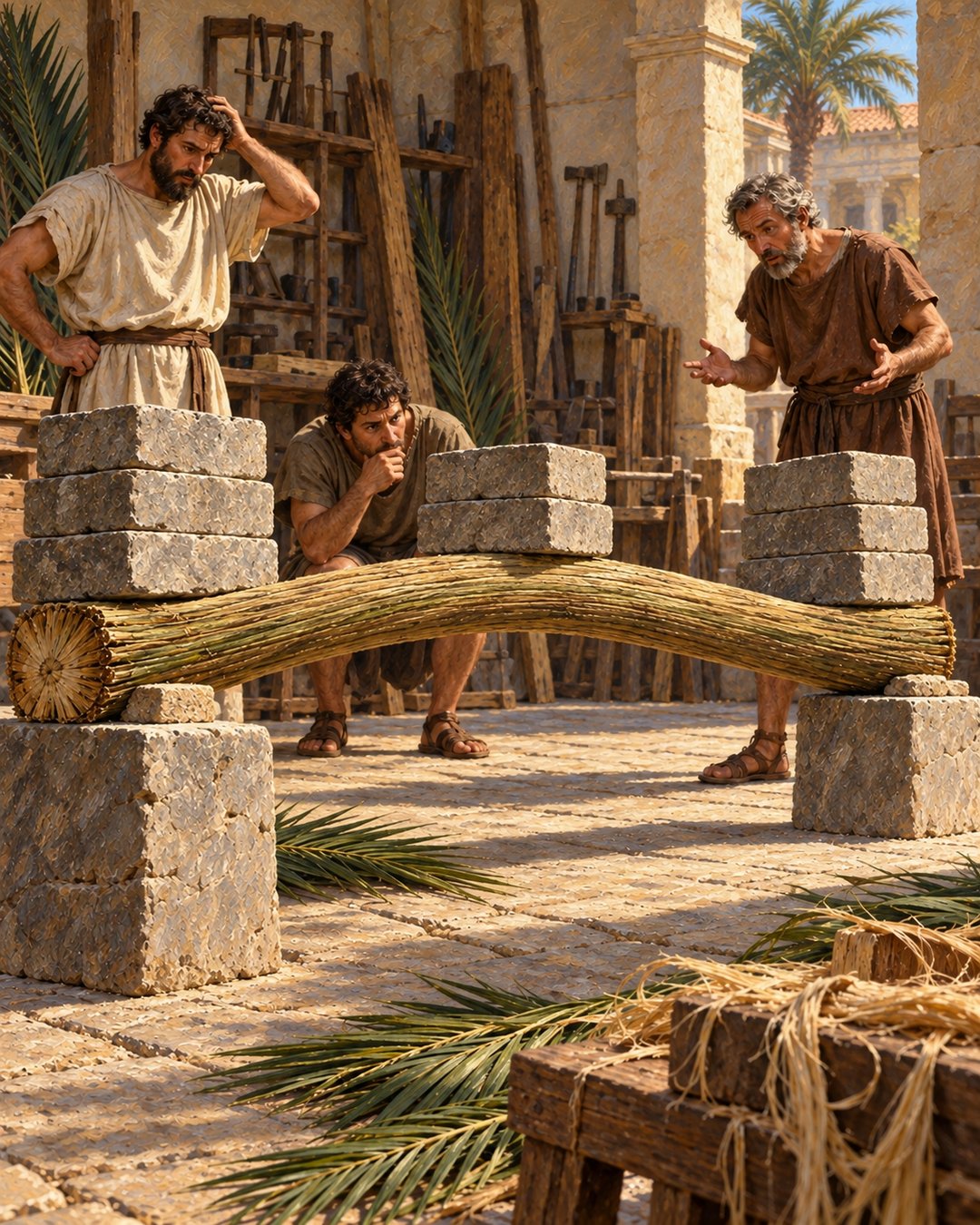
A heavy load presses a wooden beam, and the expected picture is simple: the middle sags. Aulus Gellius gives palm wood a different response. Stack on weights until the burden seems too great, he says, and the timber does not hollow downward. It rises against the pressure and takes a convex form.
Gellius calls the report wonderful, names Aristotle and Plutarch as authorities, and then turns from material behavior to public meaning. The palm was chosen as a symbol of victory in contests because its wood supposedly refused to yield to what tried to crush it. The branch in a victor’s hand carried the story of the loaded beam.
The chapter is only a compact entry in the Attic Nights, but its compression is the point. Observation, citation and symbolism lock together in a few sentences. Rather than treating the palm as an arbitrary prize, Gellius offers readers a mechanism they could picture: pressure arrives from above, and the material answers by moving the other way.
Two Greek Authorities Stood Behind One Roman Paragraph
Gellius does not present himself as the first person to place weights on palm wood. He directs readers to Aristotle’s Problems, specifying book 7, and to book 8 of Plutarch’s Table Talk. The named trail matters because the claim is surprising enough to need company.
His miscellany regularly preserves knowledge through encounters with books, teachers, remembered conversations and older authorities. Here the chain is unusually visible. A Roman author writing in Latin gathers a statement associated with two Greek writers and gives it a new, highly portable shape.
The attribution also changes the tone. Gellius begins by calling the behavior truly wonderful, but wonder is not left as a rumor from an unnamed workshop. Aristotle and Plutarch make the claim part of a learned conversation about nature. The reader is invited to recognize both the marvel and its pedigree.
That does not require us to pretend the passage is a modern test report. Gellius supplies no beam dimensions, species description, moisture level, span or measured load. His account has a clear direction of force and response, but not the controlled variables expected from present-day materials science.
Its ancient precision lies elsewhere. Weight is placed on the wood. The load becomes excessive. The expected downward concavity does not appear. An upward convex form does. Those linked stages are enough for Gellius to carry the report into an explanation about victory.
The Beam Was Defined by the Shape It Refused
The most important word in the description may be the negative one. Palm wood is not made concave. A load normally creates an intuitive contrast between the supported ends and the pressed center. By denying that hollow, Gellius prepares the reader for movement that seems to contradict the force.
He then states the positive response: the wood rises against the weight and assumes a convex form. The language gives the timber almost the posture of resistance. Pressure is not merely endured without visible change; it produces a counter-shape.
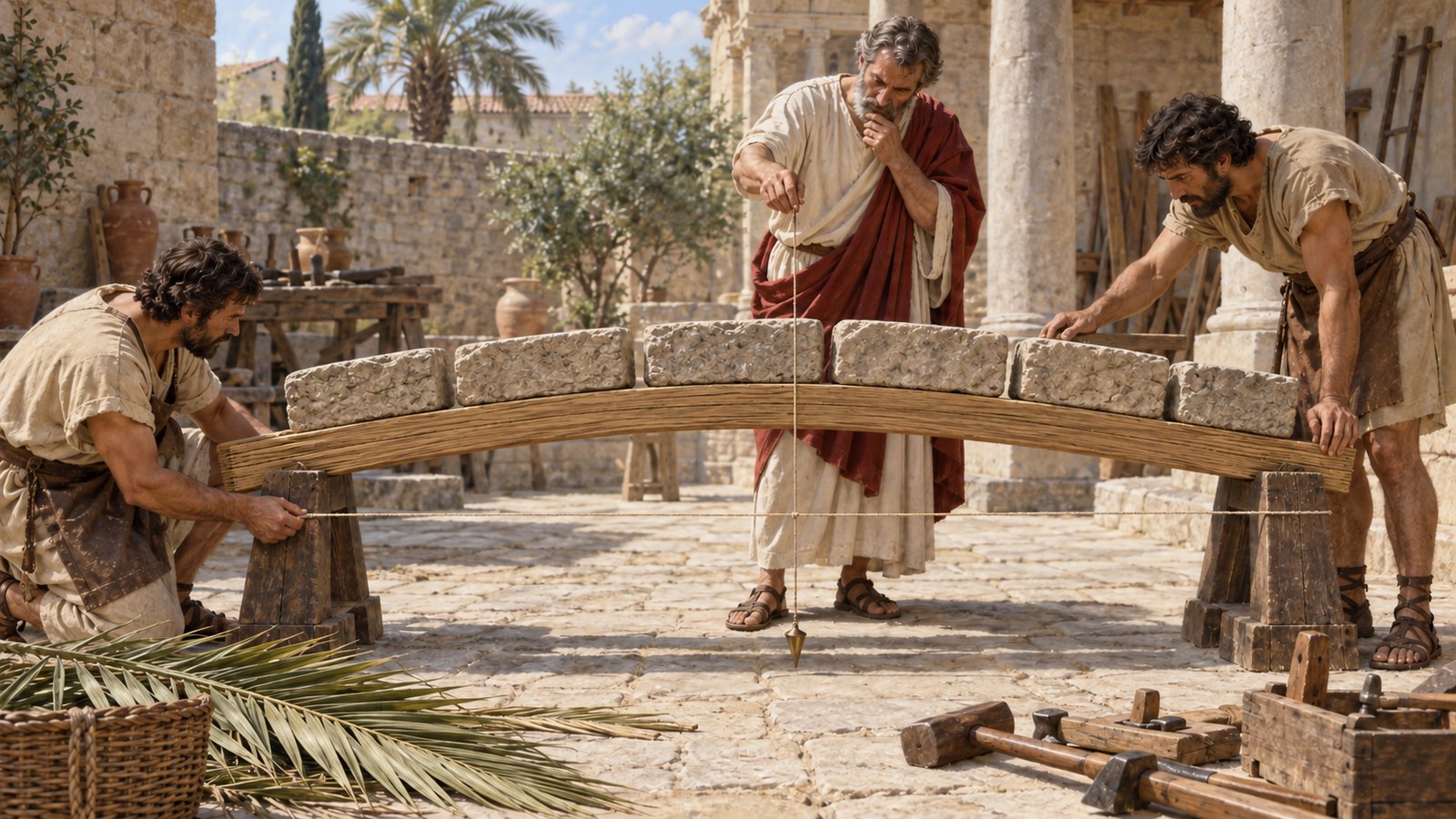
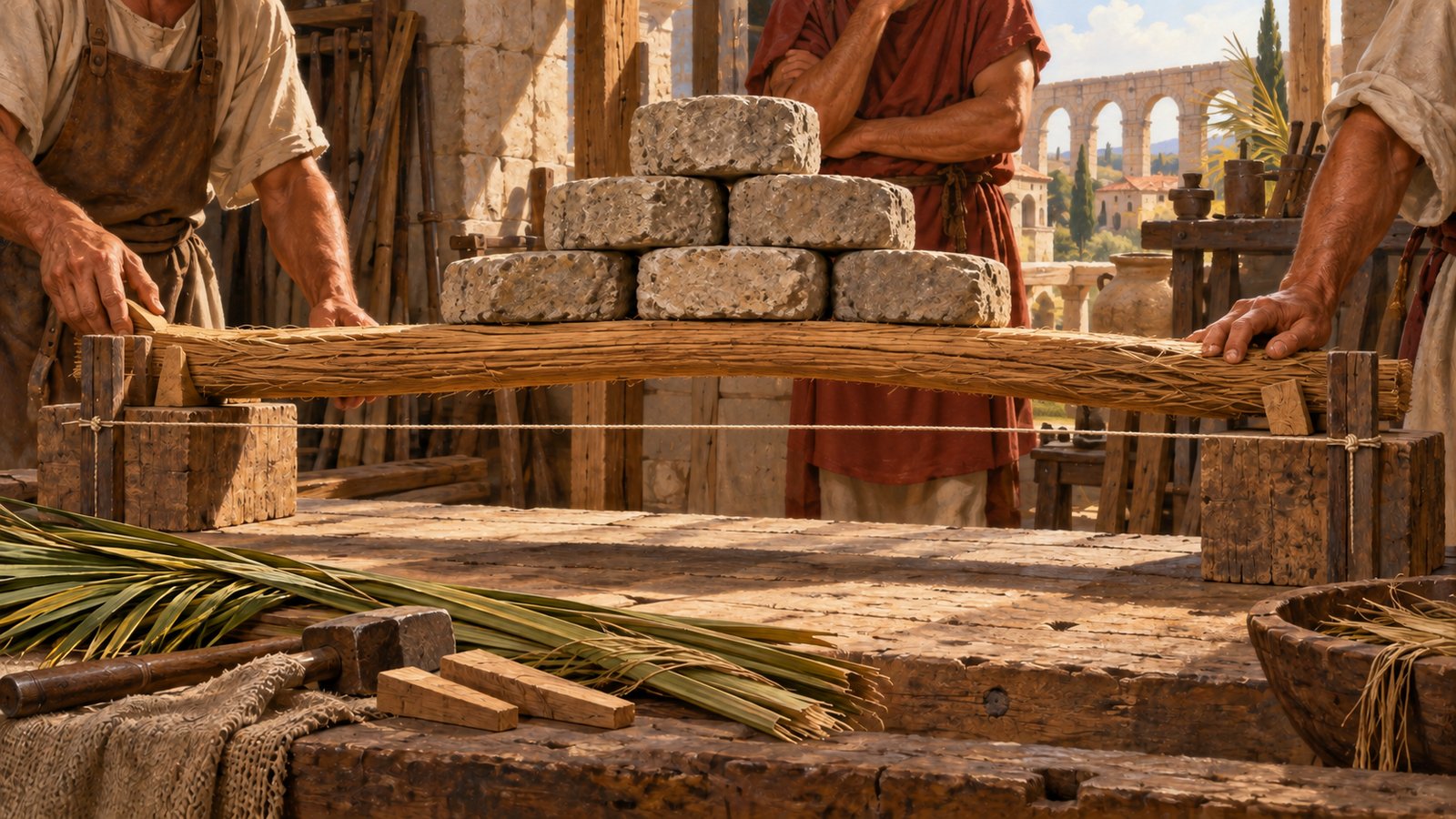
This is why a workshop image helps recover the thought. Place a beam across supports, add plain stone masses, stretch a straight cord nearby and watch the center. Whether or not such an arrangement reproduces the ancient claim, it makes clear what Gellius asks the imagination to compare: downward hollow against upward arch.
Roman readers lived among many woods selected for different jobs, and timber preparation could begin before the tree was felled. Gellius is not writing a carpenter’s procurement guide, however. He isolates one response under pressure because that response can travel beyond the workshop.
The beam is therefore both object and argument. Its supports, load and curve supply a physical sequence. The claim becomes memorable because the shape carries a direction. A flat statement that palm was strong would not do the same work. Gellius needs the wood to rise.
Pressure Made the Palm Legible as Victory
After describing the convex response, Gellius gives Plutarch’s explanation for the contest palm. The material does not yield to what presses hard upon it and tries to crush it. That resistance makes the palm appropriate for the person who has survived opposition and emerged above it.
The explanation depends on more than strength. A wall can be strong, and stone can bear enormous weight, but neither necessarily offers the same visible reversal. Palm wood, as Gellius tells the story, answers the force with an upward movement. The shape itself performs victory.
A branch awarded in a contest could then condense the whole mechanism. Spectators did not need a loaded beam beside every victor. The green palm in hand evoked a plant whose wood was said to become more assertive under pressure. Natural property and human achievement mirrored each other.
This movement from object to symbol is common in ancient explanation, but Gellius makes every hinge visible. First come authorities. Then comes the loading scene. Next comes the refusal of concavity. Finally comes the palm carried in competition. Remove the material claim and the prize becomes convention without explanation; remove the contest and the wood remains only a curiosity.
The result differs from the ritual work performed by fresh laurel in Rome’s March ceremonies. Laurel marked renewal and sacred transition in that setting. Gellius’s palm gains meaning from an imagined mechanical struggle: burden, resistance and upward form.
A Tiny Chapter Preserved an Entire Way of Knowing
Gellius’s paragraph shows how natural history could function inside a literary miscellany. He does not separate materials, books and customs into sealed categories. A statement about wood can explain an athletic emblem because both are held together by the idea of resisting pressure.
The brevity makes the chapter easy to underestimate. It preserves two source names, two book references, a test setup, an expected deformation, a reported contrary deformation and a cultural consequence. Each element is small, but none is decorative. The authority makes the marvel credible; the mechanism makes the symbol intelligible.
It also preserves uncertainty in a useful way when read carefully. We can say that Gellius reports the phenomenon and explains the victory palm through it. We do not have to enlarge his short account into a universal botanical law. The ancient text itself is the secure object: this is how one learned Roman writer connected pressure in palm wood to triumph.
That distinction lets the chapter remain vivid without turning its claim into a laboratory result it never was. Gellius wanted readers to see the beam bend upward in the mind. He wanted them to feel why a palm branch belonged with the victor. Citation and image did the work together.
A contest ends with one person carrying a simple branch, but Gellius places an invisible load behind it. The palm means victory because it has already been imagined under weight. What tries to force it down produces the curve that explains why it rises.
Sources
Aulus Gellius, Attic Nights, Book 3, chapter 6; citing Aristotle, Problems, Book 7, and Plutarch, Table Talk, Book 8.