
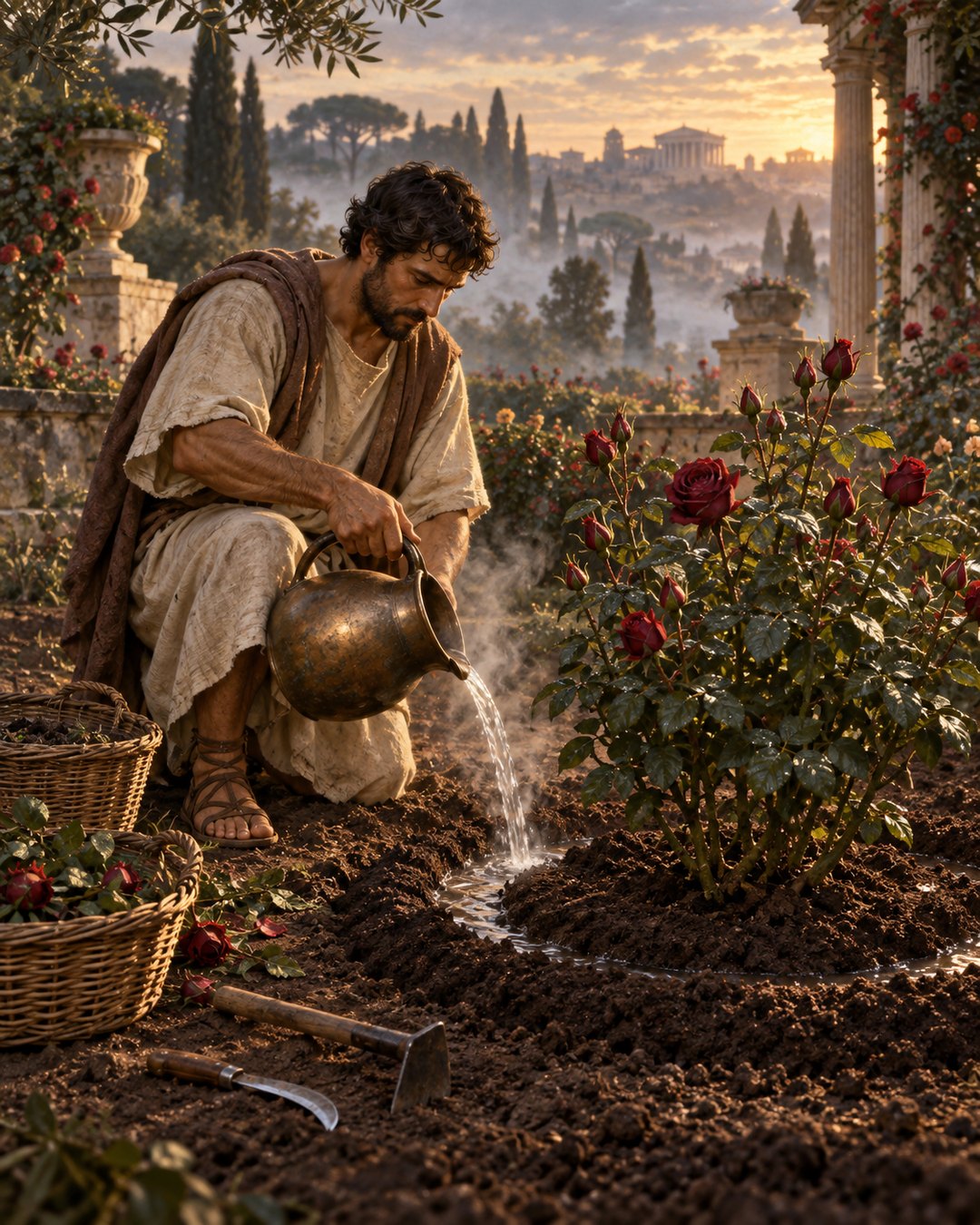
Cold still hangs over a garden when a grower opens the earth around a rose bush. The cut is broad enough to measure: one foot across around the root. As the first buds begin to push, warm water goes into the exposed ring. Pliny the Elder records the intervention in a single practical sentence. Its purpose was to bring roses early.
The instruction appears after a catalogue of colour, fragrance, soil and famous growing regions. That order matters. A rose could be valued because it came from Praeneste or Campania, because it carried an intense scent, or because its petals were unusually numerous. It could also be valued because it appeared when ordinary gardens had not yet flowered.
Pliny’s chapter therefore reveals more than botanical curiosity. It shows cultivators working on time itself. Climate gave Spanish Carthage early roses throughout winter; elsewhere, the gardener answered the calendar with a measured opening, warmed water and attention to the exact moment of bud break.
Petals, Scent and Place Created a Floral Hierarchy
Pliny does not describe “the rose” as one interchangeable commodity. He sorts varieties by traits that buyers could see or smell. The rose of Miletus carried a brilliant red but no more than twelve petals. At the other end of the count stood the centifolia, whose name advertised the possibility of one hundred petals.
The richest visual display was not automatically the strongest perfume. Pliny remarks that roses with very large or broad petals were not necessarily remarkable for scent. Petal number, colour and smell created separate axes of value. A gardener could not assume that improvement in one quality guaranteed superiority in another.
Geography added another ranking. Praeneste and Campania supplied roses Pliny calls especially esteemed in Italy. The hundred-petalled variety grew in Campania and also near Philippi. Cyrene’s rose was, in his account, the most fragrant of all, and he connected that quality with the excellence of local unguents.
These place names made flowers legible inside a broad market. A customer did not encounter only a red bloom. The bloom arrived with an origin, a reputation and an expected set of properties. The same habit of attaching quality to origin shaped Roman talk about wine, oil, timber and stone. Roses belonged in that commercial geography too.
Because flowers fade quickly, however, their hierarchy had an extra pressure. A prized rose could not wait in a warehouse like metal or marble. Its colour and scent were perishable, so distance and season mattered immediately. Cultivation had to produce beauty at the moment demand could use it.
A Spanish Winter Changed the Competitive Calendar
Pliny gives one geographical detail with startling economic force: at Carthage in Spain, early roses appeared throughout the winter. The line turns climate into an advantage. A region able to flower while colder gardens rested could offer what was scarce elsewhere without forcing every bush by hand.
He also says temperature affected fragrance from year to year. Roses could be less aromatic in some seasons than in others, and dry soils produced a stronger smell than humid ones. Timing and quality were therefore entangled. An early flower was not automatically a fragrant flower, and a wet intervention could not simply replace the conditions associated with perfume.
This is one reason the warm-water instruction is so precise. It is not a command to irrigate the whole garden heavily. Pliny actually warns that roses should not be planted in irrigated ground. He also rejects rich and clayey soils, saying the plant is content with thin, light earth.
The grower seeking an early bloom acted locally and briefly. A foot-wide opening concentrated the treatment around the root, and the water was applied as buds began to emerge. The method adjusted one stage rather than turning the bed into permanently saturated soil.
Roman horticulture could be inventive in other ways. Tiberius’s cucumbers followed the sun on wheeled beds, combining mobility, shelter and elite demand. The rose treatment used a different lever. Instead of moving the plant through space, it tried to change the temperature experienced below the stem.
One Foot Became the Unit of Both Spacing and Intervention
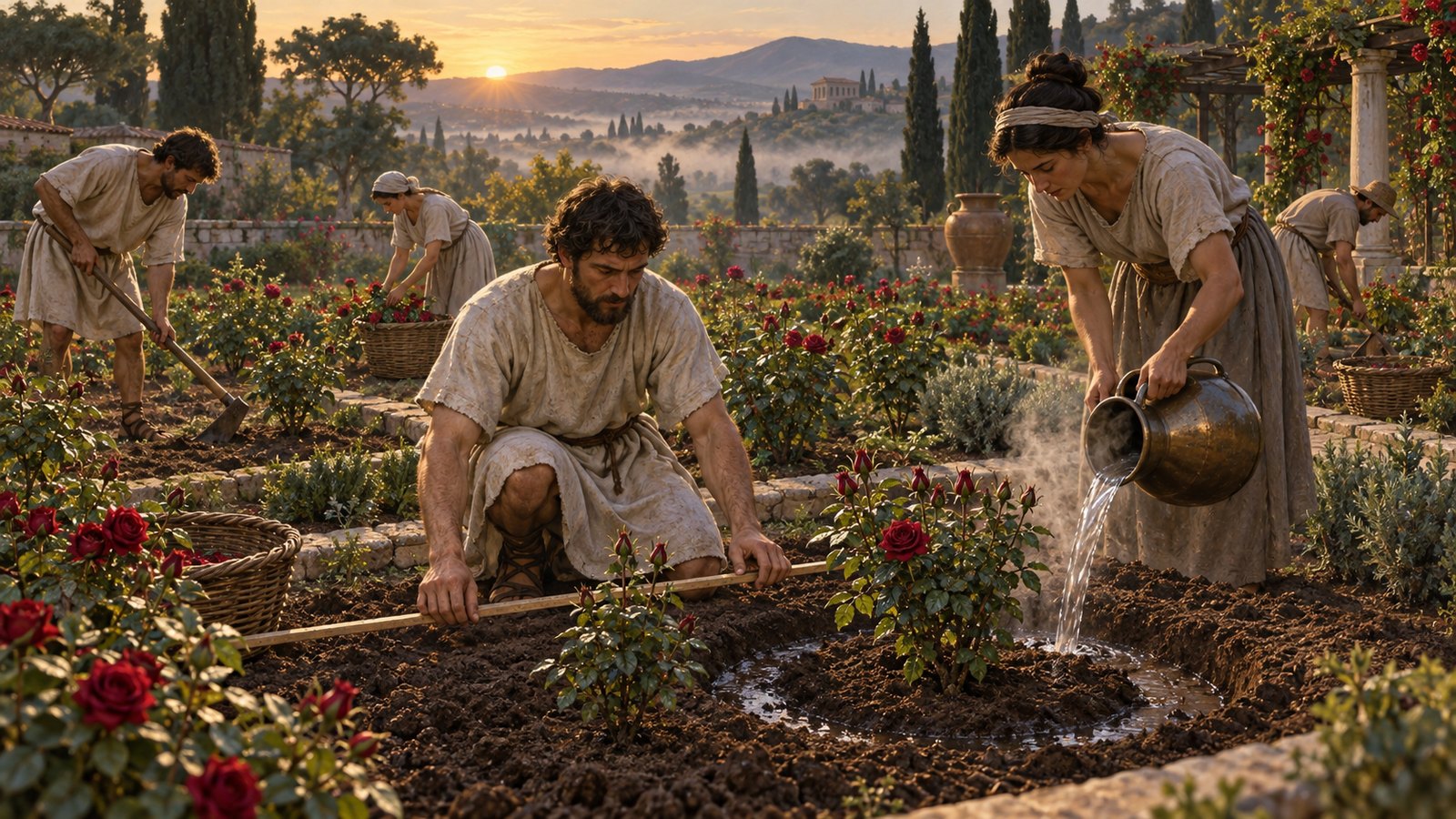
Measurement appears twice in Pliny’s cultivation notes. During the west winds, after the rising of the Vergiliae, roses were transplanted at intervals of one foot. The earth around them was then turned frequently. The bed was not an accidental thicket; it was an arranged surface maintained by repeated labour.
For early flowers, the same unit returned in another form. The grower made a hole one foot in width around the root. We should not imagine a narrow puncture receiving a splash. Pliny describes a broad zone of opened earth, large enough for warmed water to reach the soil around the plant.
The repetition of the foot gives the scene physical scale. Bushes stand in ordered relation to one another, and each root can receive a measured treatment. Workers need digging tools, vessels, fuel or another source for warmed water, and enough judgment to recognize when buds are beginning to put forth.
That final moment prevents the method from becoming a generic recipe. Watering too early would miss the stated trigger; waiting until flowers had opened would defeat the objective. The plant itself announced when the intervention should occur. The gardener watched first, then acted.
This attentive sequence resembles the timing behind fresh laurel and new fire in Rome’s March rituals, though the goals were different. Ritual renewal followed a civic and sacred calendar. The rose grower read buds and weather to steal a small advantage from the natural one.
The Luxury Was Not the Flower Alone but Its Arrival
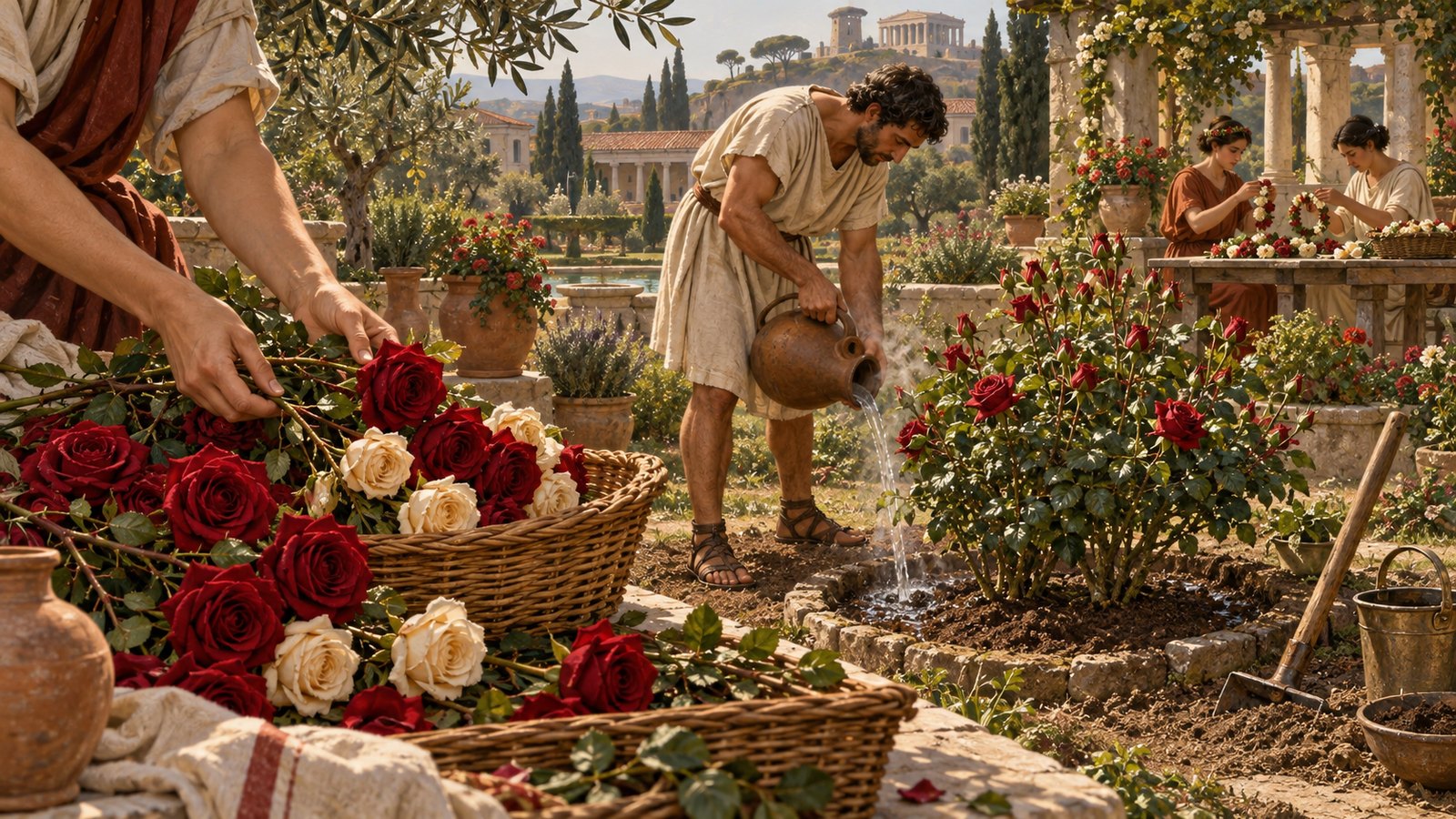
Roses entered several parts of Roman life. Pliny places them among flowers used for chaplets. He also notes their use in plasters and eye-salves, in perfumed preparations, and even in delicacies at banquets. Each use created a reason to care about supply, but display made timing especially visible.
A chaplet worn when roses were abundant could still be beautiful. A chaplet produced before neighbouring gardens had opened carried another message. It represented access to unusual land, favourable climate, skilled labour or a costly intervention. Scarcity became part of the scent.
The warm-water method should not be inflated into a modern greenhouse industry. Pliny gives no yield figures, prices, fuel accounts or proof that the treatment worked uniformly. What he securely preserves is a reported practice and its goal: people who wanted early roses opened a measured space around the roots and applied warm water when budding began.
That modest claim is historically rich. It catches a cultivator translating demand into a physical operation. The market asks for a flower before its ordinary time. The answer is not a mythic explanation but soil moved by hand, water heated, a vessel carried and a root zone treated at the chosen stage.
Pliny’s winter roses at Spanish Carthage and his forced early roses belong to the same story from opposite directions. One place possessed a climatic head start. Other growers attempted to manufacture a smaller one. The rose’s value came from petals, scent and origin, but also from the date on which someone could cut it.
At the centre of the chapter is a quiet act at ground level. A gardener watches a tight bud, measures a foot around the plant, breaks the cool soil and pours warmth toward the roots. Rome’s appetite for flowers reached all the way down into that ring of earth.
Sources
Pliny the Elder, Natural History, Book 21, chapter 10.