
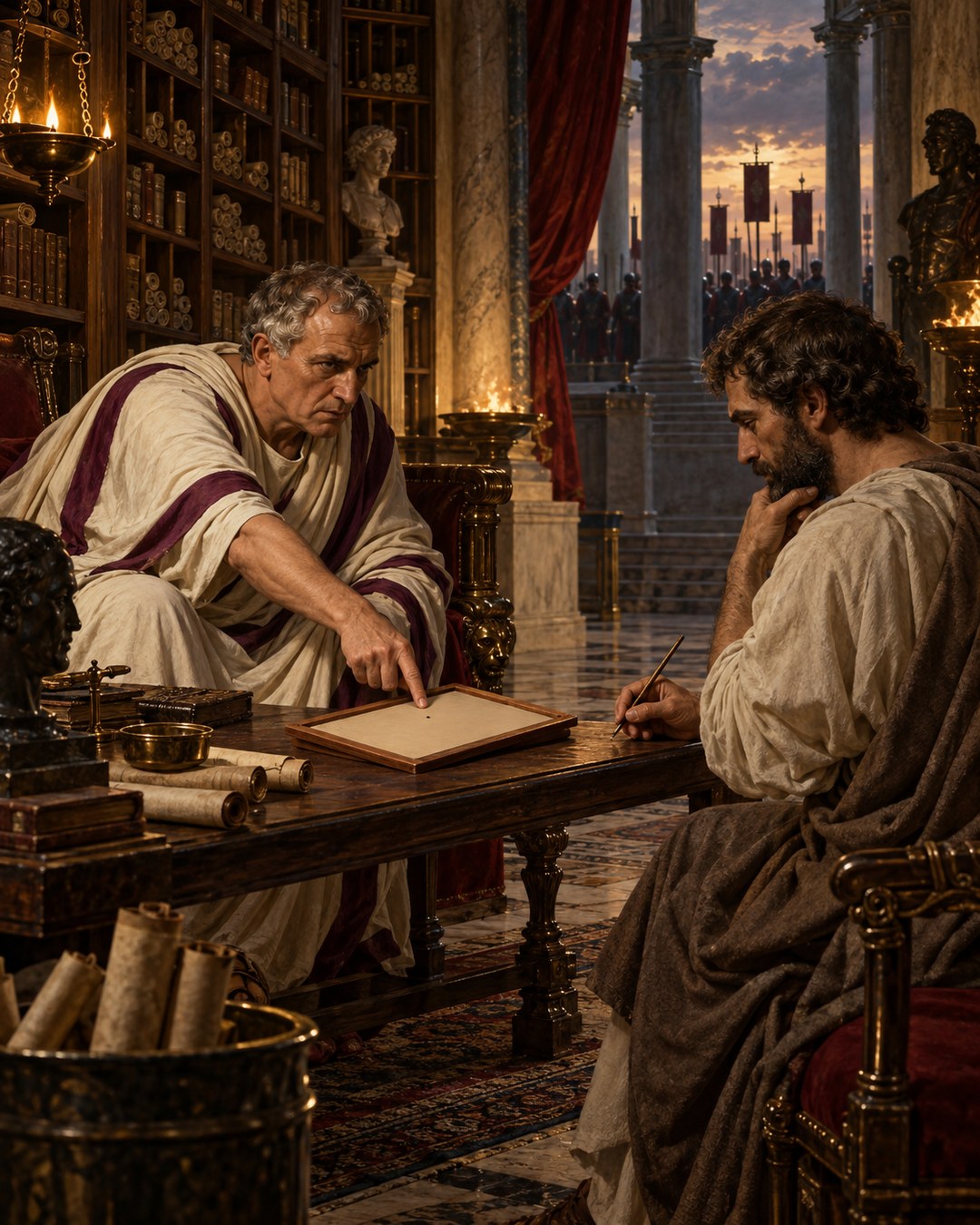
A word lies between two men in an imperial room. Favorinus has used it; Hadrian objects. The philosopher can point to reputable authors who used the same expression, yet the exchange does not end with citations weighed on equal terms. Favorinus yields. Only afterward, when friends accuse him of surrendering a sound position, does he explain the hidden rule of the debate.
They should allow him, he says, to regard the man who commands thirty legions as the most learned of men. The line survives in the Historia Augusta as a joke, but its edge depends on the audience recognizing an obvious mismatch. Legions cannot determine whether a word is good Latin. They can determine how safely someone contradicts an emperor.
Favorinus’s reply is therefore more than courtly flattery. It is a compressed account of intellectual life near absolute power. He concedes the vocabulary in public, then names the force behind the concession in private. Hadrian wins the word; Favorinus keeps the sharper interpretation of what has happened.
One Attested Word Became an Unequal Contest
The biographer gives only a few physical details, which makes the structure unusually clear. Hadrian criticizes a word Favorinus has used. Favorinus yields. His friends later object because reputable writers supplied precedents for that usage. Their complaint assumes the normal tools of scholarship: examples, comparison and judgment built from texts.
Hadrian’s position rests on another kind of precedent. He is not merely an educated participant. He appoints, rewards, exiles and commands. Every person in the discussion knows that the disagreement takes place inside that hierarchy, even if no threat is spoken. The emperor’s correction arrives carrying powers that an ordinary grammarian’s correction does not possess.
Favorinus refuses to state this bluntly. Instead, he pretends that military quantity is a credential. Thirty legions make Hadrian “the most learned” because the philosopher has no intention of testing where literary disagreement ends and imperial displeasure begins. The compliment sounds enormous and therefore reveals its own absurdity.
The number matters. “The emperor is always right” would be a flat maxim. Thirty legions turn the social pressure into a visible institution: formations stationed across provinces, officers carrying orders and a chain of obedience ending in one man. Favorinus makes that machinery enter a dispute about a single word without claiming that a soldier stood beside the tablet.
Hadrian Wanted More Than the Duties of an Emperor
The anecdote sits inside a portrait of Hadrian as an intensely competitive man of letters. The Historia Augusta calls him accomplished in prose, verse and the arts. It also accuses him of treating teachers as though he knew more than they did, subjecting specialists to ridicule, scorn and humiliation.
Hadrian did not simply collect culture as decoration. The biography says he debated professors and philosophers through pamphlets and poems exchanged by both sides. It also reports emphatic literary preferences: Cato over Cicero, Ennius over Vergil and Caelius over Sallust. These judgments placed the emperor inside arguments about style, antiquity and taste.
That appetite helps explain why Favorinus’s word mattered. Hadrian wanted recognition not only as patron or ruler but as a participant capable of correcting experts. Cassius Dio gives the same ambition a darker shape, saying Hadrian wished to surpass everyone in every field and resented people who excelled.
Another future Lost Eagles story follows a single Latin word that sent a famous grammarian searching for an answer. There the uncertainty energizes scholarship: the difficult term opens a hunt through language. In Favorinus’s encounter, uncertainty closes because the highest-ranking reader has already announced the verdict.
Favorinus Used Humor as a Two-Layer Answer
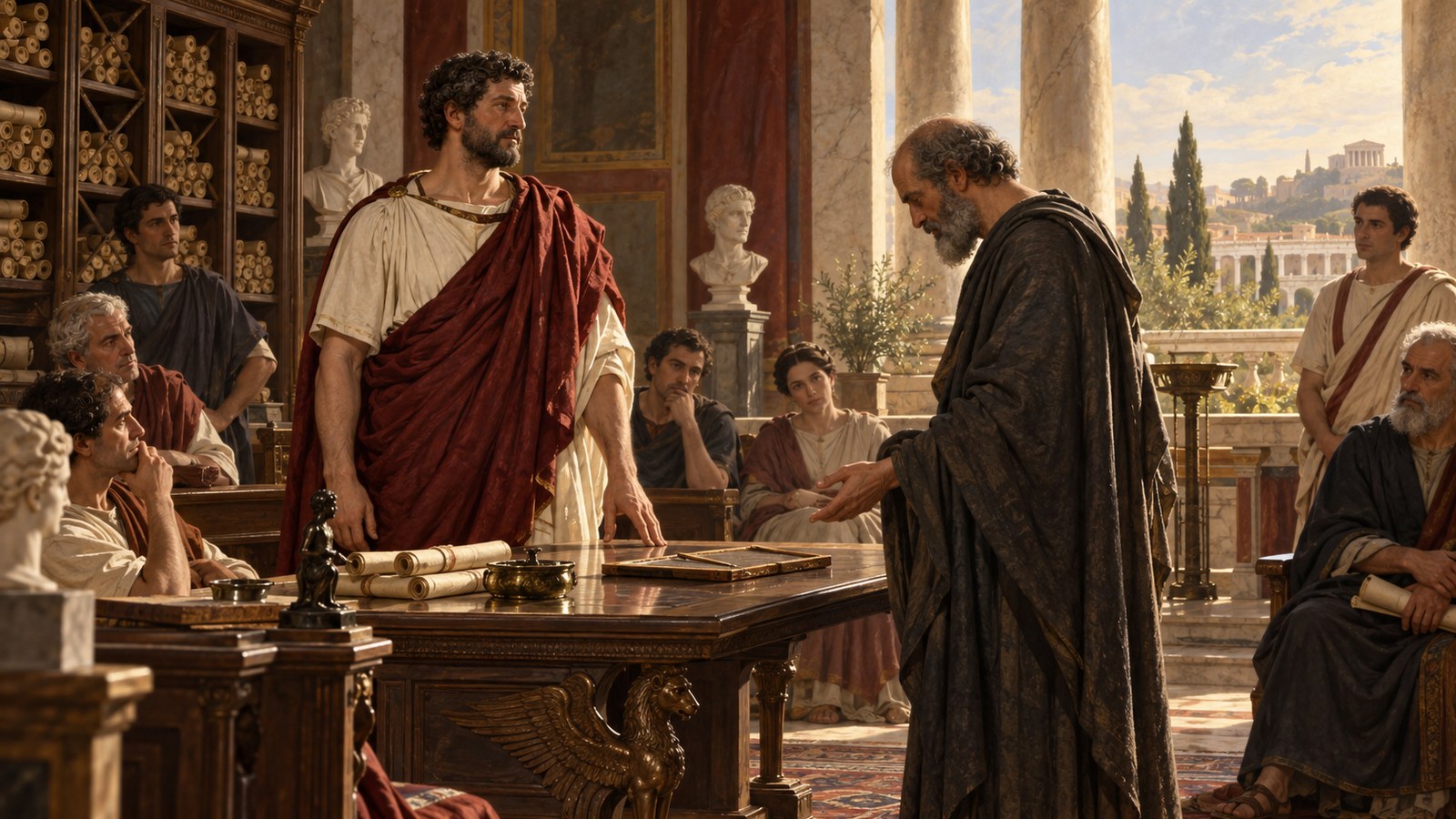
A direct accusation would have been dangerous and less elegant. Favorinus instead builds two meanings into the same sentence. On its polite surface, Hadrian is exceptionally learned. Beneath that surface, the reason offered for his learning is command of troops, a qualification unrelated to grammar.
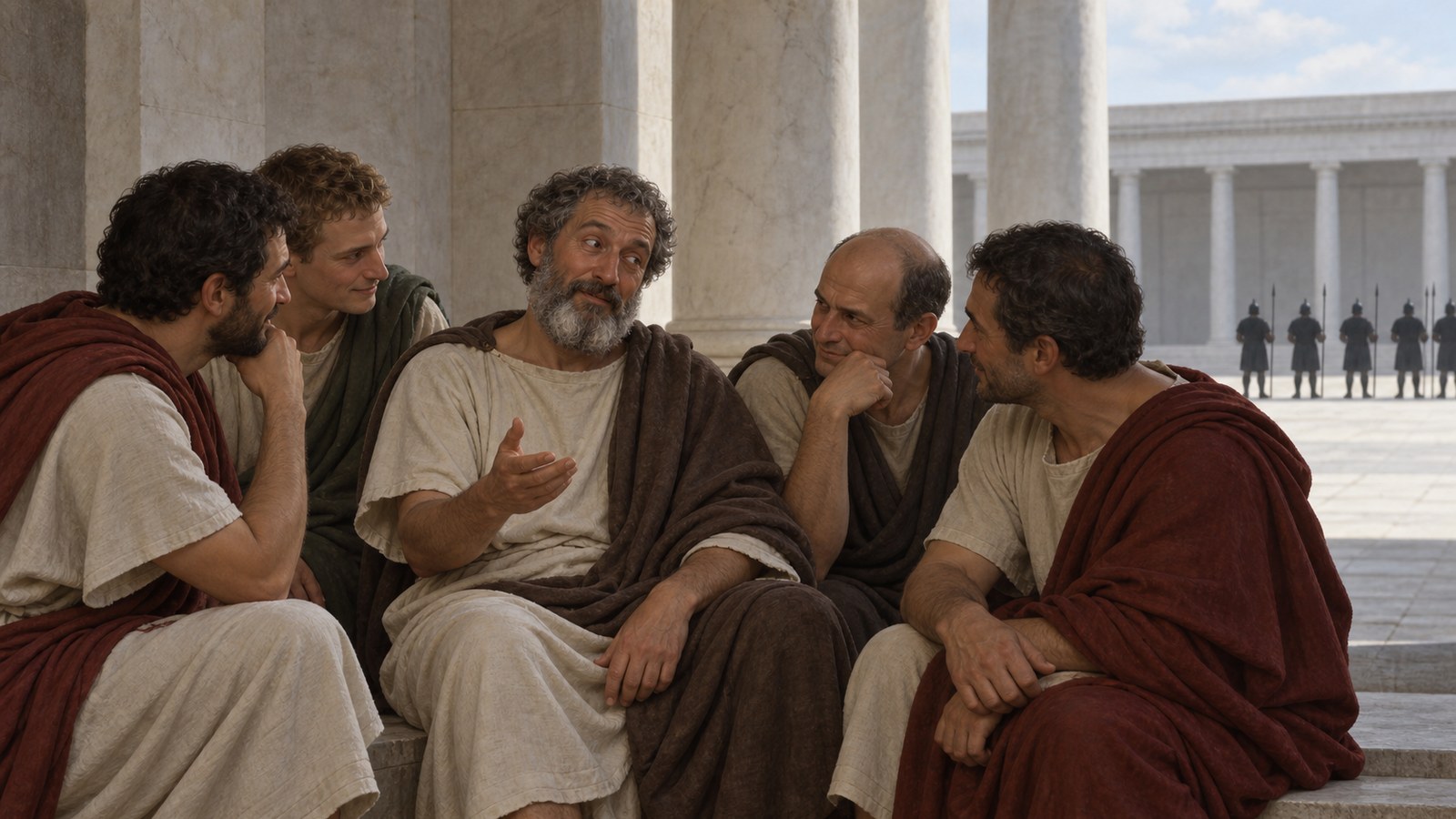
The joke works only among listeners trusted to hear both layers. His friends have reproached him, so they already believe he abandoned textual evidence. Favorinus answers their moral criticism without denying it. Yes, he yielded; no, he does not truly think military command proves correct usage. He invites them to understand prudence as the missing term.
This is not heroic resistance disguised as a victory. Hadrian still receives the public concession. Humor cannot restore an equal debate or recover the discarded word in that room. What it can do is preserve an accurate description of the imbalance and let a vulnerable scholar retain some authorship over his own retreat.
Roman literary culture prized cutting replies, remembered sayings and scenes in which wit reversed status for a moment. Pacuvius’s answer to Accius turned criticism into an argument about ripening; the exchange mattered because both poets could still use metaphor as evidence about artistic development. Favorinus’s metaphor is institutional. The legions do not improve Hadrian’s Latin; they explain why rebuttal stops.
Dio’s Favorinus Shows That the Risk Was Not Imaginary
Cassius Dio preserves no duplicate of the word dispute, but his account makes its atmosphere credible. He names Favorinus the Gaul and Dionysius of Miletus as sophists Hadrian tried to undermine, chiefly by raising up their opponents. Competition with the emperor could affect careers and reputations beyond one conversation.
Dio also places Favorinus before Hadrian in a dispute over a tax exemption for his native city. Expecting failure and insults, the sophist avoided a full confrontation by reporting a dream in which his teacher told him to serve his country. Again the response bends rather than collides. Favorinus finds language that lets him move through imperial judgment without pretending the setting is neutral.
The historian says Hadrian spared the two sophists because he lacked a plausible pretext to destroy them. That claim belongs to Dio’s hostile portrait and should not be turned into proof of a specific threat during the word argument. It does show why the thirty-legion joke could carry more than playful exaggeration for later readers.
The same Dio praises Hadrian’s close supervision, generosity and strict discipline of the army. The emperor’s command was not an empty title. The legions remained strong and ordered under him. Favorinus’s number made scholarly submission intelligible by attaching it to the most concrete foundation of imperial authority.
A Joke Preserved the Difference Between Learning and Power
The Historia Augusta is a late and often troublesome imperial biography, so its anecdotes require attribution rather than blind acceptance. We cannot reconstruct the disputed word, the room or the exact tone with which Favorinus spoke. The source asks us to remember a crafted scene.
Yet the craft of the scene is itself revealing. Its humor assumes that readers know how argument ought to work and can see that command of legions is irrelevant to usage. It also assumes that they understand why a philosopher might yield anyway. The laugh comes from holding those two truths together.
Hadrian appears learned, energetic and hungry to compete with specialists. Favorinus appears prudent enough to recognize that reputation for learning does not remove the emperor’s rank. Reputable authors may stand behind one side of the word; the Roman state stands behind the other.
The philosopher cannot make the debate equal, but he can refuse to confuse its outcome with proof. His quip separates correctness from victory. Thirty legions won Hadrian the exchange because they changed the cost of disagreement, not because they settled the Latin.
That distinction is why one lost word produced a lasting story. The vocabulary vanished from the record. The mechanism of power did not. Favorinus lowered his stylus, let the emperor have the correction and then supplied friends with the sentence that explained the silence.
Sources
Historia Augusta, Life of Hadrian, chapters 15–16. Cassius Dio, Roman History, Book 69, chapters 3–5.