
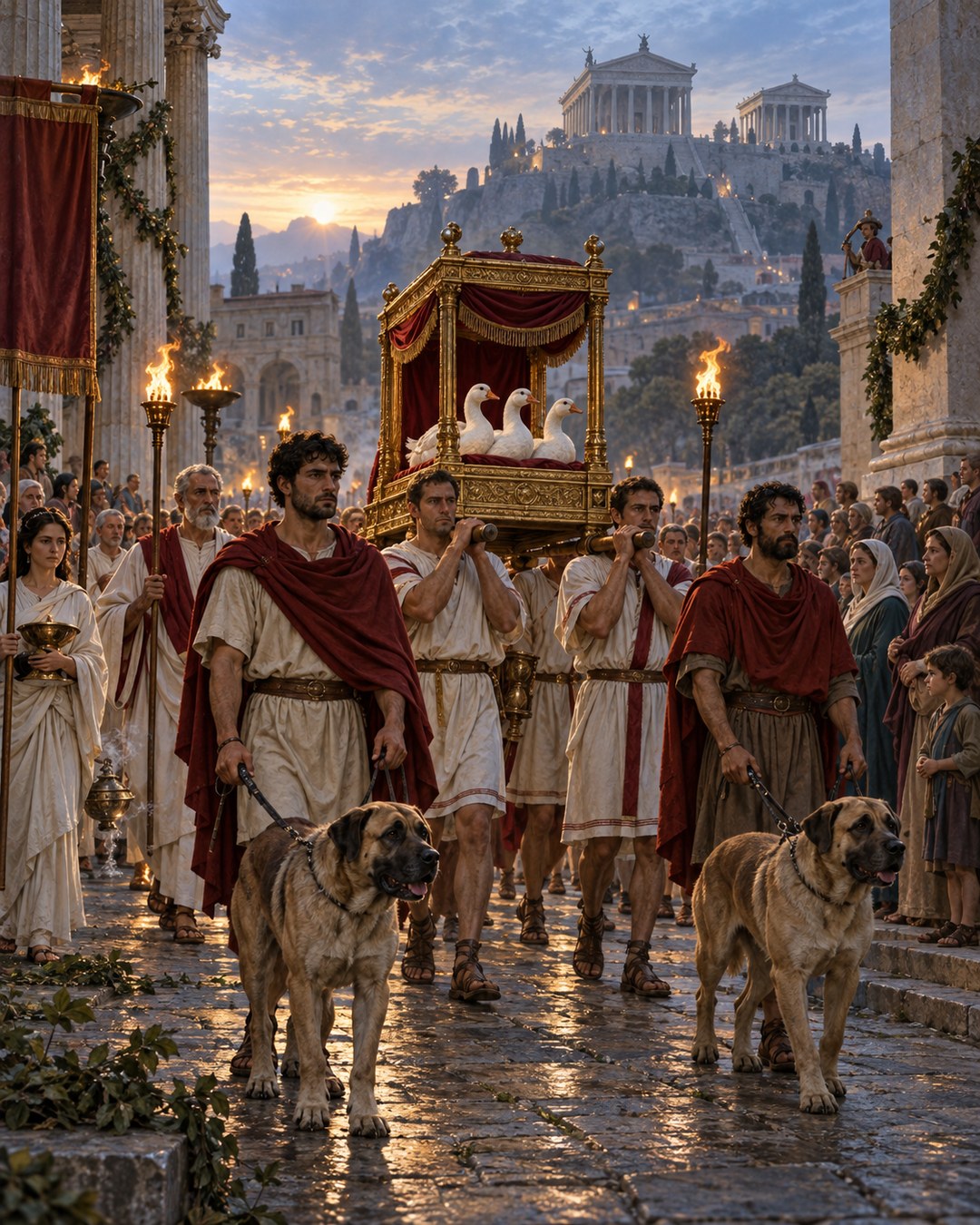
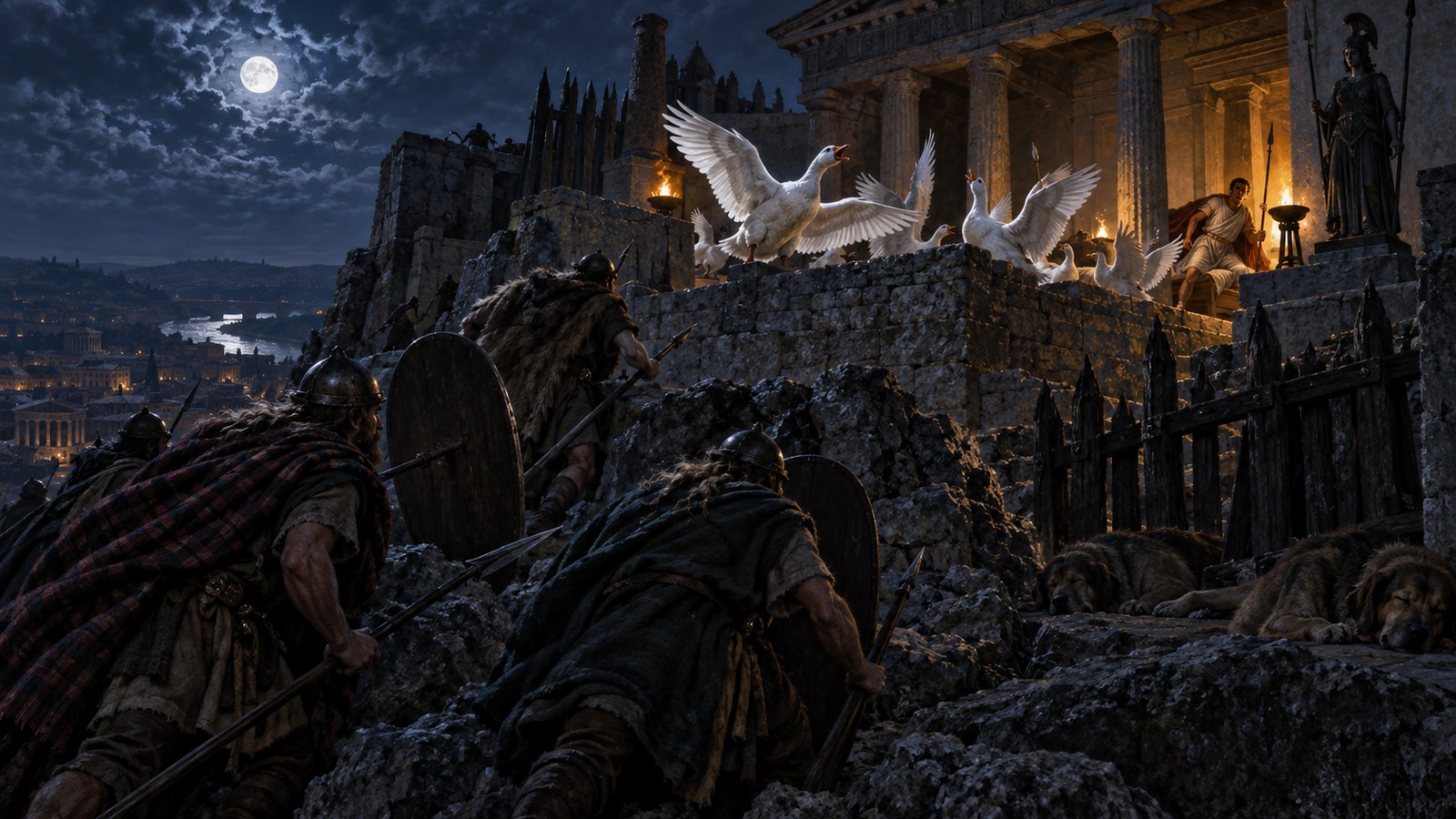
On a moonlit night, men climb the rock below Rome’s Capitol without waking the guards. They pass weapons upward, brace one another over difficult ground and reach the summit in near silence. The watchdogs do not stir. Inside the sacred enclosure, however, hungry geese begin to cackle and beat their wings.
Livy makes the noise the hinge of Rome’s survival. Marcus Manlius wakes, seizes his arms and reaches the threatened edge while the first climber is gaining the top. Yet the story did not remain only a siege episode or a monument to one defender. Pliny the Elder records a harsher afterlife: each year, punishment was inflicted on dogs because the geese had detected the Gallic ascent and the dogs had failed.
The annual rite transformed an animal contrast into civic memory. White geese embodied vigilance and divine protection; watchdogs embodied the silence that nearly lost the city. Rome replayed the judgment long after the attackers, defenders and original animals were gone.
The Attack Succeeded Until the Sacred Birds Made Noise
Livy begins with uncertainty about how the Gauls found the route. They may have noticed a human footprint left by a messenger from Veii, or they may have independently seen an easier ascent near the temple of Carmentis. Either possibility turns a supposedly secure cliff into a discoverable path.
The attackers prepare carefully. On a moonlit night they send an unarmed man first to test the way. Weapons travel from hand to hand. Where the ground becomes difficult, climbers support, pull and follow one another. Livy’s sequence emphasizes cooperation and silence rather than a loud assault.
That silence defeats two human and animal safeguards. The sentinels notice nothing, and the dogs—animals Livy calls exceptionally alert to nighttime sounds—also fail. The geese do not. They had been spared even during severe food scarcity because they were sacred to Juno, so hungry birds remained alive at the point of danger.
A previous Lost Eagles story has already followed the geese waking Manlius before the Gauls reached the Capitol. The detail that matters here comes after that famous night. Later Romans did not let the difference between canine silence and avian alarm dissolve into the ending of Livy’s battle scene.
Pliny Turns the Rescue into a Calendar of Blame
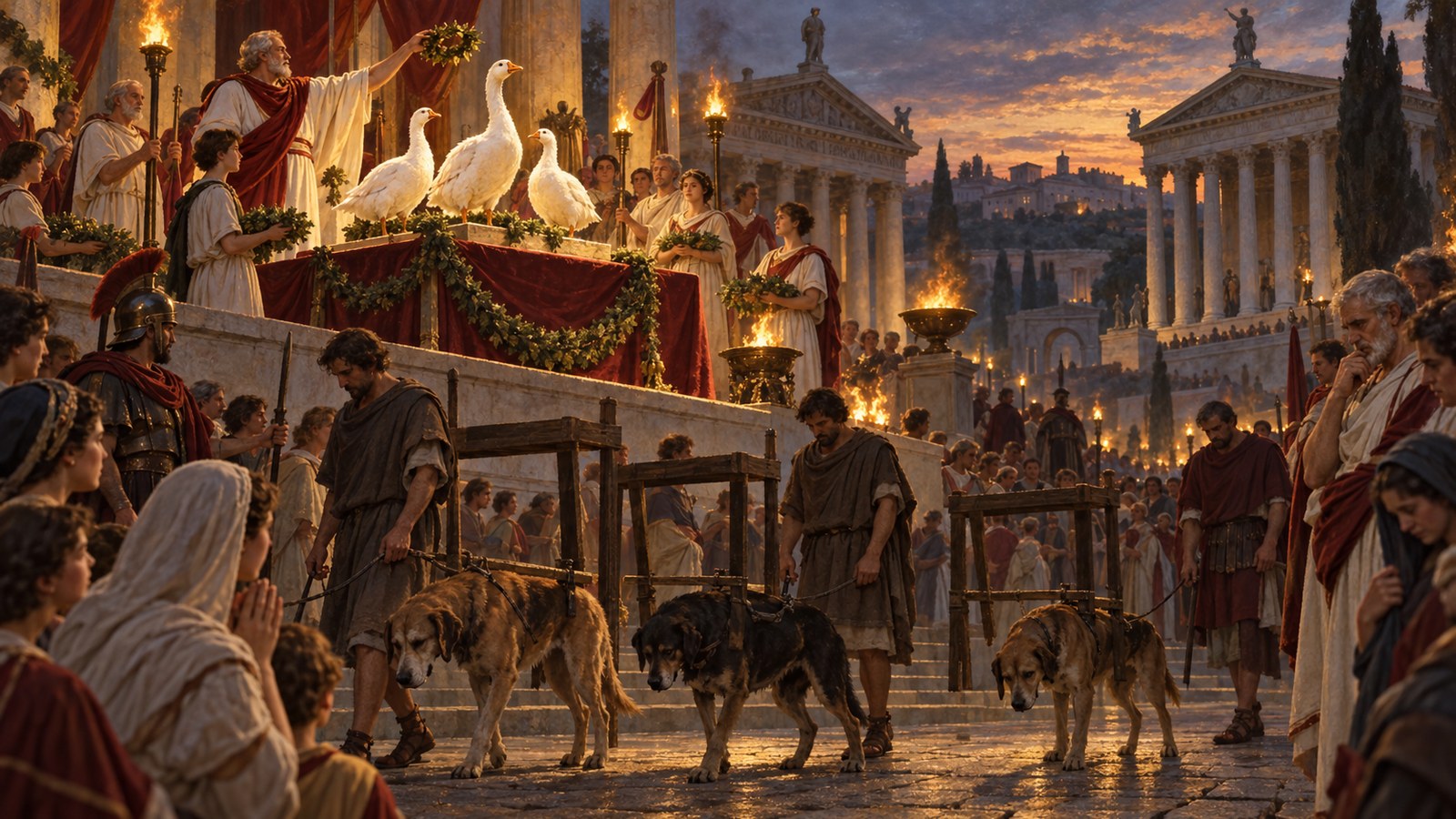
Pliny mentions the Capitoline story while discussing remedies derived from dogs. His transition is abrupt and valuable. Rome, he says, had already honored the geese for detecting the attempt to scale the Capitol. For a corresponding reason, punishment was inflicted on the dogs every year.
Annual repetition changes the meaning of the anecdote. A single dog can fail from sleep, fear, distraction or chance. A rite does not investigate that animal’s behavior. It assigns a durable public role to a category. Geese become the creatures that warned Rome; dogs become the creatures that did not.
Pliny supplies concrete ritual geography. The punishment occurred between the Temple of Juventas and the Temple of Summanus. Movement between named sacred points placed the memory in Rome’s landscape. People did not need to stand on the exact rock of the Gallic climb to encounter its lesson.
He also names the material: a gibbet of elder wood. The detail gives the ceremony construction, weight and texture. Someone had to obtain and shape the wood, prepare the procession and move through the prescribed space. Memory became organized labor rather than an abstract claim that Romans “never forgot.”
The Rite Was Deliberately Cruel, Not a Harmless Mascot Story
Pliny states that dogs were crucified alive. The fact should neither be softened into a decorative parade nor enlarged with invented spectacle. He gives no crowd count, date, chants or description of the animals’ handling beyond the punishment, the elder-wood support and the route between temples.
Modern readers may find the cruelty more striking than the lesson Romans intended. That reaction is useful because it prevents a sentimental version of the Capitoline geese. Sacred animals could receive honor while other animals carried blame through pain. Roman ritual memory was capable of making hierarchy brutally physical.
Pliny’s surrounding discussion complicates the category further. He says ancestral usage treated sucking puppies as pure enough for expiatory sacrifice and mentions a young dog offered to Genita Mana. Dogs were not simply despised creatures. The annual punishment selected one inherited failure and made it override their ordinary reputation for vigilance.
This selectivity resembles the way Anna Perenna’s feast attached another promised year to each cup. The emotional tone is entirely different, but both practices made memory repeat through embodied action. Drinking counted hoped-for years; the Capitoline rite assigned honor and blame to animals in motion through sacred space.
Manlius’s Heroism Was Only One Half of the Memory
Livy’s immediate scene gives Marcus Manlius the decisive human action. Awakened by cackling and wingbeats, he takes up arms, calls others and confronts a Gaul who has reached the summit. He strikes with the boss of his shield, sending the climber backward into those below.
A conventional heroic memory could have stopped there. It might celebrate Manlius alone and turn the geese into a picturesque signal. Pliny’s annual punishment preserves a second lesson: systems fail through unnoticed silence before heroes can respond. The rite keeps the failed watch beside the successful alarm.
That contrast also gave Juno’s sacred birds a powerful retrospective purpose. Food scarcity had not led the defenders to eat them. Livy presents their preservation as the cause of Rome’s preservation. The birds survive because of cult; the city survives because the surviving birds make noise.
The watchdogs occupy the inverse chain. Animals expected to hear nighttime movement remain quiet, and later dogs inherit the charge. The moral is not fair to individual animals. Ritual commemoration often seeks a clear opposition more than a balanced account. Geese warned; dogs slept. Honor and punishment made the opposition visible.
Yearly Repetition Kept One Night Politically Present
Neither Livy nor Pliny gives us a complete program for the annual event. Pliny’s brief notice does not say who watched, which magistrates directed it or how its date related to other ceremonies. Those gaps matter. They prevent us from staging a detailed pageant that the evidence does not supply.
What remains securely attested is already substantial: yearly punishment, live dogs, elder wood and a route between the temples of Juventas and Summanus, explicitly explained by the Capitoline failure. Each element converts a remembered event into something repeatable.
The fixed route joined narrative time to urban space. The elder structure gave the blame a visible form. The yearly cadence ensured that the story could be encountered by generations with no memory of the Gallic siege. Ritual did not merely illustrate history; it maintained a verdict about why Rome survived.
That verdict was severe. It rewarded the animals that violated expectation—geese becoming better sentinels than dogs—and punished the animals that failed their assigned character. By reversing ordinary assumptions, the story made vigilance memorable enough to survive in both history and natural history.
The moonlit climb ended when wingbeats shattered the silence. Its ritual afterlife began by deciding that this sound and silence deserved permanent, unequal consequences. Every year, Rome made the old night pass between two temples again.
Sources
Livy, History of Rome, Book 5, chapter 47. Pliny the Elder, Natural History, Book 29, chapter 14.