
Metius Carus asked Fannia whether she had commissioned a biography of her husband, Helvidius Priscus. She answered, “I did.” He asked whether she had supplied the writer with materials. Again: “I did.” Did her mother know? “She did not.” Pliny gives the exchange without a speech of defiance, as if its danger can be measured by how little Fannia needed to say.
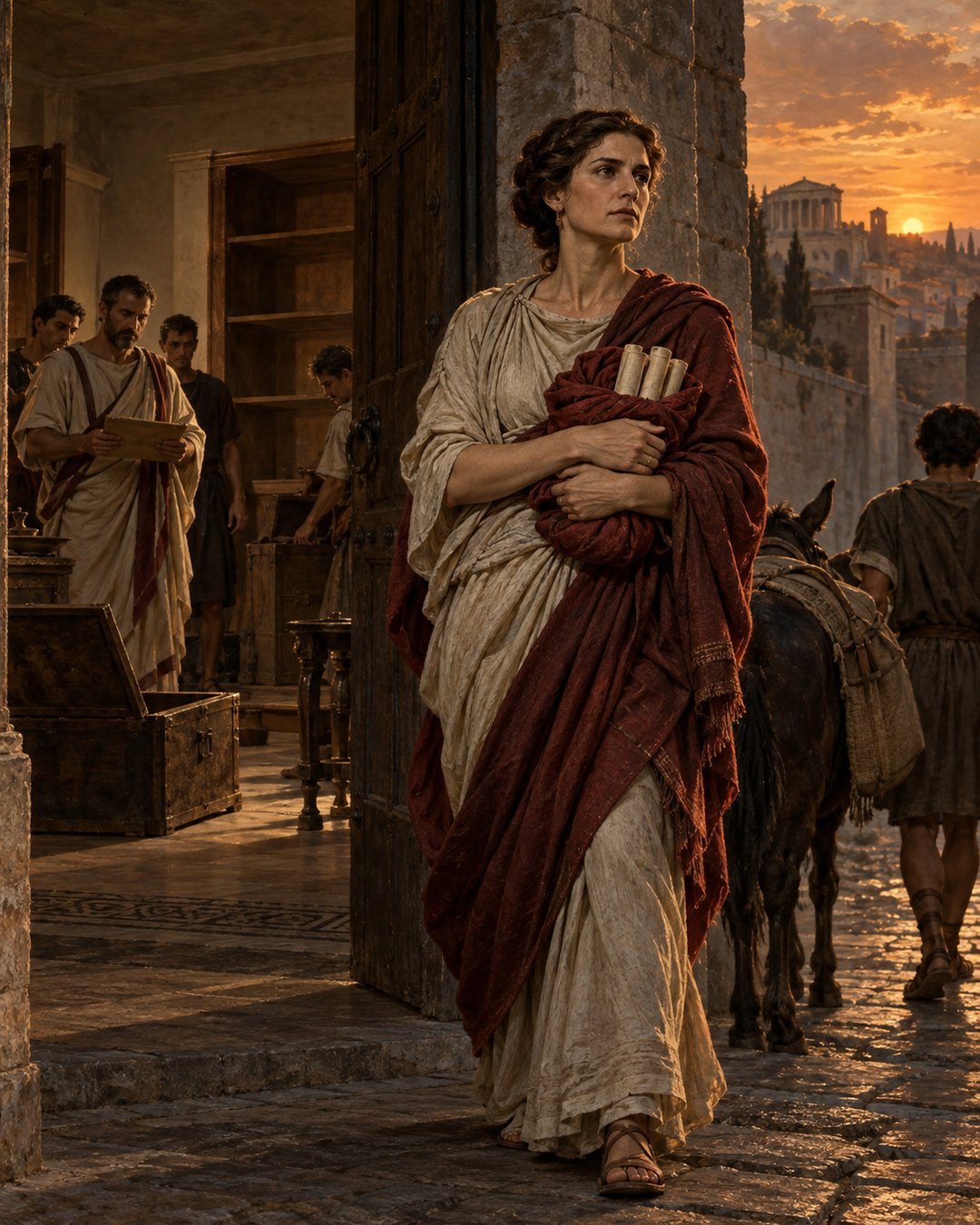
The writer, Herennius Senecio, was on trial. The Senate would decree that his Life of Helvidius be destroyed. Fannia’s property was confiscated, and she was banished for the third time. Yet the condemned volumes did not remain behind. She preserved them and carried them into the exile they had helped cause.
That last movement changes the scale of the episode. Imperial punishment could reach an author, a patron, a household and a book. It could not make a portable object disappear merely by declaring it absent. Somewhere between confiscation and departure, Fannia kept custody of the text.
Three Short Answers Fixed Responsibility on Fannia
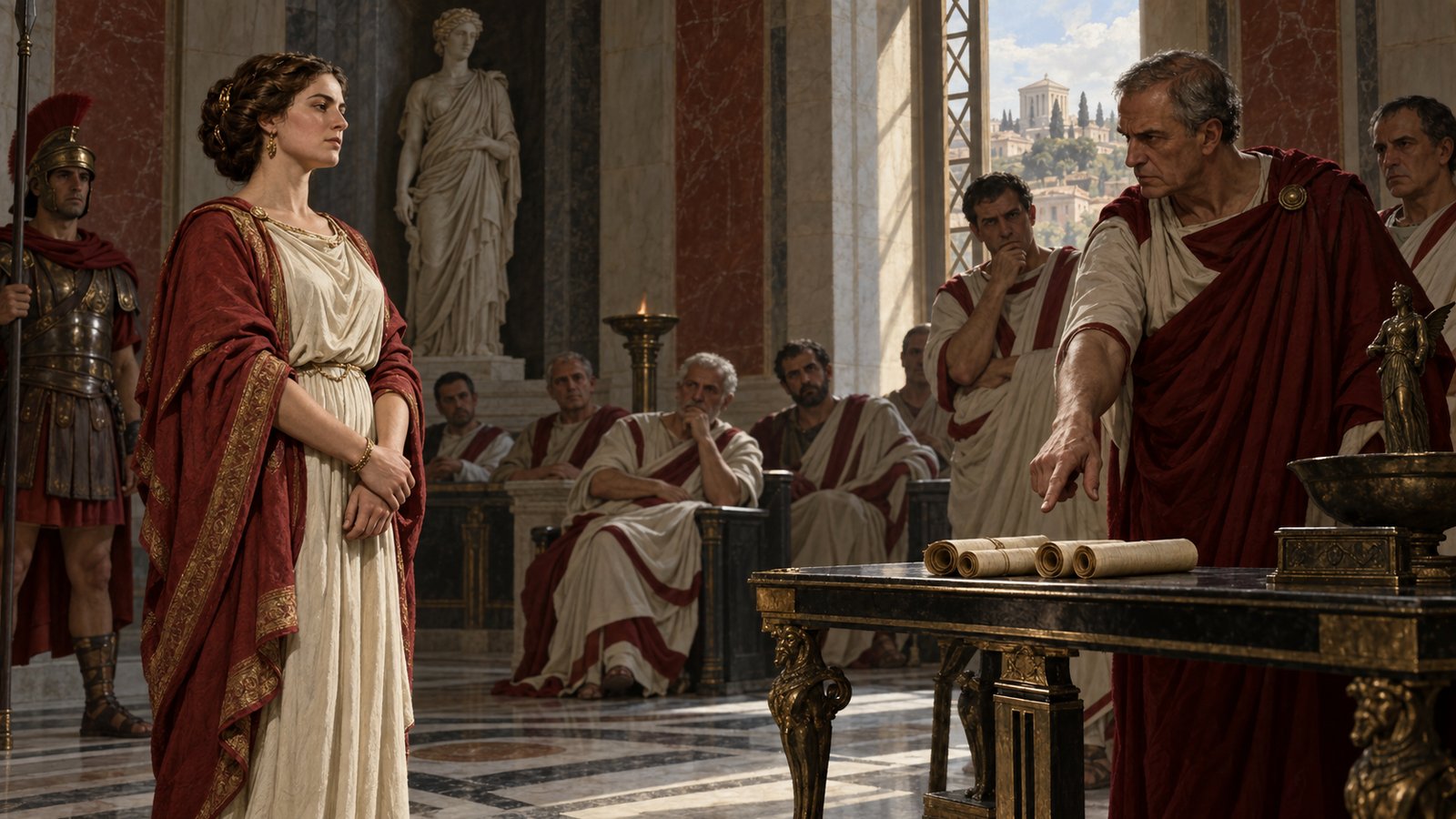
Pliny’s account starts the political story inside Senecio’s trial. Senecio had written a life of Helvidius, Fannia’s husband, and said in his defence that she requested it. Metius Carus then turned toward her. His questions separated the acts that made patronage concrete: requesting the work, providing its materials and deciding who else knew.
Fannia accepted the first two acts as her own. She did not shift the commission onto Senecio or present herself as a passive family informant. She also protected a boundary around her mother by saying the older woman had not known. The answers were economical, but each closed off an avenue of retreat.
Pliny emphasizes that she said nothing to suggest fear of the consequences. That does not mean the danger was imaginary or that the scene lacked pressure. His mention of Carus’s threatening gesture makes coercion visible. Courage here is not a long performance before the court. It is accuracy maintained when evasion might have spread responsibility elsewhere.
The family history gave those answers weight. Fannia had already followed Helvidius into exile twice. The biography did not introduce her to political punishment; it recorded a husband whose career had already carried the household across that boundary. Her third exile would be her own, imposed on account of the attempt to preserve his life.
A Destruction Decree Still Needed Every Copy
The Senate ordered the volumes destroyed. Pliny qualifies the decree by saying it was passed under compulsion and amid the dangers of the time. He does not provide an inventory of copies, a bonfire scene or the officers responsible for collecting them. What he tells us is more revealing about the practical limit of the order: Fannia kept some.
A decree could define the work as forbidden. Destruction required control of each physical roll. Papyrus could be seized, burned or torn, but it could also be wrapped, moved and concealed. The biography’s political threat and its material vulnerability were inseparable. A text survived only through particular copies occupying particular hands.
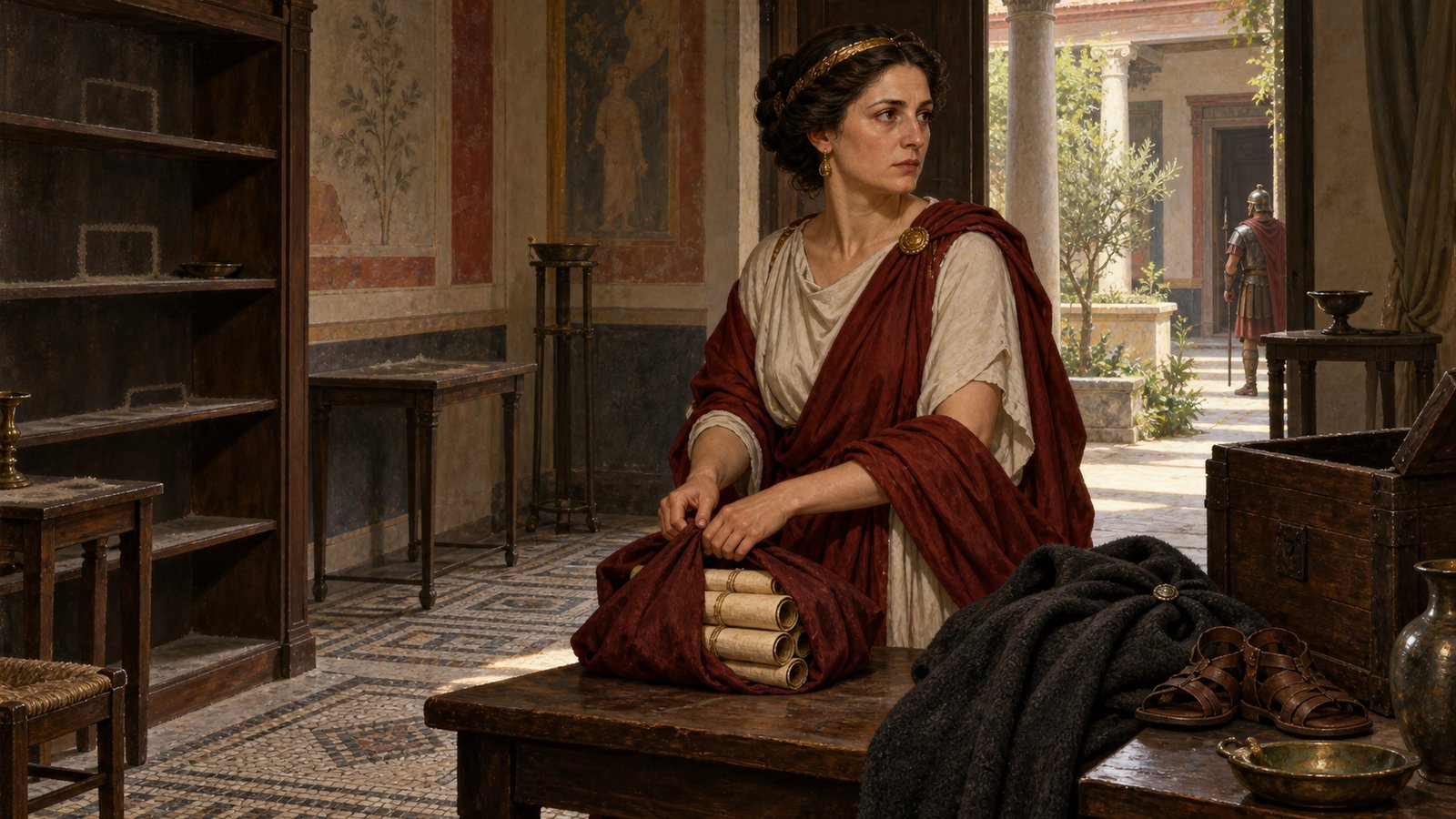
Fannia’s goods were confiscated, making preservation harder. A household under seizure was not an untouched private library from which she could calmly select keepsakes. Pliny places the volumes on the far side of confiscation: even after property had been taken, she preserved and kept the condemned work.
A Lost Eagles article on Galen’s irreplaceable books lost in Rome’s fire shows physical texts failing without a political censor. Fannia’s case reverses the pressure. The state intended destruction, but the custodian and the copies continued moving together.
Exile Turned the Reader into the Archive
Pliny’s decisive detail is that Fannia carried the volumes with her. He does not claim that she memorized the biography, commissioned a replacement abroad or trusted another household to hide it. The condemned rolls traveled inside the punishment. Exile displaced the person who had ordered the work while also displacing the work beyond the immediate scene of seizure.
This is not evidence that every copy survived or that the decree had no effect. Senecio faced trial, Fannia lost property, and the Senate’s order made possession dangerous. The survival Pliny describes is narrow: the volumes in Fannia’s keeping escaped the destruction intended for them. Narrow survival was enough to make suppression incomplete.
Her act also preserved the materials she had helped turn into biography. She had supplied Senecio with information about Helvidius, then accepted responsibility for doing so. When she carried the finished volumes away, she held the result of a chain that began with family knowledge and passed through an author into a reproducible object.
The word “archive” can sound like a room, a shelf or an institution. Fannia’s archive was temporarily a traveler’s burden. Its security depended on one person choosing not to separate self-preservation from preservation of the text. The books had no immunity of their own; their protection was her willingness to let them share her risk.
Pliny Framed Political Courage Through a Failing Body
Pliny recalls the trial because Fannia is dangerously ill when he writes. She had been nursing Junia, a relative and one of the Vestal Virgins. Fannia undertook the duty first voluntarily and then at the bidding of the high priests. Seriously ill Vestals who left Vesta’s temple were placed in the care and custody of matrons.
Service therefore produced a second kind of custody in the same letter. Earlier, Fannia kept a forbidden biography. Later, she cared for a sick sacred woman. The two responsibilities were not legally or politically identical, but Pliny’s arrangement makes character visible through what Fannia agreed to hold when holding it carried a cost.
That cost is physical in his present-tense report. The fever will not leave her. Her cough grows worse. She is terribly emaciated and exhausted. Pliny contrasts those signs with a mind and spirit he considers worthy of Helvidius and of her father, Thrasea. The body that once carried books into exile is now losing strength after caring for Junia.
The earlier Lost Eagles story about Arria controlling grief beside Paetus’s sickroom belongs to this same family’s remembered discipline. Fannia appears there as the granddaughter who preserved Arria’s example. In Pliny’s later portrait, she is no longer only a recipient of family memory. Her own answers, exile and nursing become the material from which another writer constructs an example.
Pliny fears that her death would make the whole house seem to totter despite surviving children. His grief turns lineage into an unstable structure supported by conduct rather than names alone. Fannia matters because she connected generations through actions that could be retold: following Helvidius, commissioning his life, shielding her mother and refusing to surrender the volumes.
The biography survives this letter only indirectly; Pliny does not reproduce its contents. He preserves instead the scene around its attempted destruction. A threatening questioner, three unembellished answers, confiscated goods and books carried out with an exile show how political memory depended on ordinary material decisions.
The Senate could declare that the Life of Helvidius should vanish. Fannia made the command collide with the smallest durable unit of literary survival: a copy that had not been found and a person who would not abandon it. Her victory was not immunity. She paid with exile and property. What she denied the decree was completeness.
Sources
Pliny the Younger, Letters, 7.19.