
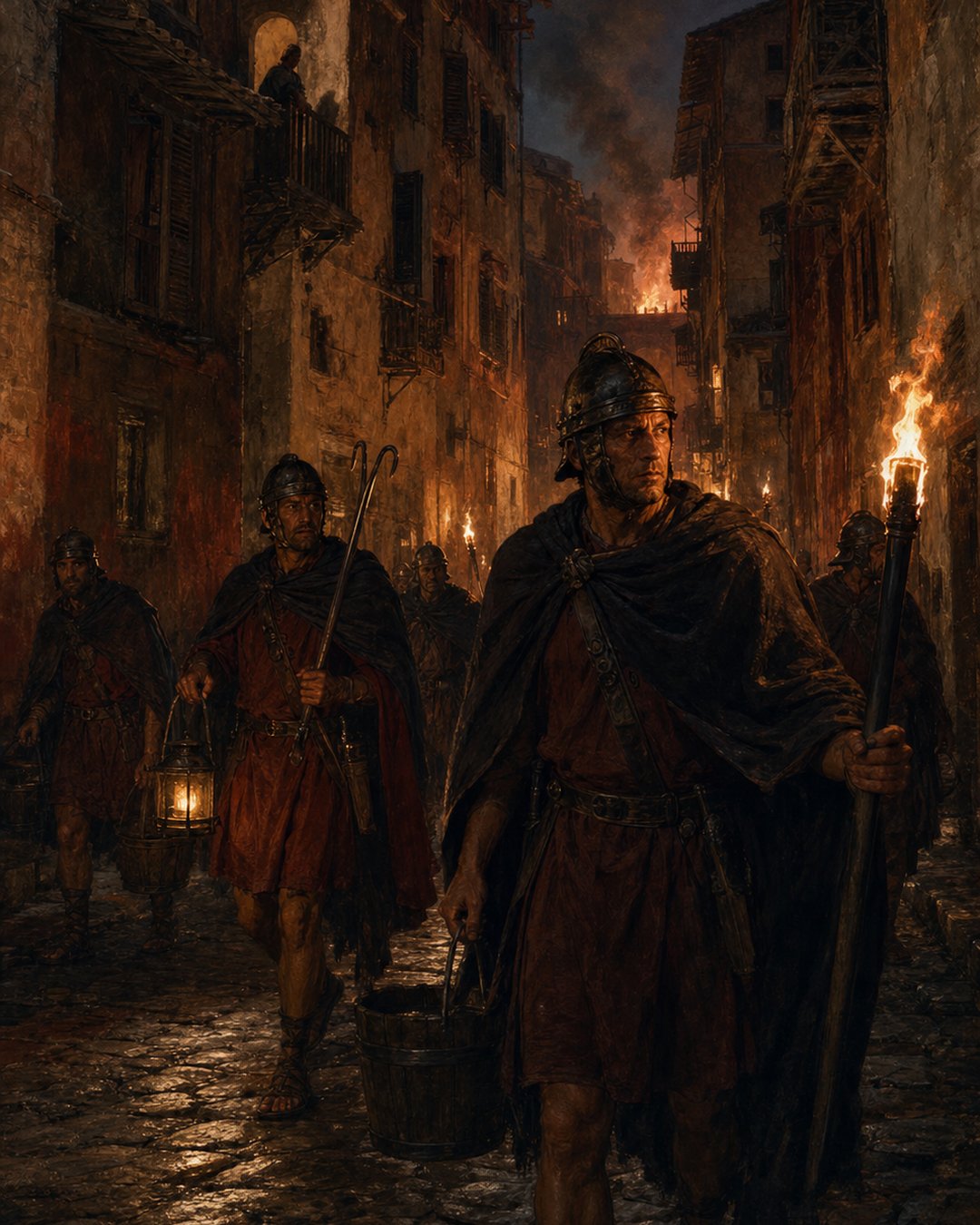
Rome’s danger did not vanish at sunset. It changed shape. Lamps burned in upper rooms, cooking fires smoldered, shops closed with embers still warm, and crowded apartment blocks held families, goods, animals, wood, cloth, and oil in tight vertical space. The night watchmen known as vigiles existed because the capital was powerful enough to rule an empire, but still fragile enough to burn from ordinary carelessness.
Augustus organized the vigiles as a force for night watch and firefighting. They were not a modern fire department with engines and hydrants, and they were not simply police in the modern sense. They belonged to a city trying to make urban risk manageable. Their work was practical: patrol, notice smoke, raise alarms, carry tools, control crowds, and keep small fires from becoming city disasters.
Rome’s streets made fire a political problem
Fire in Rome was not only a household accident. It was a threat to order. A blaze could leap through cramped streets, damage rental property, destroy shops, panic crowds, and expose the limits of imperial care. In a city where emperors claimed to provide grain, games, buildings, and security, uncontrolled fire was a public embarrassment as well as a physical danger.
Tacitus’ description of the Great Fire of AD 64 helps explain the fear. He emphasizes narrow, winding streets and irregular blocks that helped flames spread. That catastrophe came after the creation of the vigiles, but it shows the environment they worked inside. Rome could be monumental in marble and still dangerously combustible in daily life.
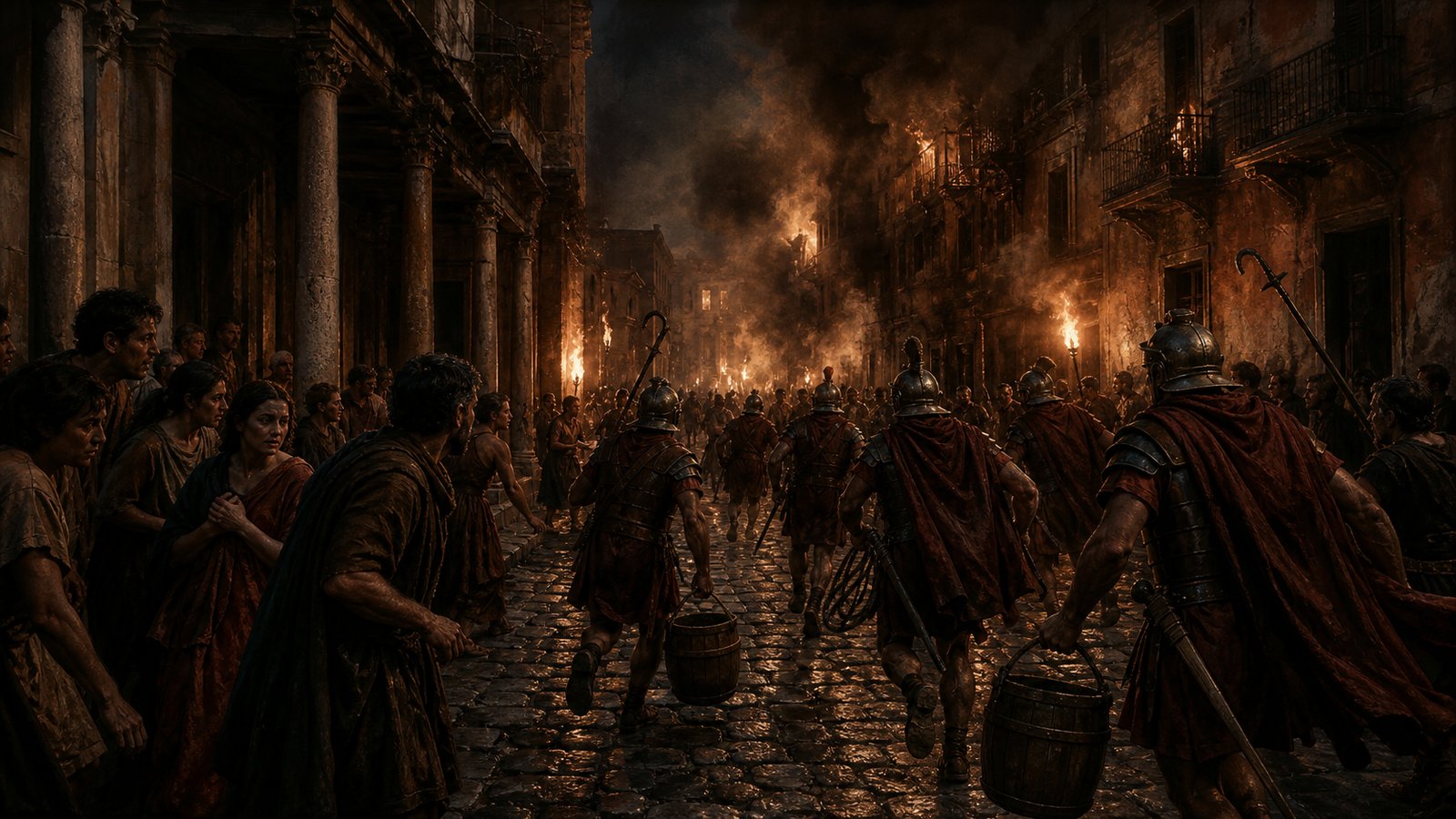
Seven cohorts turned the night into a grid
The vigiles were organized into seven cohorts, each associated with two of Rome’s fourteen regions. That detail is easy to pass over, but it is the heart of the system. The problem was not merely having brave men. The problem was covering a vast city with predictable responsibility. A region assigned to a cohort could be watched, patrolled, and blamed.
Augustus’ larger administrative habit appears here. He did not make Rome safer by hoping neighbors would improvise. He made safety part of urban organization. The city was divided, assigned, and made legible. The vigiles were a human map moving through darkness.
Their tools were humble because the danger was immediate
Ancient firefighting was physical and close. Buckets, hooks, axes, ladders, ropes, and pumps belonged to a world where men had to reach the fire with their bodies. A hook could pull burning material apart. A bucket line could slow the spread. A ladder could reach an upper room before smoke trapped the people inside.
Those tools remind us that Roman safety depended on labor, not just law. A decree against careless fire meant little if nobody heard the crackle in time. The vigiles carried the empire’s most practical kind of authority: the authority to wake people, move them, break property, and fight danger before dawn.
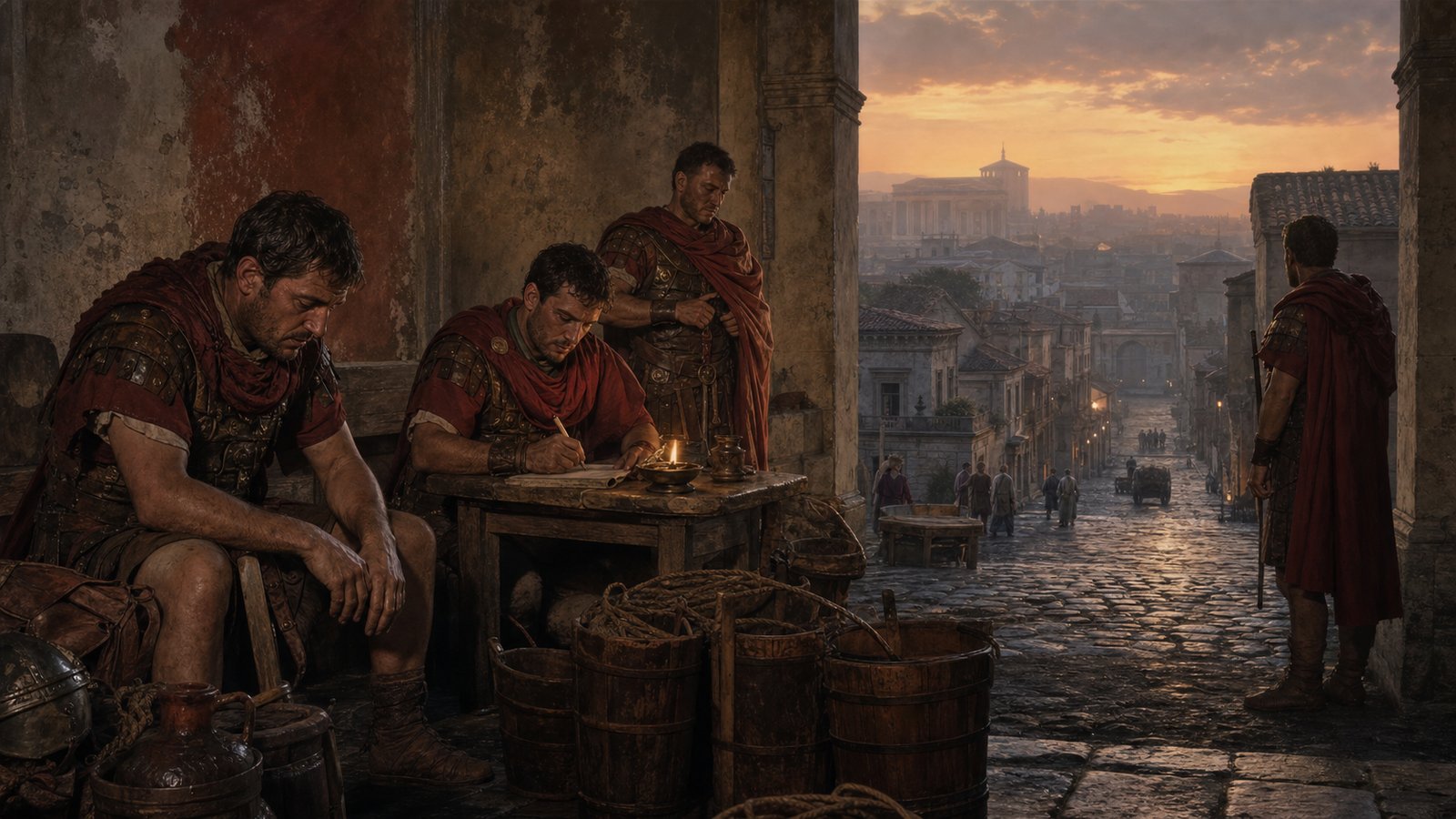
The night watch also watched people
Fire was not the only danger after dark. The vigiles also had policing duties. They watched for thieves, disturbances, and suspicious movement in streets that changed character once business ended. A city with taverns, warehouses, tenements, and narrow lanes needed more than heroic response to flames. It needed routine presence.
This presence mattered psychologically. A patrol with lamps and tools told residents that night had not been abandoned. It also reminded everyone that order had eyes. Rome’s urban discipline was not only found in courts and magistrates. It walked past doorways while most of the city tried to sleep.
Augustus turned emergency into administration
Suetonius says Augustus organized watches against fires. That statement is small, but it belongs to a larger Augustan project: make Rome appear governable after generations of civil conflict. Streets, regions, cohorts, building programs, and public order all helped translate monarchy into everyday stability.
The vigiles fit that project perfectly. They did not win battles or deliver speeches. They made the city less likely to wake in terror. For an emperor, that mattered. A ruler who could claim to protect the capital from nightly disaster looked less like a warlord and more like the guardian of Roman life.
The Great Fire shows both need and limit
The existence of the vigiles did not make Rome fireproof. The Great Fire under Nero proved that. Flames could still overwhelm preparation when conditions were right. Ancient sources shaped the fire into a moral and political drama, especially around Nero, but the physical lesson is plain. Dense cities can defeat their safeguards.
That failure should not make the vigiles seem useless. No emergency system prevents every catastrophe. The better measure is how many smaller disasters never became famous because someone smelled smoke, shouted, carried water, pulled down a burning beam, or kept a crowd from making things worse.
The empire depended on unnoticed labor
The vigiles reveal a Rome often hidden behind emperors and legions. Imperial life required people who did not appear on triumphal arches: watchmen, porters, water carriers, clerks, builders, and exhausted men finishing a shift at dawn. They kept the stage standing while famous actors crossed it.
The night watchmen who kept Rome from burning were not romantic heroes in the usual sense. They were evidence that Roman power had to become routine to survive. A city of marble temples and imperial palaces still needed men with buckets in dark streets. Without them, the capital of the world could become tinder before sunrise.
Safety was built from repetition
The vigiles mattered because emergencies are usually defeated before they become memorable. A patrol taking the same street again, a man checking a workshop door, a bucket stored where someone could reach it, and a lamp noticed too late or just in time: these are not dramatic gestures, but they are exactly what urban survival requires. Rome’s greatness depended on habits as much as monuments.
That makes the vigiles a useful correction to the usual image of Roman order. Order was not only a legion in formation or an emperor on a coin. It was also a tired watchman knowing which alley smelled wrong, which stairs were rotten, and which crowded block would panic first if smoke appeared. The city was protected by memory as well as command.
Seen from this angle, the night watch does more than explain firefighting. It shows an empire learning that administration had to enter ordinary hours. Rule had to be present not only at triumphs, trials, and taxes, but at midnight, in smoke, among people too poor to appear in official praise.
The detail of seven cohorts for fourteen regions gives that lesson a hard administrative shape. Rome was too large for informal neighborly rescue to be enough. Someone had to know which streets belonged to which responsibility, and someone had to be awake when the first shout came from an upper floor. The city survived many nights because that responsibility had a name.
Sources & Further Reading
- Britannica, police – Ancient policing
- LacusCurtius, Vigiles
- Britannica, ancient Rome – City of Rome
- Suetonius, Augustus, 30
- Britannica, Great Fire of Rome
- Tacitus, Annals, 15.38
- Britannica, ancient Rome – Augustus
- Britannica, insula