
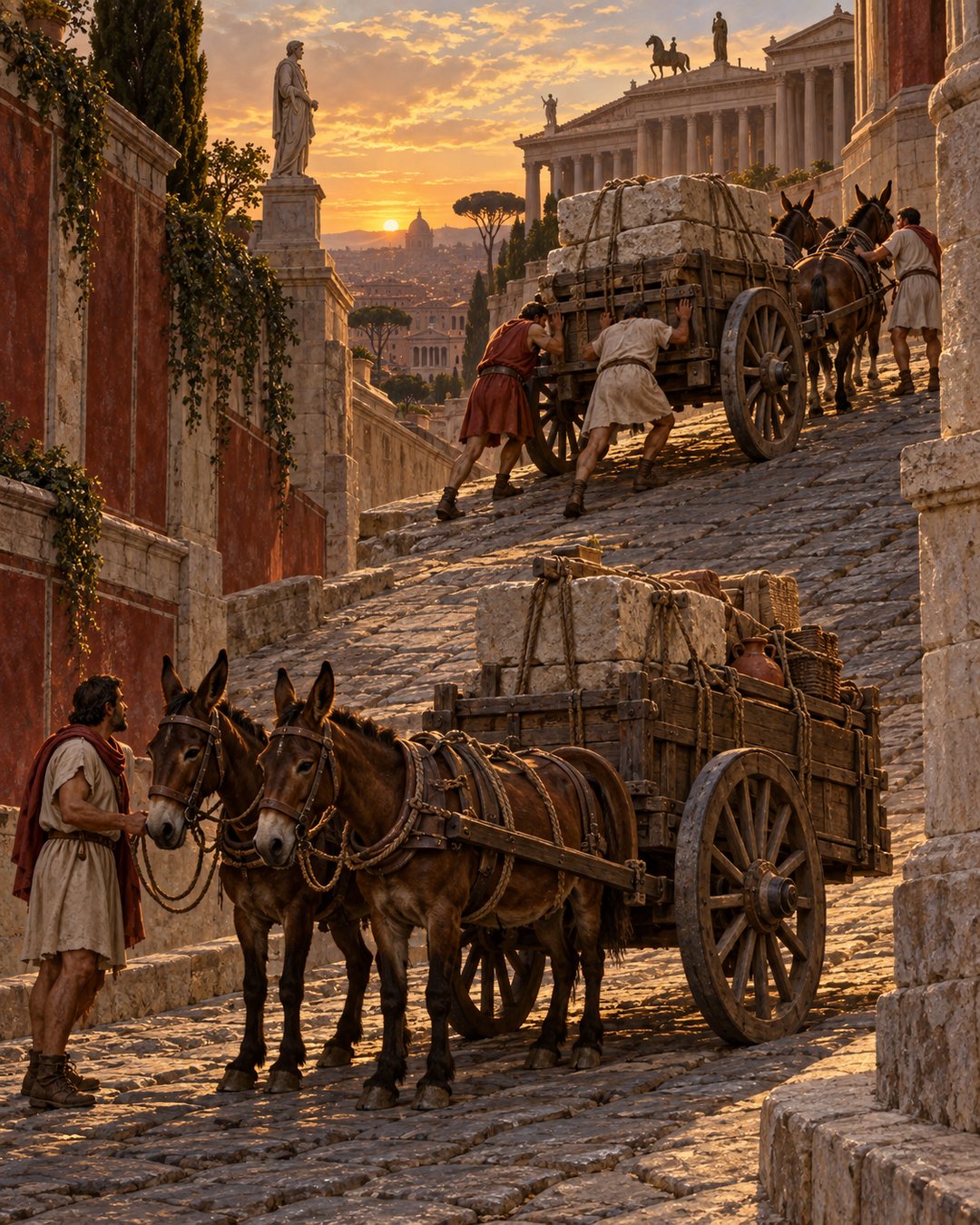
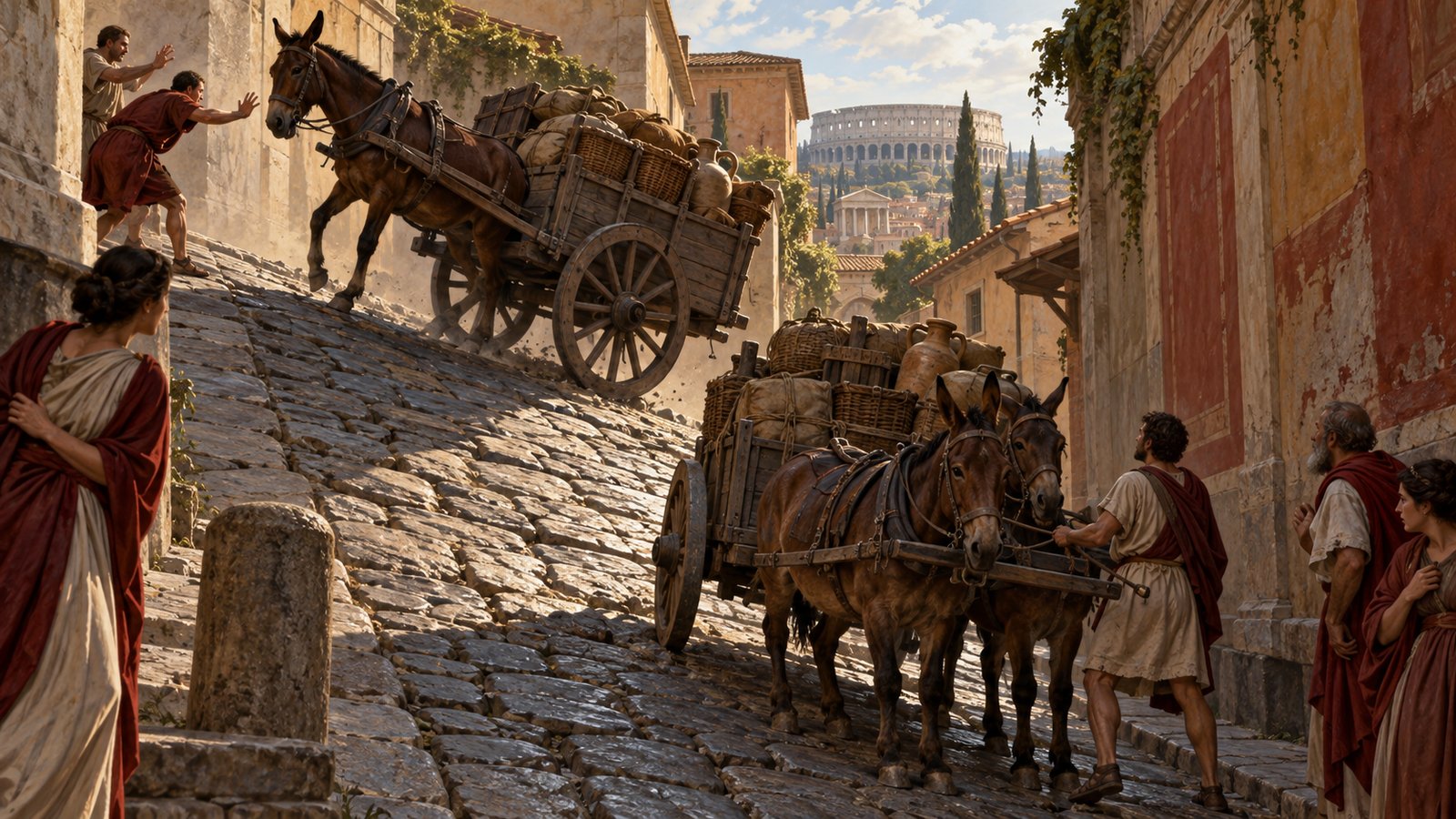
Two loaded carts were climbing the Capitoline slope, each drawn by mules. The upper vehicle had turned or threatened to run back, so its drivers stood behind it and supported the load while the animals tried to pull. Then the cart began moving downhill. The men between the vehicles got clear. The upper cart struck the lower one, drove it backward and crushed an enslaved boy.
The victim’s owner asked the practical question: whom should he sue? Alfenus Varus did not answer by pointing to the largest object, the nearest animal or the last cart to move. In the version preserved in Justinian’s Digest, he says the law rests on the cause. He then runs the same street scene through three different explanations.
That structure makes Digest 9.2.52.2 unusually revealing. Roman delict did not treat a chain collision as one undivided event. Alfenus broke it at the moment control failed. If the handlers chose to release the cart, one defendant emerged. If frightened mules forced their retreat, another could. If no person or animal was at fault, the loss might produce no Aquilian action at all.
The Street Put Weight, Animals and People in One Line
The setting matters before the legal branches begin. This is the clivus Capitolinus, an incline leading toward Rome’s central sacred and political height. Two loaded carts occupy the same slope. The first is above the second, so gravity gives every failure a direction.
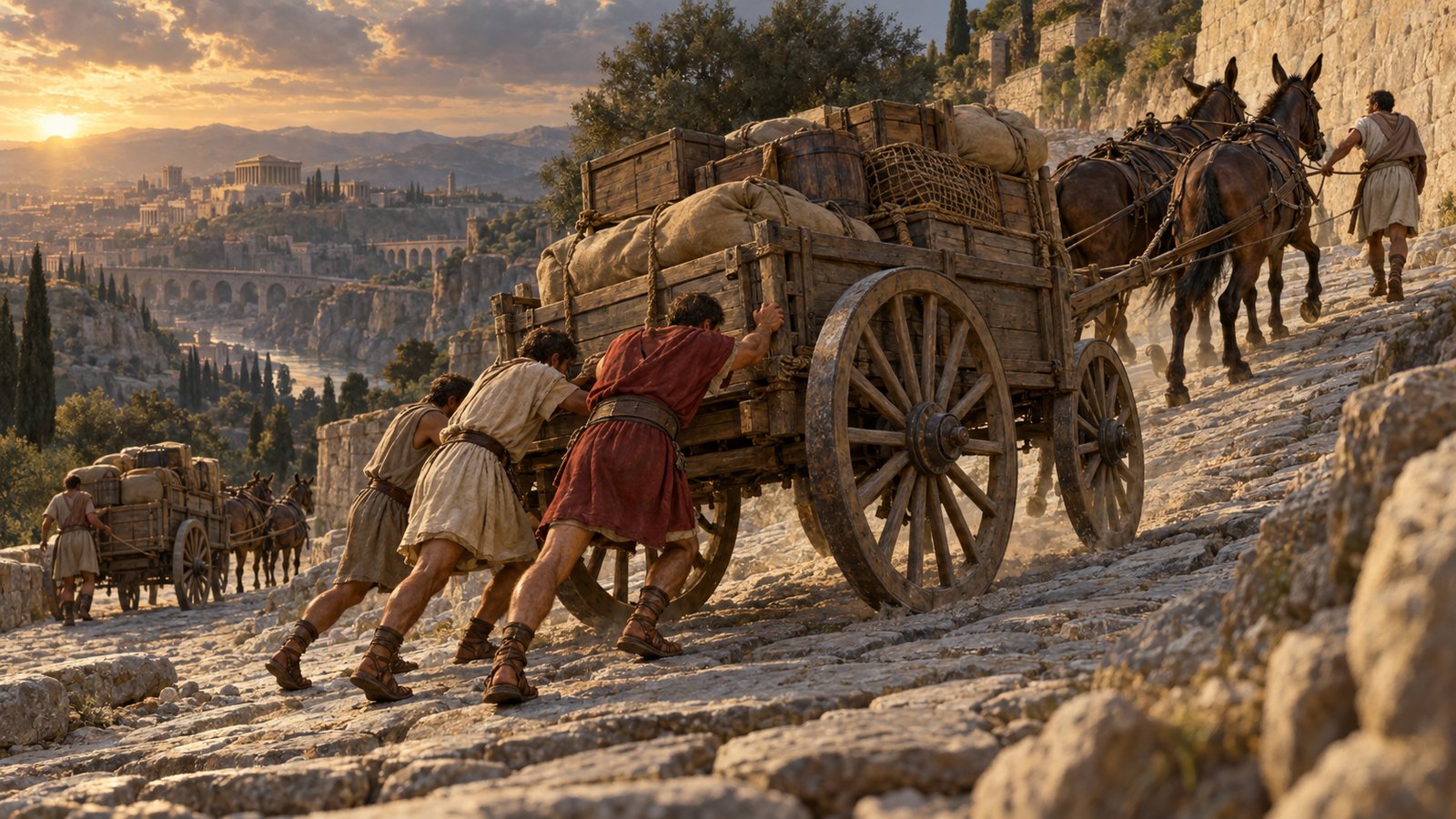
Alfenus describes the upper drivers supporting a cart that had turned back, helping the mules draw it more easily. They are not passive witnesses. Their bodies have temporarily become part of the braking system. The load remains stable only while animals, harness, wheels, road surface and handlers continue doing their separate jobs.
An earlier look at the tension that kept a Roman wheel together shows how much craft lay inside ordinary movement. Here the wheel is only one element in a larger arrangement. Even a sound axle cannot decide what handlers should do when a loaded vehicle begins to reverse on a crowded slope.
The second cart complicates the scene. Its mules and driver do not start the dangerous motion. The force arrives from above. Once struck, the lower cart runs backward into the victim. Physical sequence therefore creates a tempting but misleading chain: upper cart, lower cart, death. Alfenus asks which part of that chain was legally attributable to choice, animal behavior or misfortune.
Voluntary Release Could Count as Causing the Blow
In the first branch, the upper drivers withdraw of their own accord. Their departure leaves the mules unable to hold the load, and the cart’s weight pulls it back. Alfenus places a Lex Aquilia action against the men who had supported it, not against the owner of the upper mules.
The reasoning is more precise than saying they were careless because they stood nearby. A person who voluntarily lets go of something he is holding can cause damage when that object strikes another. The fatal contact may come from timber and iron rather than a hand, but the release supplies the decisive change.
Alfenus reinforces the point with compact analogies. Someone who drives an ass and fails to restrain it may be responsible. So may someone who lets a weapon or another object go from his hand. The common element is not the shape of the instrument. It is controlled force being allowed to continue into someone else.
This differs from the stray ball that pushed a barber’s razor into Roman law. That case asks how a dangerous workplace and an outside impact divide blame. The Capitoline problem turns on the reason support disappeared from a load already pulling downhill.
Fearful Mules Moved the Legal Focus Away from the Men
Alfenus next changes one fact. Suppose the mules shied at something. Suppose the handlers left because they feared the reversing cart would crush them. In that version there is no action against the men. Their retreat is no longer a free abandonment of a manageable load; it is a response to danger generated by the animals.
The legal focus then shifts toward the owner of the mules. Alfenus does not tell us what frightened them, how long the team had been struggling or whether a command was shouted. He does not need those details for the contrast he is constructing. The important point is that the animals’ sudden reaction explains why human support vanished.
That branch prevents hindsight from doing all the work. After a death, it is easy to say that the drivers should have held on. Alfenus asks whether staying would itself have exposed them to crushing. A rule that ignored that danger would convert self-preservation into automatic fault.
The slope was built for movement but did not guarantee it would be easy. Roman road-width rules distinguished straight stretches from bends; this case reveals another kind of constraint. A lane may be legally open to carts while weight, gradient and animal fear still make control fragile.
Effort Without Fault Could Leave the Owner Without an Action
The third branch is the hardest because it refuses to promise a defendant. Perhaps neither the mules nor the handlers caused the failure through blameworthy conduct. The animals may simply have been unable to hold the load, or they may have slipped and fallen while straining. The men supporting the turned cart may then have lacked the strength to stop it.
In that version Alfenus gives an action against neither the handlers nor the mule owner. Damage and grief remain, but the Lex Aquilia does not become insurance against every failed ascent. The answer separates a bad outcome from a legally wrongful one.
The distinction also keeps the inquiry anchored to evidence. A voluntary release, a panic caused by shying animals and a collapse despite effort can look similar after the carts have come to rest. Each leaves vehicles downhill and a victim beneath the sequence. Yet each assigns control differently at the instant before movement became irreversible.
Roman lawyers often taught through cases because small factual turns expose the limit of a rule. Alfenus does not offer a general sermon about traffic safety. He keeps the loaded carts, changes the explanation for one retreat and lets the available action change with it.
The Lower Team Was Moved by a Force It Did Not Start
One conclusion survives every branch. The owner of the lower mules cannot be sued. Their cart did not run backward of its own accord; it was struck by the upper vehicle. The lower team transmitted the impact, but it did not originate the dangerous motion.
That exclusion is as important as the shifting liability above. The lower cart is closest to the victim and may have delivered the immediate crushing force. Proximity does not make its owner responsible when another load imposed the movement. Alfenus distinguishes the instrument nearest the harm from the cause that set it moving.
The same discipline appears in practical transport stories without the legal aftermath. Ephesian builders turned stone columns into their own rolling axles by designing control around immense weight. On the Capitoline slope, control is reconstructed only after it has failed: hands, mules, gravity and impact must be separated in argument.
We do not know whether the episode came from a litigated dispute, a consultation shaped from experience or a jurist’s refined hypothetical. The text preserves no verdict, witness testimony or payment. It preserves Alfenus’s diagnostic method. Ask why the men let go. Ask whether the mules created the emergency. Ask whether anyone could have held the load. Do not blame the lower team for being pushed.
The result is not a modern traffic code hidden in Latin. It is a Roman liability puzzle rooted in an unmistakably physical street. Two loaded carts climb. One reverses. Several causal stories fit the same wreckage, and only the facts can choose among them. On Alfenus’s Capitoline slope, blame had to travel uphill before law would let it stop.
Sources
Justinian, Digest 9.2.52.2 (Alfenus, Digest, book 2).