
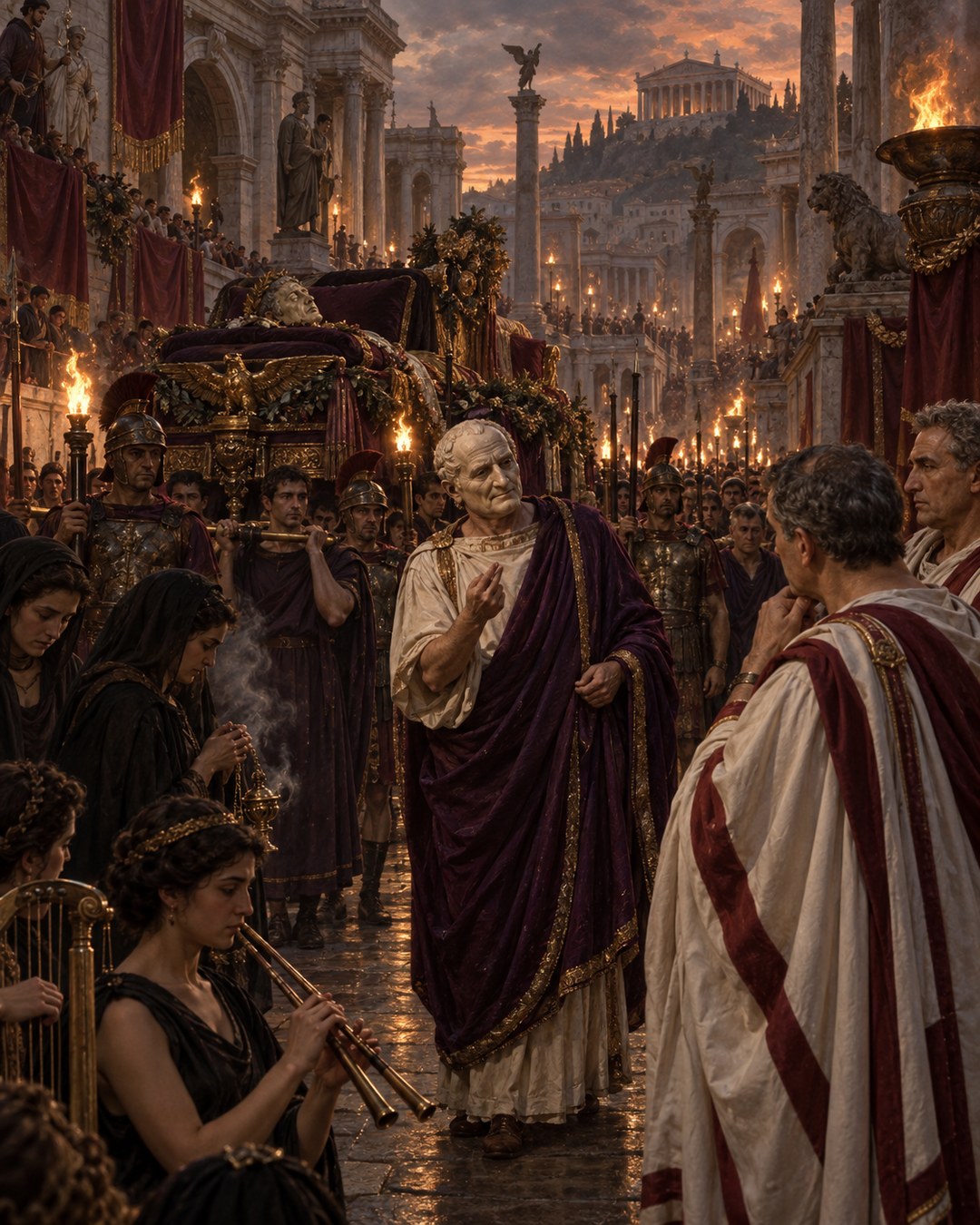
The dead emperor returned to public view behind a mask. At Vespasian’s funeral, Suetonius says, the leading mime Favor wore the ruler’s likeness and copied his familiar actions and words. Then the performer turned toward the procurators and asked what the procession cost.
Ten million sesterces, came the answer. Favor replied that they should give him one hundred thousand and throw the body into the Tiber.
The line did more than puncture solemnity. It made the funeral’s expense collide with the dead emperor’s reputation for watching money. A state ceremony preserved Vespasian by allowing a professional imitator to bargain over the price of preserving him.
A Mask Returned a Recognizable Emperor to the Crowd
Suetonius introduces Favor as the leading mime of the funeral. His task was not to deliver a neutral portrait. Wearing Vespasian’s mask, he imitated actions and words that spectators could identify with the dead ruler. The performance depended on recognition: a gesture, tone, or verbal habit had to summon a public personality quickly enough for the scene to work.
The mask solved one problem of imperial funeral ritual. The body could be present yet unavailable as an acting person. A living performer supplied motion and speech. Vespasian’s public character crossed from the man into a role that could walk before the crowd.
That transfer was selective. Favor did not reproduce an entire reign. He condensed it into traits sharp enough to survive imitation. Suetonius makes frugality the decisive one. The emperor who had spent a lifetime being accused of chasing revenue is made to inspect the cost of his own obsequies.
Roman commemoration often relied on controlled images. The enormous prices attached to paintings in Caesar’s purchase of Medea and Ajax turned art into a visible statement of possession and prestige. Favor’s mask worked differently. Its value lay not in rare material but in the brief human performance it enabled.
The source does not preserve the mask’s materials, its exact expression, or a full script. Nor does it list every gesture that Favor copied. Those absences matter. The surviving scene is powerful because Suetonius gives only the mechanism required for recognition: likeness, imitation, cost, bargain.
A mime could exaggerate without abandoning resemblance. Indeed, exaggeration may have made the emperor easier to recognize at procession scale. The body moved through a crowded city; a private mannerism had to become visible enough for public reading. Imperial identity was rebuilt as a sequence of signs.
The Procurators Supplied the Number That Made the Joke Work
Favor’s question is addressed to the procurators, officials associated with imperial administration and finance. He asks how much the funeral procession costs. Their answer, ten million sesterces, changes a ritual into an account that can be compared, challenged, and undercut.
The exact sum provides the joke with weight. Without it, Vespasian’s reputation for economy would remain an adjective. Ten million gives the performer something to divide. His counteroffer of one hundred thousand is one hundredth of the reported expense: a modest personal payment set against a vast ceremonial bill.
Suetonius does not provide an itemized budget. We cannot assign portions of the total to purple cloth, musicians, attendants, construction, or distributions. The number belongs to the anecdote as reported. It marks the scale of public expenditure and creates room for Favor’s cheaper proposal.
The exchange also makes officials part of the performance. The mime needs an answer from people who can plausibly speak for cost. Their figure becomes his cue. A bureaucratic fact, or at least a figure presented as one, is converted immediately into theatrical timing.
Money could transform reputation in less controlled settings too. In Tongilianus’s suspiciously profitable house fire, Martial uses the gap between property value and gifts from friends to sharpen an accusation. At Vespasian’s funeral, the distance between ten million and one hundred thousand turns expenditure into a posthumous character sketch.
The procurators do not answer the joke in Suetonius’s version. Their function is to establish the official scale. Once they have spoken, Favor can offer an unofficial alternative so severe that it sounds both absurd and economically tidy.
The Tiber Offer Compressed Frugality into a Cruel Bargain
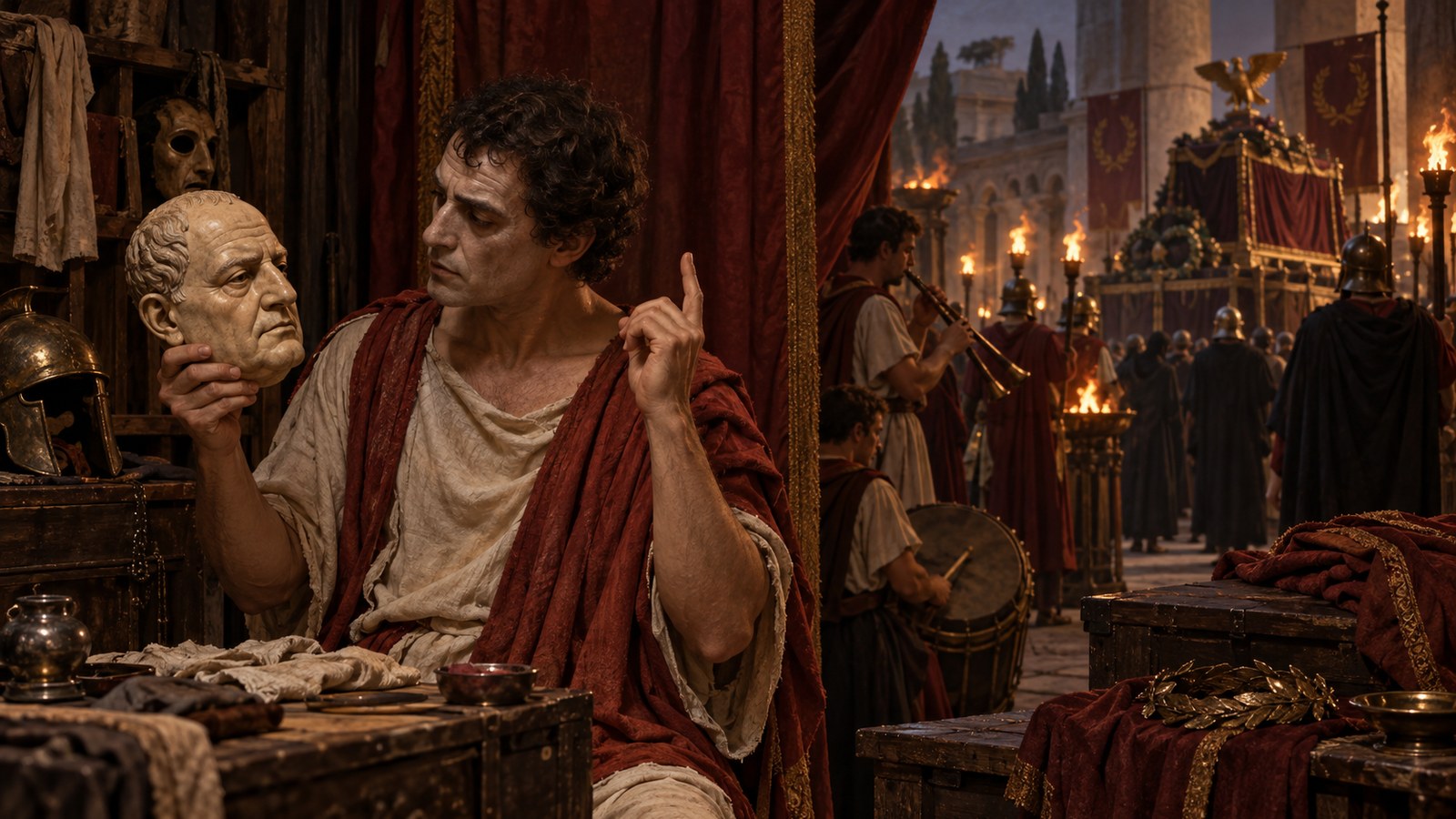
Favor’s proposed economy is blunt: pay him one hundred thousand, then throw Vespasian’s body into the Tiber. The river converts savings into a physical shortcut. Instead of completing a costly route of honor, the state could dispose of the corpse and retain almost all the reported sum.
The line is deliberately unsuitable for a funeral. That impropriety is the source of its force. The performer speaks through the mask of the person whose dignity the procession exists to sustain. Vespasian appears to cancel his own magnificent commemoration because the price is too high.
This is not evidence that officials seriously considered river disposal. It is a staged joke reported by a biographer. Its truth claim concerns the performance and the reputation it activated, not an alternative plan lodged in an administrative file.
Suetonius has already prepared readers to accept the voice. Elsewhere he portrays Vespasian as comfortable with coarse wit and willing to joke about revenue. Near death, the emperor is said to have remarked that he was becoming a god. The funeral mime extends that style after speech from the actual man has ended.
The Tiber also gives the joke a destination familiar to a Roman audience. It is not an abstract command to spend less. A procession moving through the capital is countered with the shortest brutal route out of ceremonial obligation. The river waits as a visible alternative to architecture, parade, and memory.
Favor’s fee keeps self-interest inside the economy. He does not offer to save the state for nothing. He names his own hundred thousand first. That detail prevents the imitation from becoming a moral sermon. The masked emperor is economical, opportunistic, and funny at once.
Official Irreverence Completed Rather Than Broke the Funeral
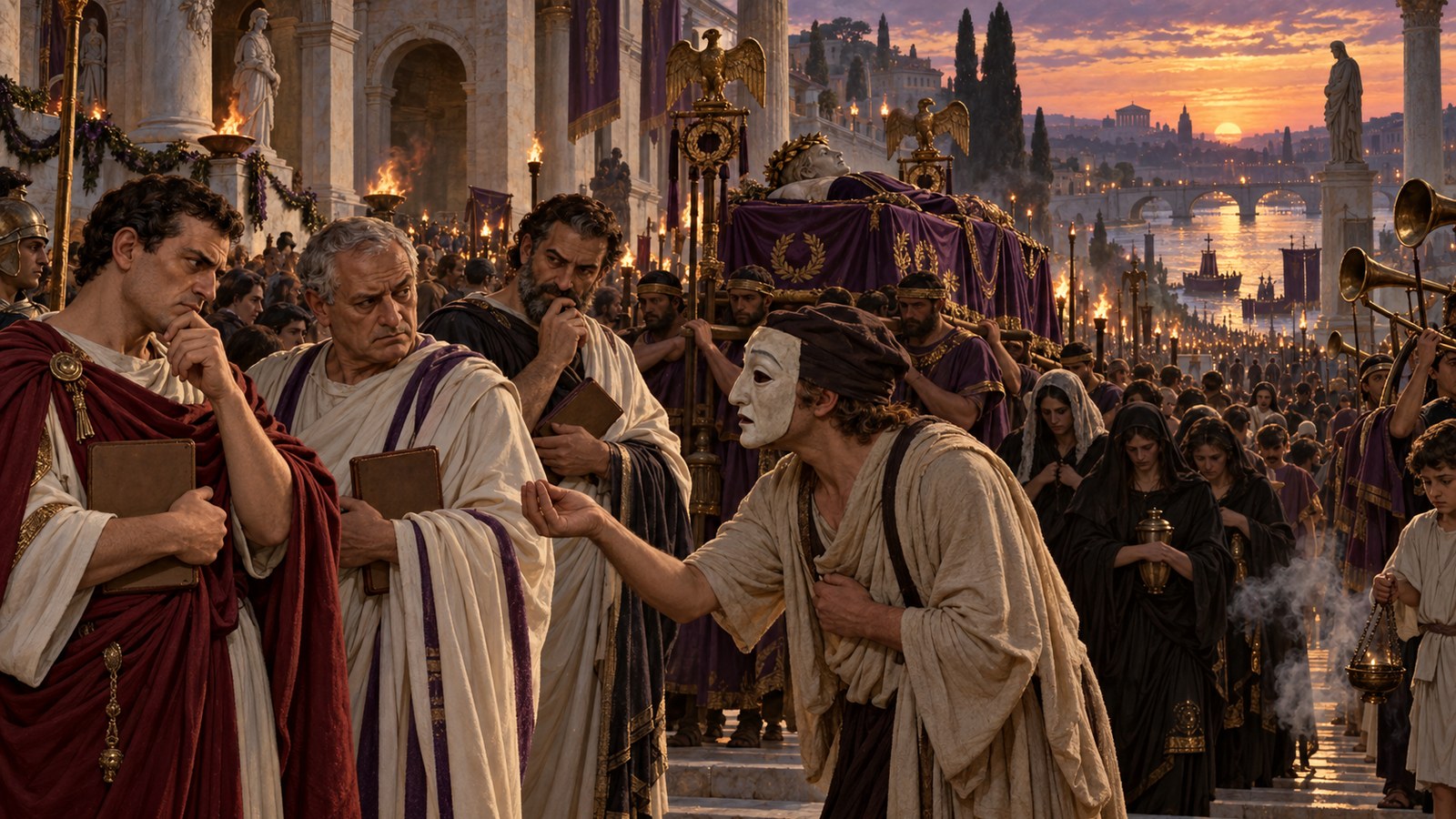
A joke spoken outside the ceremony might be mockery. Spoken by its appointed mime, it becomes part of the ceremony’s machinery. The funeral authorizes an imitation capable of criticizing funeral expense, then uses that criticism to make Vespasian seem present one last time.
The arrangement protects two kinds of memory. The costly procession presents imperial scale. Favor preserves the smaller habits by which people believed they knew the ruler: the quick calculation, the suspicion of waste, the appetite for a rough joke. Neither image has to defeat the other.
This is why the anecdote is more than proof that Romans laughed at funerals. It shows a political culture managing contradiction through performance. Vespasian can be honored with immense expenditure and remembered as the man who would object to it. The contradiction becomes credible because a masked professional stages both sides in one exchange.
Suetonius reports that Vespasian died in the ninth year of his reign at sixty-nine. Those details close a biological life. Favor’s appearance opens a second existence made of repeatable behavior. Once habits can be copied, the emperor becomes available to audiences who never heard the original voice.
The copy was temporary. When the procession ended, the mask stopped speaking. Yet the bargain remained compact enough for a biographer to preserve: ten million, one hundred thousand, the Tiber. Three concrete elements carry the public character farther than a catalogue of virtues could.
The funeral therefore spent lavishly and economized narratively. Rome paid for scale, while Favor reduced Vespasian to one perfectly legible transaction. The emperor’s last public appearance was not a silent portrait. It was an argument over the bill.
Sources
Suetonius, Vespasian 19, 22–24.