
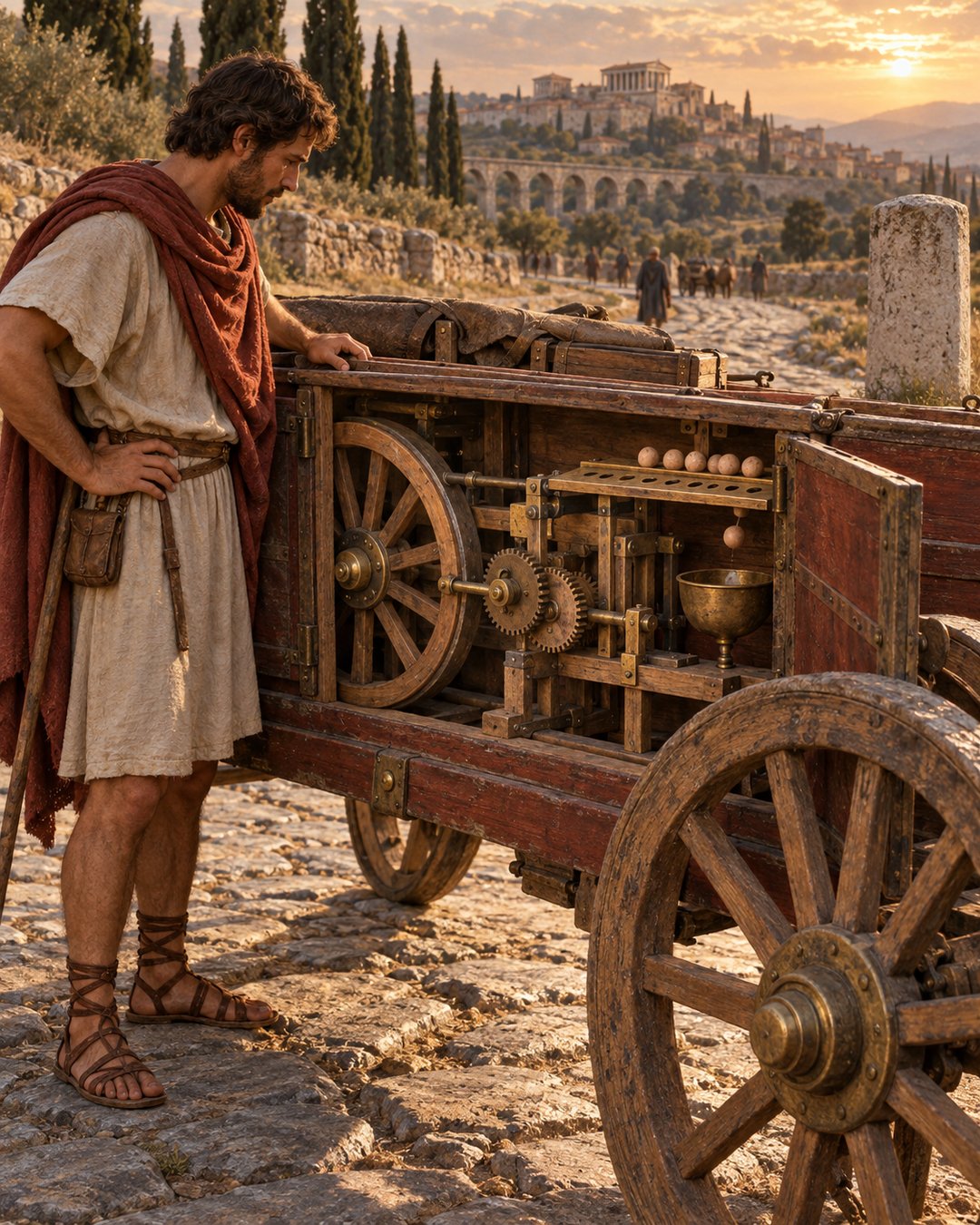
A Roman chariot travelled continuously, but Vitruvius wanted its distance to arrive in separate pieces. Inside the vehicle, the road wheel drove a slower vertical wheel. That wheel drove a horizontal plate pierced with holes. In each hole waited a small ball.
After four hundred turns of the carriage wheel, one ball reached an opening, passed through a channel and fell into a bronze vessel. The sound marked a mile. At the end of the journey, the traveller did not need to estimate the road by fatigue or scenery. The accumulated balls supplied the count.
The machine described in Book Ten of On Architecture is easy to summarize and difficult to build. Its purpose is clear, its numerical reduction is explicit, and its gear arrangement has prompted arguments about how well the written design could actually mesh. That tension makes the odometer valuable: it shows Roman technical thought turning motion into information without giving us permission to pretend every carriage carried one.
A Four-Foot Wheel Established the Unit
Vitruvius begins with geometry before he introduces a counter. The chariot wheel should be four feet in diameter. Mark one point on its rim, let the wheel complete a revolution on the ground, and it will cover twelve and one-half feet in his calculation.
That starting dimension determines everything downstream. Four hundred revolutions at twelve and one-half feet produce five thousand feet, the Roman mile used by the design. The road wheel is therefore both support and measuring instrument. Its repeated contact with the surface samples the journey.
Real travel complicates that neat relationship. A wheel can slip, bounce, wear, take a curved line or differ from its intended diameter. Vitruvius does not use this chapter to quantify those errors. He gives a construction rule whose arithmetic assumes each completed turn corresponds to the stated length on the road.
The mechanism answers a different problem from the one discussed in the hidden tension that kept a Roman wheel together. Wheelwrighting had to make a rotating structure survive shocks and loads. The mileage counter borrowed that durable rotation and made it carry a second burden: memory.
Continuous movement is hard to remember directly. A traveller cannot watch and record four hundred revolutions for every mile over a long day. Vitruvius inserted mechanical stages that counted on the traveller’s behalf, preserving one small increment each time the wheel completed its cycle.
One Tooth Slowed Four Hundred Revolutions
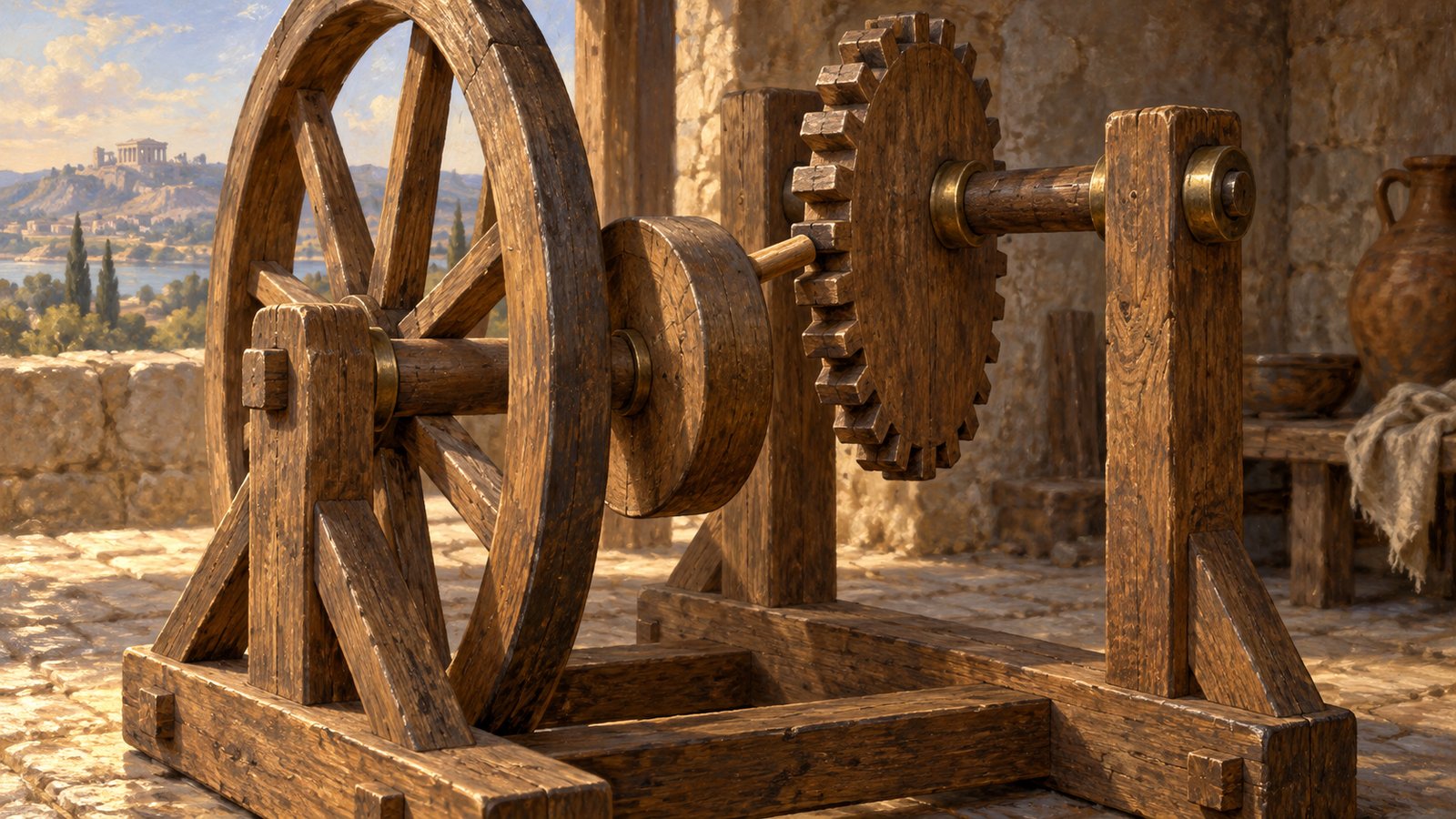
On the inner side of the wheel nave, Vitruvius fixes a drum with one small tooth projecting from its circumference. Each revolution of the carriage wheel brings that tooth around once.
Inside a box on the chariot sits a second drum wheel mounted vertically on an axle. Its edge is divided into four hundred teeth. The single tooth on the wheel-mounted drum meets one of them on each revolution, advancing the large count by one step.
The reduction is the heart of the design. The vehicle’s wheel may turn rapidly, but the 400-tooth drum turns slowly. Only after the wheel on the road has revolved four hundred times does the second wheel complete one revolution.
Vitruvius gives the second drum another projection, this time on its side. When the drum completes its slow circuit, that side tooth acts on a third wheel above it. Fast rotation has now been converted into one rare impulse.
This is related to the principle behind the Roman steelyard’s moving weight, but the information is transformed differently. A steelyard balances force against position at one moment. The odometer accumulates repeated equal movements over time and waits to announce their total.
The text is precise enough to invite reconstruction, yet precision does not remove every engineering question. A lone tooth must reliably engage a wheel divided into four hundred parts while the carriage vibrates. Surviving wording and workable hardware are not identical kinds of evidence. The chapter proves that Vitruvius transmitted the design; it does not by itself document a fleet of completed counters in daily service.
A Perforated Plate Turned Motion into Objects
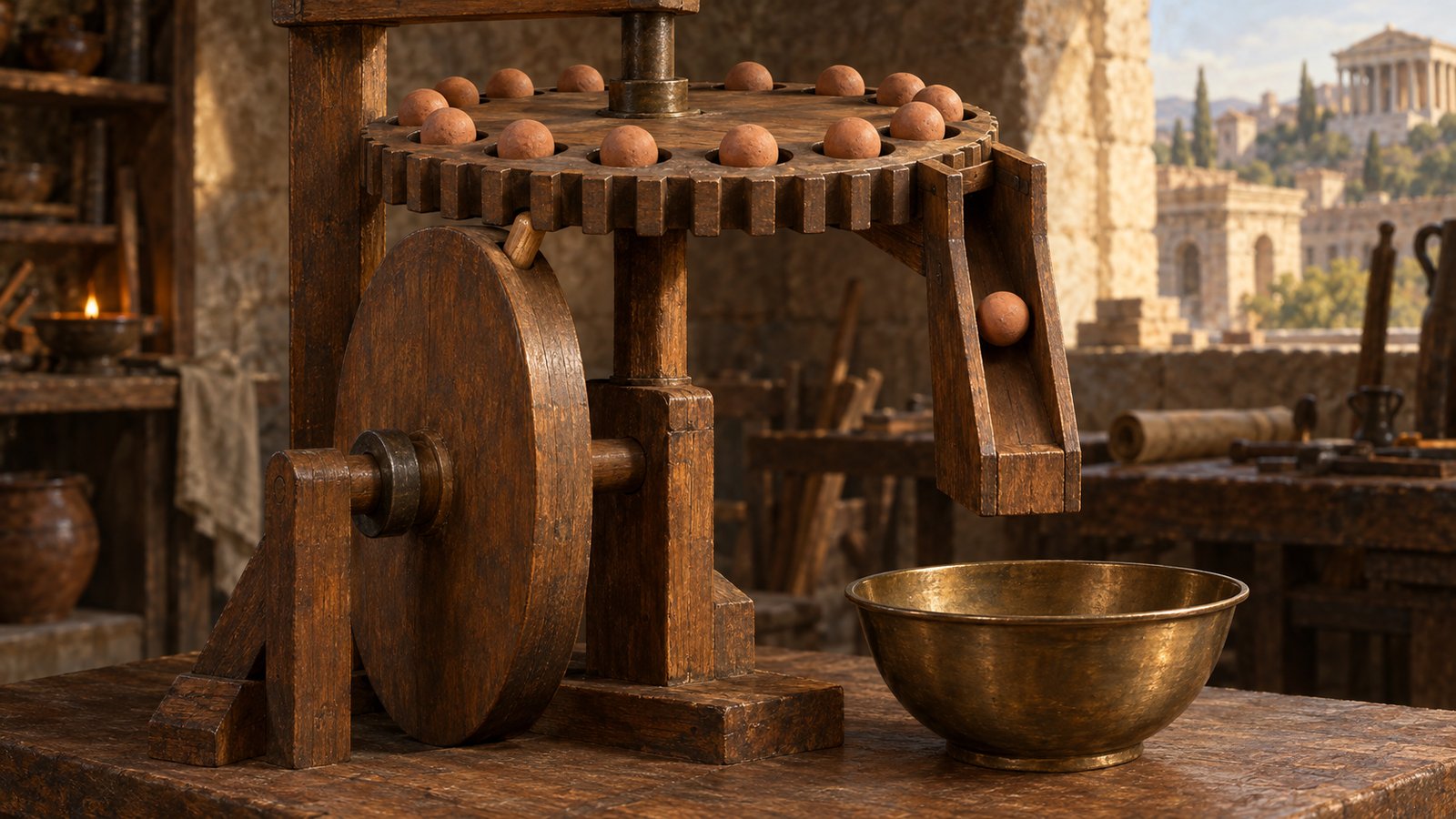
The third wheel lies horizontally in an enclosure above. It is toothed so the side projection on the vertical drum can advance it. Its upper face contains a circle of holes, each loaded with a small ball.
Vitruvius says the number of holes may equal the miles in an ordinary day’s journey, but he adds that having more or fewer does not matter. The machine’s principle depends on one ball being released per completed mile, not on one universal daily limit.
Beneath the plate, an opening and a channel lead toward a box and bronze receiving vessel. As the horizontal wheel advances one position, a loaded hole reaches the outlet. Gravity completes what the gears began. The ball drops from stored position into counted position.
The choice is wonderfully physical. A painted dial could indicate a total only while its pointer remained correctly aligned. A falling ball leaves a durable object in the receiver. Each mile changes the inventory. If the journey ends after seventeen releases, seventeen balls wait to be counted.
The bronze vessel adds sound to storage. Vitruvius explicitly describes the ball falling with a noise. A passenger could hear the counter register without staring into the box. Distance became an occasional tap amid the continuous creak of axle, rim and road.
Nothing in the mechanism requires the ball to understand a symbol or carry an inscription. Position supplies meaning. Above the channel it is potential mileage; below it, completed mileage. The design turns an abstract length into a collection of small, interchangeable things.
The Count Extended from Roads to Water
Vitruvius does not stop with a chariot. He adapts the system for a ship by placing paddle wheels at the vessel’s sides. Blades meeting the water turn those wheels as the ship moves, and their axles carry the motion inward to the counting mechanism.
The medium changes from road contact to water resistance, but the logic remains reduction and release. Repeated rotation advances slower gears until the horizontal plate yields one ball. Land and sea can therefore be described with the same informational trick even though wheel slip and paddle behavior create different practical errors.
This extension reveals the ambition of the chapter. The device is not merely a curiosity hidden in one cart. It is a general proposal for translating travel into a count by attaching machinery to whatever rotates with movement.
It also reinforces the need for caution. Vitruvius introduces the invention as useful and inherited from earlier experts. His detailed prose is evidence for technical knowledge and transmission. It is not an excavated odometer, a maintenance log or a statement that Roman surveyors routinely trusted one on every measured road.
A responsible reconstruction should preserve both sides. The arithmetic is intelligible: four hundred wheel turns equal one mile under the stated dimensions. The sequence is intelligible: nave tooth, vertical 400-tooth drum, side tooth, horizontal perforated wheel, falling ball. The uncertainties concern manufacture, engagement, vibration, calibration and actual deployment.
That boundary does not diminish the design. It clarifies what is most inventive about it. Vitruvius’s counter did not attempt to make a wheel “know” distance. It arranged matter so repeated movement could not occur without eventually relocating an object.
A journey flowed through thousands of feet, but the machine remembered in lumps. One ball sounded, fell and remained. Four hundred more wheel turns began the next count. By slowing motion twice and letting gravity finish the record, the design made a Roman mile something a traveller could hear—and later hold in the hand.
Sources
Vitruvius, De architectura 10.9.