
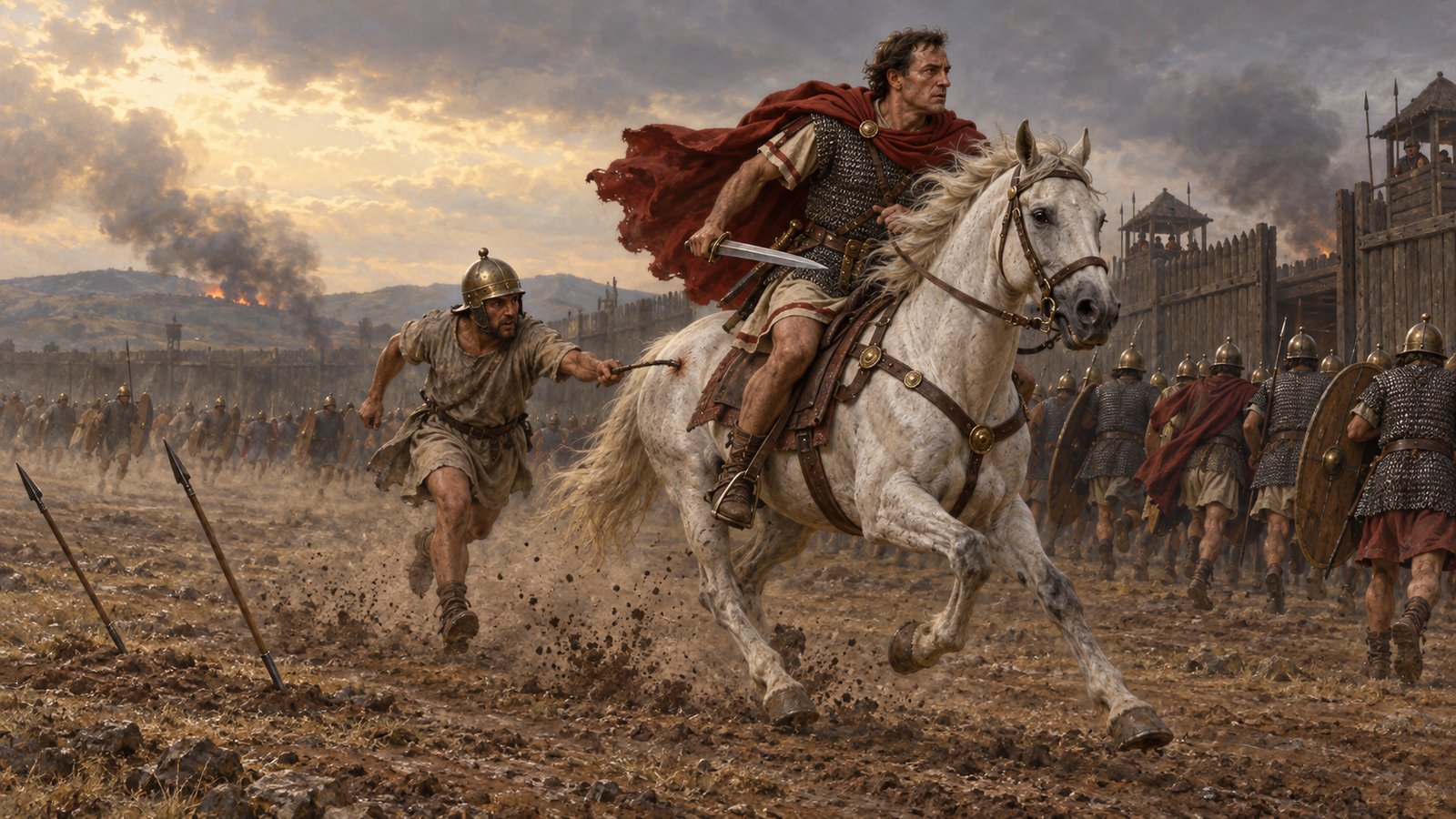
Two enemy soldiers recognized Sulla on his horse and set their spears for the throw. The commander did not see them. His groom did, struck the animal forward with a lash, and the iron points passed so close that they grazed the tail before fixing themselves in the ground.
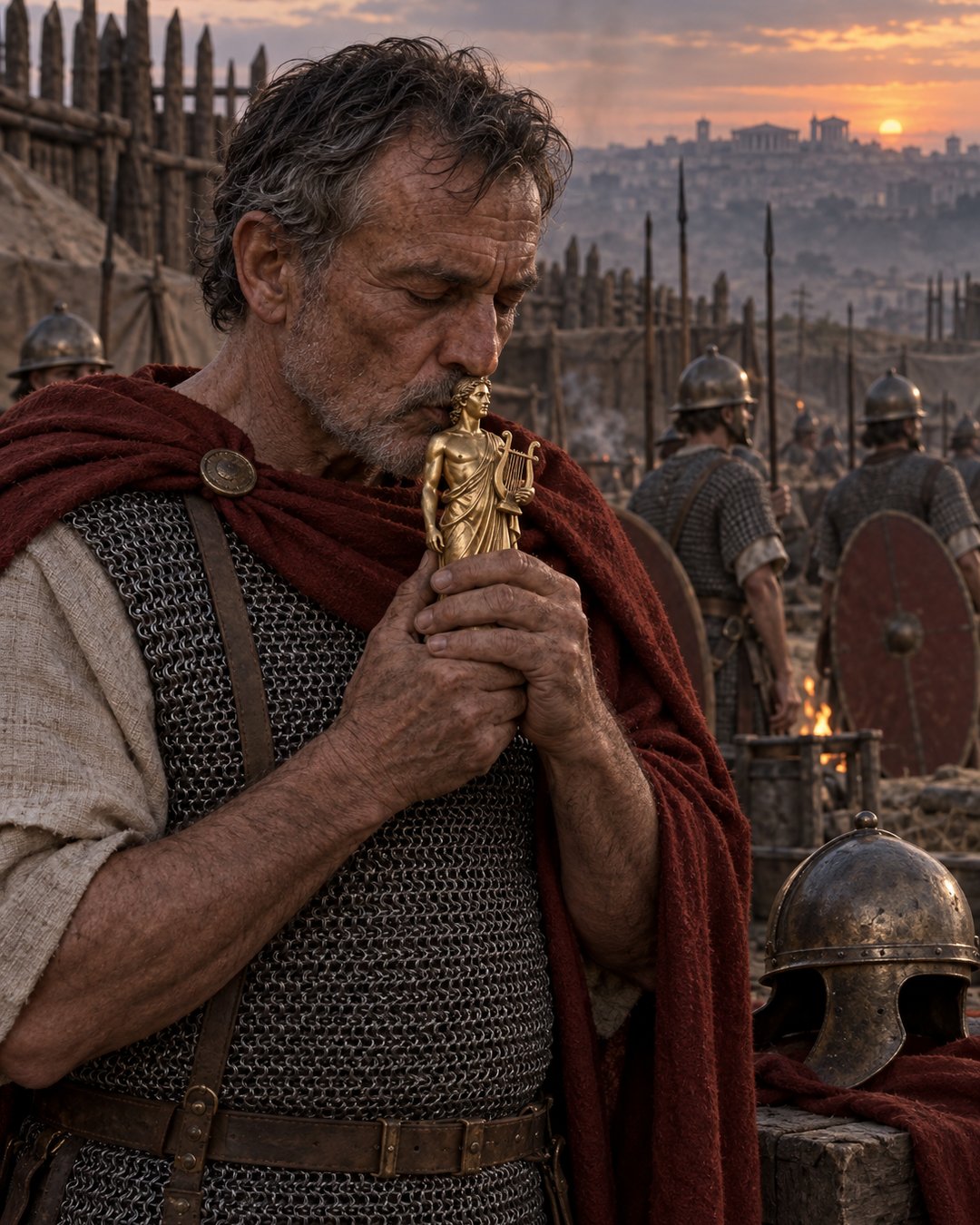
The escape did not end the danger outside Rome. Sulla’s part of the army was giving way near the Colline Gate. At that point, Plutarch says, he reached into his clothing, brought out a little golden image of Apollo from Delphi, kissed it, and asked whether the god who had raised him through so many struggles had brought him home only to destroy him at his own city’s gates.
It is an intimate action inside a public disaster: a small object held against the noise of a collapsing wing. Yet the next sentences matter as much as the kiss. Sulla went straight back to human command. He pleaded with some men, threatened others, and physically seized still others. The figurine gave his fear a listener; it did not issue orders.
A Return to Italy Put Fortune under Strain
Plutarch prepares the scene by making Sulla’s return look formidable. The general came from the war against Mithridates and prepared to cross from Dyrrhachium to Brundisium with twelve hundred ships. His soldiers swore of their own accord to remain with him and to do no damage in Italy without his instructions.
He landed with forty thousand men. Brundisium admitted him without resistance, an act for which he later granted the city freedom. Allies and former enemies moved toward him as the struggle against the Marian side gathered into another Roman civil war.
None of those numbers made the outcome automatic. Ships delivered an army, an oath helped bind it, and a cooperative port opened the road. They could not make every battlefield formation hold. Plutarch’s biography repeatedly associates Sulla with fortune, but the Colline Gate episode tests what that language meant when events looked suddenly hostile.
The broader political road is traced in the account of Sulla turning his army toward Rome. The small Apollo belongs to a narrower problem. It asks what a commander who claimed extraordinary luck did during the instant when luck seemed to have stopped answering.
The answer begins with scale. Sulla did not carry a temple into battle. He carried an image small enough to remain in his bosom while riding. Whatever ceremonies surrounded Apollo elsewhere, this version of divine presence travelled against the body, protected by cloth until the hand reached for it.
Two Spears Made the Commander’s Body the Crisis
Plutarch locates Sulla in direct physical danger. He rode a mettlesome and very swift white horse. That visibility helped two opponents recognize him and prepare their casts. The animal’s color, speed and the commander’s exposed position made leadership legible to enemies as well as followers.
The rescue depended on another pair of eyes. Sulla failed to notice the poised weapons, but his groom saw them. A single cut of the lash sent the horse ahead. The spearheads only grazed its tail and buried themselves behind it.
There is no need to enlarge the incident into a miracle the text does not claim. The sequence gives the groom clear agency: he sees, acts and changes the horse’s position. It also leaves Sulla with a terrifying measure of the margin. The points landed where he had just been.
This concrete escape makes the later prayer sharper. Roman commanders routinely operated among signs, sacrifices and reports of divine favor. The article on what Roman omens did before battle explains the public systems through which action could be authorized or delayed. Sulla’s Apollo is different in size and setting. It was a private, portable focus revealed after battle was already joined.
A talisman against the chest could accompany movement in a way that an altar or formal consultation could not. It stayed with the commander through dust, riding and sudden reversals. When Sulla took it out, the gesture turned an invisible attachment into an observable act, though Plutarch does not tell us exactly which soldiers saw or heard it.
The Kiss Addressed a God—and Sulla’s Own Story
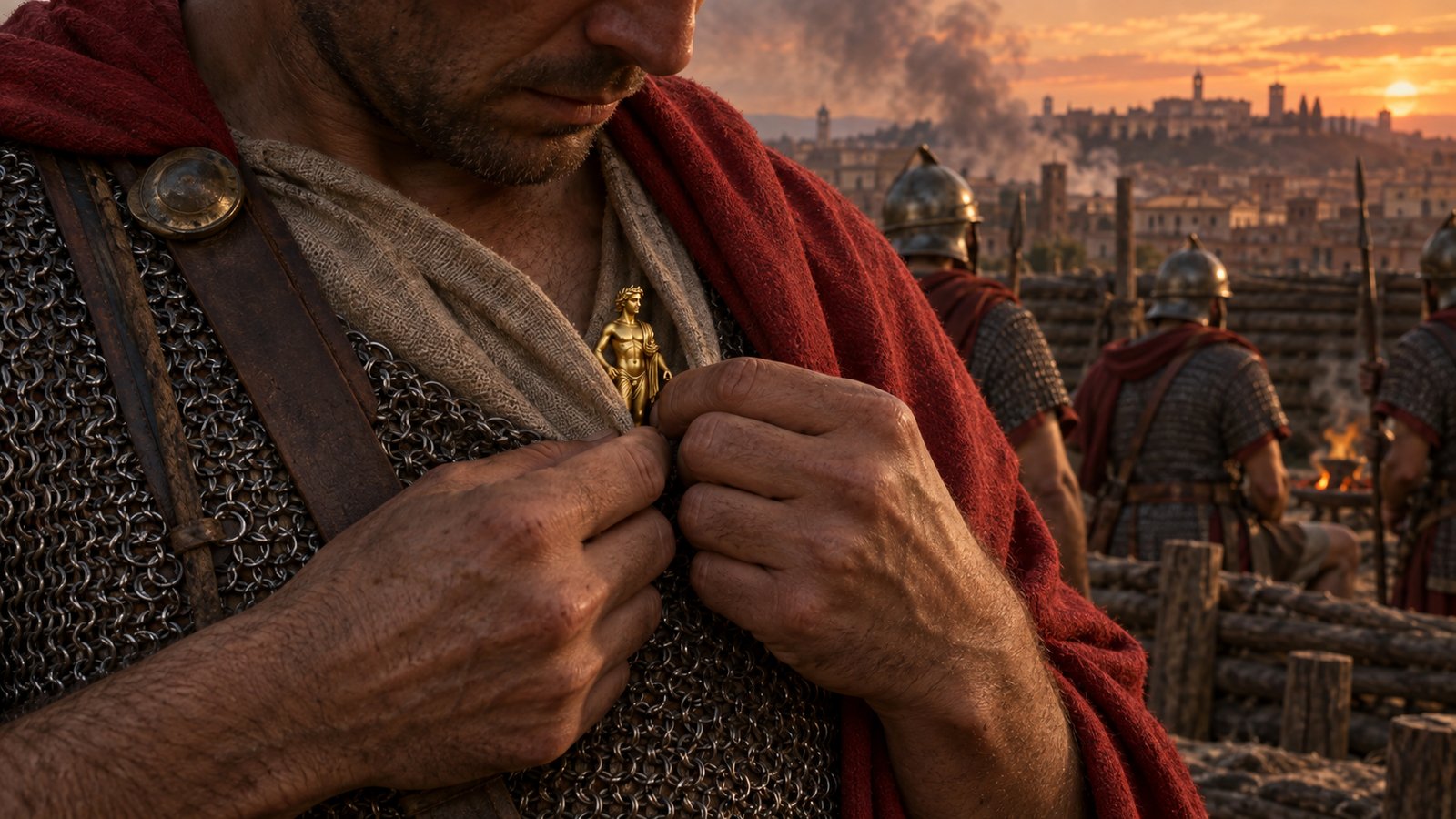
Plutarch introduces the object cautiously: there is also a story that Sulla possessed it. That phrasing is important. The biographer reports a memorable tradition rather than presenting an inventory witnessed at the battle.
Within that tradition, the figurine came from Delphi and represented Apollo. Sulla carried it whenever he was in battle. The repeated practice made it more than an ornament. Its place inside his clothing tied the object to danger, decision and his cultivated relationship with success.
At the Colline Gate he did not merely display it. He kissed it affectionately and spoke to Pythian Apollo. The words are not a calm request for tactical advice. They form an accusation shaped as a question: after lifting the fortunate Cornelius Sulla to glory and greatness through many struggles, would the god cast him down at the threshold of his native city?
The prayer compresses Sulla’s biography into a bargain. Past victories become evidence of a pattern; the present collapse threatens to make that pattern incoherent. Calling himself fortunate was not only boasting after success. Here it created a problem during failure. If divine support explained the ascent, who could be addressed when the ascent seemed about to end?
The image supplied a body for that address. Gold caught light; the tiny figure could be held and kissed. Touch converted a vast question about destiny into a sequence of motions that one frightened person could complete: reach, uncover, lift, kiss, speak.
But portability also exposed the object’s limit. Apollo remained small in Sulla’s hand while formations broke around him. The god could be invoked as guarantor of the commander’s story, but the material figure could not physically close a gap, stop a fugitive or reform a line.
After Prayer Came Threats, Hands and a Camp
Plutarch moves immediately from invocation to command behavior. Sulla entreated some men, threatened others and laid hands on others still. The three verbs describe escalating pressure. Persuasion, fear and physical restraint followed one another because no single appeal held everyone.
Even that effort did not restore the whole position at once. His left wing was completely shattered, and Sulla withdrew with fugitives into the camp after losing friends and acquaintances. People who had come from the city to watch were trampled, and panic carried reports toward Praeneste that Rome’s defense was effectively finished.
This is why the scene should not be retold as “Sulla kissed Apollo and won.” The prayer occurs before a documented retreat. Plutarch preserves no simple mechanical line between devotion and victory. The carried god helped Sulla voice the crisis, while survival still depended on a groom, camp defenses, coercion, other officers and events elsewhere on the field.
Elsewhere, Crassus had prevailed on his wing and pursued the enemy to Antemnae. Sulla did not learn of that success until after dark, when messengers arrived asking for provisions. The delay matters. During the kiss and the collapse, he could not yet use Crassus’s victory as reassurance. His local evidence pointed toward defeat.
The golden Apollo therefore reveals neither empty superstition nor effortless divine rescue. It shows sacred confidence functioning beside practical action without replacing it. Sulla could kiss the god and grab a retreating soldier within the same crisis because those acts answered different needs.
One defended the meaning of his career at the moment it threatened to break. The other tried to keep bodies between the enemy and Rome. The figurine made fortune portable, but the battle exposed how much weight that small object could not carry.
Sources
Plutarch, Life of Sulla 27 and 29.