
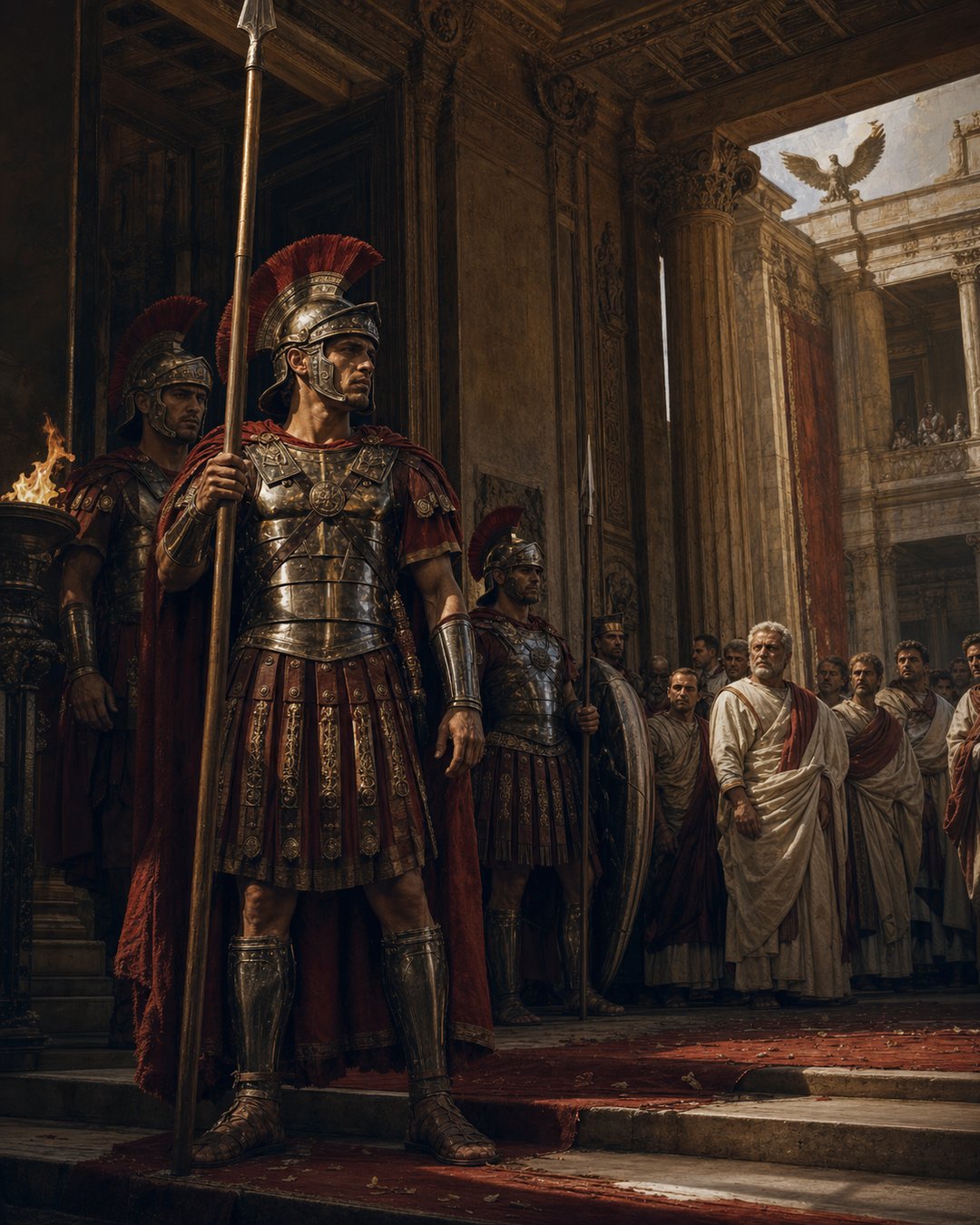
The Praetorian Guard did not become dangerous because Rome hired unusually wicked bodyguards.
That would be too easy.
The real problem was structural. Rome placed armed, privileged soldiers close enough to touch the emperor, close enough to hear the panic inside a palace, and close enough to turn uncertainty into a new ruler.
A bodyguard can protect a throne. In Rome, the bodyguard learned that it could also bargain with one.
Augustus Built the Trap Carefully
The guard was not born as a late imperial accident. Its roots reached back into the Republican world of commanders and their headquarters troops. But under Augustus it became part of the new imperial order.
That matters because Augustus was trying to solve the problem he had created by winning. Rome had come out of civil war with one man at the center. As we saw in the first Augustus article, his genius was making that one-man rule look like restoration rather than kingship.
Security was part of that performance.
An emperor needed protection. Everyone understood that. Assassination and civil war were not imaginary fears in Roman politics. But protecting the emperor meant creating a unit whose loyalty mattered more than almost anyone else's.
Augustus seems to have understood the danger. Ancient tradition presents him as cautious about how many guards were kept inside Rome itself. The guard existed, but the whole machine was not yet simply sitting in the city's throat.
That restraint did not last forever.
Sejanus Made Proximity Into Power
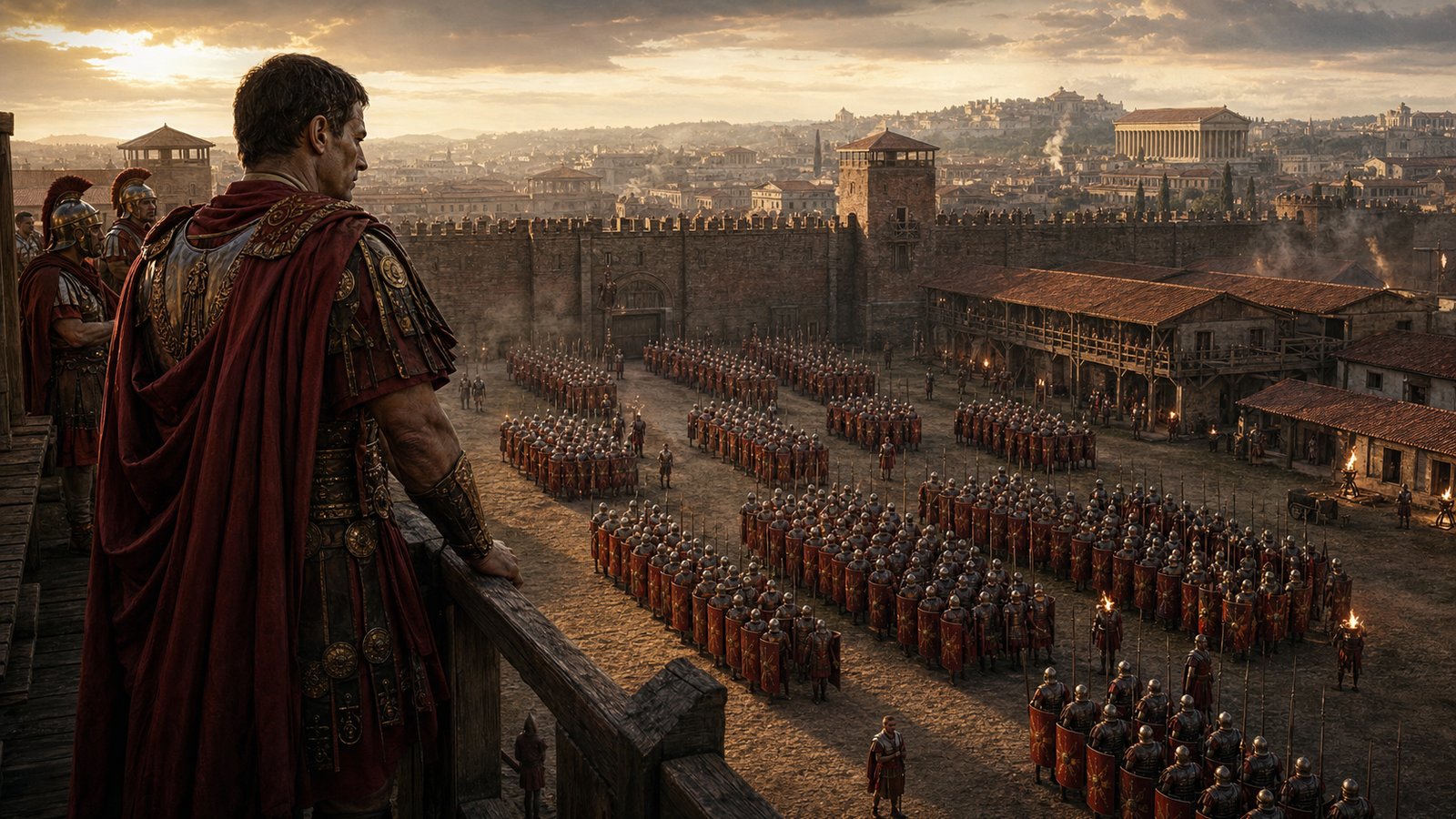
Under Tiberius, the Praetorian prefect Sejanus helped make the guard more concentrated and more visible.
The key development was the Castra Praetoria, the permanent camp at Rome. A scattered guard is one thing. A unified guard in a single camp, near the center of power, is another.
This did not automatically make the Praetorians masters of Rome. Institutions rarely become dangerous in one dramatic moment. They become dangerous when a useful arrangement keeps solving short-term problems while creating a larger one.
For the emperor, the guard solved security.
For the prefect, it created access.
For ambitious men, it created a lever.
Sejanus is the warning sign. As Tiberius withdrew from daily life in Rome, Sejanus became more than a commander of guards. He controlled access, information, and fear. Cassius Dio's account of the period shows how poisonous that closeness could become: the emperor, the Senate, the guard, and the prefect were all tied together in a politics of suspicion.
The guard's danger was not just its swords. It was the fact that its commander could stand between Rome and the man who ruled it.
Succession Was the Moment Everything Broke Open
A stable emperor could keep the guard useful.
A dead emperor made the guard powerful.
Succession was the weak joint in the imperial system. Rome had rejected kingship in language, but emperors still had to be replaced. That meant there were moments when legality, family claim, Senate approval, army loyalty, and palace reality all collided.
The Praetorians lived inside that collision.
After Caligula was assassinated in 41 CE, Claudius emerged with Praetorian support. The famous details vary by source and tradition, but the political lesson is clear enough: the men guarding the palace were not passive furniture. In a crisis, their recognition mattered.
Once that lesson existed, it could not be unlearned.
The Senate could debate. Aristocrats could whisper. Provinces could wait for news. But the guard was there, armed and organized, at the point where rumor became decision.
That is why the guard's power was so different from ordinary military strength. A frontier legion might be far away. The Praetorians were near the room where the imperial body lay.
Privilege Made the Problem Worse
The guard was not only close to power. It was rewarded for being close.
Praetorians enjoyed higher status than ordinary soldiers, better conditions, and a special place in the imperial system. Emperors gave donatives: cash payments that could be framed as celebration, gratitude, or political insurance.
That created an ugly logic.
If a new emperor needed the guard, the guard could expect payment. If an emperor disappointed the guard, the guard could remember that another candidate might pay better.
This does not mean every Praetorian spent his day plotting treason. Most institutions are not cartoons. The danger was that the incentives pointed in a brutal direction whenever authority weakened.
A guard paid to secure the emperor could start asking what the emperor was worth.
The Year 193 Showed the Nightmare Version
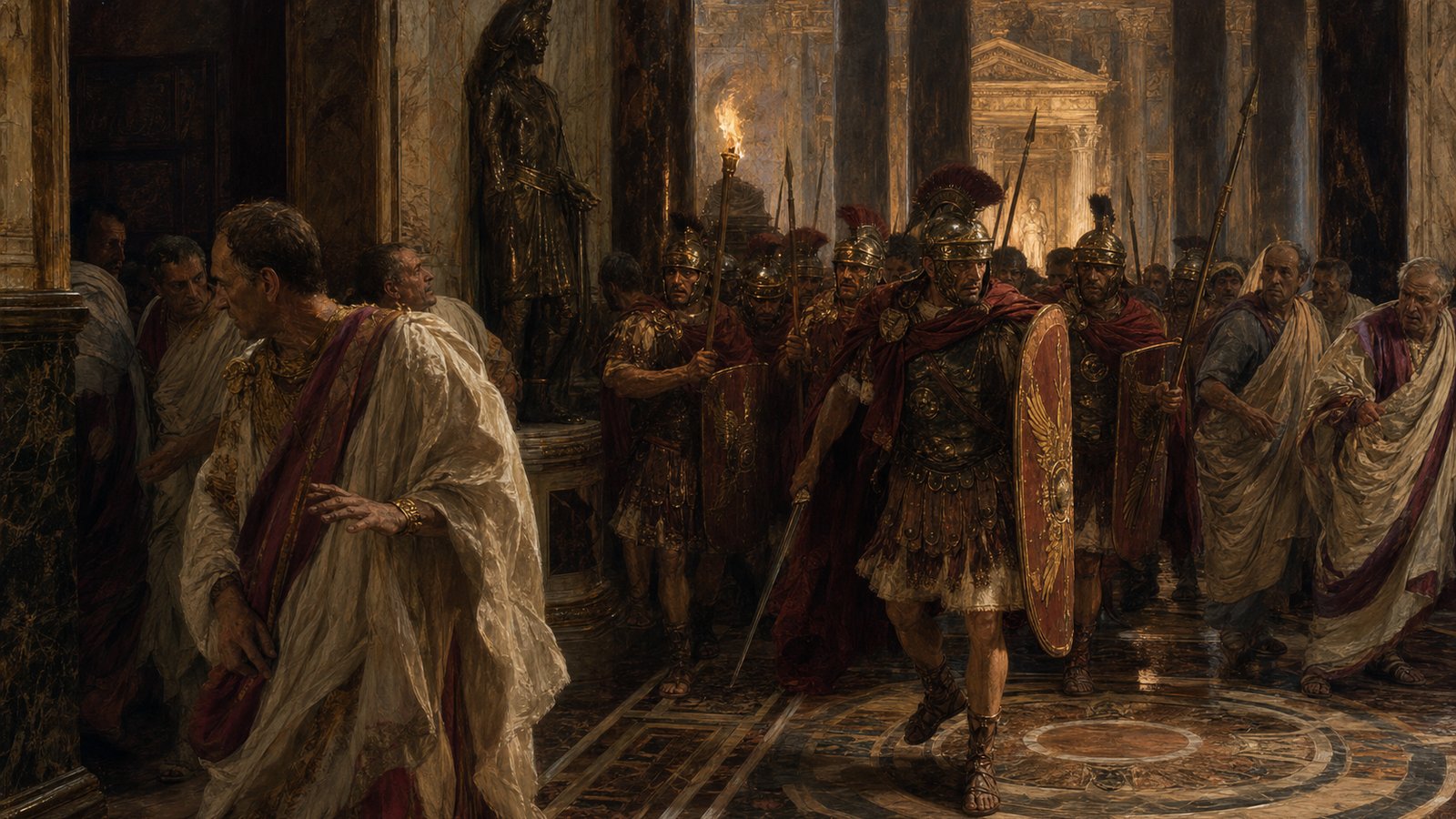
The most infamous example came after Commodus.
Pertinax became emperor at the start of 193 CE. Ancient writers present him as a serious, corrective ruler after the extravagance and violence of Commodus' regime. That was exactly the problem for some Praetorians.
Herodian says the guards complained under Pertinax's stricter rule and longed for the looser violence and rewards of the previous tyranny. Then they rushed into the palace and killed him.
Cassius Dio gives the same basic horror: Pertinax was upright, ruled briefly, and was removed by soldiers.
Then came the disgrace that made the guard's reputation almost impossible to rescue. The imperial office was treated as something that could be won by the man who promised the most. Didius Julianus became emperor after this grotesque bargaining, and Rome had to watch the fiction tear open.
The emperor was supposed to be the summit of Roman order.
For a moment, he looked like the successful bidder outside a barracks.
Severus Understood the Lesson
Septimius Severus did not miss the point.
When he took power, he punished and reorganized the old Praetorians, replacing them with soldiers loyal to himself. That response tells us what everyone already knew: the guard was not just a ceremonial body. It was a political risk that had to be controlled by force when it slipped loose.
But even that did not erase the larger problem. The imperial system still needed armed loyalty. It still needed palace security. It still had moments when succession could become a military question.
Rome could dismiss one set of guards. It could not easily dismiss the logic that had made them matter.
The Bodyguards Became a Mirror
The Praetorian Guard became dangerous because it revealed a truth Rome preferred to hide.
The Principate spoke in old Republican language. It had Senate debates, magistrates, titles, ceremonies, and legal forms. But at the heart of the system stood one man whose safety and replacement could decide the state.
That made the men closest to him more than bodyguards.
They were witnesses to fear. They were brokers in uncertainty. They were the armed edge of a political system that never fully solved how one emperor should become the next.
In the end, the guard's story is not just about corrupt soldiers. It is about what happens when personal protection becomes a constitutional institution without admitting that it is one.
Rome did not simply put swords around the emperor.
It put swords around the question of who had the right to rule.
Sources & Further Reading
- Wikipedia: Praetorian Guard: https://en.wikipedia.org/wiki/Praetorian_Guard
- Wikipedia: Castra Praetoria: https://en.wikipedia.org/wiki/Castra_Praetoria
- Wikipedia: Sejanus: https://en.wikipedia.org/wiki/Sejanus
- Wikipedia: Claudius: https://en.wikipedia.org/wiki/Claudius
- Cassius Dio, Roman History 59: https://penelope.uchicago.edu/Thayer/E/Roman/Texts/Cassius_Dio/59*.html
- Cassius Dio, Roman History 74: https://penelope.uchicago.edu/Thayer/E/Roman/Texts/Cassius_Dio/74*.html
- Herodian 2.5, Pertinax Murdered: https://www.livius.org/sources/content/herodian-s-roman-history/herodian-2.5/
- Herodian 2.6, Didius Julianus: https://www.livius.org/sources/content/herodian-s-roman-history/herodian-2.6/
- World History Encyclopedia: Praetorian Guard: https://www.worldhistory.org/Praetorian_Guard/