
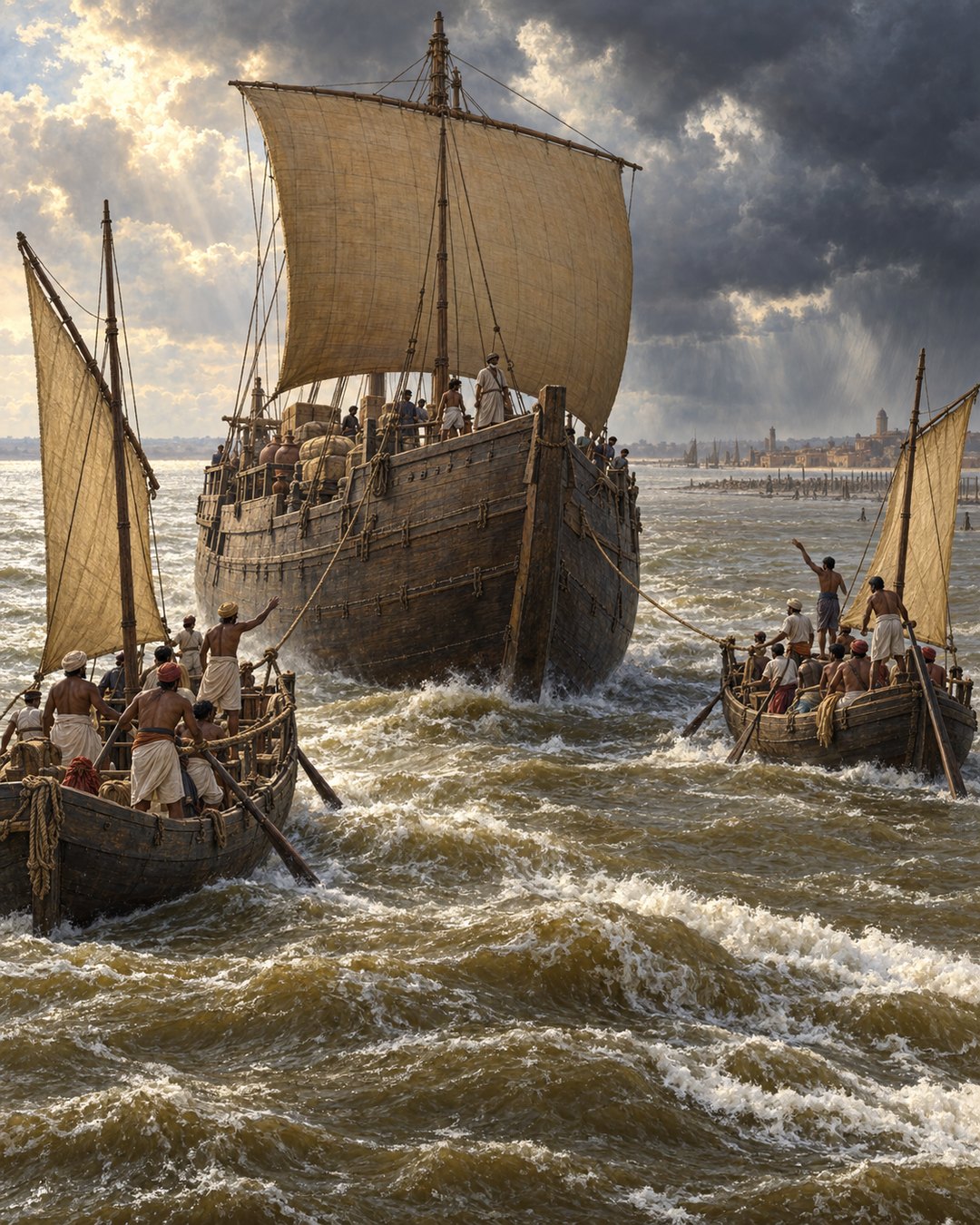
The coast offered almost no help. A ship approaching Barygaza could cross the outer gulf and still fail to identify the river mouth because the land lay too low to distinguish until the vessel was close. Finding the entrance solved only the first problem. Shoals waited inside it, currents punished the anchorage, and the tide could reverse the river with startling force.
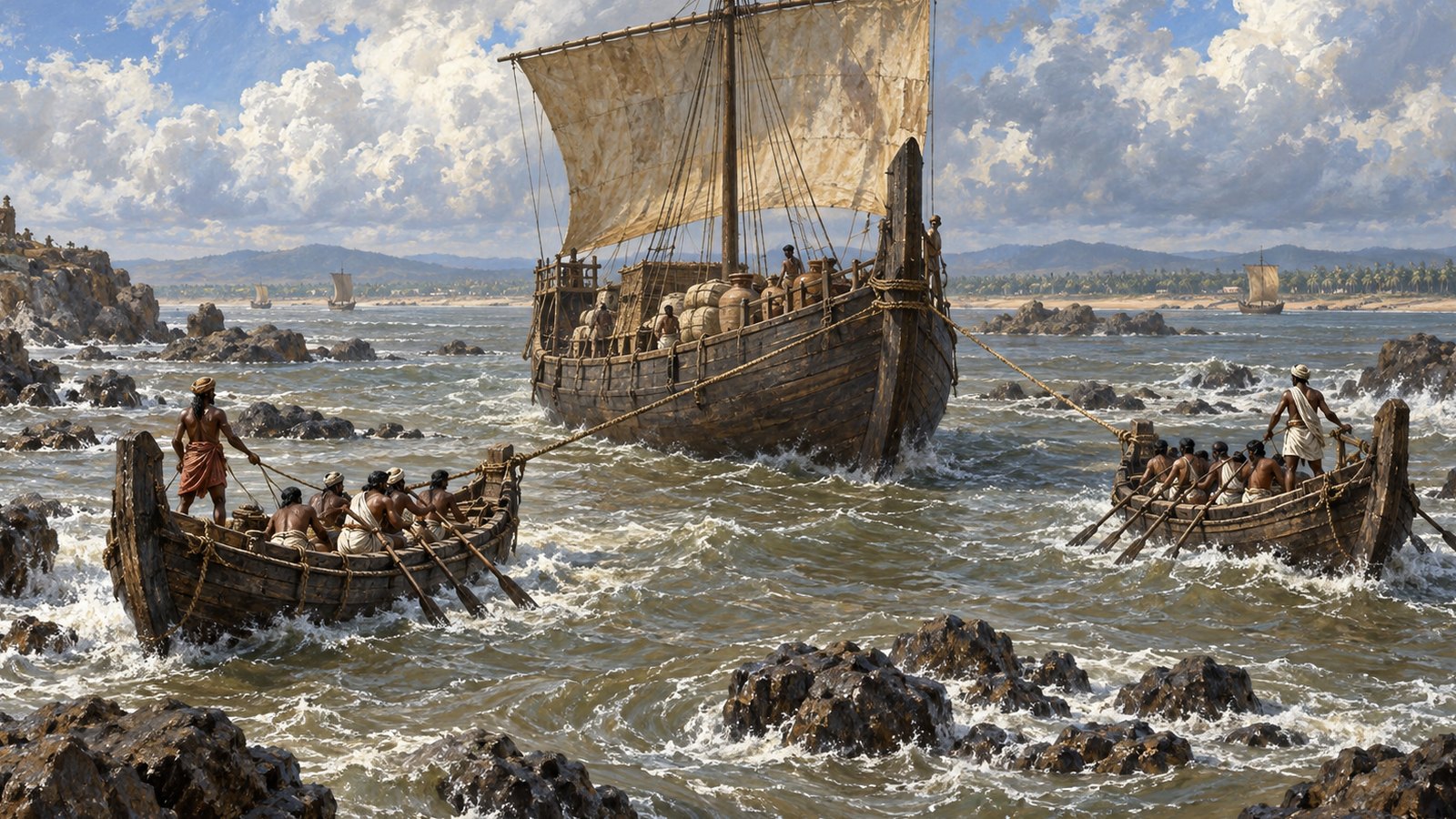
The Periplus of the Erythraean Sea does not answer this danger with a monument. It introduces fishermen in the king’s service. Stationed near the entrance in well-manned local boats called trappaga and cotymba, they went out along the coast, met arriving vessels and brought them toward Barygaza.
Their work followed the water rather than fighting it. They steered ships between shoals, towed them to fixed stations with the beginning of the flood, and waited through the ebb in anchorages and deep basins. A foreign captain’s ocean crossing ended with a local relay whose timing could decide whether the cargo reached market or the hull rolled onto mud and filled.
This is a different picture of long-distance trade from a list of pepper, cloth or coin. Barygaza’s access depended on trained people who knew what the coast concealed and what the moon would make the river do. The fishermen’s knowledge functioned as harbor infrastructure even though it moved in boats.
A Low Coast Hid the Entrance behind Shoals
Vessels approached by crossing a gulf three hundred stadia wide toward the Nammadus, the river of Barygaza. The Periplus calls the next gulf narrow and very difficult for ships coming from the ocean. Both sides were hazardous, although the left-hand passage was better.
On the right lay Herone, a long narrow shoal full of rocks opposite the village of Cammoni. On the left projected the promontory called Papica. Its current made anchoring dangerous, while the rough rocky bottom could cut or chafe anchor gear.
These were not hazards a newcomer could read from one obvious landmark. Even after entering the gulf safely, navigators struggled to find the river mouth. The shore was so low that it could not be made out until a ship stood close to it. Shoals then made the passage itself difficult.
The sequence tightened risk at every stage. Open water narrowed into a gulf. The better side still demanded recognition. The mouth remained visually uncertain. Once found, it did not provide a clean channel. An ocean-going vessel could possess sound hull, sails and cargo yet remain poorly equipped for the final approach.
The article on how Roman anchors made stopping a ship active work shows how much handling ordinary anchorage required. Papica made that work harsher: current pressed the ship while rock threatened the very gear intended to hold it.
The King’s Fishermen Met Ships before the River
Because of these conditions, native fishermen served the king at the entrance. The Periplus names their large boats, trappaga and cotymba, and stresses that they were well manned. Local craft and adequate crews mattered together.
The pilots did not wait passively for foreign vessels to stumble into sight of Barygaza. They traveled up the coast as far as Syrastrene. That outward reach shifted the meeting point away from the most confusing water and gave the approaching ship local guidance before the decisive passage.
The text continues to call them fishermen, but their assigned task is pilotage. They brought vessels toward Barygaza, steered directly from the bay’s mouth between shoals and worked with the ships’ crews. Knowledge crossed from the local boat to the larger vessel through coordination rather than through a map.
Service to the king gives this arrangement a political frame. The passage does not present a private bargain improvised by one merchant after he ran aground. Men were stationed at the entrance and dispatched in named boat types. Their repeated presence turned dangerous knowledge into an organized route.
The pilots’ value lay partly in knowing where not to sail. Herone, Papica and the low river mouth were not abstract points. They were a working pattern of current, bottom, visibility and safe alignment learned by people who used that water continuously.
Flood and Ebb Divided the Journey into Stages
Once inside, the fishermen did not tow a ship steadily all the way upriver. They moved it to fixed stations. The beginning of the flood supplied the forward push; the ebb required a pause in anchorages and basins.
The basins were deeper parts of the river. They offered places where a vessel could wait while surrounding water fell away. Barygaza itself stood about three hundred stadia from the mouth, so the tidal approach was an inland journey, not a brief turn behind a breakwater.
This staged method transformed time into a route. A station was safe not only because of where it lay but because of when the ship occupied it. The same channel could support movement under the flood, expose mud under the ebb and become dangerous again when the next wall of water arrived.
Crews therefore needed patience as much as force. Tow ropes and manpower worked with the favorable phase. Waiting was part of navigation, not a failure to advance. The sequence could be repeated until the vessel reached the market town.
The Muziris cargo contract reveals the money and obligations attached to Indian Ocean goods after a voyage. The Barygaza passage exposes a different layer of cost and dependence: before cloth, aromatics or coin changed hands, a foreign hull had to submit to the schedule of local water and local pilots.
The Moon Made Dry Ground and Sea Exchange Places
The Periplus enlarges the warning by describing tides around Barygaza. Their rise and fall were especially great, increasing around new moon and full moon for three days and decreasing during the days between.
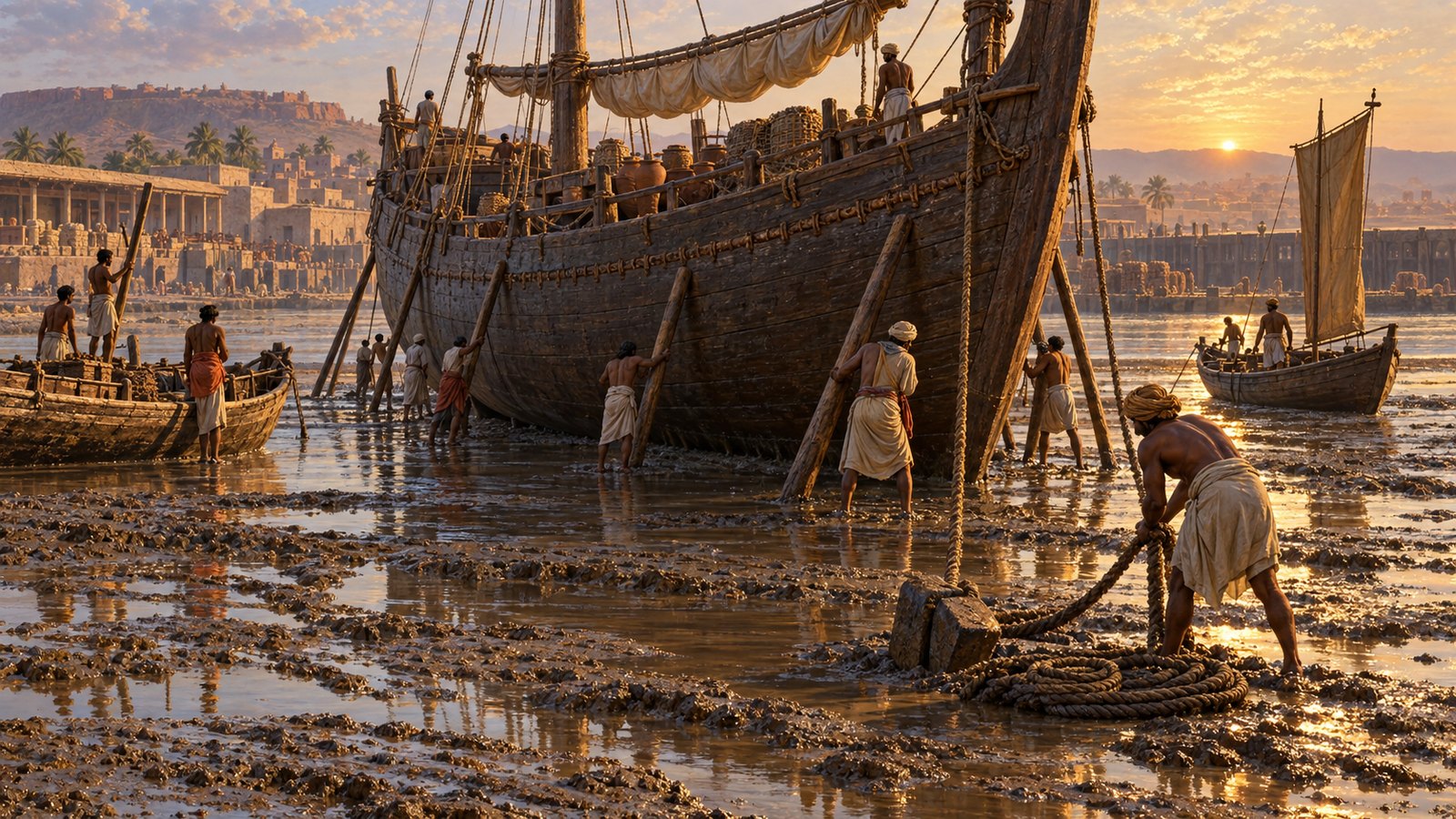
The effects appeared almost theatrical. The bottom could suddenly become visible. Places that had been dry land became sea, while water recently crossed by ships vanished and left ground exposed. The river itself was driven upward against its natural current for many stadia.
For an experienced pilot, this rhythm created windows. For a first-time visitor, it could destroy ordinary expectations. A calm-looking river was not necessarily stable water, and a place where the ship floated safely at one hour could leave the hull unsupported at another.
The lunar pattern also explains the fixed stations. Deep basins preserved useful water as the ebb uncovered neighboring ground. Pilots who knew the river could position a vessel before the phase changed, rather than discovering too late that a chosen anchorage had become a slope of mud.
Nothing in the passage suggests that crews could cancel the cycle. The system worked by prediction, placement and restraint. Barygaza’s navigators made extreme tidal change manageable by breaking one difficult river into timed sections.
A Still Mouth Could Roar Like a Distant Army
The consequences of bad timing occupy the most violent part of the account. The incoming water could become irresistible and anchors could fail to hold. Large ships were caught by the current, turned broadside and driven onto shoals. Smaller boats overturned.
The ebb created another trap. Boats carried into side channels could settle on their sides as water withdrew. Unless crews held them upright with props, the returning flood struck the tilted hull and filled it. The danger came not only from impact but from the posture in which the previous tide left the vessel.
At night near new moon, the change could announce itself by sound. The entrance might be still when a noise like the cries of an army arrived from afar. Soon the sea rushed over the shoals with what the Periplus calls a hoarse roar.
That mini-scene explains the fishermen’s importance better than any general statement about skilled pilots. A stranger hears distant noise over apparently calm water. A local crew knows that the flood is already on its way, where the ship must point, which line must tighten and which basin can hold it through the next ebb.
Barygaza’s harbor system was therefore distributed across people, boats, stations and celestial timing. The king’s fishermen met ships beyond the mouth, transferred local judgment to foreign crews, used the flood instead of opposing it and stopped where the river remained deep. Cargoes traveled thousands of kilometers, but their last three hundred stadia depended on men who knew exactly when dry ground would become sea.
Sources
Periplus of the Erythraean Sea, sections 40–46.