
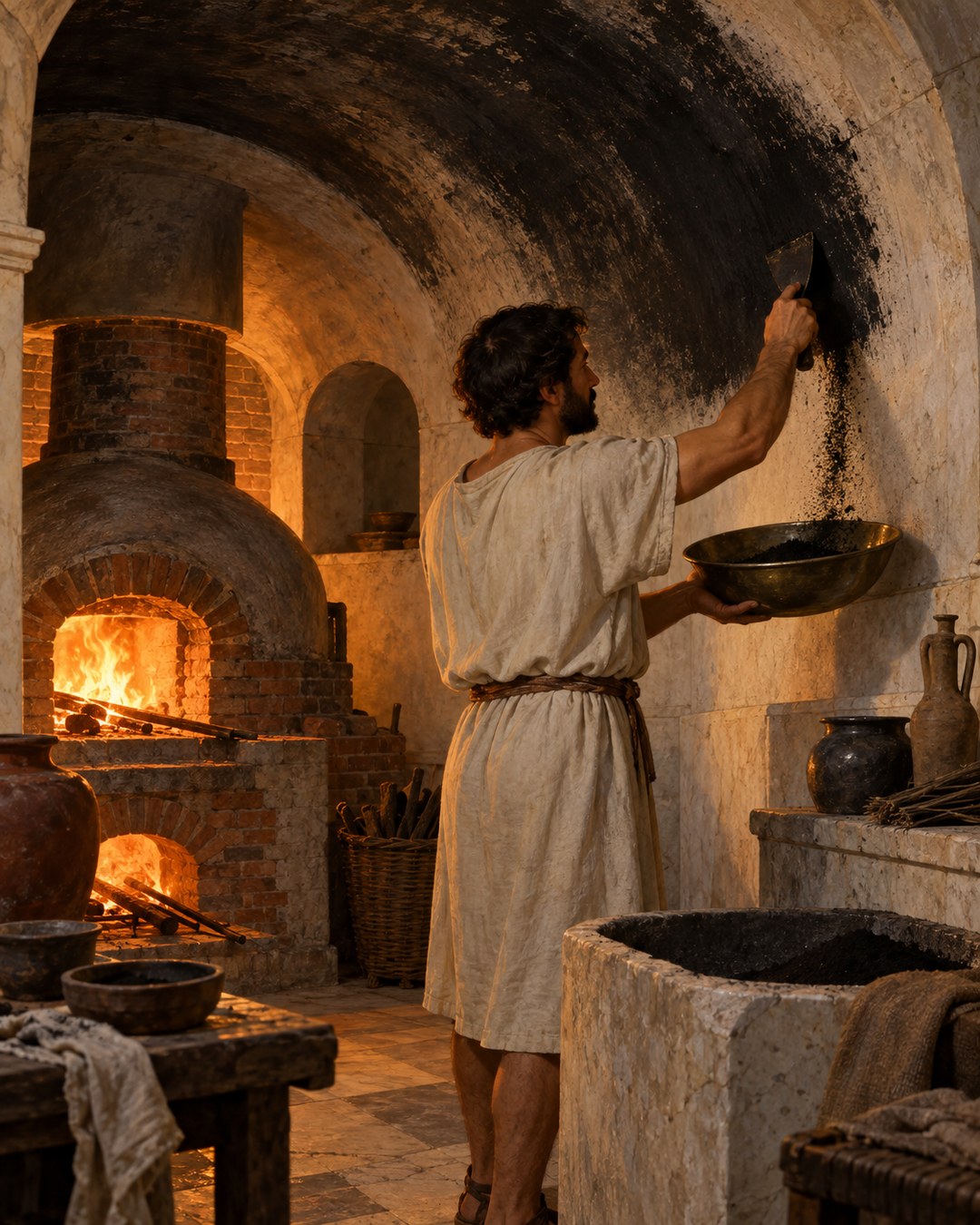
The useful material began as dirt on a polished ceiling. Resin burned in a furnace outside a small vaulted room, and smoke passed through a masonry connection into the chamber. There it settled on pale walls and the curve overhead until a worker could gather the black deposit.
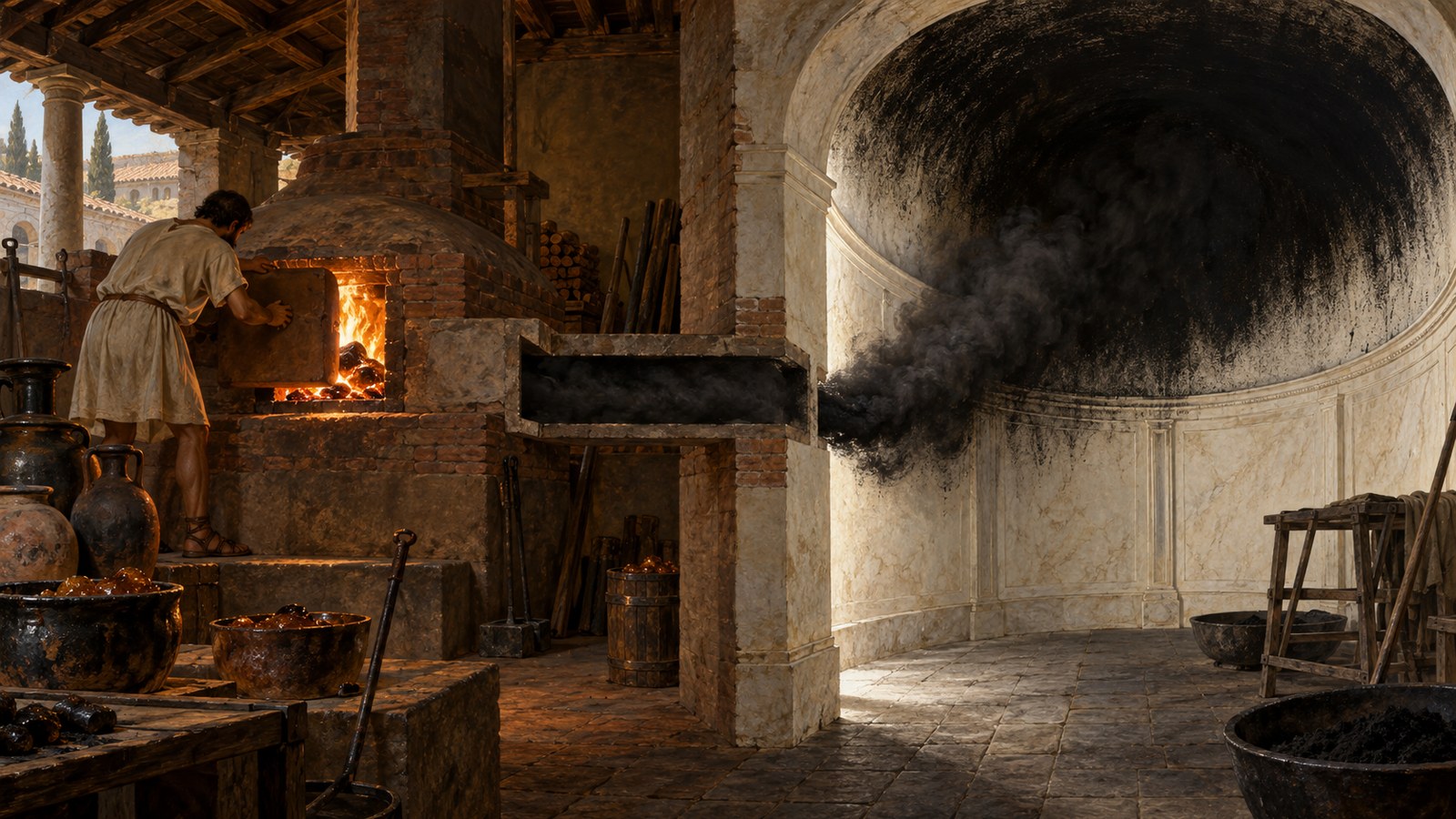
Vitruvius describes this installation while explaining colours made by treatment rather than simply found ready for use. His black does not emerge from one named lump of earth. It is produced by controlling fire, smoke, enclosure and surface. The furnace generates the smoke; the sealed mouth keeps the flame where it belongs; the passage directs the fumes; and a polished, marble-stuccoed room receives what would otherwise escape.
Collection is only the middle of the process. Vitruvius divides the recovered black according to binder and task. Gum makes one part suitable as ink for transcribers. Size prepares the rest for stuccoers colouring walls. If the special chamber product cannot be obtained, he gives two alternatives: thoroughly charred pine pounded with size, or dried wine lees burned, ground and likewise mixed for use.
The recipe is brief, but its logic is unusually visible. Black pigment was not merely “soot.” In this account it was smoke deliberately moved, caught, scraped, divided and bound. The room itself belonged to the tool kit.
A Polished Room Became the Collector
Vitruvius begins with an apartment similar to a laconicum, the heated type of room familiar from bath architecture. He does not ask the pigment maker to leave its surfaces rough. The chamber is to be plastered with marble stucco and polished, and its ceiling is arched.
That finish gives the smoke a defined place to adhere. Vitruvius does not describe a loose canopy, a cloth filter or a pot held over an open flame. He specifies walls and a vault, surfaces broad enough to acquire a coating and firm enough for that coating to be collected afterward.
The chamber therefore performs two jobs. It confines the resin smoke, and it presents a prepared interior on which the black can accumulate. Its resemblance to a heated room does not make it a bath in this passage. Vitruvius is borrowing an architectural form for manufacture.
This use of a deliberately finished surface distinguishes the operation from the accidental blackening of a kitchen or lamp niche. A stained ceiling elsewhere would be a nuisance. Here, darkening is the result being sought. The worker wants smoke to meet the plaster and stay there.
The finish also links pigment making to the work of builders. Marble stucco and a polished vault had to exist before anyone could harvest the deposit. The colour workshop begins with construction, not with a painter’s palette.
The Furnace Had to Send Smoke Without Losing Flame
A furnace stands in front of the chamber and communicates with it. Vitruvius’ short description makes the route explicit: resin is placed in the furnace, ignition produces smoke, and the smoke travels through the connection into the vaulted room.
The furnace mouth receives a specific warning. It must be closed very carefully to prevent the flame from escaping. Vitruvius does not elaborate on a door material or fastening, so the surviving instruction does not support inventing hinges, valves or a precise draft control. What it does establish is that closure mattered to the operation.
Fire and smoke have separate destinations. The resin burns at the furnace. Its smoke moves onward and coats the chamber. A flame escaping at the mouth would break that controlled arrangement, while smoke following the built passage supplies the desired deposit.
The sequence resembles other Roman processes in which movement has to be constrained before material becomes useful. A covered-vessel recipe for white pigment likewise depends on keeping reactive vapour around metal rather than letting it disappear. The substances and result differ, but both instructions turn containment into productive work.
Vitruvius gives no duration, furnace temperature or measured charge of resin. The evidence is architectural and procedural rather than numerical. Resin goes in; the mouth is closed; smoke is routed; the interior receives it. Those are the secure steps.
Black Was Scraped, Divided and Given Two Binders
Once the smoke has adhered to the wall and arched ceiling, it is collected. That verb changes the status of the coating. What looked like a blackened room becomes stored material ready for another craft.
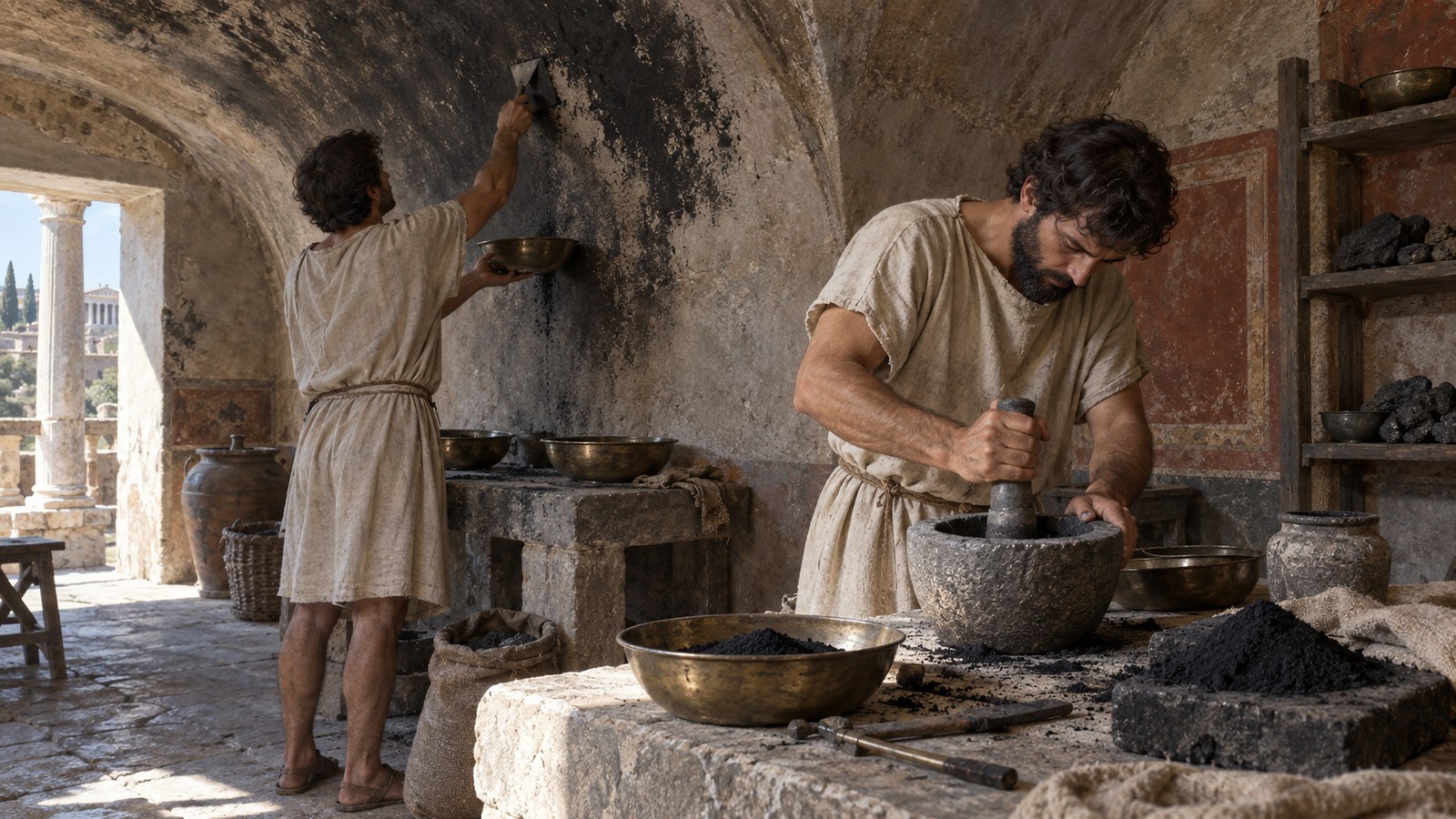
Vitruvius then separates the batch. Some is tempered with gum to make ink for transcribers. The remainder goes to stuccoers, but only after it is mixed with size. The black base can cross between writing and wall colouring; the binder determines how it will be handled next.
This division is more informative than calling every dark mixture “ink.” The transcriber needs a fluid that can travel through a writing tool and remain on a writing surface. The wall worker needs black prepared for plaster decoration. Vitruvius names gum for the first and size for the second without claiming they are interchangeable.
The scribal branch connects directly with the soot-and-gum mixture used behind Roman writing. Chapter 7.10 adds the production room that precedes the ink bowl: someone first had to generate a cleanly recoverable black deposit and remove it from a built surface.
The remainder does not become inferior waste. Vitruvius assigns it to another skilled use. One firing can therefore supply two workshops, provided the collected material is portioned and combined with the appropriate binder.
Pine Char Offered the Fast Substitute
Vitruvius knows that the chamber-made black may not be available. Rather than allow work to stop, he offers an expedient specifically “to prevent delay.” The substitute does not require a polished soot room.
Pine branches or chips are burned until they are thoroughly charred. The char is then pounded in a mortar with size. The operation moves from wood to brittle carbon and from brittle carbon to a dispersed wall colour.
Here the pigment is not scraped from a vault. It remains in the solid pieces created by charring, so grinding becomes essential. Mortar work replaces the chamber’s collection stage, while size again connects the black material to a plasterer’s task.
The word “thoroughly” matters. Vitruvius does not propose half-burned wood with its original texture intact. The branches or chips must reach a charred state before pounding. His goal is a pleasing black, not a mixture visibly full of wood fragments.
This fallback reveals a practical hierarchy. The purpose-built chamber is described first, but the work must continue when its product cannot be procured. Vitruvius preserves a shorter route based on common pine material, fire, a mortar and binder.
Wine Lees Could Return as an Indigo-Like Black
A final route begins with wine lees, the sediment left from wine. Vitruvius directs the maker to dry them, burn them in a furnace, and grind the result with size. The stages again remove moisture, transform the raw material with heat and reduce the burned product for mixing.
He judges this black pleasing too, then adds a striking quality claim. Better wine, he says, yields a better black, one that can approach the colour of indigo. The remark ties the appearance of the finished pigment to the quality of the material from which the lees came.
Vitruvius does not explain the chemistry behind that difference, and his sentence should not be expanded into a modern formula he never supplied. Its historical value lies in the workshop observation: makers compared blacks, noticed variation and associated the richer result with better wine lees.
The three routes are not identical recipes wearing different names. Resin smoke is caught on polished architecture. Pine is charred and pounded as a solid substitute. Wine sediment is dried, burned and ground. What unites them is controlled carbonization followed by a binder suitable to the intended surface.
Black colour thus sits at the meeting point of furnace tending, masonry, scraping, grinding, writing and plaster work. Vitruvius begins with a room that is meant to become dirty, because its dirt can be harvested. He ends with workshop substitutions that keep a job moving. Between them, the chapter shows how Roman craft could turn smoke on a ceiling into a material precise enough for a line of script or a field of wall colour.
Sources
Vitruvius, De architectura 7.10.