
The useful part of the tree waited high above the ground.
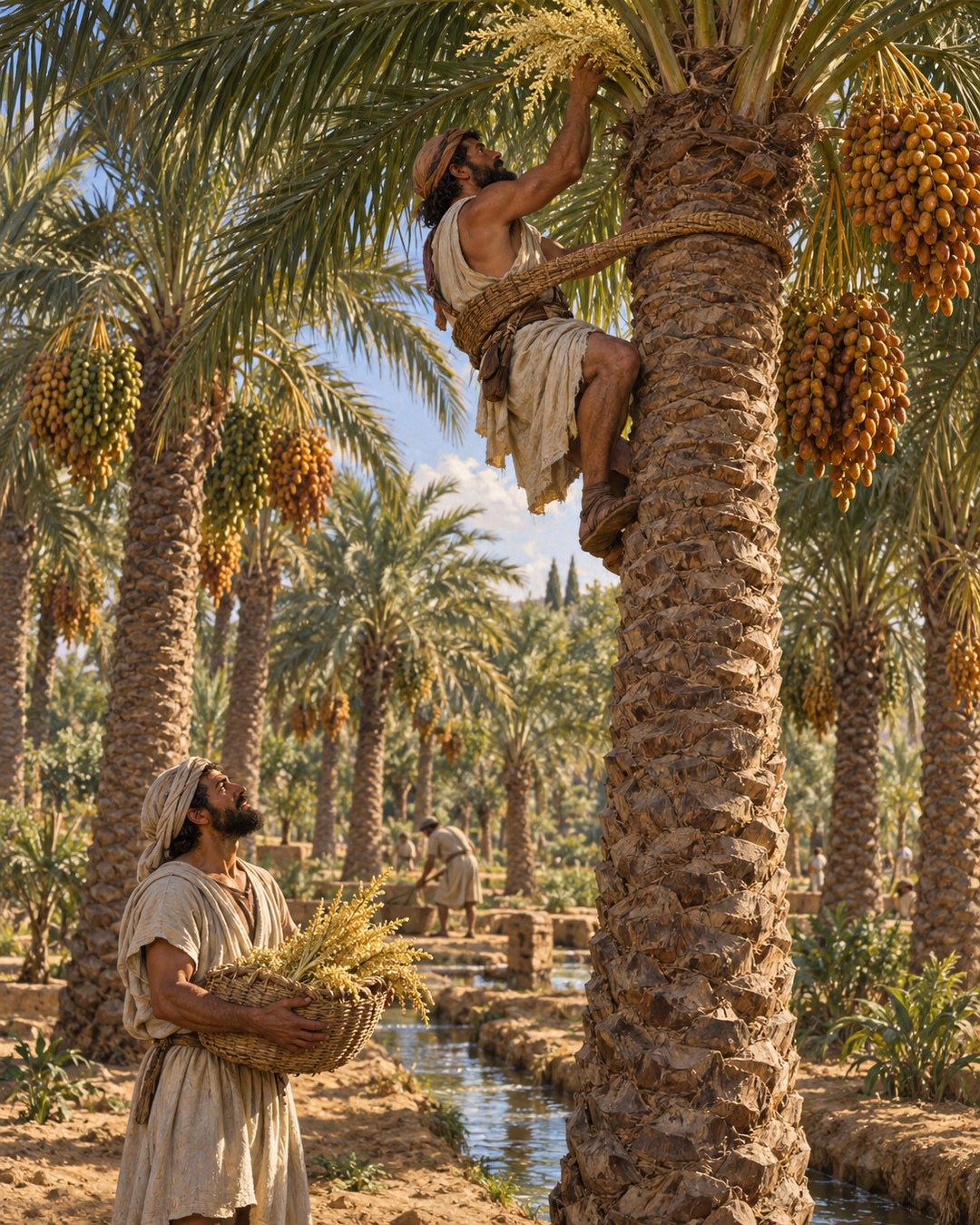
Date palms carried foliage, flowers and fruit in the crown. Pliny the Elder describes eastern climbers fastening an osier loop around body and trunk, then moving upward with striking speed. At pollination time, the climb joined a second piece of skilled work. Growers collected blossoms, soft down or dust from male palms and carried it to female trees.
Pliny wrapped this practice in the language of sexual trees that longed for one another. He also preserved the operational observation beneath the imagery: female palms could become barren without males, while deliberately applying material from male flowers could restore fruiting.
The orchard did not need a modern vocabulary of pollen to act on that relationship. Failure, proximity, season and repeated handwork had already made plant reproduction manageable.
The Orchard Concentrated Work in the Crown
Pliny begins with the palm’s environment and architecture. It favored light, sandy ground, often with a nitrous quality, and it loved flowing water. He reports an Assyrian belief that the tree drank throughout the year, enough that manure in drought might injure it unless mixed with running water.
The trunk rose through regular projecting knobs or rings. People in the East used them as footholds, but Pliny’s climber did not trust bark alone. A loop of osier encircled both body and trunk, creating a movable brace as the worker ascended.
That equipment responded to the tree’s distribution of resources. Leaves occupied the summit. Fruit hung there too, in clusters on separate shoots among the branches. Harvest, pruning and pollination all pulled labor upward.
A tall palm grove therefore organized expertise vertically. Workers below could manage water, soil and baskets; someone had to enter the crown. Speed mattered because an orchard might contain many female trees and a narrow seasonal window for handling blossoms.
The climbing loop is a small detail, yet it prevents the pollination story from becoming abstract botany. Knowledge reached the female flowers through fiber against bark, pressure around a worker’s body and practiced movement above the ground.
Male and Female Trees Made Failure Predictable
Pliny says diligent investigators assigned sex to plants and found the difference especially evident in palms. The male tree blossomed at its shoots. The female produced a bud that he compared with an ear of grain.
His terminology belongs to ancient natural history, but the orchard pattern was concrete. Some palms supplied male flowers; others bore dates. Female trees could fail when isolated from males. One male could stand among many females and support fruiting across the group.
Pliny adds that small fruits sometimes appeared without seed. He uses the observation while describing how flesh and the woody interior developed. For cultivators, such outcomes made reproduction visible not through theory alone but through the quality of a crop.
A barren grove asked a spatial question. Had the orchard lost its male? Had trees been planted too far apart? Had flowering material failed to reach receptive crowns? These questions could be tested by moving what wind or proximity might otherwise carry.
The distinction also shaped orchard economy. Male palms did not produce the desired date crop in the same way as females, yet removing them all to maximize fruit-bearing trees would destroy productivity. A small number of apparently less productive trees enabled many others.
Dust Became a Tool before It Became a Theory
Pliny’s explanation mixes close observation with literary personification. Female palms surrounding a male bow their foliage toward him; the male’s leaves stand erect; exhalation, sight and dust all participate in fecundation. Modern readers should not flatten that language into a laboratory account he did not possess.
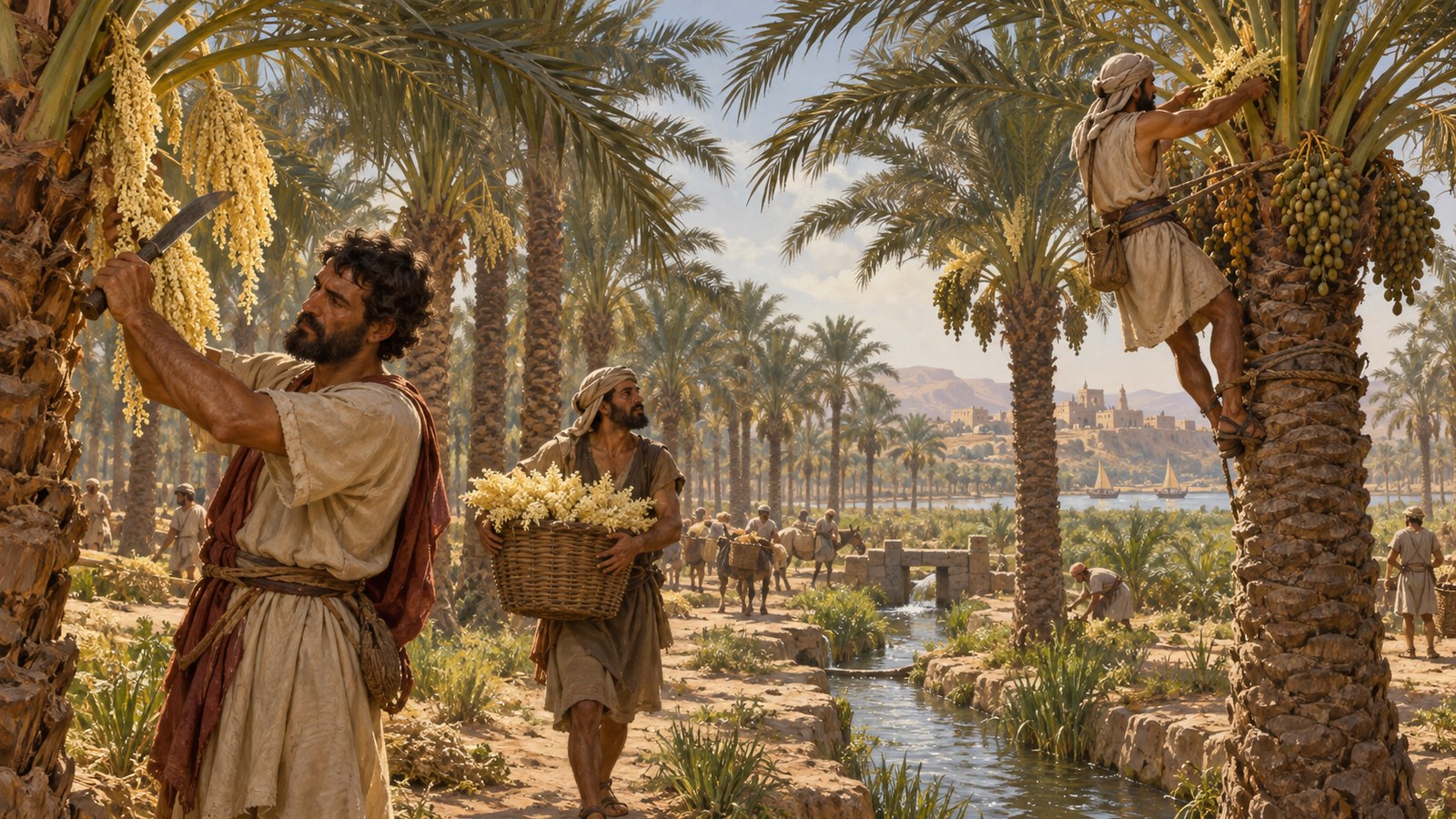
Yet the practical procedure is unmistakable. People gathered blossoms and down from male trees. They could sprinkle dust from those trees on females. The crop responded to deliberate transfer.
The material was light, transient and easy to overlook. That made timing and handling central. A grower needed to recognize the male inflorescence, collect it while useful, carry it without wasting everything to wind, climb the female and place or shake it where contact could occur.
Knowledge here lived in a sequence rather than a definition. Identify, cut, contain, climb, apply and wait. Successful fruiting confirmed the chain even if explanations of “exhalation” or visual attraction exceeded what the work actually demonstrated.
This is why calling the dust merely superstition would miss the mechanism. Pliny’s prose includes imaginative claims, but it preserves an intervention that corresponds to the reproductive difference cultivators observed. Practice could be more precise than the philosophy surrounding it.
Hand Pollination Rebalanced the Whole Grove
Natural proximity placed limits on orchard design. If female palms depended on a male nearby, a grower had to preserve enough males and arrange trees so that their material could travel. Hand transfer loosened that constraint.
A worker could carry one male tree’s blossoms to multiple female crowns. Human movement extended biological reach. The orchard became a managed network rather than a set of isolated trunks.
This did not make the process effortless. Palms were tall; flowering was seasonal; the relevant parts were delicate; and each climb carried risk. The value of pollination knowledge lay partly in directing expensive labor to the moment when it mattered most.
Other Roman agricultural techniques likewise turned plant behavior into sequences of touch. The process of joining fruit trees with bark, clay and a knife follows the controlled wound of grafting. Pollinating palms required no cut into the female trunk, but it depended on an equally deliberate transfer between plants.
The male palm also acquired value through relationship. Judged only by baskets of dates, it might look like wasted space. Judged by the fruiting of surrounding females, it became essential infrastructure.
Pollination was only one part of keeping palms productive. Pliny’s opening emphasis on sandy soil and flowing water anchors reproduction in the orchard’s broader material system.
Irrigation kept roots supplied in dry landscapes. Trunk structure enabled ascent. Leaf fibers themselves could become ropes and withes, materials close to the kind of loop used by climbers. Baskets received cut blossoms and harvested fruit. Each element connected the biology of the tree with tools made by people.
The technique for moving young trees with their native earth shows another way cultivators managed invisible risk. Soil clinging to roots protected continuity during transport. Male dust carried to female flowers protected continuity at reproduction. In both cases, success depended on moving a fragile material with the plant rather than treating the tree as self-sufficient.
Pliny ranges through Cyprus, Arabia and Assyria while discussing palms. His geography reminds us that Roman readers encountered expertise from regions where date cultivation was older and more central than it was in Italy. The text gathers eastern practice into a Latin natural history.
That movement of knowledge was not neutral. Pliny classified, compared and sometimes embellished what others did. Still, the osier loop and transferred blossom preserve the presence of growers whose repeated labor made the account possible.
A Crop Revealed What the Eye Could Barely See
A male palm’s contribution was easy to underestimate because the decisive material could look like dust. The harvest, by contrast, was heavy and visible. Dates accumulated in clusters; failed trees remained barren.
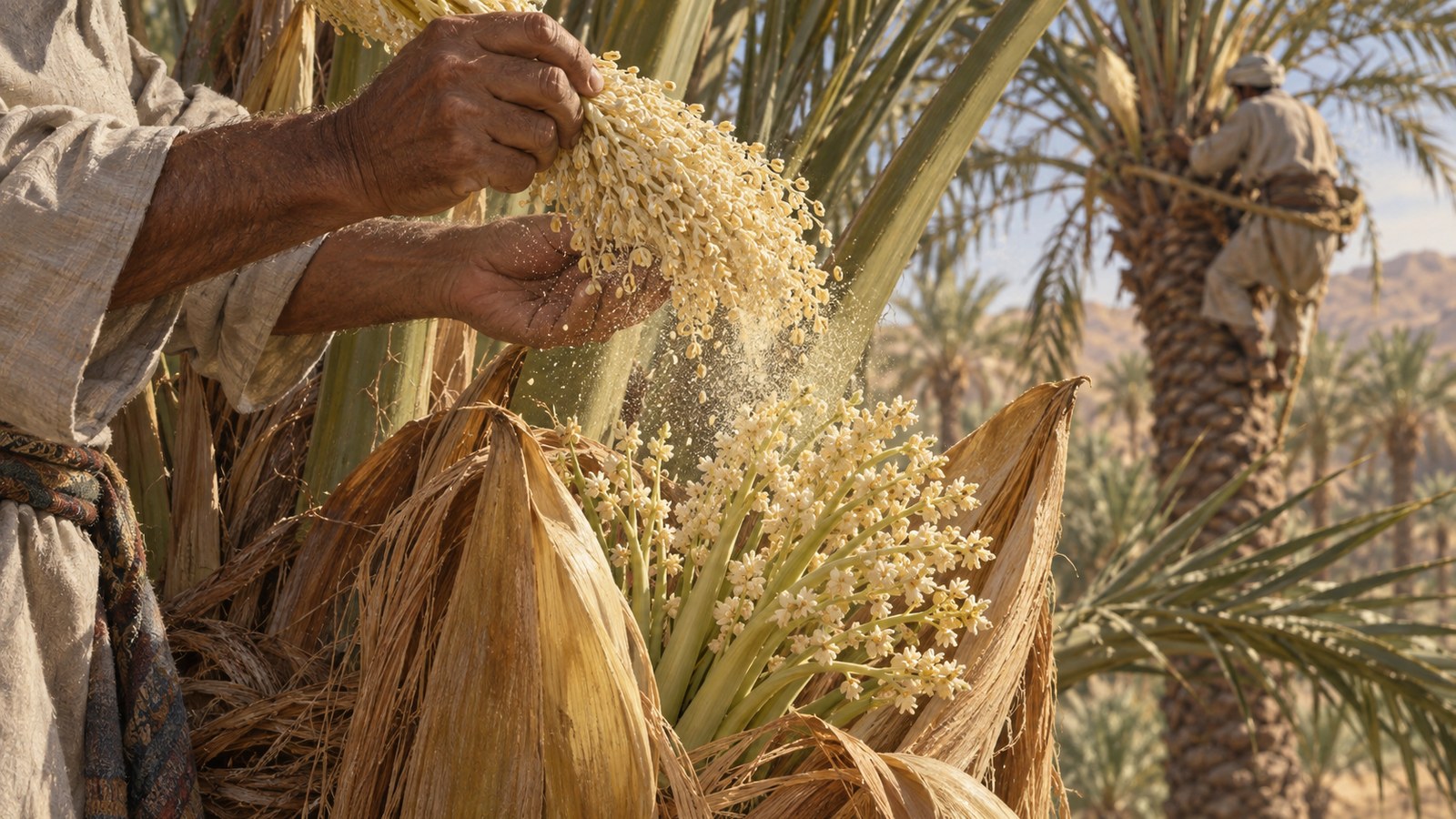
Between those outcomes stood a fine transfer that growers learned to reproduce. They did not need to see each grain do its work. They needed to notice that female crowns treated with male material bore fruit more reliably than isolated ones.
Pliny’s personified trees gave the relationship a memorable narrative, but the labor gave it economic force. Someone preserved male palms, watched flowering, gathered blossoms, climbed and applied them. The orchard’s fertility was neither automatic nor entirely left to wind.
The result is a rare ancient description of expertise operating at the edge of visibility. Water could be seen in the channel and dates in the basket. The crucial dust passed briefly through a worker’s hands.
One male among many females was not an idle tree. It was the source of a material small enough to blow away and important enough to organize an orchard around.
Sources
Pliny the Elder, Natural History 13.7.