
Fifty years was the promise attached to one sealed store of wheat.
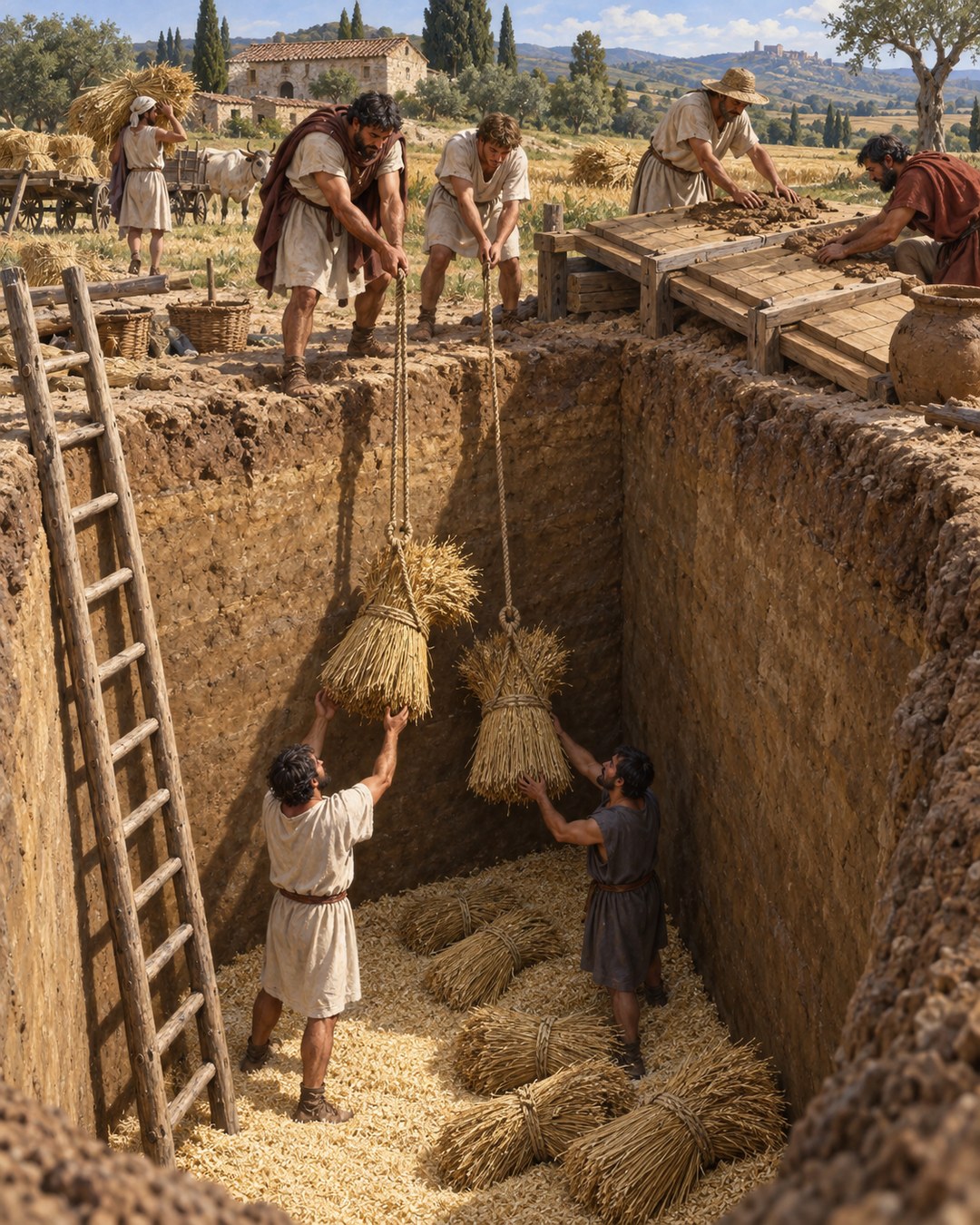
Pliny reports the figure from Varro while describing trenches called siri. They were dug in dry soil, bedded with chaff, filled with grain still in the ear and closed against incoming air. Under those conditions, Varro said wheat could last fifty years and millet one hundred.
The numbers are the most startling part of the chapter, but they are not its only lesson. Around them Pliny records thick brick rooms, raised wooden granaries, competing rules about wind and warnings about harvest heat.
Roman grain storage was a contest over air, moisture, insects and time.
Granary Builders Disagreed About Air
Pliny begins with expensive masonry advice. Some authorities wanted brick walls at least three feet thick, grain introduced from above, no windows and air carefully excluded. Others specified a north or north-east aspect and warned against lime in the walls.
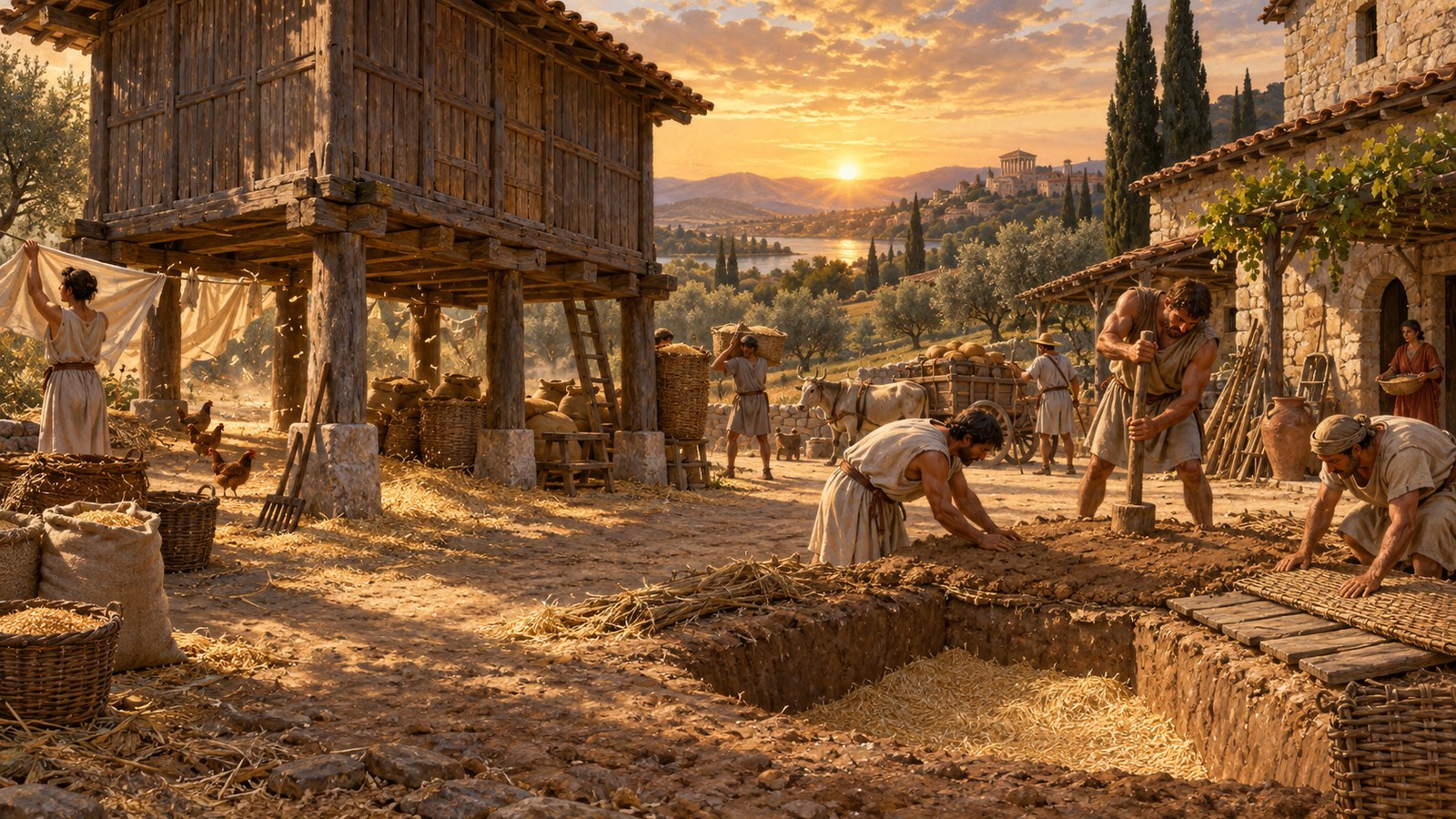
Then the design reverses. In some places, he says, granaries were built of wood on pillars because people thought air should reach them on every side, even from below.
These are not minor variations on one blueprint. One system seeks enclosure; the other seeks ventilation. Their coexistence shows that “keep grain dry” could lead builders toward different mechanisms depending on climate, crop condition, materials and experience.
A sealed masonry room limits new humid air and outside pests but can trap trouble already brought inside. A raised wooden floor separates grain from ground moisture and encourages circulation but opens more paths through the structure. Pliny does not erase the disagreement by declaring one universal winner.
Instead, his chapter preserves an argument among practices. Even the west wind appears as a disputed influence: Columella called it beneficial, while Pliny found that surprising because he regarded it as parching.
The important point is not that Roman writers had solved every storage problem. It is that atmosphere was treated as something architecture could manage. Wall thickness, openings, orientation and elevation all changed the air around a harvest long after cutting ended.
The Harvest Entered Storage Alive with Risk
Pliny’s strongest personal emphasis falls on timing. The most important precaution, he says, is to house grain at the proper moment. If it is cut unripe, lacks firmness or enters in a heated condition, harmful insects will breed.
Storage could not repair every mistake made outside the granary. Grain carries moisture and heat from the field and threshing floor. Closing an unstable crop inside thick walls does not make those conditions disappear; it gives them a confined place to continue.
This connects storage to the sequence of hooves, flint and wind used to separate a harvest. Threshing and winnowing did not merely produce a commodity ready for sale. They prepared material whose dryness, cleanliness and temperature affected whether the store would preserve it.
Pliny distinguishes crops as well. Millet’s multiple outer coats, sesame’s oily juices and the bitterness of lupine or chicheling vetch receive attention because different physical qualities changed susceptibility. Wheat, with dense juices and thick bran, was especially apt to heat and breed insects in his account.
The granary therefore held more than volume. It held biological and physical differences between crops, plus the history of how each batch had been cut and moved.
Good storage began before the door closed. The moment of housing determined what kind of problem the building inherited.
Four Fingers Marked a Claimed Insect Frontier
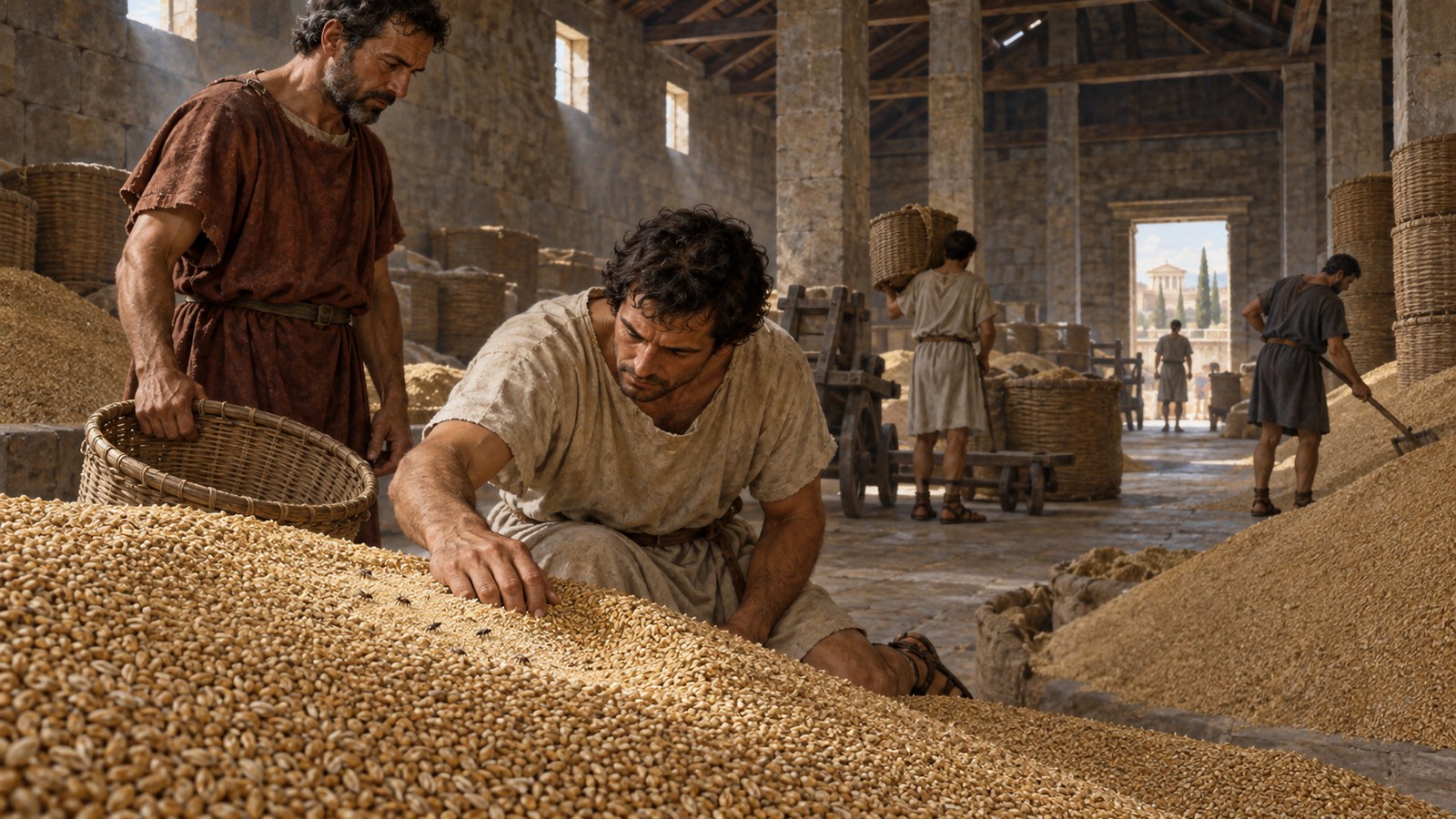
One reported practice advised against stirring grain to air it. The reason was a claim that the weevil did not penetrate beyond four fingers in depth, leaving the deeper mass safe.
The measurement is small and tactile. It imagines infestation as a shallow upper zone rather than a threat evenly distributed through the heap. If that observation held, turning the grain might carry insects or affected material deeper instead of helping.
Pliny records the claim without turning it into an absolute law for every store. Its presence among conflicting recommendations matters. Ventilation was not automatically good, and disturbance was not automatically cleansing. A keeper had to consider what movement might spread.
The four-finger boundary also shows how grain was inspected. People watched surfaces, handled upper layers and compared damage with depth. They did not need to empty an entire granary to form an operational belief about where insects concentrated.
Other countermeasures ranged from plausible coatings to ritual. Pliny mentions olive-derived liquid, chalk, wormwood and even a bramble-frog hung by a hind leg at the threshold. He does not endorse them equally; indeed, the frog appears just before his own return to proper harvest timing.
The mixture warns us against presenting the chapter as a modern manual. It is a record of recommendations, observations, inherited claims and Pliny’s judgments. Its value lies partly in showing which risks ancient keepers thought they could manipulate.
Dry Trenches Reversed the Visible Granary
The siri took storage below ground. Pliny places these trenches in Cappadocia, Thrace, Spain and a location in Africa. They were dug in dry soil, lined at the bottom with chaff and filled with grain stored in the ear.
Dryness was essential because soil can preserve a cool environment or deliver destructive moisture. The method did not celebrate burial in any ground available. It selected a dry site and added a sacrificial plant layer between crop and base.
Keeping grain in the ear preserved another envelope around the kernels. The bulk would be less compact than fully threshed grain, but the ear reduced handling before storage and added physical separation inside the mass.
The decisive step was exclusion of air. Pliny says that if no air penetrated, harmful insects would not breed. The trench became a controlled volume, unlike the raised wooden granary that welcomed circulation.
That reversal makes sense within different starting conditions. Ventilation tries to remove moisture and heat continuously. Sealing tries to begin with dry, sound material and prevent the outside atmosphere from changing it. Each fails if its assumptions fail.
The trench also hid the reserve from ordinary view. A tower or granary advertises stored abundance. A sealed pit turns food into a buried inventory that can remain untouched until reopening becomes necessary.
Long Durations Turned Grain into Security
Varro’s reported figures give the method its scale: wheat for fifty years and millet for one hundred. Pliny adds oil jars covered with ashes for beans and other legumes, plus an extraordinary story of beans preserved from the time of King Pyrrhus to Pompey’s Piratical War.
These durations should be read as ancient claims, not warranties we can independently apply to every pit. Pliny is transmitting authorities and marvels alongside practical instructions. The fifty-year wheat figure tells us what longevity the method was believed capable of achieving.
Even a much shorter successful reserve could alter a household, estate or community. Grain held beyond one harvest bridges bad seasons, postpones sale and gives owners choices about when food enters the market.
That is why storage belongs beside the archive’s examination of grain supply as Roman power. Production creates abundance once. Preservation determines how long that abundance can shape prices, obligations and survival.
Pliny’s chapter never lets the huge number float free of mechanism. Fifty years is attached to dry soil, chaff, grain in the ear and excluded air. The claim is impressive because the conditions are specific.
A granary was not simply a pause between harvest and eating. It was technology for carrying one season into another. Roman writers disagreed over whether air should move or vanish, but they agreed that the future of grain depended on controlling the space around it.
Sources
Pliny the Elder, Natural History 18.73.