
The patrols had mountains on one side and the cold Hellespont on the other. The route near Abydus looked closed.
Iphicrates waited. Then, on a day when nobody expected men to enter the water, he selected his toughest soldiers, rubbed them with oil, warmed them with wine and sent them along the sea’s edge.
Where the cliff left no path, they swam.
A Defile Became Secure in the Enemy’s Mind
Frontinus places the episode during Iphicrates’s campaign against the Spartan Anaxibius on the Hellespont near Abydus. Enemy patrols occupied ground through which the Athenian commander needed to lead his force.
The terrain appears in two hard boundaries. Precipitous mountains hemmed the route on one side. The sea washed the other. The patrols did not need to imagine an attack from every direction because geography seemed to reduce the number of usable approaches.
That apparent security was the opening. A barrier on a map is also a judgement in a sentry’s mind. If a cliff looks impassable and cold water looks unusable, attention gathers on the remaining road.
Iphicrates did not charge that obvious road immediately. Frontinus says he delayed for some time. The pause matters because it separates observation from action. He needed a condition that would make the least likely route even less expected.
An unusually cold day supplied it. Frontinus explicitly links the weather to surprise: no one suspected such a move then. The cold increased the physical difficulty for Iphicrates’s men, but it also strengthened the patrols’ belief that the sea protected them.
The stratagem resembles the logic behind Pompey’s use of moonlight against Mithridates. An environmental condition did not decide the fight by itself. A commander recognized how the enemy interpreted it and moved from the direction that interpretation neglected.
Selection Came Before Oil and Wine
Frontinus does not say the whole army entered the Hellespont. Iphicrates selected his most rugged men. The phrase limits the feat to bodies judged capable of carrying it out.
That is the first practical mechanism in the story. A surprising route is worthless if the chosen force cannot survive it, arrive together or fight afterward. Selection reduced the group to men whose endurance matched the task.
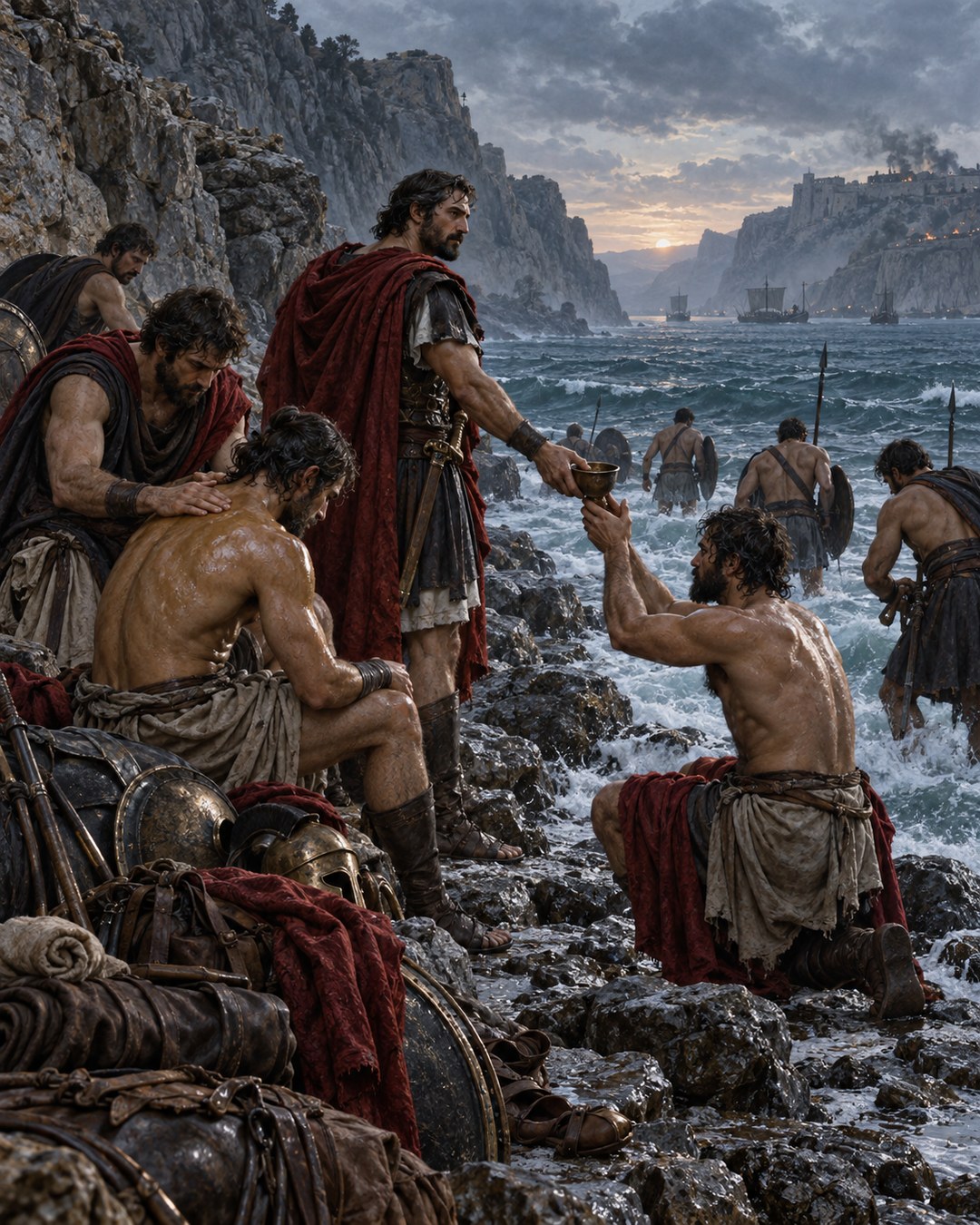
Only then does Frontinus mention preparation. The men were rubbed down with oil and warmed with wine. Ancient readers could understand both actions as responses to cold, but the text does not give quantities, duration or a physiological explanation.
We should not turn the anecdote into a recipe for cold-water survival. Oil did not make skin waterproof, and wine did not abolish the danger of exposure. Frontinus’s point is tactical readiness: Iphicrates took measures his culture associated with warming and bodily preparation before sending selected men into an extreme route.
The details are memorable because they occur before the movement. A flask, a cup and hands working oil over shoulders create a miniature scene of preparation. The commander’s idea depended on human bodies, not only arrows on a plan.
Roman military culture also valued swimming as a trainable skill. The evidence that recruits practised crossing the Tiber shows water treated as part of mobility. Iphicrates’s episode is narrower and earlier: not routine mass training, but a selected group using swimming to bypass surveillance.
The Shoreline Alternated Between Path and Water
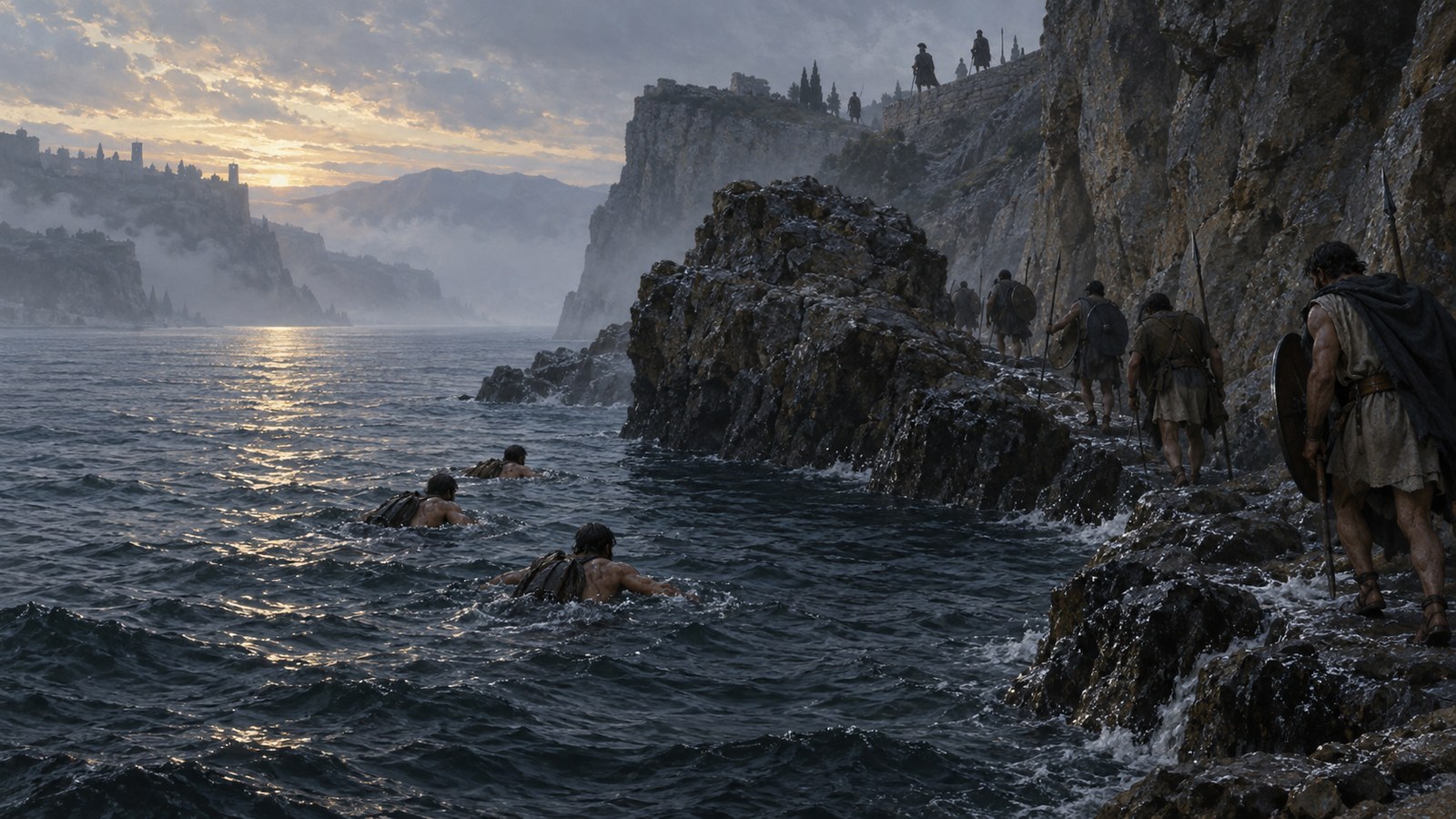
Iphicrates ordered the group to skirt the very edge of the sea. This was not a long open-water crossing. The coastline itself remained the guide.
Where ground existed beneath the cliff, the men could advance along wet stones and narrow strips of shore. Where the rock became too precipitous to pass, Frontinus says they swam across. Movement alternated between footing and water.
That distinction gives the action plausible scale without inventing a distance. The source does not describe ships, rafts or a formation swimming across the whole Hellespont. It describes local bypasses around impassable sections.
The sea route also changed what equipment the selected men could carry. Frontinus does not tell us whether weapons were bundled, held above water or waiting with another detachment. Any precise reconstruction would be guesswork. What we know is that the men reached a position from which they could attack.
Coastal terrain can break a force into fragments. A swimmer rounds a projection before seeing the next landing. Surf and slippery rock slow communication. The operation therefore required the group to preserve enough cohesion to become a fighting body again beyond the obstacle.
Frontinus omits mishaps, which is typical of a compact collection of successful stratagems. His sentence preserves the decisive geometry rather than the full ordeal: mountain, sea, cliff, waterline and the enemy’s rear. It also leaves the nameless swimmers as a group, although every stage depended on individual nerve, balance and endurance.
The Rear Attack Completed the Deception
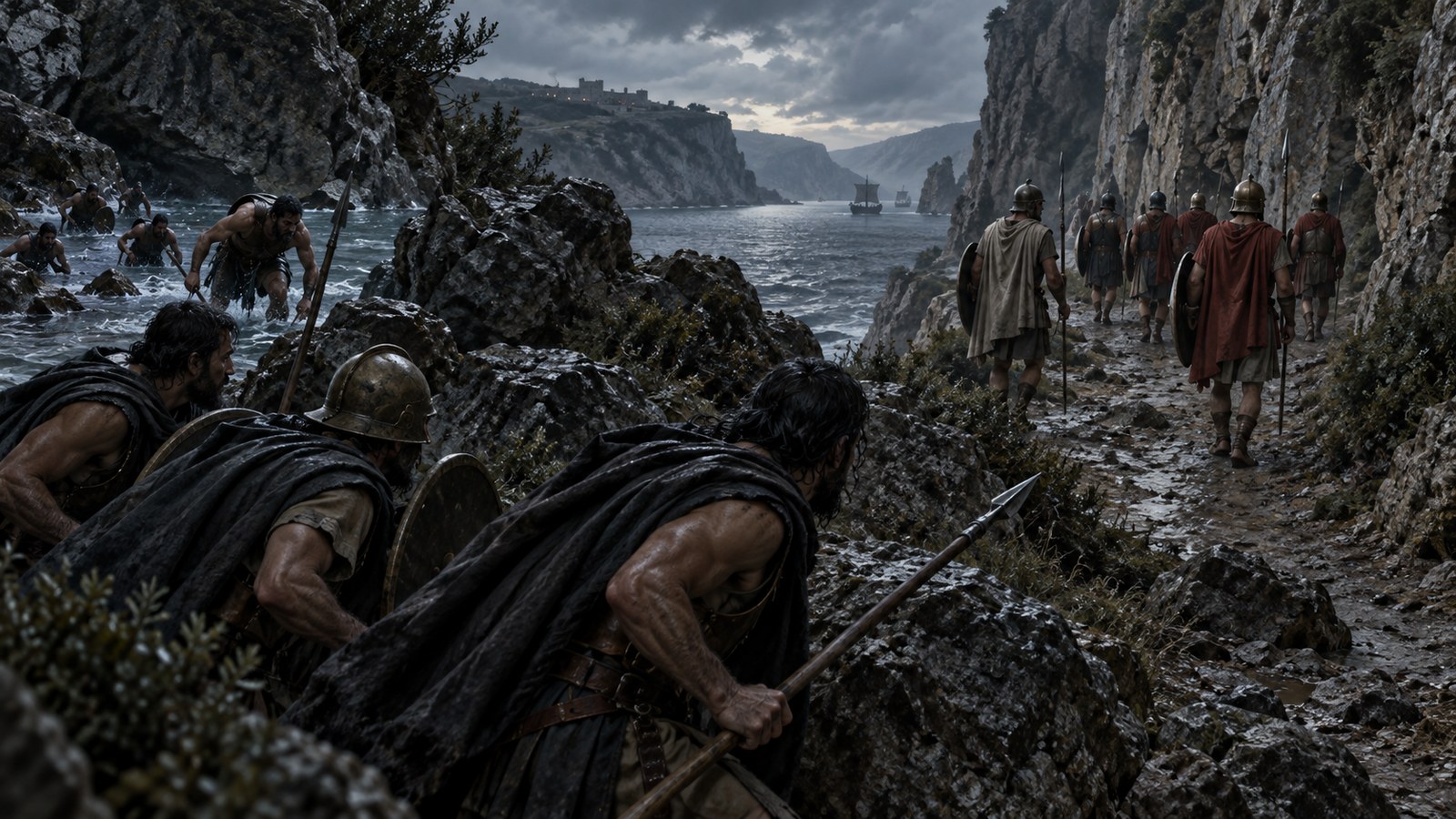
The selected men did not make the swim merely to avoid the patrols. Frontinus says they launched an unexpected attack from behind and overwhelmed the guards of the defile.
That ending shows why secrecy mattered more than speed alone. A force emerging at the rear changes the direction from which shields, eyes and escape routes have been arranged. Guards confident in the terrain suddenly had to reinterpret their position.
The effect did not require a large amphibious army. A compact group in an impossible place could force the patrols to divide attention or abandon the choke point. The source attributes the result to surprise, not to superior numbers.
Iphicrates converted the enemy’s strongest assumption into the axis of attack. The mountain and sea still constrained his men physically. What changed was who suffered from the constraint. Once troops appeared behind the patrols, the defile that had protected the guards also limited their response.
This is close to Frontinus’s broader interest in reversals. His collection repeatedly shows commanders using darkness, weather, noise, campfires and ground to make an opponent prepare for the wrong event. The cleverness lies less in a strange object than in controlling what the enemy thinks the object means.
Here the cold meant “safe flank” to the patrols. To Iphicrates it meant “unguarded flank,” provided he could prepare men capable of paying the physical cost.
Frontinus Preserved a Method, Not a Complete Battle
The episode is compact enough to fit inside a catalogue. Frontinus names the commanders, fixes the action near Abydus, defines the terrain, lists the preparation and gives the result. He does not offer casualty figures, unit names, exact dates or the swimmers’ testimony.
That shape should govern how the story is retold. We can see the mechanism clearly, but not every splash, command or weapon. A vivid reconstruction must stop where the source stops.
Even the oil and wine can distract from the main intelligence of the operation. They attract attention because they are tactile and unexpected. Yet they belong between two more important decisions: selecting the right men and selecting the moment when the enemy’s confidence would be greatest.
The cold day was both danger and camouflage. The cliff was both obstruction and screen. The water was both exposure and road. Each element retained its physical character while acquiring a second tactical meaning.
That double use is the enduring lesson in Frontinus’s anecdote. Iphicrates did not erase the landscape’s limits. He accepted them for a short, prepared movement and trusted that the patrols would not imagine anyone else doing the same.
Oil and wine helped bodies face the route. Surprise made the route matter. When the swimmers climbed out behind the guards, an apparently sealed defile opened from the side nobody had watched.
Sources
Frontinus, Stratagems, book one, chapter four, section seven.