
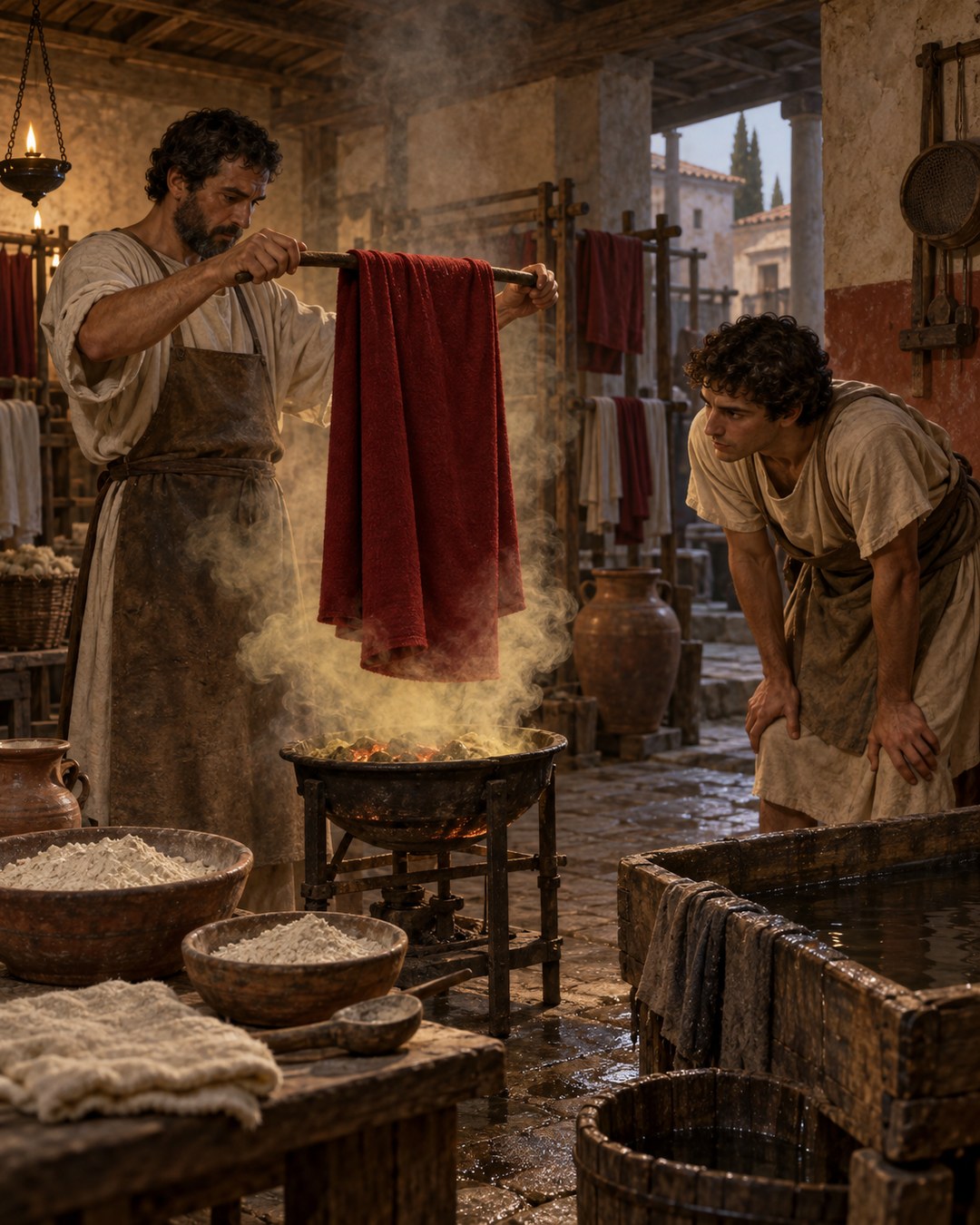
The red cloth entered the smoke looking expensive. If its colour was sound, it would leave the fulling sequence brighter. If the dye was weak, sulphur could turn it black and make the colour spread.
Pliny the Elder describes that risk inside an exact order of operations: Sardinian earth, sulphur fumes, then Cimolian earth. The fuller was not merely washing dirt from wool. He was asking the material a question.
The answer could protect a valuable garment or expose a dyer’s poor work.
Three Stages Made the Finish a Test
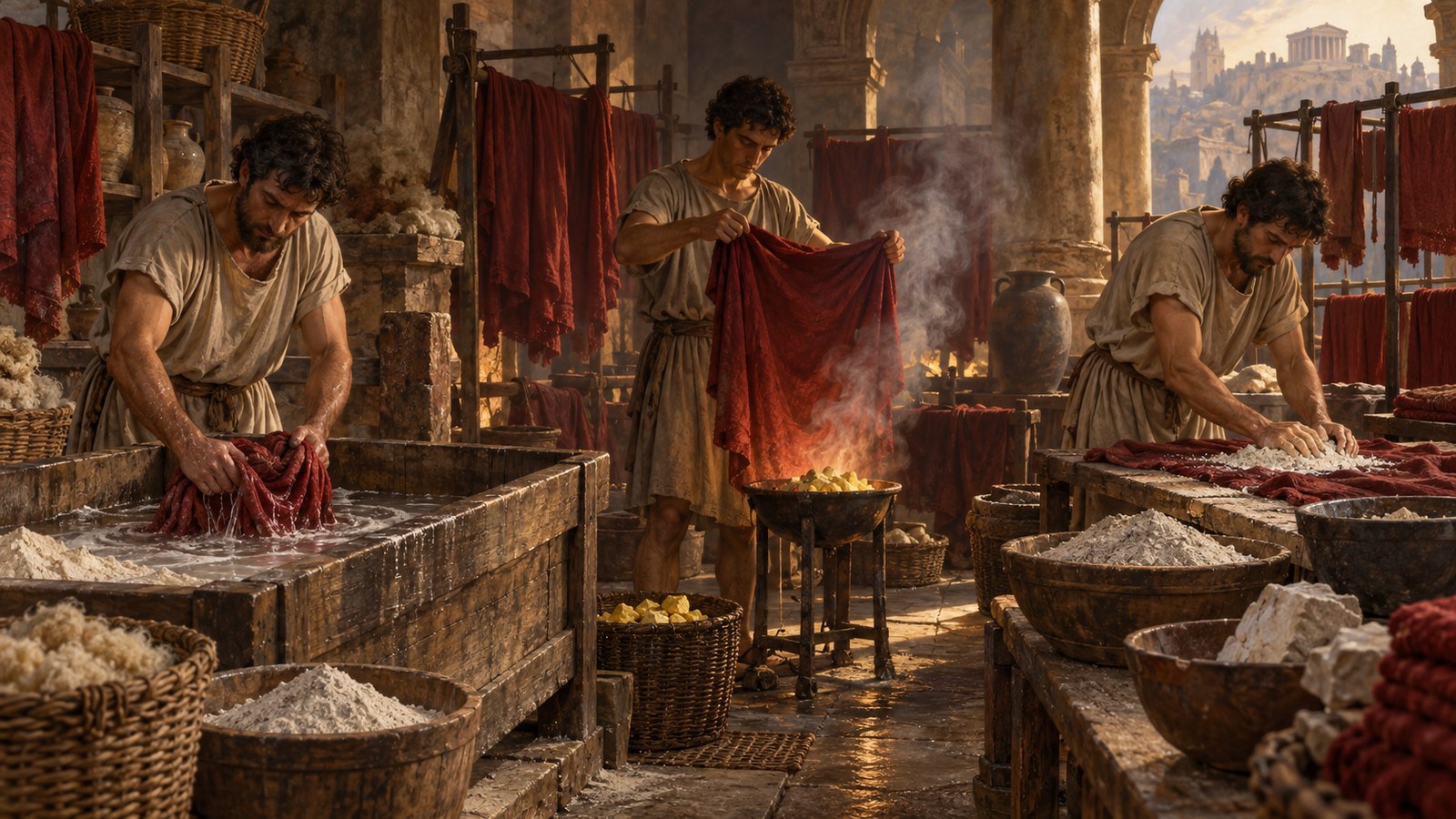
Pliny begins his account of cloth finishing with earth from Sardinia. The fabric was washed with it before smoke touched the fibres. Only after that first treatment did the fuller fumigate the cloth with sulphur.
A third operation followed. If the dye was fast, the fabric was scoured with Cimolian earth. The order matters because Pliny gives each substance a different task. Sardinian earth belongs to the opening wash, sulphur creates the decisive reaction, and Cimolian earth restores the surface afterward.
That sequence makes a workshop intelligible as a process rather than a picturesque room of tubs. A worker needed to know which cloth had completed which stage. Mineral earths that look similar in a bowl were not interchangeable in use. Smoke needed to reach the fabric without consuming it. The final scouring depended on what the fumes had revealed.
Roman fulling is often reduced to its most notorious liquid ingredient. Vespasian’s levy on what laundries collected shows why that detail is memorable. Pliny’s mineral sequence preserves a different side of the trade: judgement exercised after washing, when colour and finish still had to be managed.
The finished surface was therefore not produced by one miraculous substance. It emerged from controlled transitions. The craft lay partly in making those transitions without confusing cleansing, fumigation and polishing.
Sulphur Made Hidden Dye Quality Visible
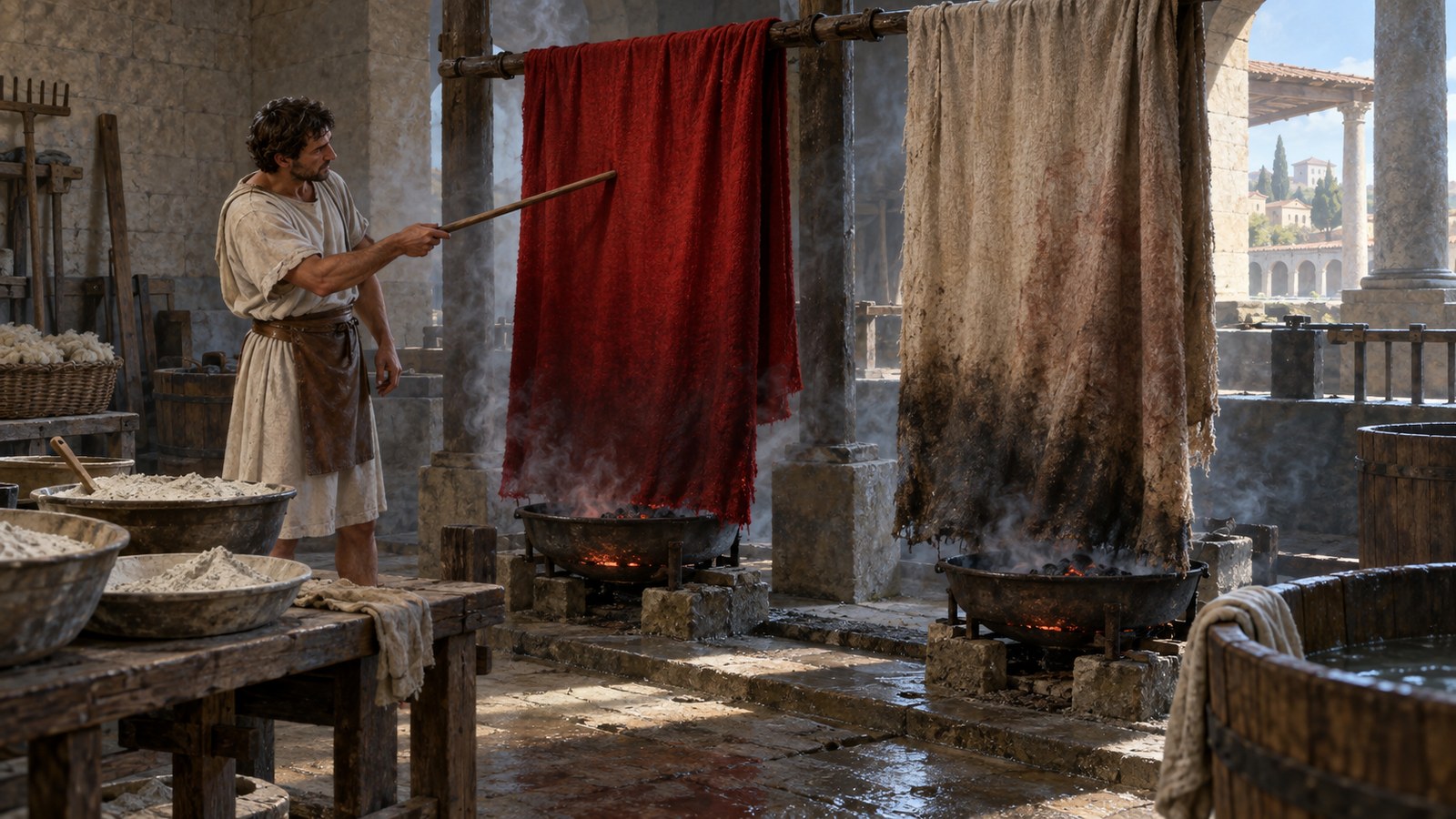
Weak colour could survive long enough to reach the fuller’s hands. Sulphur made the weakness harder to conceal. Pliny says badly dyed cloth was detected because the fumes turned it black and spread the colour.
That result was not a subtle aesthetic disagreement. A patchy blackening or migrating colour would be visible on the fabric. Smoke translated an invisible problem in the bond between dye and fibre into damage that a buyer, worker or owner could see.
Fast colour also changed under sulphur, but differently. Pliny says genuine and valuable colours became sombre. Cimolian earth then softened and brightened them, producing a kind of brilliance. Temporary darkening was part of the route to the desired finish rather than evidence of failure.
The fuller therefore had to distinguish two dark outcomes. One was recoverable and belonged to sound cloth. The other announced that colour was breaking down. Experience mattered because the workshop could not treat every shadow as the same condition.
This was quality control conducted through transformation. Modern testing language can make it sound clinical, yet the ancient method was physical and sensory: smoke rising from below, wool changing tone, mineral slurry moving across the surface, and the worker deciding whether brilliance could be recovered.
The risk also explains why finishing added value. A process that could expose bad dye demanded confidence before an expensive cloth entered it. The fuller’s reputation rested not only on cleanliness, but on knowing how far a fabric could be pushed.
Different Earths Belonged to Different Cloth
Cimolian earth was not a single undifferentiated powder in Pliny’s account. He distinguishes varieties and gives them separate practical profiles. Umbrian earth, for example, was used to give lustre to cloth.
The variety called “rock” behaved unusually: Pliny says it increased in size when steeped in liquid. It was sold by weight, while Umbrian earth was sold by measure. Those details join workshop behaviour to commerce. A fuller buying material had to understand both how it was priced and how it changed when wet.
The rock kind was especially useful for white garments after sulphur treatment. The same material, however, was very harmful to colour. A substance suitable for one pile of cloth could threaten another.
That distinction turns sorting into part of the craft. White and dyed garments could not simply advance together through identical bowls. Their treatment paths diverged because the final mineral interacted differently with colour.
Pliny also notes a regional substitute. Greek workers used Tymphaean gypsum instead of Cimolian earth. The objective could remain similar while the available mineral changed. Roman readers were thus shown a trade that depended on geological supply as well as manual skill.
Cloth connected a workshop to islands, quarries and markets before it reached a customer. The same economy that moved salt into the preparation of purple dye moved named earths into the finishing room. Colour was never only a matter of pigment; it depended on the materials used after dyeing too.
A Law Remembered the Workshop’s Public Importance
Pliny pauses before the recipe to mention a Metilian law concerning fullers. He says it still stood and attributes its proposal to the censors Gaius Flaminius and Lucius Aemilius.
He does not reproduce the law’s clauses. We cannot use his brief notice to reconstruct every inspection, penalty or permitted substance. The responsible conclusion is narrower: regulation of fullers was old and memorable enough for Pliny to frame the technical sequence with it.
That framing fits the social reach of the trade. Clothing carried status, office and respectability in public. A workshop that damaged colour, weakened fabric or misrepresented finish affected more than household tidiness. It handled goods whose appearance mattered in courts, streets, ceremonies and business.
Pliny praises ancestral care “about everything,” and the fulling law becomes his example. His nostalgia should not be mistaken for a complete administrative record. It does show that technical practice could be imagined as a proper object of civic supervision.
The law and recipe illuminate each other. Regulation makes sense because the process involved judgement and risk. The recipe matters socially because its products left the workshop on Roman bodies.
A fuller’s smoke was thus part of a larger chain of trust. The dyer claimed the colour was secure. The fuller subjected it to treatment. The garment’s owner expected the result to remain presentable. Sulphur could reveal where that trust failed.
Smoke Turned Craft Knowledge into Evidence
The strongest feature of Pliny’s description is its conditional logic. If the dye was bad, one result followed. If it was genuine and valuable, another sequence restored brightness. The materials did not merely act; they sorted cloth into outcomes.
That is why the fumes deserve attention beyond their smell or danger. They converted the fuller’s knowledge into visible evidence. Blackening and spreading made instability public. Recovery under Cimolian earth confirmed that temporary sombreness was not ruin.
Pliny’s preceding classification of sulphur supports the workshop setting. He lists four kinds. Clod sulphur was commonly found only in fullers’ workshops, while a third kind called egula smoked woollens from beneath to bestow whiteness and softness. The trade selected among forms of the same mineral.
He also ties sulphur to place. It came from the volcanic Aeolian Islands, was especially famous on Melos, and was mined and fire-dressed in parts of Campania. The pale smoke in a fuller’s room began with extraction and processing elsewhere.
None of this makes the ancient shop a modern laboratory. Measures, temperatures and exposure times are absent. Pliny gives a craft sequence, not a reproducible scientific protocol. Its precision lies in ordered substances and contrasting results.
The cloth’s colour told the final story. A weak dye could imitate quality until fumes forced it to behave. A strong one endured a dark interval and returned with brilliance. In that moment, Roman fulling became both finish and verdict.
Sources
Pliny the Elder, Natural History, book thirty-five, chapters fifty and fifty-seven.