
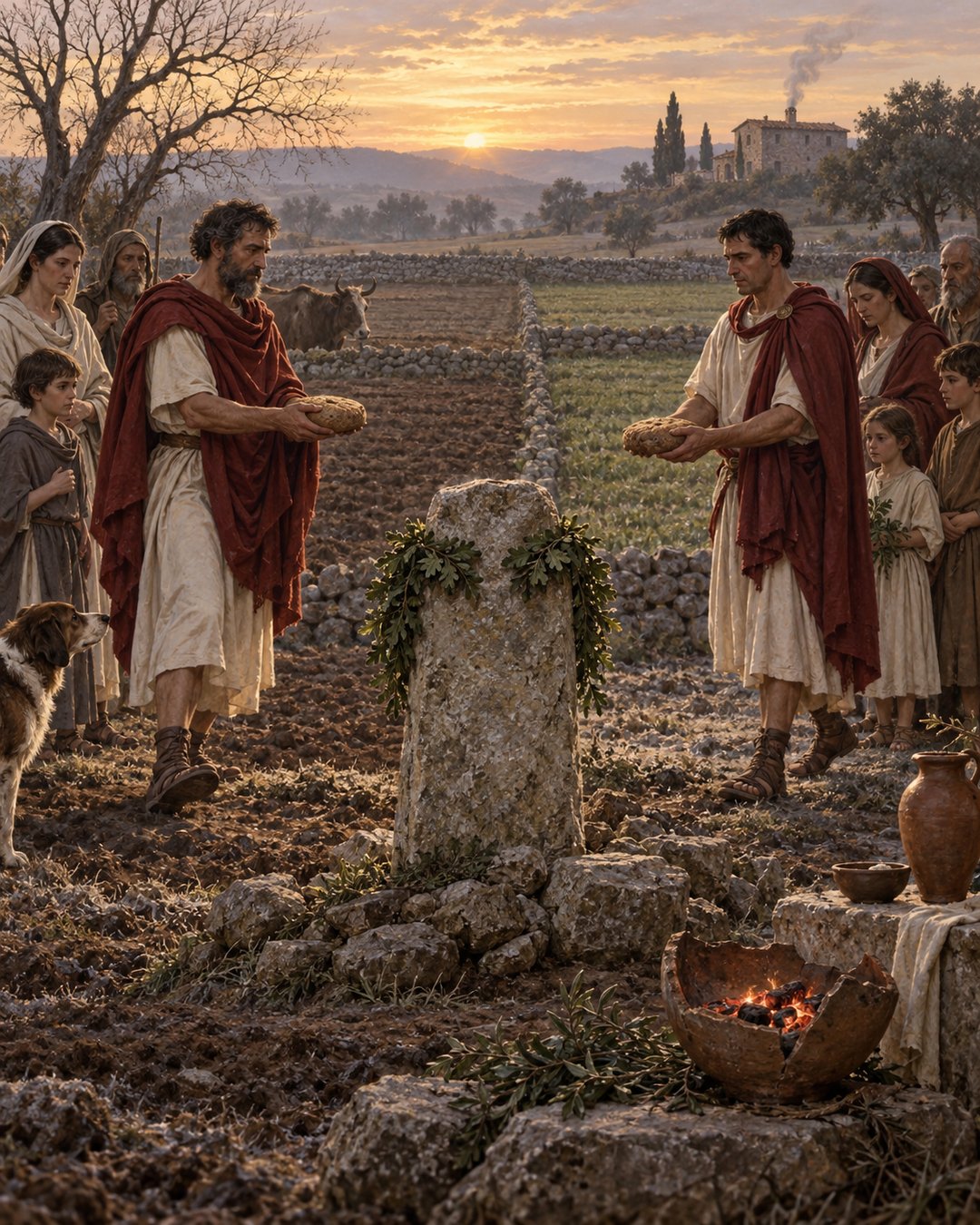
Two landowners approached the same boundary marker from opposite sides. Each carried a garland. Each brought a cake.
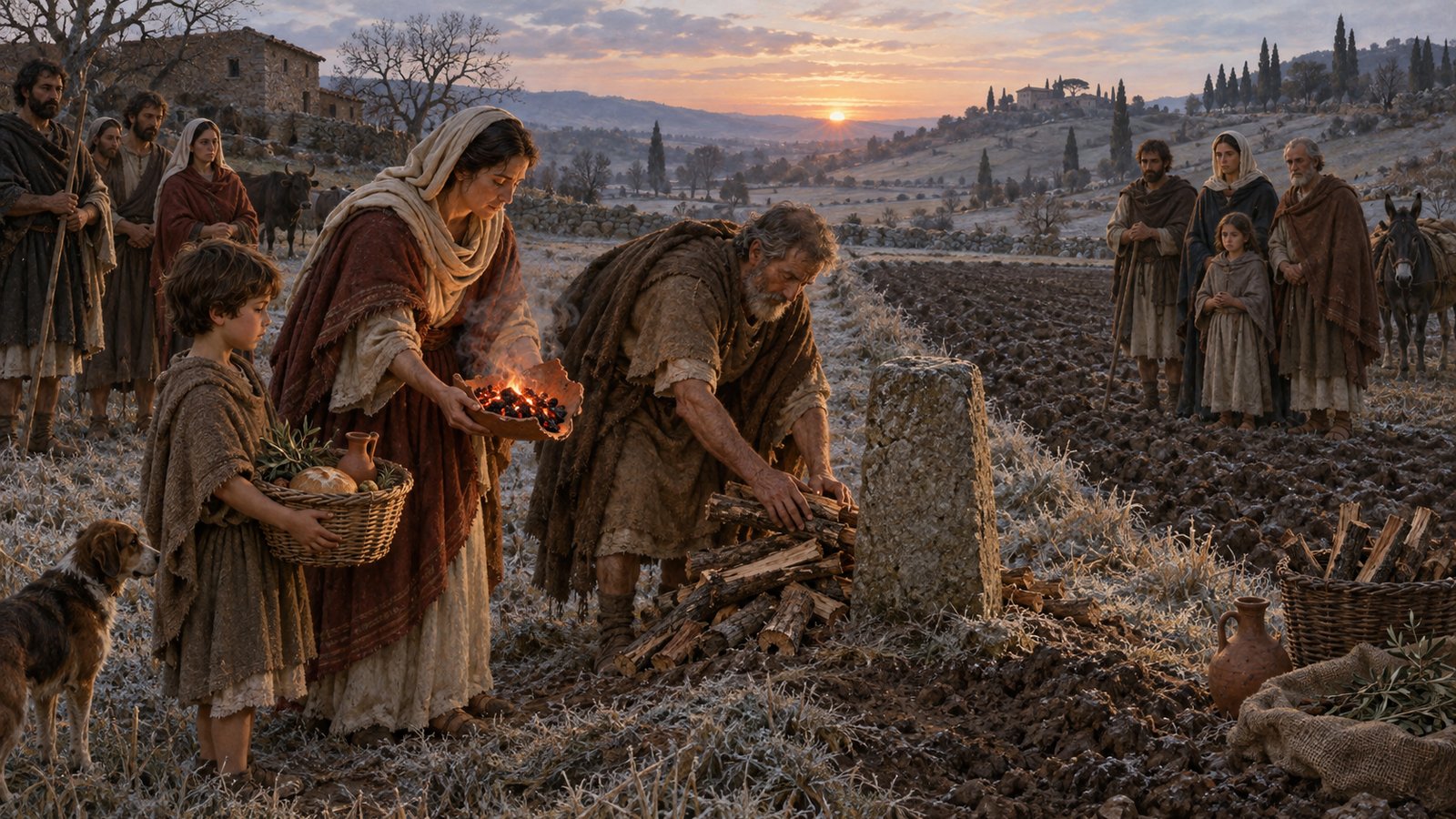
Then the households arrived: a farmer’s wife with coals from the hearth, an old man with wood and bark, a boy with a basket, and a daughter with sliced honeycomb.
In Ovid’s account of the Terminalia, the line dividing two fields became the one place where both neighbors had to perform the same work together.
A Stone or Buried Stump Made the Limit Visible
Ovid assigns the rite to February 23 and addresses Terminus as the god who separates fields by his sign. The sign could be a stone or a stump buried in the earth. Either form gave a fixed physical presence to a limit that otherwise might exist only in memory, measurement or argument.
The marker did not need an image of a human-shaped deity. Its position was its meaning. One patch of ground lay on one side, another holding on the other, and the object stood where those claims met.
That simple arrangement carried risk. A boundary marker protected possession only while people agreed that it remained in the correct place. A movable object could be shifted; an ignored one could vanish under weeds or cultivation. Ovid’s ritual returned owners to it on a named day and surrounded its location with witnesses.
The annual visit therefore did more than flatter a god. It refreshed knowledge. Both households saw the line, saw one another acknowledge it and remembered which point in the landscape carried authority.
This rural scene differs from the royal building conflict in the story of Terminus remaining inside Jupiter’s new temple. There a king failed to remove an older sacred claim. Here two neighbors voluntarily meet at an ordinary agricultural edge and maintain a claim that matters to them both.
Ovid does not describe a surveyor taking measurements during the festival. He gives something more social: a stone or buried wood, recurring offerings and participants who know why they are there. The limit survives because it is made visible and remembered.
Two Sides Supplied Matching Garlands and Cakes
The first action is strikingly balanced. Terminus is crowned from either side by two landowners. They bring two garlands and two cakes. Ovid’s paired nouns reproduce the geography of the marker: one neighbor here, one there, and one boundary between them.
Neither owner appears as host while the other appears as guest. Each comes from his own side and contributes a corresponding gift. That symmetry matters because an unequal rite could imply that one household controlled the marker. Parallel offerings instead recognize separate holdings without turning separation into hostility.
The cakes also make participation tangible. Agreement is not left as a silent assumption. Each owner has prepared or obtained something and carried it to the field edge. The ritual consumes resources and time from both sides.
A marker crowned only from one field would be visually incomplete in Ovid’s description. The two garlands wrap mutual recognition around the same fixed point. They do not erase the boundary. They honor it precisely because the properties remain distinct.
Roman rules often made dimensions and placement legible through physical form. the Twelve Tables’ road widths distinguished a straight course from a bend. The Terminalia uses no road measurement, but it likewise connects an abstract right with something that can be seen, approached and checked on the ground.
The result is not modern neighborliness projected backward. Ovid explicitly praises a power that prevents fields from being disputed. The pleasant cooperation of the day is built around awareness that boundaries can become contested.
Hearth Fire Travelled from the House to the Field Edge
After the paired gifts, Ovid expands the scene into household labor. An altar is made. The farmer’s wife brings live coals from the warm hearth on a broken pot. Fire is not imagined appearing by itself at the boundary; it travels from domestic space in a humble, practical carrier.
The broken pottery detail gives the rite texture. A sherd can hold embers without requiring a special ceremonial vessel. The familiar hearth supplies continuity, while the journey out to the marker transfers heat from the house to the exposed agricultural line.
An old man cuts wood and stacks it carefully. He sets branches in firm earth and nurses the first flames with dry bark. Ovid divides the task into stages: transport the coals, build the fuel, stabilize the branches and encourage the flame.
A boy waits with a broad basket. The poem does not reduce the family to spectators behind the two owners. Different ages hold materials or perform steps. The boundary is taught through participation; a child learns its place while helping the rite proceed.
This is a datable mini-scene in Ovid’s calendar: once the preceding night has passed, people gather at the field edge, carrying the warmth and tools of the farm. Winter ground, dry bark and managed embers make the observance look like work because ritual is being assembled from ordinary resources.
The altar is temporary, but the marker is not. Wood burns down, food is offered, and people go home. The stone or stump remains. Rebuilding the rite around it each year emphasizes the contrast between recurring human activity and the fixed location it serves.
Grain, Honeycomb, and Wine Arrived in a Set Order
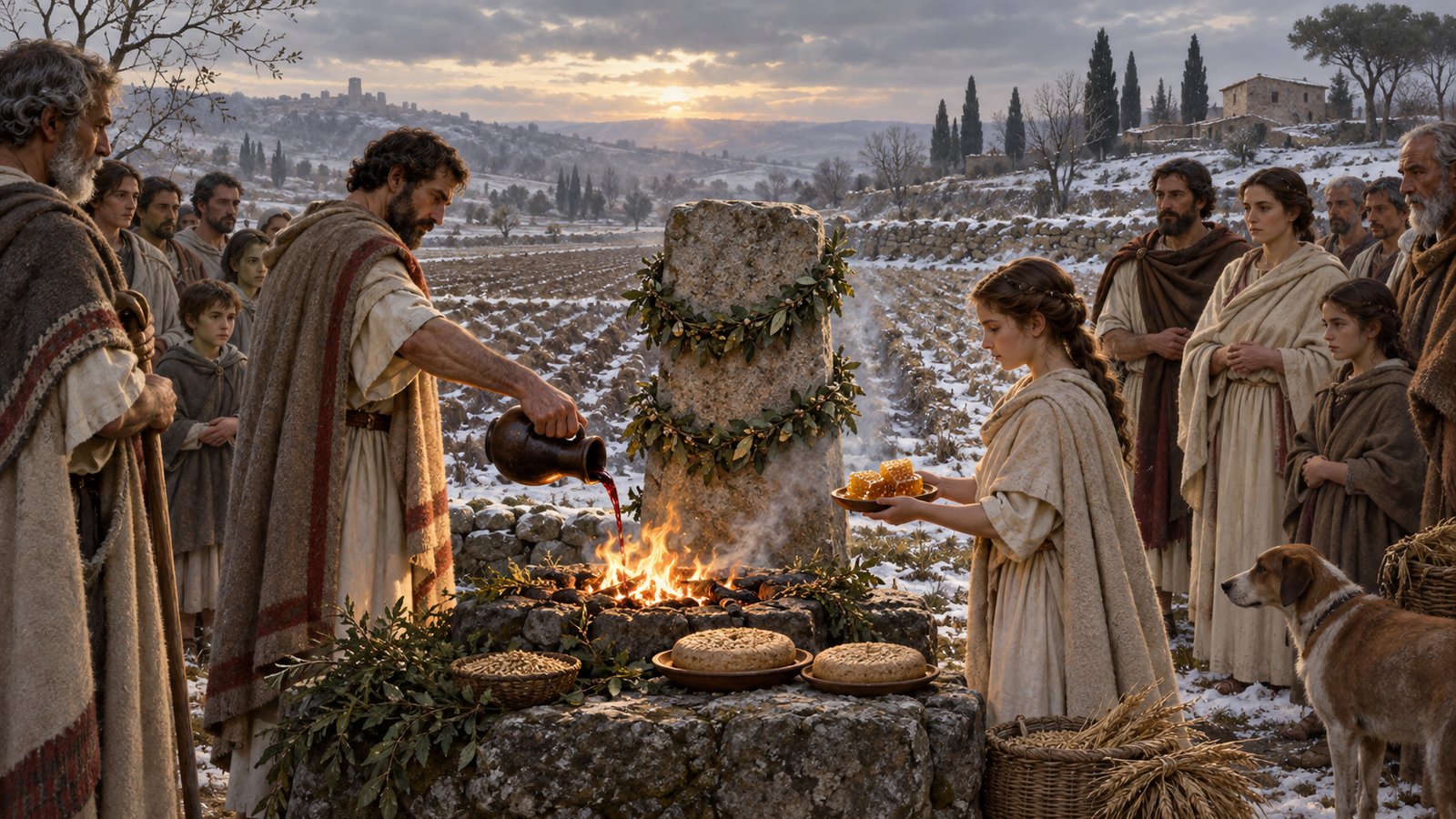
Ovid next gives the offerings a sequence. Grain is thrown into the fire three times. Only after that repeated act does the little daughter present sliced honeycomb. Others carry wine, and a share of each gift goes to the flames.
The number belongs to the source: three casts of grain. Ovid does not explain why three is required in this passage, so the scene should not be padded with an invented symbolism. What can be said is that repetition made the action countable. Participants could know when that stage had been completed.
The honeycomb follows rather than arriving as random food at a picnic. Its sliced form suggests preparation before the family reached the marker. Wine also has to be carried from storage, and part of it is deliberately surrendered to the fire.
A crowd dressed in white watches silently. That pause changes the atmosphere. Earlier lines are full of cutting, stacking and carrying; now the group becomes still while the offerings pass into the flames.
Ovid then describes animal sacrifice in direct terms. The boundary is sprinkled with a lamb’s blood, and the poet says Terminus does not object when a sucking pig is granted as well. The detail should neither be hidden nor turned into spectacle. It marks a costly stage in an observance that began with garlands and cakes.
The order links household products to the land that produced them. Grain, honey and wine arrive at the line between fields. The rite returns a portion of agricultural value to the power imagined as keeping each field from falling into dispute.
The Feast Rejoined People after the Offerings Divided Property
After the sacrifice, neighbors gather sincerely, hold a feast and sing to Terminus. The day ends with people together beside the object that states where their land is separate.
The hymn praises the god for setting bounds not only to fields but to peoples, cities and great kingdoms. It also gives the smallest scale a sharp political meaning: without Terminus, every field would be disputed. The poem moves from one rural marker to an ordering principle large enough for states.
Ovid’s praise insists that the boundary power cannot be bribed with gold and must guard entrusted land in good faith. That language imagines the marker as resistant to private pressure. One neighbor’s wealth or request should not make it wander.
The feast does not dissolve ownership into common property. The fields remain on different sides. What becomes common is the occasion: fire, attention, song and food shared in the marker’s presence.
That choreography gives the ritual its practical force. The owners confirm the limit with matching gifts. Their families build and provision the observance. A silent crowd witnesses the offerings. The neighbors then turn from parallel action to a collective meal.
Ovid adds a public counterpart at the sixth milestone on the road toward the Laurentine fields, where sheep entrails were sacrificed to Terminus. The god therefore belonged both to intimate farm boundaries and to a marked point on a road leading out from the city.
The rural scene remains the more revealing one because it shows exactly how a line could enter household memory. Children carried materials; adults performed repeated actions; neighbors supplied equal gifts. A stone that might otherwise attract suspicion became the focus of a jointly completed day.
Terminus separated fields. The Terminalia kept that separation from becoming silence.
Sources
Ovid, Fasti, book two, February 23.