
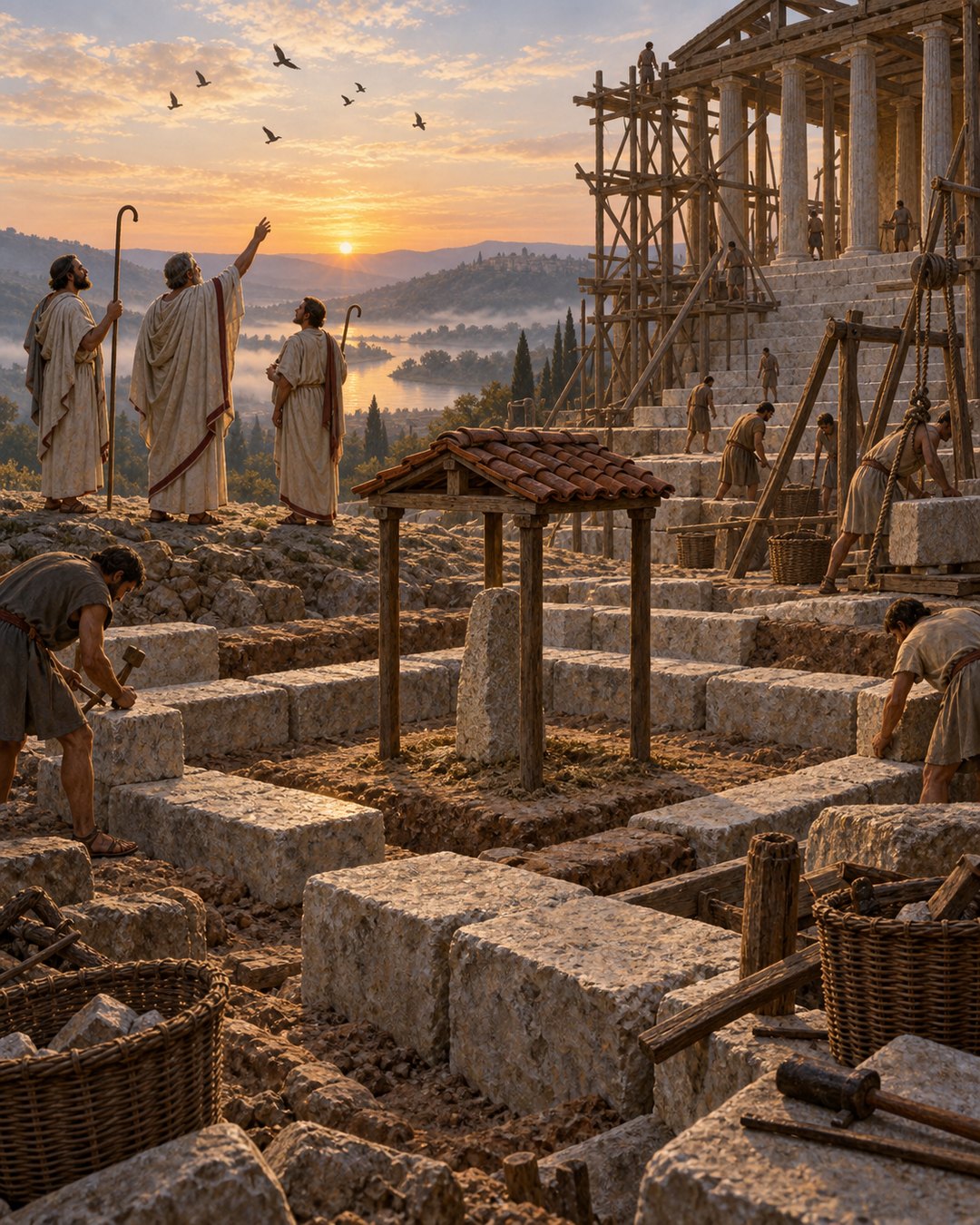
On the Tarpeian Mount, Tarquinius Superbus wanted a site that belonged wholly to Jupiter. Livy says older fanes and shrines stood where the king intended to raise the great temple. Their consecrations had to be rescinded before the ground could be cleared.
The augural answer released almost all of them. One refused to leave. The birds would not consent to the removal of the shrine of Terminus, the god whose very identity belonged to boundaries.
That obstruction did not cancel the project. It changed its meaning. The largest royal building claim on the hill advanced around one sacred claim the king could not annul.
A Royal Monument First Required Sacred Clearance
Livy introduces the construction after Tarquin’s seizure of Gabii and renewal of agreements with neighboring powers. The king then turns inward, toward a temple of Jupiter on the Tarpeian Mount. This was not described as ordinary maintenance. It would memorialize his reign and complete a vow associated with the two Tarquins: one had vowed the temple, the other would fulfill it.
The chosen summit was not empty. Livy traces the smaller sacred places there to vows made by King Titus Tatius during his conflict with Romulus and to later acts of consecration. The building site therefore held claims older than Tarquin’s program. Stone could be moved by labor, but consecrated space needed a religious release.
Tarquin’s aim was comprehensive. He wanted the site free from other religious claims so that it would belong wholly to Jupiter and the temple rising there. That phrase exposes the project’s territorial logic. The king was not merely adding a sanctuary beside its neighbors. He was consolidating the sacred ground beneath one dominant monument.
The process differs sharply from the provincial negotiation in Trajan’s exchange about moving a shrine at Nicomedia. There, legal uncertainty and local precedent complicated a civic relocation. On the Capitoline, Livy presents the clearance as an augural question whose answer could either dissolve or preserve an existing dedication.
No surviving project plan tells us the exact footprint of each earlier shrine. Livy does not give dimensions, masonry types, or a map. His concern is the sequence of authority: a king proposes, ritual specialists consult, and divine consent determines which sacred boundaries can be withdrawn.
Construction began, in other words, with a problem of jurisdiction. Before the hill could carry a new architectural order, Rome had to decide whether older gods still possessed pieces of it.
The Birds Released Every Claim Except Terminus
Livy says the birds permitted the consecrations of the other shrines to be rescinded. The sentence compresses what must have been a serious transformation of the summit. Sacred places whose claims had once seemed durable could be ritually ended, allowing their ground to enter the new temple precinct.
Terminus alone received a different answer. The augural signs refused consent for his shrine. Livy emphasizes the result in physical language: the seat of Terminus was not moved. A decision read in the sky fixed one point on the earth.
The fit between deity and outcome made the omen unusually legible. Terminus marked limits; Terminus held his limit. The god did not need a speech, miracle of motion, or elaborate apparition. His power appeared as non-movement while everything around him was being reorganized.
This was not simply a builder encountering a stone too heavy to shift. Livy frames the obstacle as a failed act of deconsecration. The king could command labor and spending, but he could not make a sacred claim disappear without the required assent. Ritual procedure imposed a hard boundary on royal will.
The contrast with the repeated household commands used to dismiss the dead at Lemuria is useful. There, words and gestures send dangerous presences beyond the threshold. On the Capitoline, the attempt to release a sacred presence stops at one shrine. Terminus remains because the ritual mechanism refuses to complete.
Livy does not report a debate among builders about avoiding delay. He preserves something more politically useful: a king strong enough to remake the hill, and a religious order strong enough to tell him where the remaking must stop.
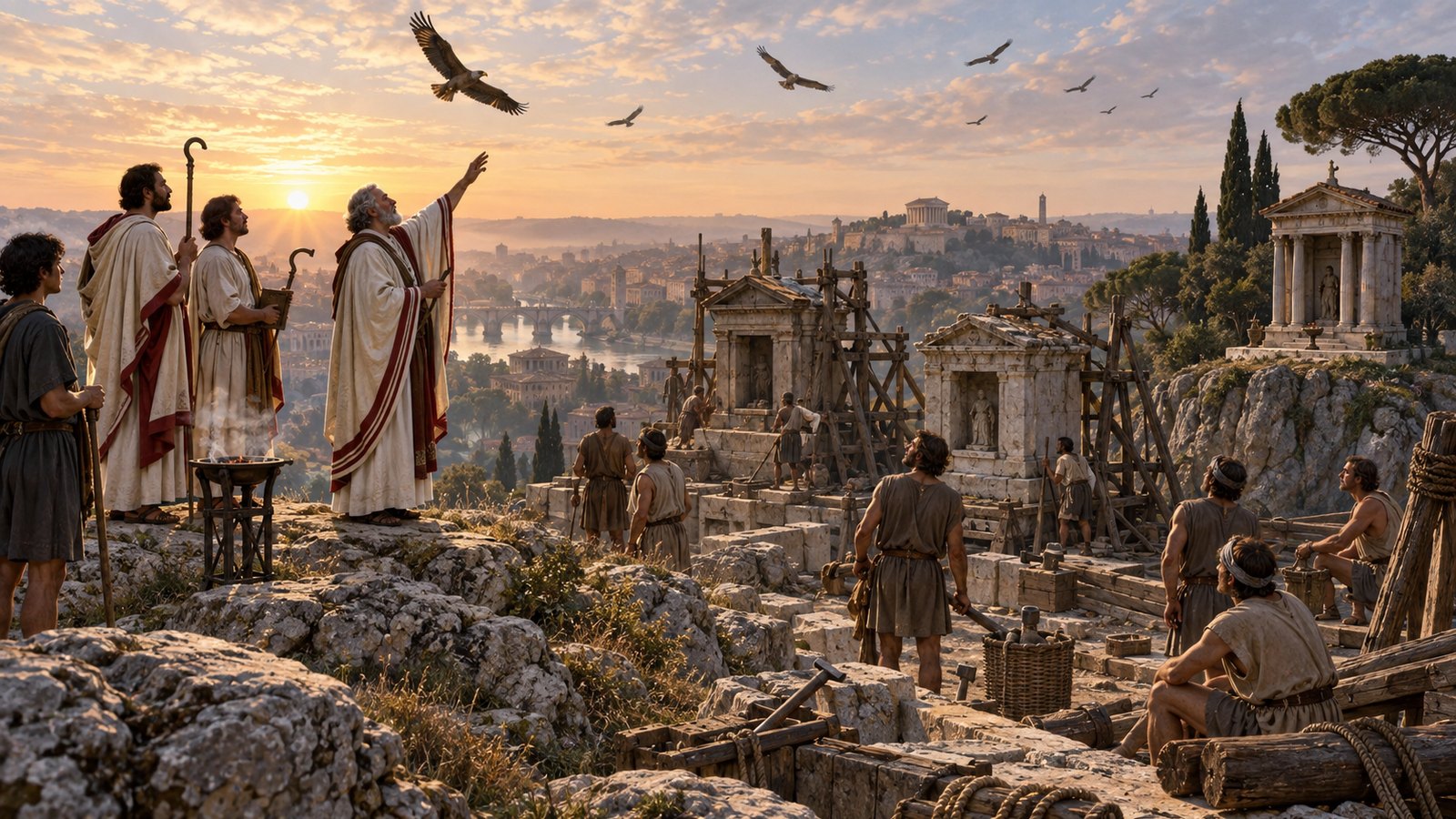
An Immovable Boundary Became an Omen of Permanence
Romans interpreted Terminus’s survival as a promise. Because his seat could not be moved and he alone was not called away, Livy says the whole power of Rome would be firm and steadfast. A local resistance inside one building site expanded into a forecast about empire.
The logic worked through analogy rather than engineering. The shrine stayed; therefore Roman dominion would stay. Boundary, place, and political endurance collapsed into one compact sign that could be remembered whenever the Capitoline monument was seen.
That interpretation also converted an inconvenience into prestige. A failed clearance might have looked like incomplete control. Instead, the refusal became evidence that the new temple stood on a destiny more durable than the king’s orders. The project gained meaning from the one operation it could not perform.
The omen did not mean Roman frontiers would never change, nor does Livy offer it as a measurable law of expansion. It belonged to the retrospective language by which later Romans explained the apparent permanence of their state. The old shrine supplied a physical anchor for that claim.
Terminus therefore occupied two scales at once. At the small scale, he held one consecrated seat amid foundation works. At the large scale, he represented the refusal of Roman power to be displaced. The strength of the story lies in the clean passage between those scales.
A boundary god’s immobility also disciplined the image of conquest. Rome’s greatness was not represented only by pushing outward. In this scene it depended on knowing that one line could not be pushed at all.
The Foundations Gathered Omens, Money, and Memory
Livy follows the Terminus episode with another discovery from the same works. Laborers digging the foundations reportedly found a human head whose features remained intact. Soothsayers in Rome and from Etruria interpreted it as a sign that the place would become the citadel of empire and the head of the world.
The two prodigies gave the construction a narrative before the building was complete. Terminus promised steadfastness; the head promised supremacy. Neither omen was an ornamental addition installed after the walls rose. Both emerged from the difficult work of making and clearing the site.
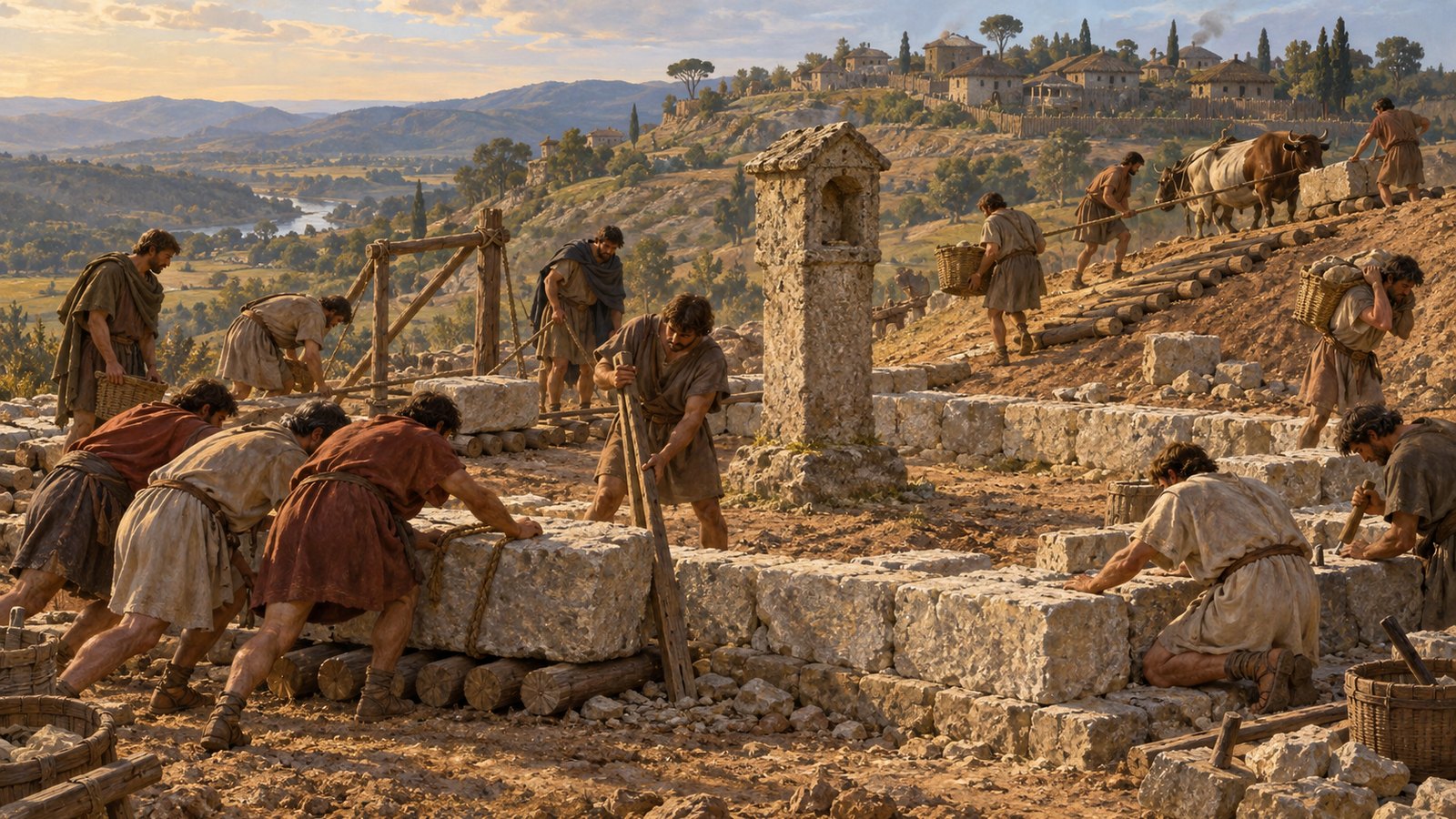
The king’s response was material. Livy says the signs made him more ready to spend. Spoils from Pometia intended to carry the project to the roof barely sufficed for the foundations. The historian even weighs competing figures, preferring Fabius’s forty talents to Piso’s implausibly vast forty thousand pounds of silver.
Those numbers keep the account attached to labor and resources. Sacred destiny did not lift masonry by itself. A promising site consumed booty, excavation, transport, timber and stone. The deeper the claims made for the monument, the more expensive its base became.
The Capitoline story therefore binds constraint to ambition. Tarquin sought a precinct without rival claims, but Terminus prevented total clearance. Workers dug downward and uncovered a sign of future supremacy. Money meant for the visible height vanished into foundations. The temple’s meaning accumulated through what resisted, what appeared, and what the ground consumed.
Terminus is the decisive detail because he prevents the monument from looking like a blank royal creation. Jupiter’s temple rose on a hill already occupied by memory and ritual title. One older god kept enough ground to remind every later claim of permanence that power had first met a boundary.
Sources
Livy, History of Rome 1.55.