
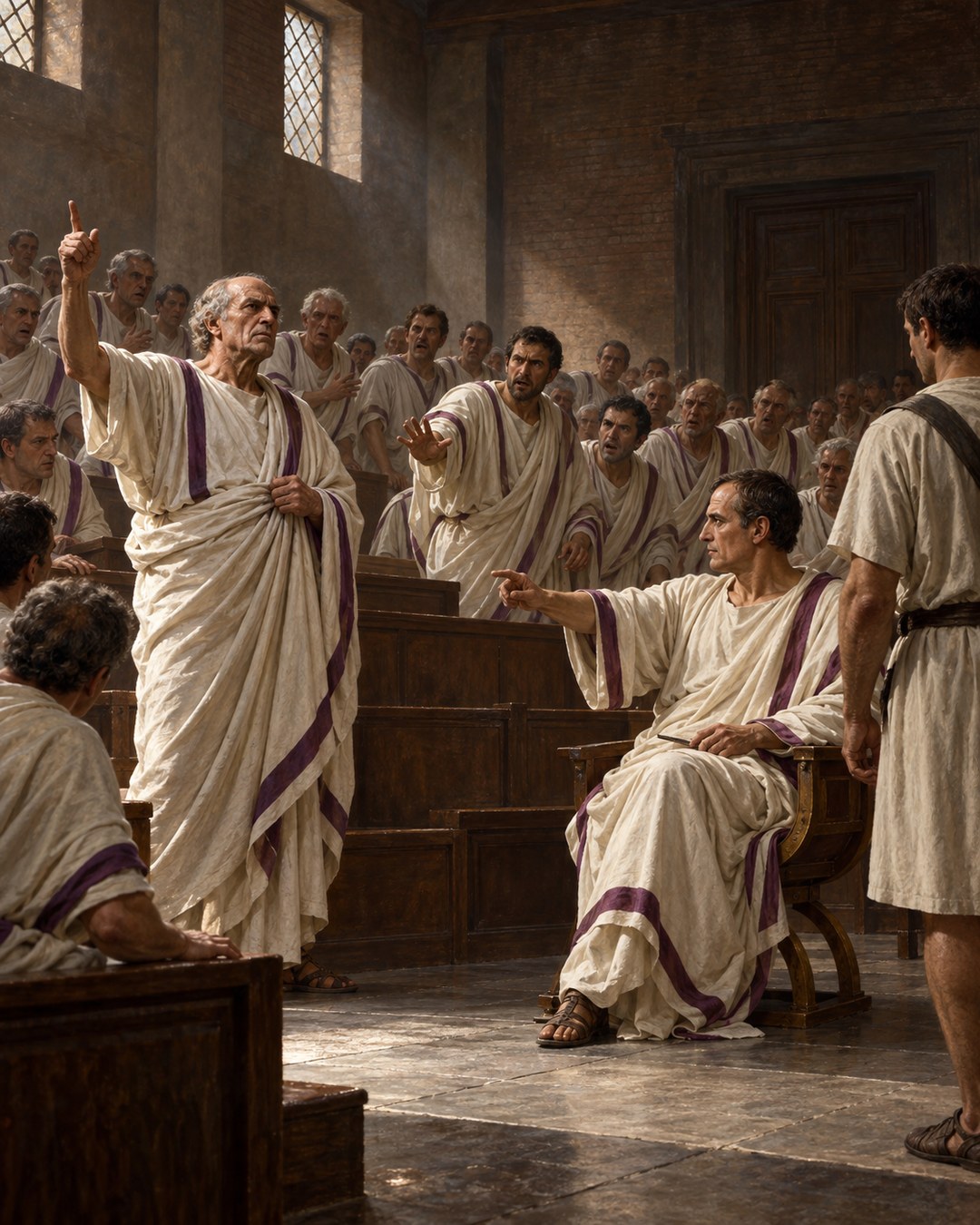
Cato did not need to win a vote if he could prevent the vote from arriving. Asked for his opinion in the Senate, he ranged beyond the motion and kept talking, aiming to consume the whole day.
Caesar, presiding as consul, answered with an attendant and an arrest order. Cato was to be taken to prison while the speech was still flowing.
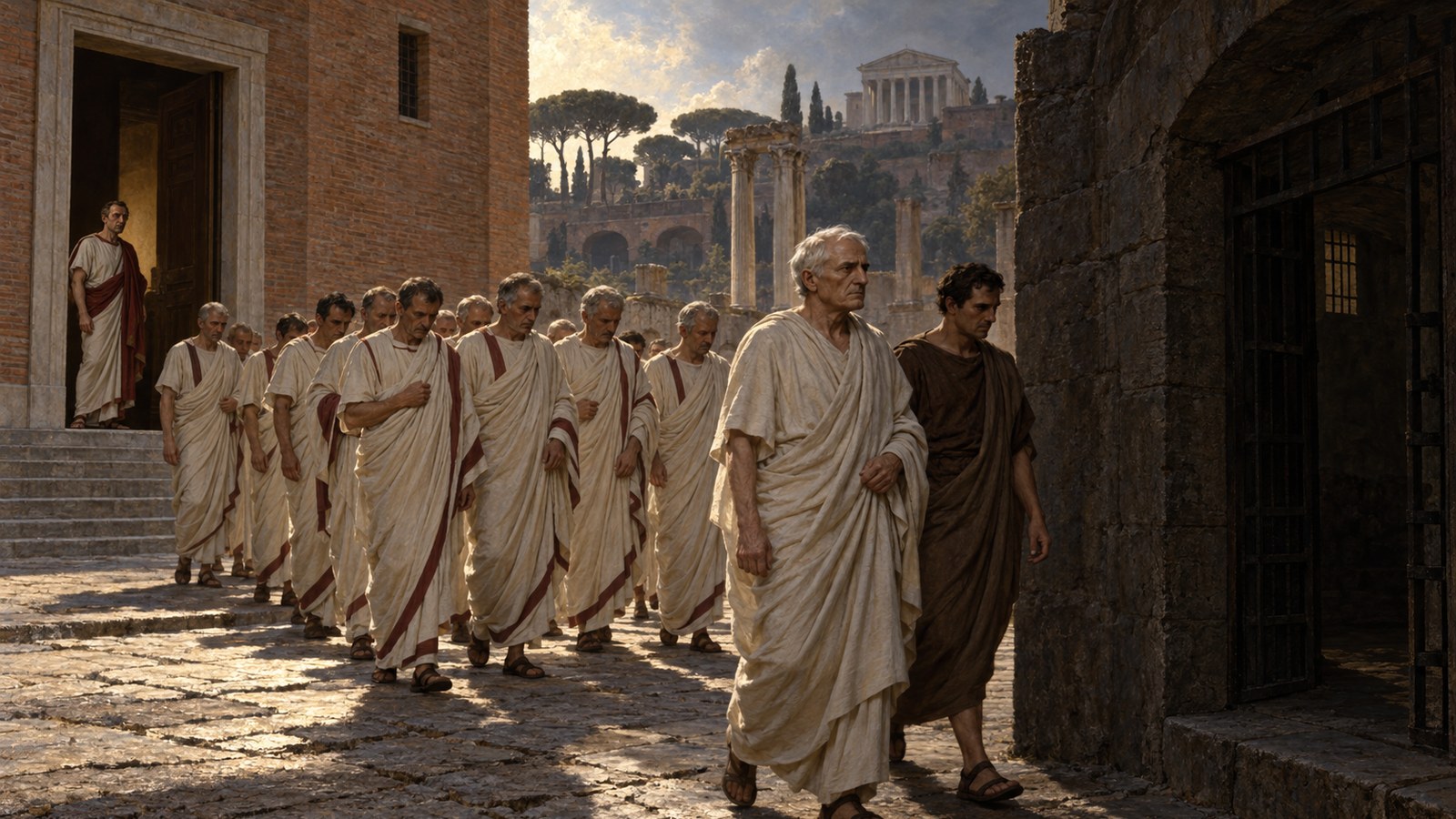
Then the Senate rose and went with him.
The First Voice in the Chamber Was a Political Reward
Aulus Gellius introduces the clash through a quieter procedural question: whom did a consul ask to speak first? Before the rule current in Gellius’s own time, the order varied.
One possibility was the senator whom the censors had placed first on the roll. Another was a consul-elect. Both choices linked precedence to recognized standing, but they did not eliminate discretion.
Some consuls called on a preferred man out of order because of friendship or another personal connection. The departure acted as a compliment. It made hierarchy audible before anyone addressed the substance of the motion.
There was still a boundary. Gellius says that even when usual order was set aside, the first call went only to someone of consular rank. Favor worked inside a status rule rather than wiping rank away.
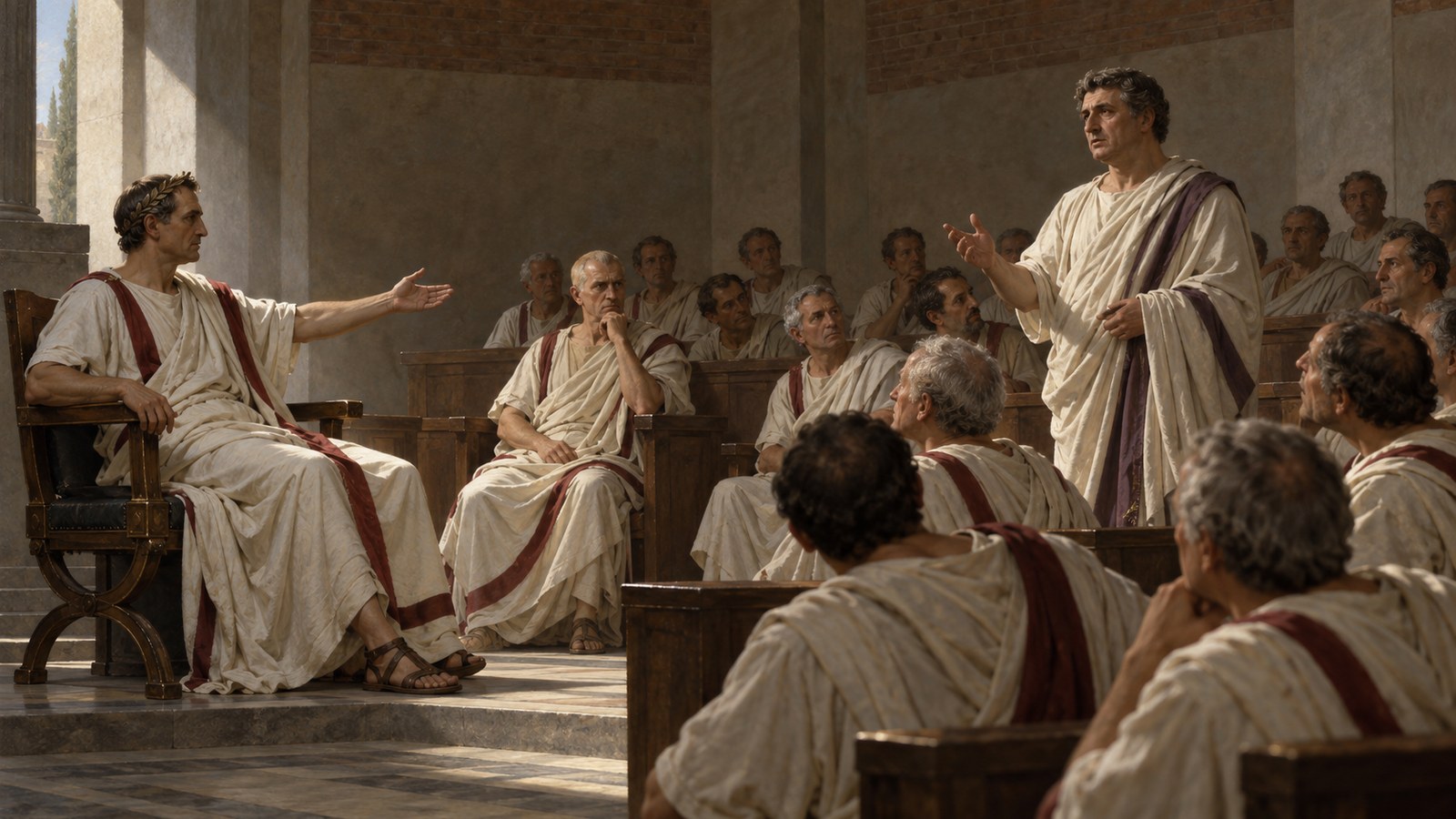
Caesar reportedly used that space sparingly when he shared the consulship with Bibulus, calling only four senators out of order. Yet one change exposed how public and personal alliances met. He initially called Crassus first. After Pompey became betrothed to Caesar’s daughter, Pompey received the first call.
The preference did not secretly alter a ballot. It shaped the room before later speakers responded. The first opinion could frame the issue, announce an alliance and tell every senator which relationship the consul wanted the chamber to notice.
The story of Papirius inventing a marriage debate to protect Senate secrecy shows access to deliberation guarded at the doorway. Gellius 4.10 looks inside: even among admitted senators, sequence distributed influence.
Gellius Built the Account from Political Memory
Gellius does not claim to have a transcript. He identifies a chain of authorities. Tullius Tiro, Cicero’s learned freedman, recorded Caesar’s explanation and said he had the information from Cicero. Ateius Capito gave a comparable account in a work on senatorial conduct.
That chain matters because the episode concerns customary rights and disputed behavior. Gellius is preserving what later legal and antiquarian writers believed the chamber allowed, not offering a modern rulebook complete with every exception.
His interest joins vocabulary, procedure and anecdote. The speaking order illustrates how an institution operated. The Cato story then tests what happened when two recognized powers collided inside it.
Cato opposed a motion because he judged it contrary to the public good. Gellius does not specify the proposal in this chapter. The omission keeps attention on the method of obstruction rather than inviting a reconstruction of policy not present in the text.
Capito’s reported rule gave the method its opening. Once a senator was asked for an opinion, he could speak first on another subject of his choosing. He could also speak for as long as he wished.
That freedom joined debate to delay. A senator did not need a separate procedural motion to consume time. The very invitation intended to gather advice could become a way to stop the house from completing the business for which advice had been requested.
Cato Turned an Opinion into Control of the Clock
Cato used duration as his instrument. He did not merely wander from the motion by accident. Gellius says he made a long speech for the purpose of delaying action and tried to use up the entire day.
The tactic depended on a deadline outside the words themselves. If the chamber had unlimited time, length would only postpone. When business had to be completed before the day ended, every additional passage reduced the chance of a decision.
The speaker’s body therefore occupied the institution. As long as Cato remained recognized and talking, the motion could not advance through the normal sequence. His lungs and stamina became part of the political machinery.
This makes the confrontation different from a loud interruption. Cato exploited a liberty attached to being properly called. He obstructed from within the role the presiding consul had given him.
Caesar faced an awkward choice. Waiting respected the custom but risked losing the motion. Cutting off Cato without consequence would show that the speaking liberty existed only at the consul’s pleasure. Arrest supplied a harder answer.
The account of a hidden flute checking Gaius Gracchus’s pitch in the forum follows a speaker regulating his own delivery through a companion’s signal. Cato’s instrument was not pitch but time, and the person trying to regulate it sat in the consul’s chair.
An Arrest Order Emptied Caesar’s Audience
Caesar summoned an attendant and ordered Cato taken to prison in the full course of his speech. The command asserted that the presiding magistrate could use coercion where ordinary management had failed.
It also changed the question. Senators no longer had to decide only whether they agreed with Cato’s position or enjoyed his delay. They had to decide whether deliberation could continue while one of their number was removed for using a speaking privilege.
Their answer was physical. The Senate rose as a body and accompanied Cato. Gellius gives no roll call and no list of individual motives. The image is enough: benches emptied behind the prisoner.
That movement denied Caesar the institutional setting he had been trying to control. A consul could order one man away, but he could not conduct meaningful senatorial business if the chamber chose to become a procession following that man.
The walkout transformed solidarity into pressure without requiring a successful counter-motion. Senators did not defeat arrest by overpowering the attendant. They made the arrest politically unusable.
Indignation forced Caesar to yield and order Cato’s release. The sequence is important. Release did not come because Cato’s speech suddenly became shorter. It came because coercion produced a collective response more damaging to Caesar’s purpose than delay had been.
In Metellus’s Senate speech presenting marriage as necessary trouble, the chamber receives an argument preserved for its blunt framing. Here, the decisive communication contained no quoted speech from the senators. Standing up together carried the message.
Procedure Worked Only while the Chamber Recognized It
Gellius’s two parts belong together. A consul could influence order by honoring one consular senator before another. A senator could exploit the resulting floor to delay. A consul could escalate to arrest. None of these powers operated in isolation.
Precedence required the chamber to understand why a first call mattered. Unlimited speech required listeners to treat the speaker as still holding the floor. Arrest required the remaining senators to continue as though removal had restored normal business.
At the last step, recognition failed. The Senate’s collective movement exposed a limit that was social rather than mechanical. Caesar still possessed office and attendants, but the chamber would not supply the audience his order needed.
The episode should not be turned into a timeless rule that Roman senators always defended free speech. Gellius preserves one remembered confrontation, filtered through Tiro, Cicero and Capito. Its value lies in the mechanism it makes visible.
Roman politics could turn on sequence, daylight and bodies in seats. Who spoke first signaled alliance. How long he spoke controlled timing. Where other senators walked determined whether punishment strengthened or weakened the chair.
Cato began by preventing a motion from reaching its vote. Caesar tried to remove the obstruction. The senators made Cato’s route to prison the only business left in view.
The longest speech did not end with a final sentence. It ended when an emptying chamber made silence more dangerous to Caesar than Cato’s words.
Sources
Aulus Gellius, Attic Nights, book 4, chapter 10.