
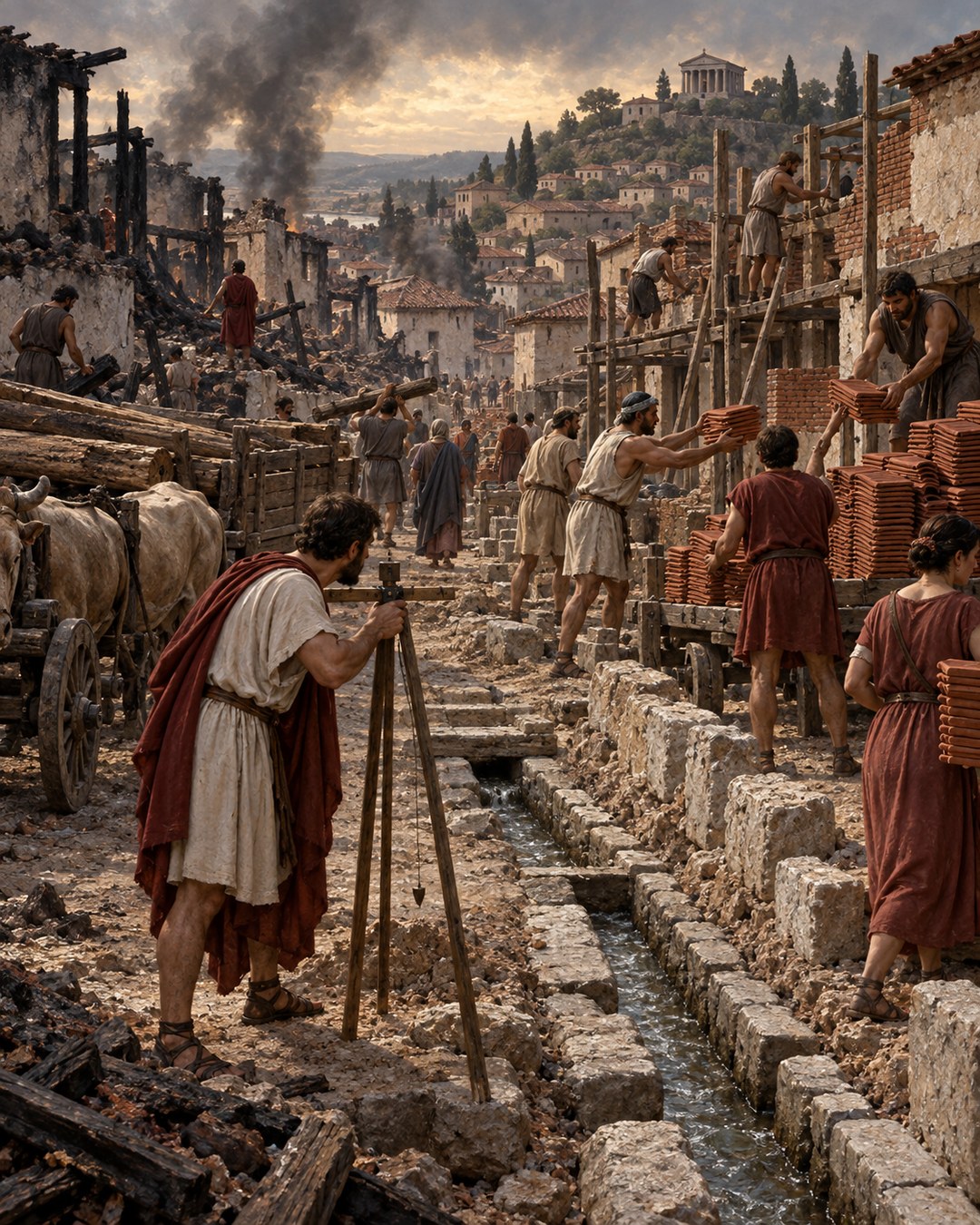
Rome had survived the Gauls, but survival left a practical question spread across scorched ground. Should the population rebuild the damaged city or move into captured Veii, where walls and houses already stood?
Livy resolves the argument with an omen, then turns immediately to materials and deadlines. Roof tiles came at public expense. Stone and timber could be taken wherever builders found them, provided they guaranteed completion within the year.
The arrangement put roofs back quickly. It also put old public sewers under new private houses.
A Capital Could Not Be Packed into Carts for Veii
Camillus’s speech against relocation begins by refusing the premise that a city is only a stock of buildings. If another fire consumed part of Veii, he asks, would Romans keep moving from one borrowed settlement to the next? Timber and wall surfaces could burn anywhere.
What could not be transferred was the landscape in which Roman identity had accumulated. Camillus names hills, plains, the Tiber and the familiar sky. His memory of exile had not been a list of houses. It had been the face of the country in which he was born and educated.
He also makes a logistical case. The river joined inland produce to maritime supply. Rome stood near enough to the sea to use it, yet far enough inland to reduce exposure to foreign fleets. The central Italian position supported growth in a way that an empty inventory of Veientine houses could not duplicate.
The sacred map was even harder to move. Camillus points to the Capitol, the fire of Vesta and the heavenly shields. Juventas and Terminus, he says, had refused to be displaced when the Capitol was ritually cleared. Staying meant preserving a web of rites whose locations carried their own authority.
Livy therefore makes reconstruction a choice about continuity, not a failure to recognize easier accommodation. The buildings had been damaged, but geography, cult and civic memory still made Rome the more complete city.
The recent story of the geese waking Manlius before the Gauls reached the Capitol follows survival at the city’s sacred height. The rebuilding debate asked whether that survival still mattered once ordinary homes below it were wrecked.
A Passing Command Became the Vote’s Final Argument
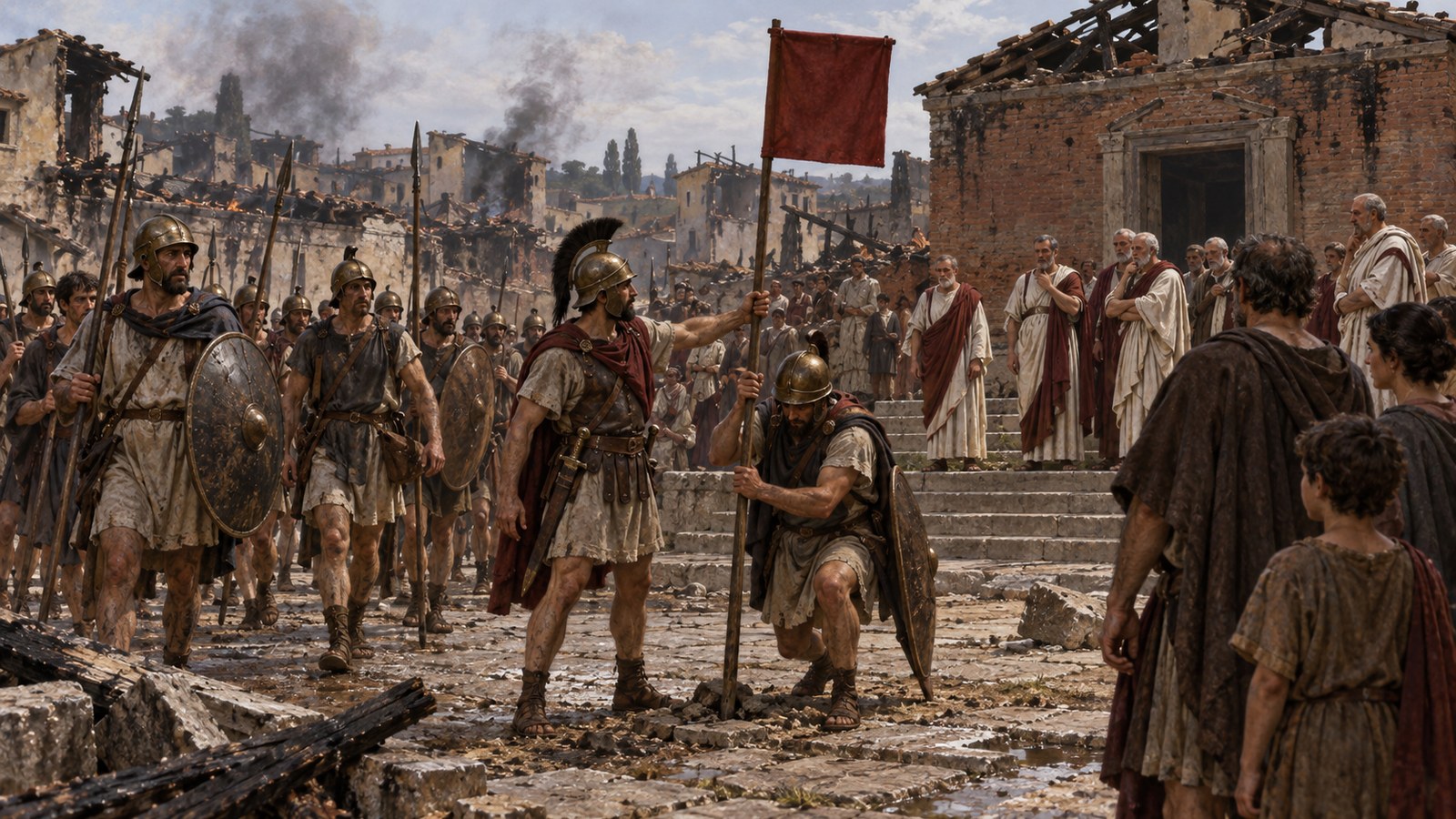
Reasoned speech did not settle everything. Livy places the decision inside the Curia Hostilia while senators were still debating. Outside, soldiers returning from guard duty crossed the forum.
A centurion called to a standard-bearer to plant the standard and added that it was best to remain there. The words belonged to military movement, not constitutional debate. Heard at exactly that moment, they became available for a second meaning.
The senators came out and declared that they accepted the omen. The surrounding commons approved. Livy compresses the end of a divisive proposal into an overheard sentence that both political groups could claim without reopening every argument.
The standard mattered because it made staying visible. A planted military sign marked a fixed point around which a unit gathered. In the forum, after invasion and flight, the gesture could stand for the community recovering its position.
This was not an urban plan. It was authorization to begin. Once the proposal to move was rejected, construction started in several parts of the city at the same time. The omen closed the political question before anyone had solved the spatial one.
Livy’s sequence is exact: decide that Rome must remain, then discover what rapid remaining requires. The emotional and religious argument created urgency. The physical city had to catch up with the declaration.
Public Tiles Turned Private Households into a Building Force
The state did not rebuild every dwelling through one central works crew. It changed the conditions under which many households could build at once.
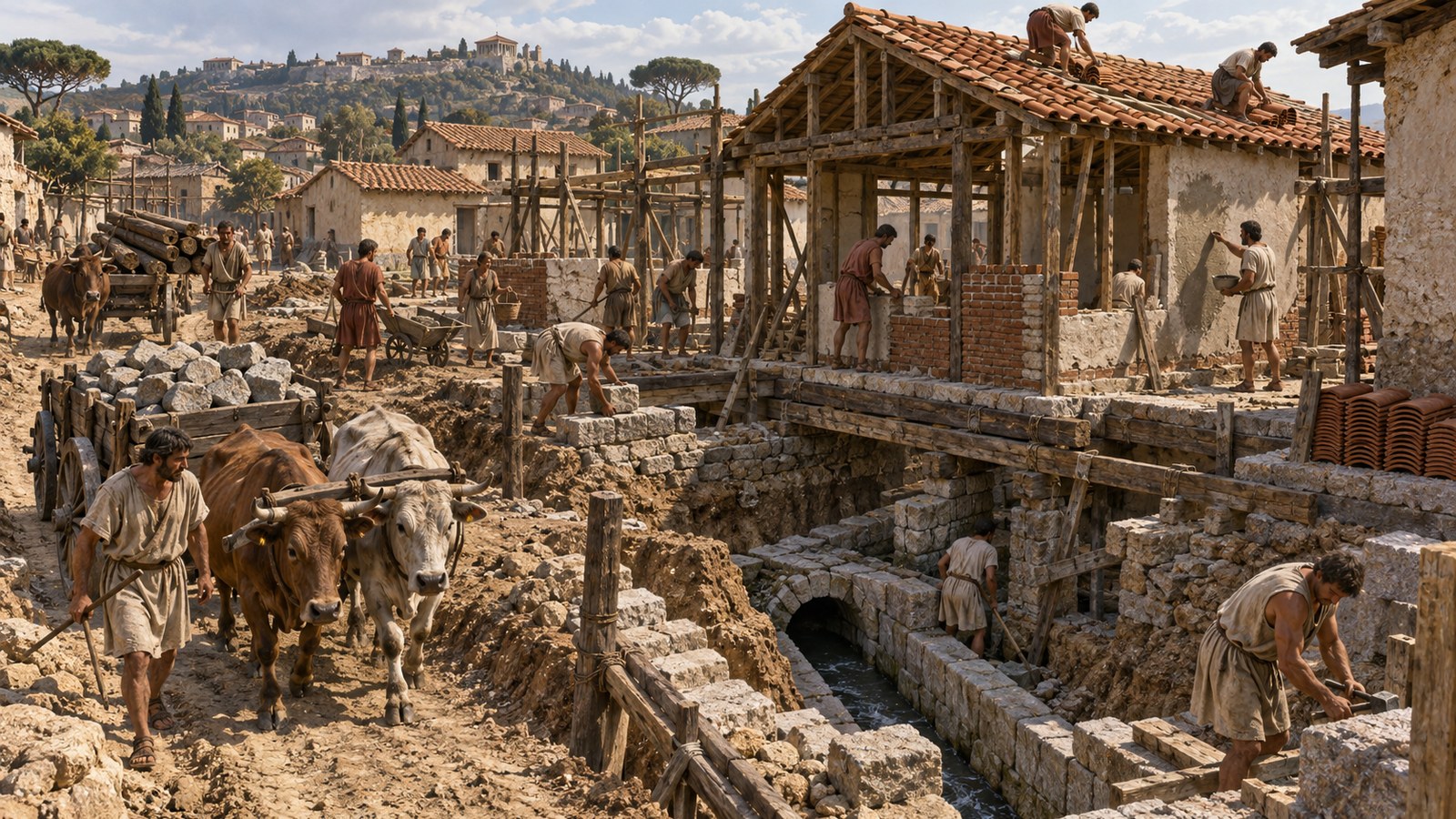
Tiles were provided at public expense. That intervention addressed a common bottleneck. A roof required a large number of standardized, fired pieces; distributing them allowed separate projects to move toward weatherproof completion without each household arranging the whole supply.
Stone and timber were opened through a different mechanism. Builders received permission to quarry and fell materials wherever they wished. Livy does not describe modern ownership procedures or a detailed compensation system, so those should not be invented. His emphasis is on removing restraint from acquisition.
Permission came with security. Anyone taking advantage of the access had to guarantee that the buildings would be finished within that year. Public generosity and private obligation were paired. Materials could move freely because time was tightly measured.
The one-year horizon converted rebuilding into a citywide rush. It rewarded households that could seize vacant ground, gather labour and put up habitable structures before regular planning caught them. Livy presents the pressure as a feature of the recovery system, not an accidental mood.
Compare the measured advice in the account of Vitruvius turning a street grid against eight winds. There, orientation precedes construction. After the Gallic disaster, the order reversed: occupation came first, and a coherent grid lost the race.
Old Sewers Stayed Put while Property Moved above Them
Livy says haste removed attention from the course of the streets. Builders also set aside distinctions of property and occupied whatever ground stood vacant. Walls rose according to immediate availability rather than a newly surveyed pattern.
That statement does not mean every boundary vanished forever or every street lacked order. It explains why the rebuilt whole appeared irregular. Numerous local decisions, made under the same deadline, produced a city that no single planner had apportioned.
The sewers supplied Livy with physical evidence. Channels originally conducted beneath public streets later passed under private houses. The underground line preserved an older relationship even after the surface had been divided differently.
A sewer is difficult to shift compared with a timber frontage. Its gradient and outlet constrain it. Rapid builders could bridge or build across an existing channel more easily than they could redesign an entire drainage network while racing to complete roofs.
The result turned infrastructure into memory. Above ground, plots and lanes recorded the hurried return. Below, the older sewer alignment recorded where public space had once run. A homeowner might possess the floor while a civic channel followed a previous street beneath it.
The archaeological record in Herculaneum’s sewer preserving an entire block’s diet shows drains as archives of what a city discarded. Livy uses Rome’s sewers differently: their position became an archive of how the city had been rebuilt.
The Irregular City Was the Price of Immediate Continuity
It is tempting to read Livy’s complaint as a simple contrast between Roman haste and good planning. His narrative is more revealing when the benefits and costs stay together.
Rome needed houses before another season passed. Public tiles, accessible raw materials and a completion guarantee mobilized many builders without waiting for a comprehensive scheme. The policy restored residence and political confidence at the speed the decision to remain demanded.
The cost was coordination. Each household could solve its own shortage while worsening the citywide pattern. A quick wall narrowed the space available for a lane. A chosen vacant plot ignored an earlier property line. A surviving sewer became somebody’s subfloor.
Camillus had insisted that Rome exceeded its buildings. The reconstruction proved him right in an unintended way. Sacred sites, the river and civic institutions anchored the community, while ordinary buildings could be improvised around them. Continuity did not require copying the old surface exactly.
Yet the improvised surface endured. Livy, writing centuries later, could still explain the city’s appearance through that emergency. Whether every irregularity truly came from one rebuilding year cannot be demonstrated from his literary account alone. What matters is the causal model Romans found persuasive.
They imagined their city as the product of a successful refusal to leave. The crooked lanes were not merely defects beside a glorious past. They were traces of a moment when speed, material aid and distributed effort made staying possible.
The standard was planted before the plan existed. Rome rebuilt around that choice, and the old sewers carried its consequences underneath the new roofs.
Sources
Livy, History of Rome, book 5, chapters 54–55.