
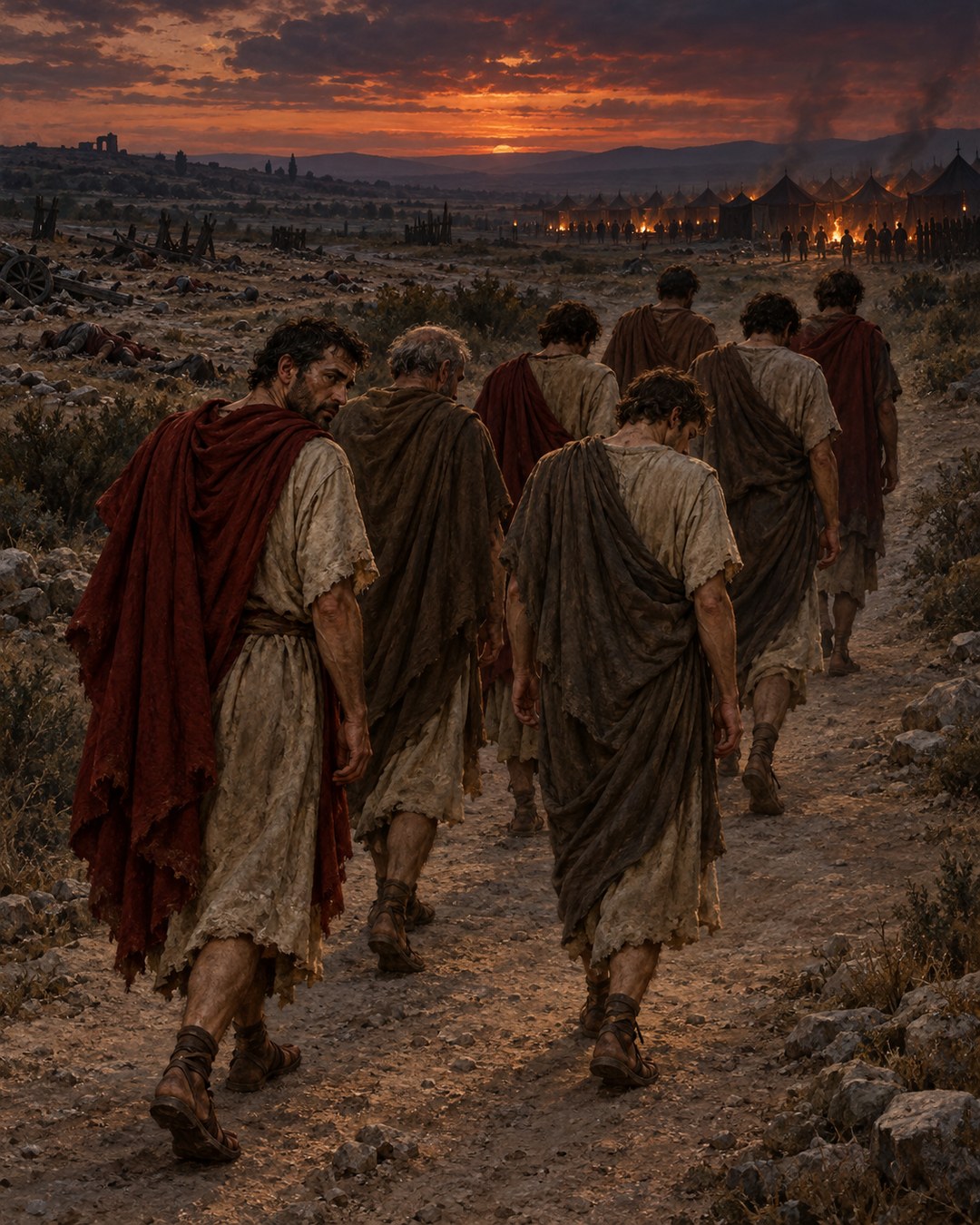
Ten Roman prisoners left Hannibal’s camp after Cannae and reached home alive. They carried a proposal for exchanging captives, but their freedom came with an oath.
If the Senate refused, they had sworn to return to the Punic camp. The Senate refused.
Eight men embraced their families and walked back.
Hannibal Made Captives into His Negotiators
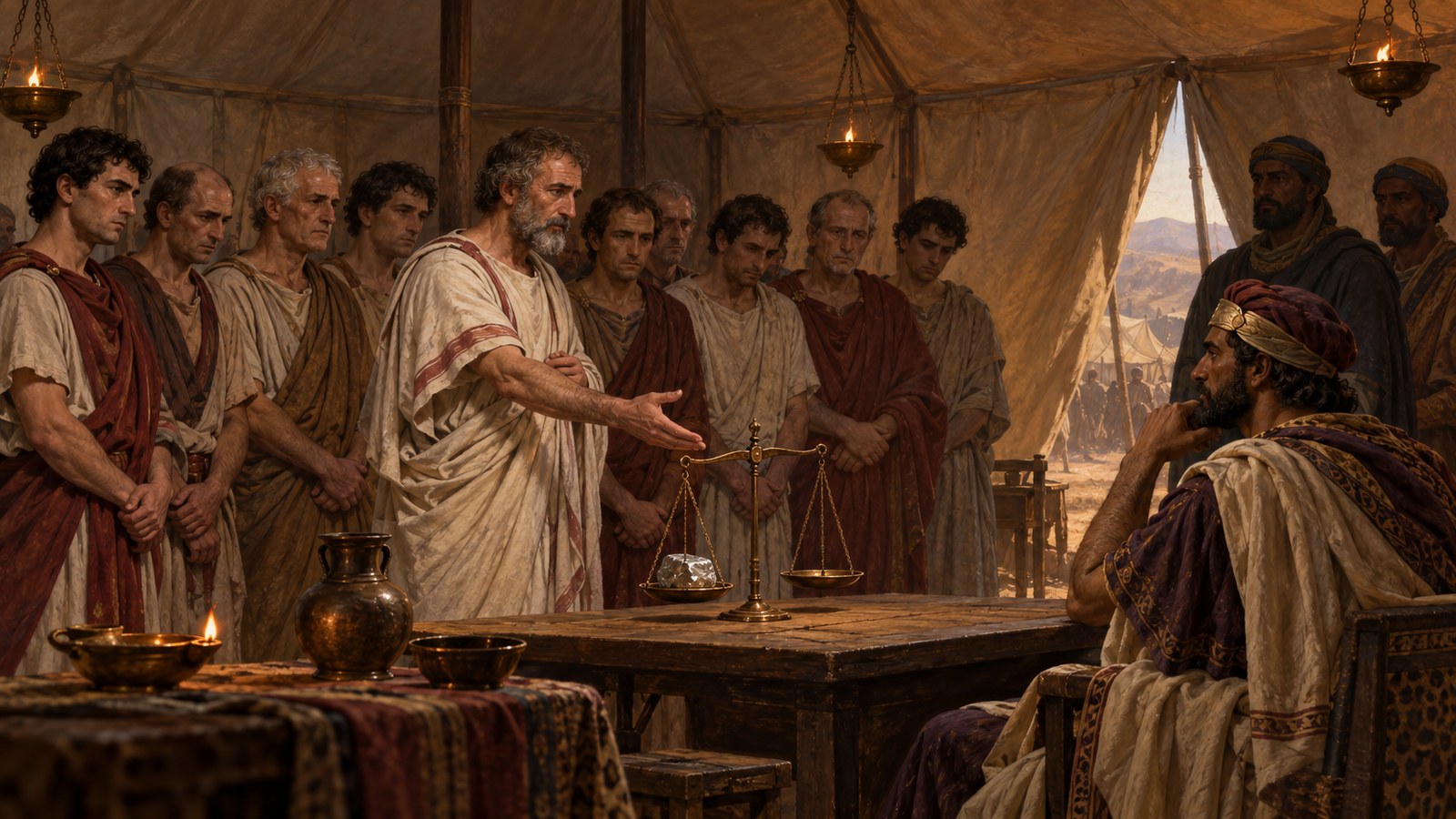
Gellius begins with military disaster already complete. After Cannae, Hannibal held enough Roman prisoners to choose ten as envoys. Their bodies became the channel through which an exchange could be offered.
The proposed accounting was exact. If one side received more captives than the other, it would pay a pound and a half of silver for each person in excess. Human return was organized through balancing headcounts and a stated weight of metal.
Hannibal did not simply trust the men to deliver his message. Before departure, he required an oath that they would come back to the Punic camp if the Roman people rejected the arrangement.
The oath made temporary movement possible without pretending they had been released unconditionally. The prisoners could cross the enemy line because their own sworn commitment was expected to bring them back.
That mechanism saved guards and displayed confidence. Hannibal placed enforcement partly inside Roman religious and moral discipline. If the men believed an oath remained binding, distance from the camp would not be escape.
The story of Hannibal counting Antiochus’s glittering army as Roman booty uses a joke to expose weakness behind display. Here Hannibal’s leverage was quieter: ten unarmed enemies carried his terms because their word was expected to travel with them.
The Senate Rejected the Price despite the Men in Front of It
The ten arrived in Rome and delivered the Carthaginian commander’s proposal to the Senate. The decision was made with the prisoners and their families close enough to embody its consequence.
The Senate refused the exchange. Gellius does not provide the debate or a complete strategic explanation in this chapter. It would be unsafe to invent speeches about money, manpower or deterrence.
What matters for his account is the refusal’s immediate effect. The condition in the oath had been met. The men now had to decide whether being physically home changed what they had promised.
Their relatives supplied a legal route toward staying. Through postliminium, they argued, captives who returned to their native land recovered an intact condition of freedom. Embraces reinforced the claim with everything legal language could not contain.
Homecoming and status pulled in one direction. The oath pulled in another. If restored Roman standing erased the obligation made in captivity, the men could remain without calling themselves oath-breakers.
Gellius frames the problem to test Roman seriousness about sworn words. Law did not vanish, and affection was not mocked. The question was whether either could cancel the purpose for which Hannibal had allowed the journey.
Eight Men Said Postliminium Could Not Cancel the Oath
Eight prisoners rejected the argument offered by their families. They said they had no just claim to postliminium while the oath still bound them.
The wording matters. They did not deny that they had crossed back into Roman territory. They denied that the return was legally or morally complete while it depended on a promise to go back if the mission failed.
They immediately set out for Hannibal. Gellius compresses the road into a sentence, but its physical meaning is severe. Every step away from Rome exchanged recovered safety for renewed captivity.
The action made an oath more than remembered speech. It became a route traced twice: first toward home to perform the mission, then back toward the enemy because the mission had failed.
Gellius offers the eight as evidence for a Roman ideal, not a statistical survey of all prisoners. The exemplary shape should remain visible. Their return shows the standard his source wanted readers to admire.
The recent account of close-set stakes turning scythed chariots back follows discipline shaping movement during battle. The Cannae prisoners faced discipline after battle, when no formation forced them and the road home lay behind.
Two Men Tried to Satisfy the Words without the Purpose
The other two remained in Rome. They claimed they had discharged the oath through a maneuver performed earlier.
After first leaving the Punic camp, each had returned as if for some accidental reason. Having physically re-entered, they argued that they had fulfilled the requirement to return. They then departed again, now supposedly free of the promise.
The maneuver treated the oath as a sequence of positions: outside camp, inside camp, outside again. If the required verb had been performed once, the condition could be marked complete.
Gellius supplies the fact that destroys this defense. The men had returned with the intention to deceive. Their brief step into camp was not submission to the agreement after a failed embassy. It was preparation for evading that future duty.
Roman judgment therefore looked through literal motion to purpose. The oath had enabled a mission whose result was not yet known. Returning before the Senate decided could not honestly perform the return required after rejection.
The story draws a boundary between precision and bad faith. Exact words mattered enough to bind the eight, but language did not become a trapdoor through which intention disappeared.

Censors Turned a Loophole into Public Disgrace
The two men’s cleverness was broadly condemned. Gellius calls it dishonorable and says they were despised and reproached.
The censors later converted opinion into civic penalty. They imposed fines and marks of disgrace because the men had not done what they swore to do.
The judgment did not accept their camp re-entry as performance. It defined performance by the obligation’s understood end: return to Hannibal after the exchange was rejected.
Cornelius Nepos preserved an additional political response. Many senators proposed sending the non-returners to Hannibal under guard. The motion failed because a majority opposed it.
That defeat is important. Rome did not mechanically enforce the oath by surrendering the men. Formal coercion stopped short, while stigma and censorial punishment continued.
Gellius reports an even darker ending from Nepos: the men became so hated and infamous that they tired of life and killed themselves. That literary claim belongs to the exemplary tradition and should not be expanded into invented private scenes.
The community’s message was already clear without them. A sworn envoy could not use a rehearsed loophole to keep the benefit of trust while refusing its cost.
Gellius presents the tale as proof that Romans treated oaths as inviolable and sacred. Its strongest insight lies in the contrast between the eight and the two.
All ten crossed the same lines. All heard the same refusal. The difference was how they understood fulfillment.
The eight treated the oath as a continuing bond between Hannibal’s permission and their conduct after the Senate answered. The two isolated one verb from that sequence and staged a return before it could mean what the agreement required.
Public judgment restored context. It asked not merely whether feet had touched the camp again, but whether the prisoners had accepted the consequence to which those words committed them.
This does not make the Roman decision uncomplicated. Families lost men they had just recovered, the Senate refused exchange, and a foreign commander benefited from Roman fidelity. Those costs are what give the example force.
Trust across enemy lines depended on the possibility that an oath could survive advantage, fear and legal ingenuity. Without that expectation, no captor would send ten prisoners home to negotiate.
The eight men returned because they believed their word had not ended at Rome’s gate. The two stayed because they believed one deceptive step had ended it earlier. Gellius’s Romans remembered which journey counted.
Sources
Aulus Gellius, Attic Nights, book 6, chapter 18.