
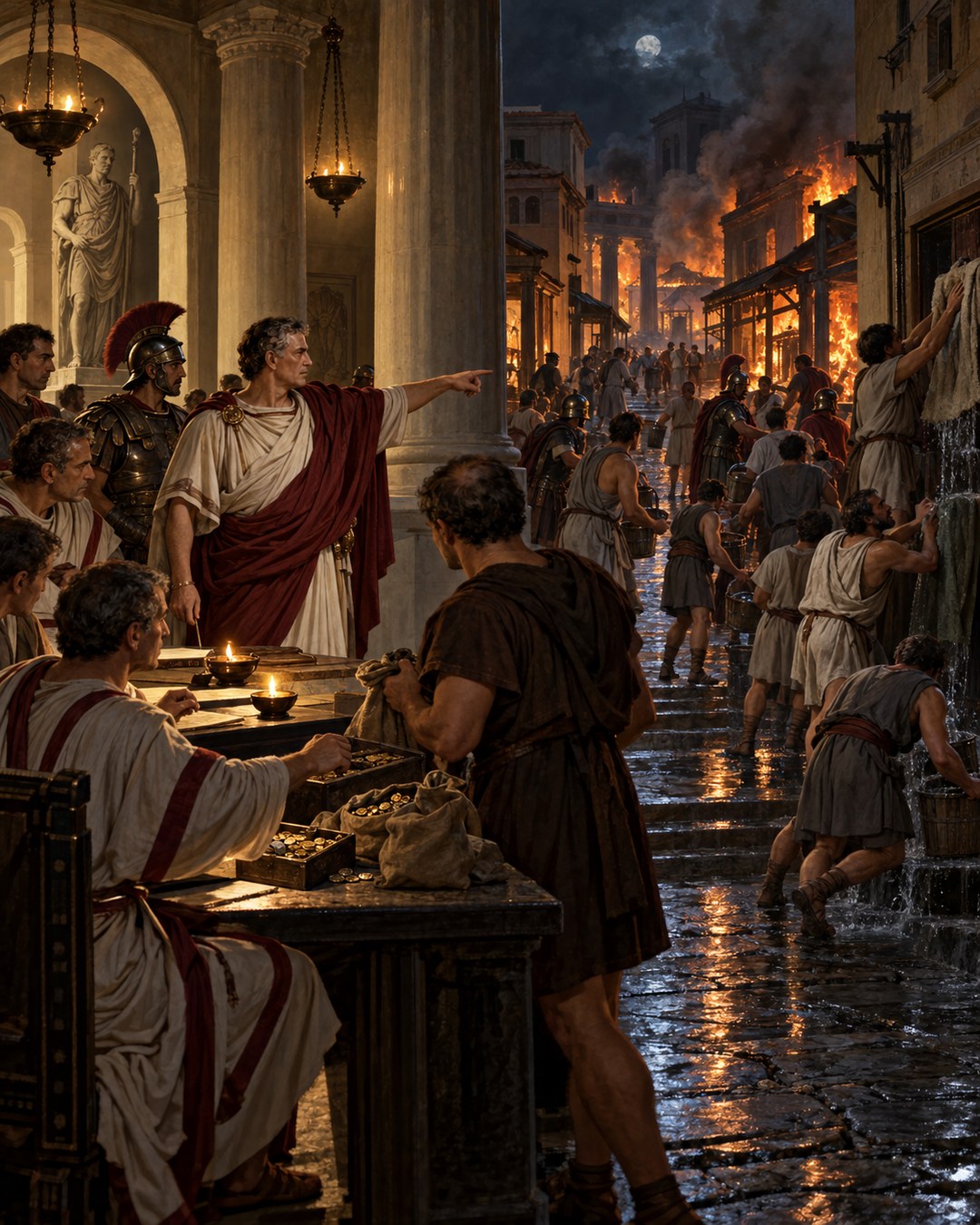
The fire was still burning after soldiers and the imperial household had joined the response.
Claudius stayed at the Diribitorium for two nights. Then bags of money appeared before the people Rome still needed.
Suetonius’s brief scene shows an emergency force being purchased in real time.
Two Nights Turned Presence into Command
Suetonius introduces the episode as evidence of Claudius’s attention to the care of Rome. The fire in the Aemiliana was stubborn, not a small flame extinguished before the emperor arrived.
Claudius based himself at the Diribitorium, a major public building, and remained there for two nights. Duration changed the meaning of his presence. This was not a ceremonial inspection followed by departure.
Night made an urban fire more difficult to read and coordinate. Smoke, darkness, collapsing materials and narrow routes could obscure where help was needed. Suetonius does not inventory those conditions, but the two-night vigil establishes a response continuing through repeated periods of darkness.
The public building supplied a recognizable command point. Magistrates, soldiers, household personnel and later civilian helpers could act around a place associated with the emperor’s continuing attention.
Staying also exposed Claudius to the pace of the emergency. Orders could be adjusted while the fire resisted control, rather than reported upward only after delay.
The two nights also created continuity across changing workers. Individuals could tire or leave, but the command point remained. A persistent location allowed new arrivals to discover where authority, information and payment were concentrated.
Suetonius does not tell us where Claudius slept, whether he slept, or which exact tasks he directed. The defensible detail is duration at the Diribitorium. That is enough to show that imperial attention lasted beyond a single daylight appearance.
Ancient Rome had no modern municipal fire service operating with engines, hydrants and radio dispatch. That contrast should not flatten the actual organization visible here. Public authority could still gather bodies, containers, tools, routes and rewards.
Another Roman city asked for a permanent answer after disaster. Nicomedia sought a 150-man fire brigade, which Trajan refused. The Aemiliana episode instead shows temporary capacity assembled while flames were active.
Soldiers and Household Labor Reached Their Limit
A body of soldiers was already involved. So were people Suetonius identifies as Claudius’s own enslaved household workers. The source is explicit that they did not provide sufficient help.
That sentence marks a capacity failure, not necessarily a failure of effort. A force can work hard and still be too small for the perimeter, water movement, demolition, evacuation or salvage an expanding fire demands.
Soldiers brought habits of command and coordinated labor. The imperial household gave Claudius personnel he could direct immediately. Both were resources close to power.
The fire exceeded them. Once that happened, repeating the same order to the same people could not create more hands. The response needed a new reservoir of labor.
Suetonius does not say that the original crews withdrew when civilians arrived. The more natural reading is expansion: an existing organized core received additional people summoned from across the city.
The presence of enslaved workers must not be softened into a generic “staff.” Their labor was coerced by status. The later paid summons therefore added people under a different incentive and relationship to the emergency.
This distinction helps explain the money. Claudius could command soldiers and his household through existing authority. To enlarge the force with ordinary inhabitants, he made service immediately rewarding.
The initial force may also have supplied organization for the newcomers. Civilians arriving from different districts would not automatically know where water, tools or threatened structures were most urgent. Soldiers, magistrates and household workers already on scene could give the added labor direction.
Numbers alone were not the solution. A larger response had to avoid blocking lanes, competing for the same containers or rushing into unstable buildings. The command point and the people already working gave shape to the expansion.
Magistrates Turned a Crowd into a Citywide Call
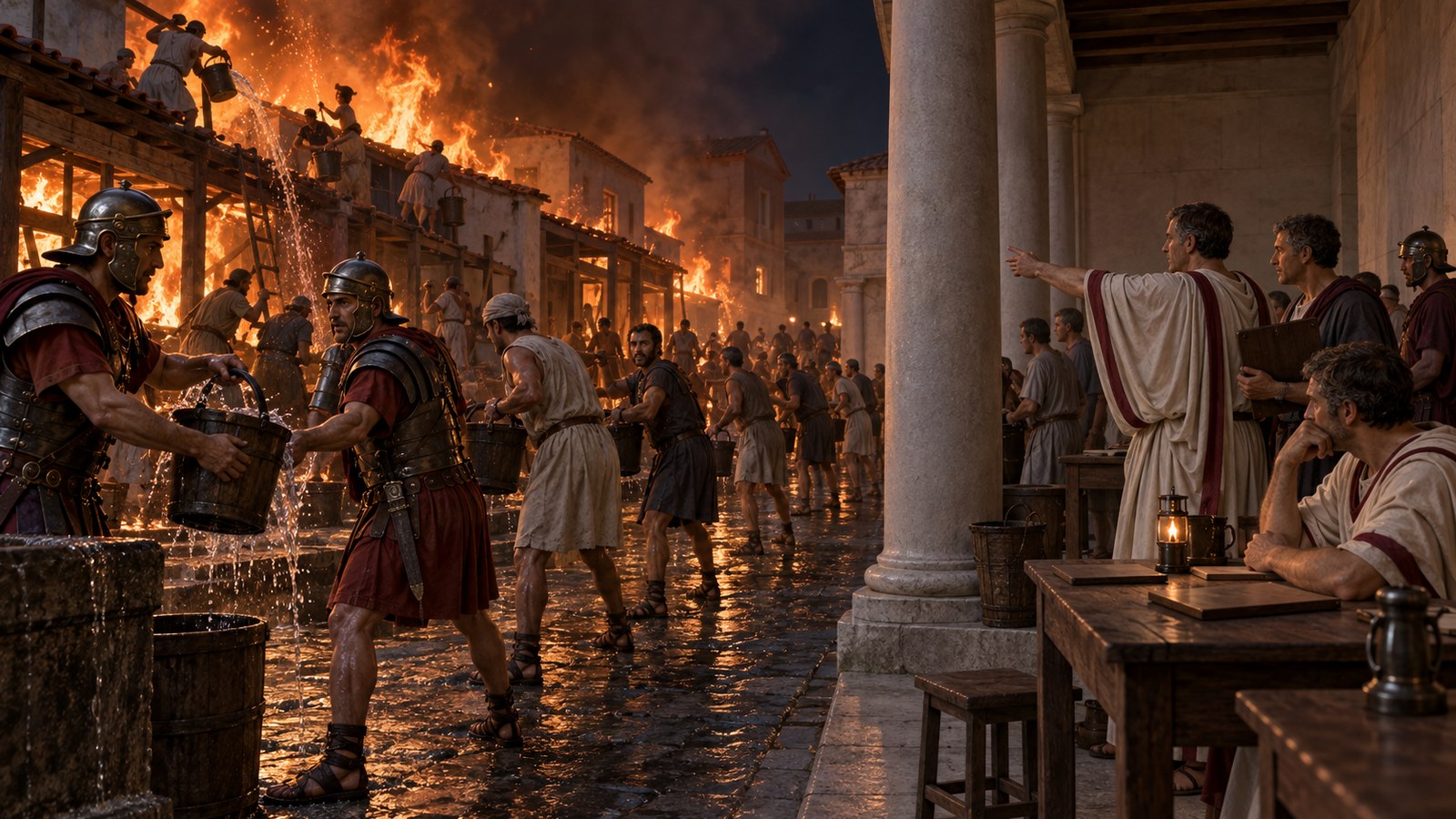
Claudius did not personally walk every district looking for volunteers. Suetonius says the commons were summoned through the magistrates from all parts of the city.
Magistrates provided a network. They could carry the call beyond those already watching the flames, making an emergency in one district a demand placed on the wider urban population.
The phrase “from all parts” matters because proximity is not the same as capacity. Neighbors might be first on scene, but they were also the people most threatened, displaced or occupied with their own property.
A broader summons reached inhabitants whose homes were not yet in immediate danger and whose labor could be redirected. The city became a pool larger than the burning quarter.
Yet a summons alone faced practical obstacles. Fire rescue was dangerous, exhausting and disruptive. People had reasons to hesitate, particularly if the blaze threatened property that was not theirs.
Private actors could profit from that vulnerability. The builders attached to Crassus’s property purchases belong to a story in which fire enabled acquisition. Claudius’s cash served a different transaction: payment for immediate rescue labor rather than distressed ownership.
Public authority thus handled reach and incentive separately. Magistrates spread the call. Money gave the recipients a concrete reason to answer it now.
The division of labor is striking. Claudius supplied authorization and resources. Magistrates connected that decision to the city’s districts. Ordinary residents supplied the additional physical effort. The response expanded through layers already present in Roman public life.
A summons from “all parts” also spread the burden. The threatened district did not have to produce every rescuer from among people already protecting families and possessions. Labor could arrive from areas with more freedom to respond.
Visible Cash Made the Promise Immediate
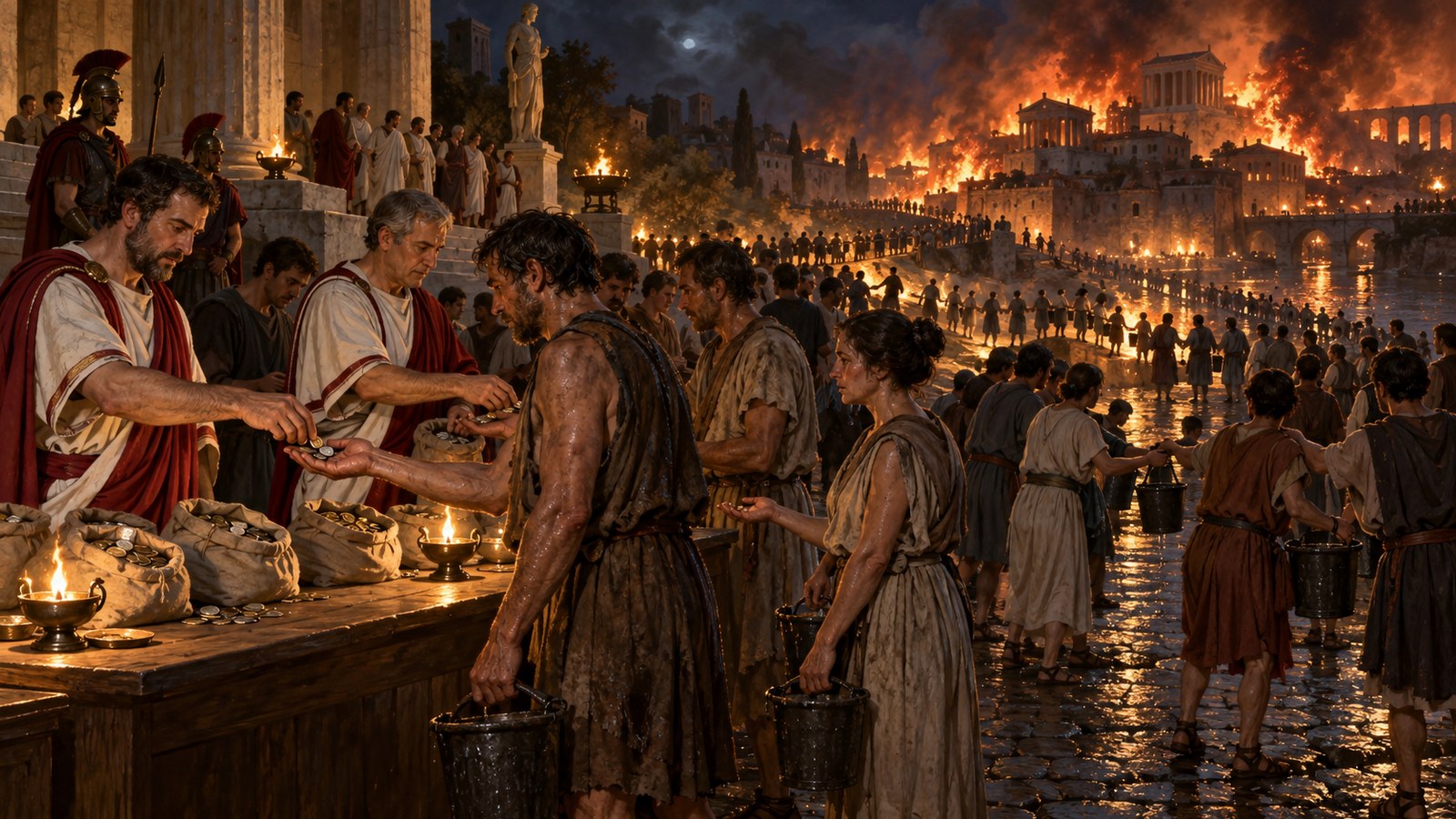
Claudius ordered bags full of money placed before the people. The cash was not hidden in an account office or promised after names had been reviewed.
Visibility made credibility part of the mechanism. A prospective helper could see that funds existed. The offer did not depend entirely on trust that a distant treasury might honor a vague promise later.
Suetonius adds that each man was paid on the spot with a suitable reward for his services. Timing reduced the gap between risk, labor and compensation.
Immediate payment also made repeated assessment possible. “Suitable” implies variation tied in some way to service, though the source does not preserve a rate table or say exactly how work was valued.
The scene therefore should not be turned into a modern wage system with invented denominations. What survives is the operational outline: cash bags, public urging, service and prompt reward.
Money functioned alongside command rather than replacing it. Magistrates still summoned. Existing crews still worked. Claudius still remained at the command point. Payment opened another channel into the response.
On-the-spot reward reduced another kind of emergency friction: paperwork after the danger. A helper did not need to prove the promise weeks later to an official who had not seen the work. Someone at the scene connected observed service to payment.
That procedure required money to be physically available and people able to judge services while smoke and rescue continued. The bags on display were therefore only the visible end of a small administrative machine.
The solution was temporary by design. It did not create a standing brigade after the fire, establish training, or guarantee faster action in the next district. It bought capacity for this stubborn emergency.
That limitation is also the episode’s insight. Institutions often meet sudden overload not by rebuilding themselves overnight but by attaching an immediate incentive to a wider population.
Claudius’s money bags became emergency equipment because they moved people. In Suetonius’s scene, the coins did not quench flames. They made more hands arrive while quenching was still possible.
Sources
Suetonius, Claudius, section 18.1.