
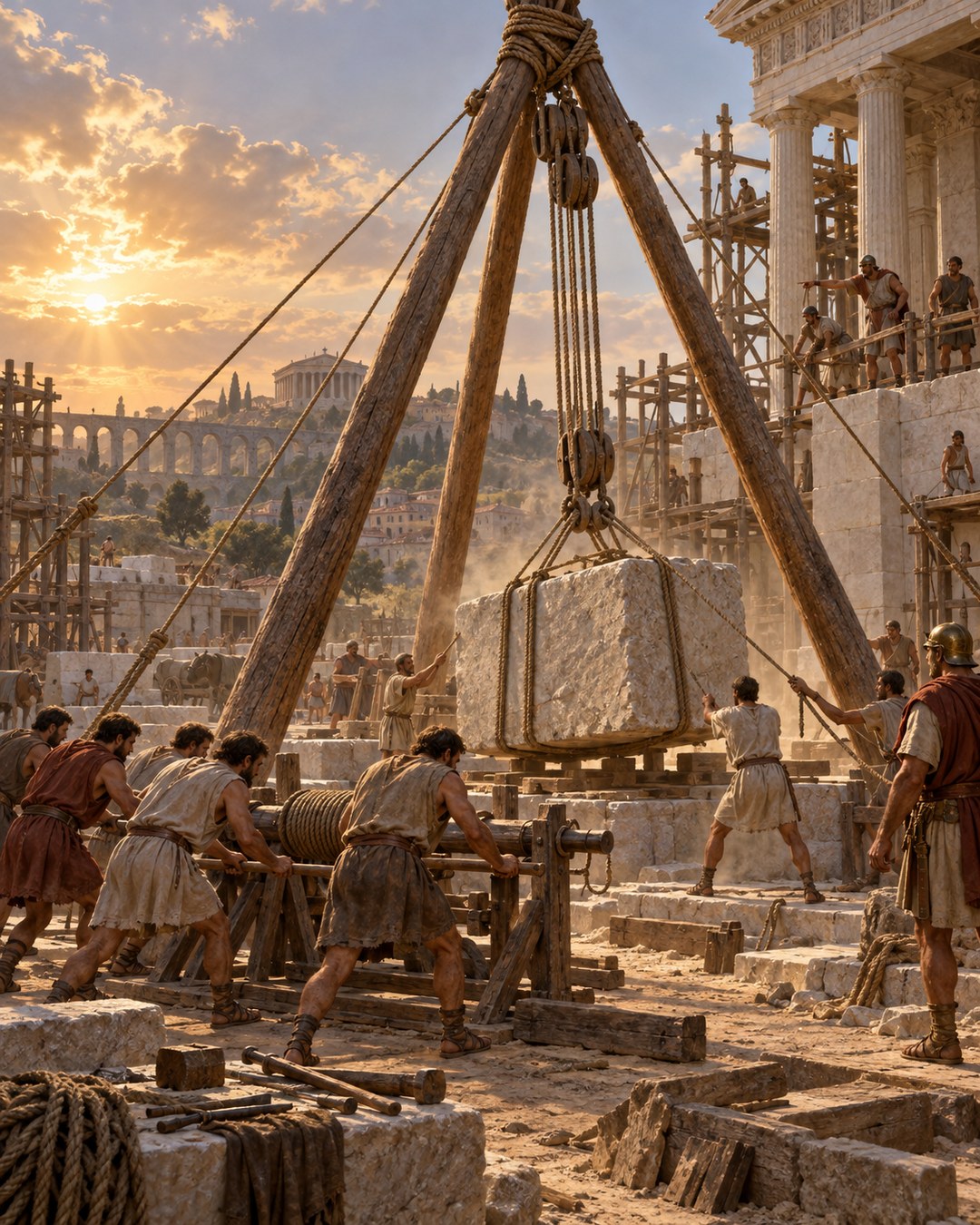
A monumental stone did not rise because one laborer pulled harder.
It rose because timber, rope, iron, ground anchors and rotating axles divided the problem into manageable movements.
Vitruvius’s crane grew stronger one controlled layer at a time.
Three Timbers Created a Place to Hang Force
Vitruvius begins his account with machines used to erect sacred buildings and other public works. The first requirement is not a pulley but a frame able to carry one above the load.
Three timbers were selected according to the weight. They were joined with a pin at the top and spread widely at their feet. That shape turned separate beams into a stable elevated support.
Ropes raised the frame and then kept it steady. An upper block was fastened at the head. It carried two pulleys rotating on axles, while another block moved below.
The leading rope passed over an upper pulley, descended around the lower block, returned over another pulley and descended again. Repetition changed the relation between the worker’s pull and the load’s movement.
The system did not abolish work. A longer movement of rope produced a shorter movement of stone. What it changed was the force required at any one moment and the ability to control that force.
Roman quarrying had already reduced bedrock into transportable pieces. The sequence used by quarrymen to free blocks ended with a new difficulty: even a movable block could still be far beyond direct human lifting.
Three feet also gave the crew room beneath the apex. The stone could rise through the center while the frame carried the upper block above it. Spreading the timbers widened support at ground level without filling the lifting path with a solid wall.
The top pin concentrated enormous demands in a small connection. Vitruvius’s instruction to size timbers according to the load was therefore a system rule, not decorative advice. A strong rope hanging from an undersized frame would only relocate the point of failure.
The crane placed a mechanical path between hands and stone. Workers could act at the axle and rope while the load rose beneath the frame.
Pulleys Multiplied the Path of the Rope
Vitruvius gives names to levels of the system. A block with three pulleys was called a trispastos. When the lower system had two pulleys and the upper one three, it was a pentaspastos.
The names matter because builders could specify an arrangement rather than vaguely request “more rope.” Each additional run had to enter the right block, turn around the right pulley and remain clear of its neighbors.
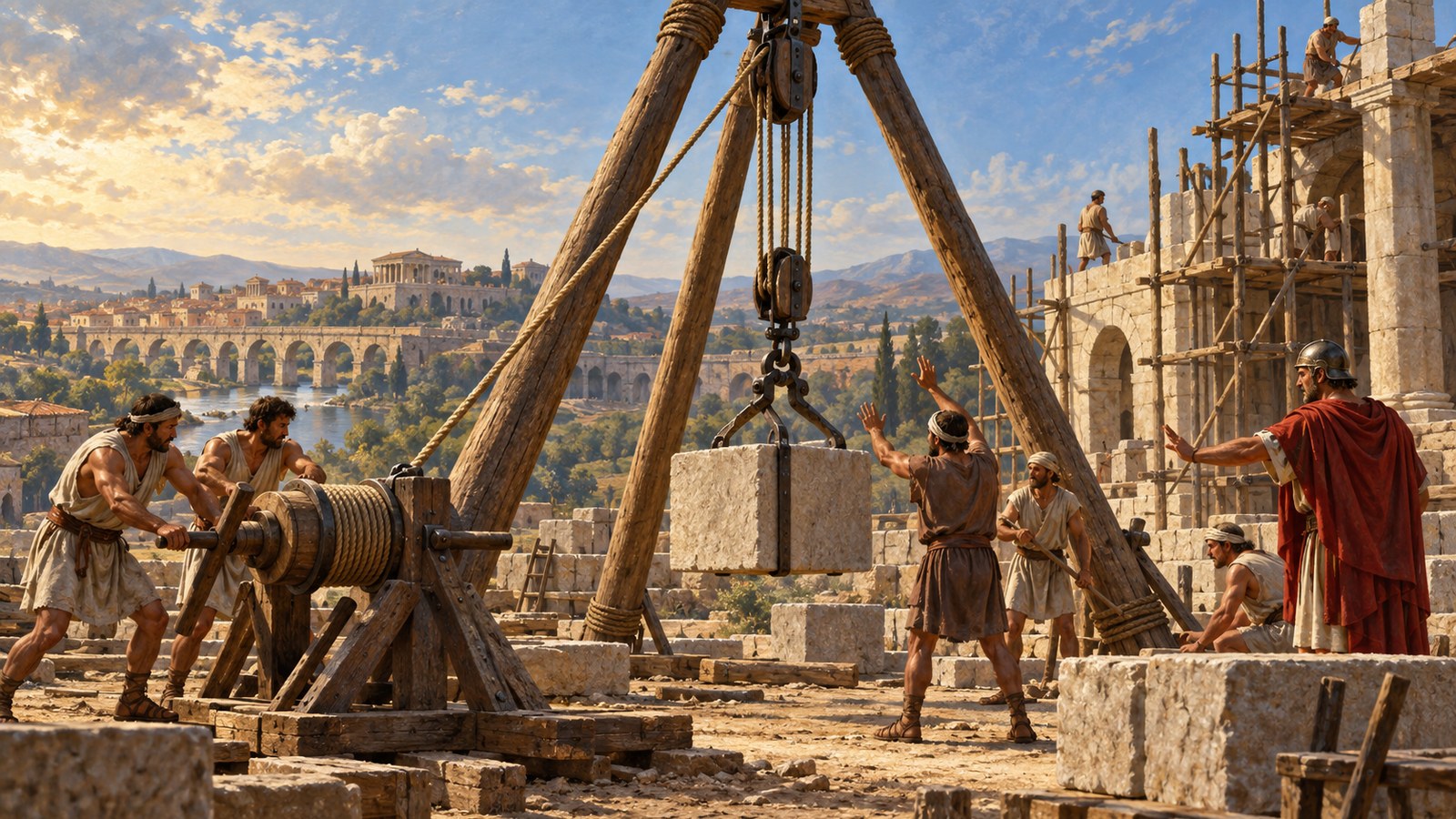
At the bottom, iron shears were fixed under the moving block. Their teeth entered holes cut in the stone. The lifting machine therefore depended on preparation of the load as well as construction of the frame.
The loose end of the rope attached to an axle near the ground. Workers inserted levers into holes at the axle ends and walked them around. Rotation wound the rope instead of demanding one continuous straight pull.
This gave the crew pauses and positions. A worker could apply force through a long lever, and the axle gathered rope in an orderly coil. The stone rose toward its assigned place in the work.
Repeated rope runs meant repeated inspection points. Each pulley had to turn freely; each axle had to stay seated; each strand had to follow its intended groove. Friction that accumulated across the system could steal force or heat and damage rope.
The lower block traveled with the stone while the upper block remained with the frame. Their changing separation was the visible measure of progress. As rope accumulated on the axle, the gap closed and the prepared stone climbed.
For heavier weights, Vitruvius required longer and stouter beams. Pins and axle had to grow in proportion. Mechanical advantage could reduce the pull, but it could not excuse a frame too weak for the load.
The same discipline appears in smaller Roman tools. dividers preserved a measurement across a workshop by making geometry physical. Pulley blocks preserved a force path by making every turn of the rope physical.
Guy Ropes Sent Instability into the Ground
A suspended stone does not only pull downward. It can swing, shift the frame or drag a foot inward. Vitruvius answered that problem with guys attached to the shoulders of the machine.
If no fixed anchor was available, the ropes were attached to sloping piles driven into the ground. Soil was rammed around them. The crane’s stability therefore extended beyond the visible timber legs into prepared earth.
These lines did not lift the stone directly. They kept the lifting structure in the geometry required for the pulleys to work. Strength and stability performed different jobs.
Vitruvius repeatedly connects correct arrangement with safety. Once the ropes were distributed, the guys secured and the leading rope fastened to the axle, levers could put the system in motion “without danger.”
That phrase should not be read as a claim that ancient building sites were accident-free. It describes the intended result of the prescribed setup: a lift whose forces had recognized paths instead of improvised ones.
Experienced judgment remained essential. Timber dimensions, pin size, rope condition, anchor ground and stone attachment all had to match the actual weight. A diagram alone could not inspect cracked wood or loose soil.
The crane was thus partly a machine and partly a temporary structure. It had to be erected, braced, tested, operated and dismantled around the work it served.
Anchors also let the crew answer forces from different directions. Guys could be distributed rather than tied to one convenient object. If the load or frame tended to pull one way, the opposed lines carried that tendency outward to separate stakes.
Workers at those lines had a different responsibility from workers at the axle. One group produced lift; another protected alignment. Coordination mattered because increasing the pull on a badly leaning frame would make danger grow faster.
Capstans and Treadwheels Scaled the Human Input
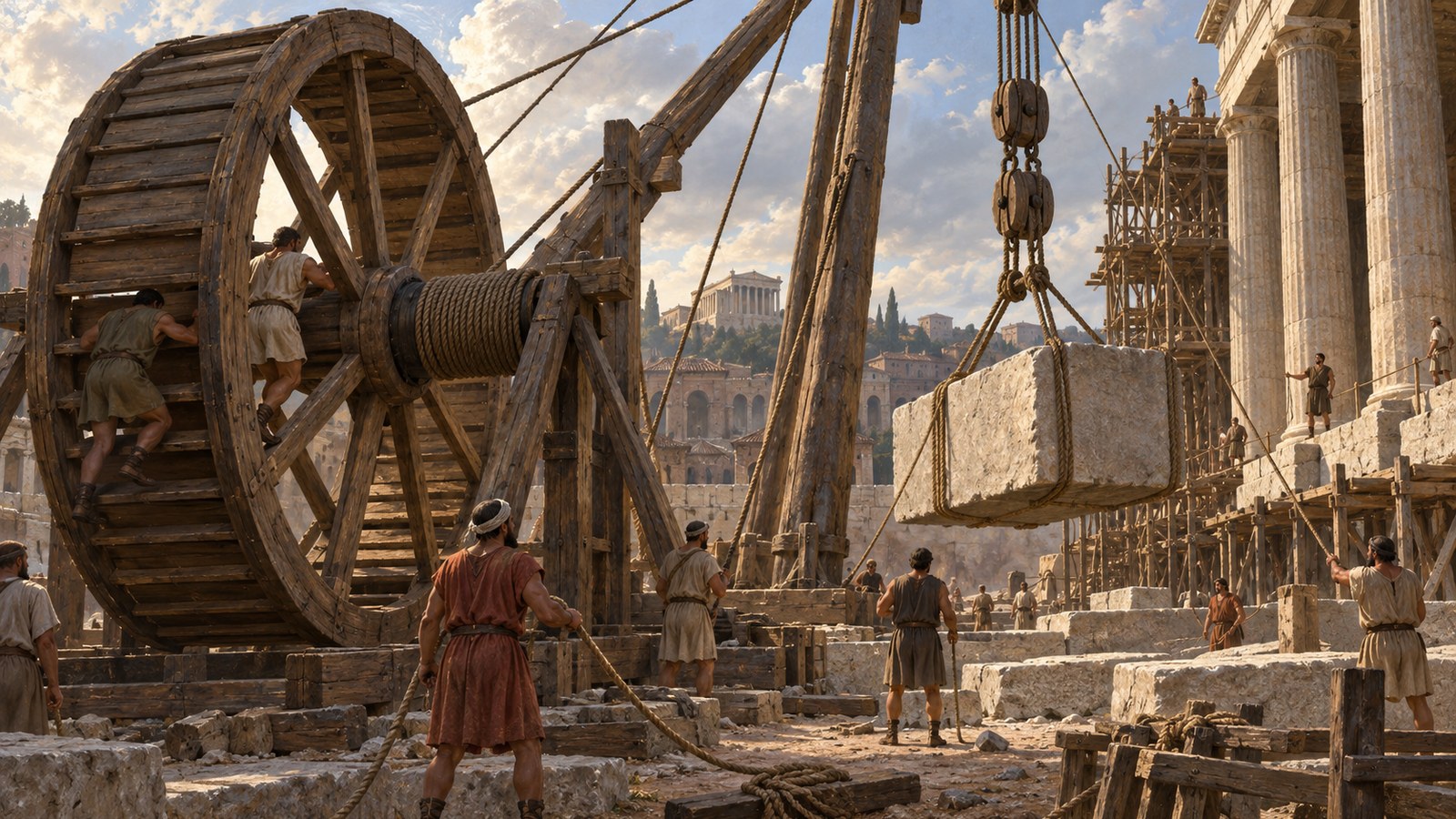
Vitruvius reserves another change for exceptionally large weights. A mere axle was no longer enough. A large drum-wheel was fixed to it, and the rope system was arranged around upper and lower blocks.
A separate rope ran from the drum-wheel to a capstan. Turning the capstan rotated the drum and axle, which drew the lifting ropes and raised the weight gently.
For still more effective power, the drum-wheel could be large enough for men to walk inside. Their body weight and repeated steps produced rotation at a radius much larger than the axle.
The workers did not climb with the stone. They walked a circular path while the load followed a vertical one. The machine translated ordinary stepping into controlled hoisting.
A treadwheel increased the distance between the worker’s weight and the axle’s center. That larger radius gave each step more turning effect. Again, the price was distance: feet traveled around the wheel many times while the stone advanced slowly.
Slow movement could be useful. A block approaching a wall course or column position needed adjustment, not merely altitude. Gentle hoisting gave the crew outside the wheel time to watch clearance, steady the suspended mass and signal corrections.
Vitruvius also describes a many-pulley arrangement worked by three teams without a capstan. That variation reminds us that “the Roman crane” was not one fixed object. Builders selected frames, blocks and drives to fit the site and load.
The machines could serve away from temples too. Vitruvius says they loaded and unloaded ships, and blocks and ropes could help draw vessels ashore. The same principles moved between architecture and waterfront labor.
What made the system impressive was not hidden magic. Every part announced its task: legs carried, guys steadied, pulleys multiplied, the axle collected rope, and people supplied rotation.
Five pulleys did not make weight disappear. They made its movement negotiable.
Sources
Vitruvius, On Architecture, book 10, chapter 2.