
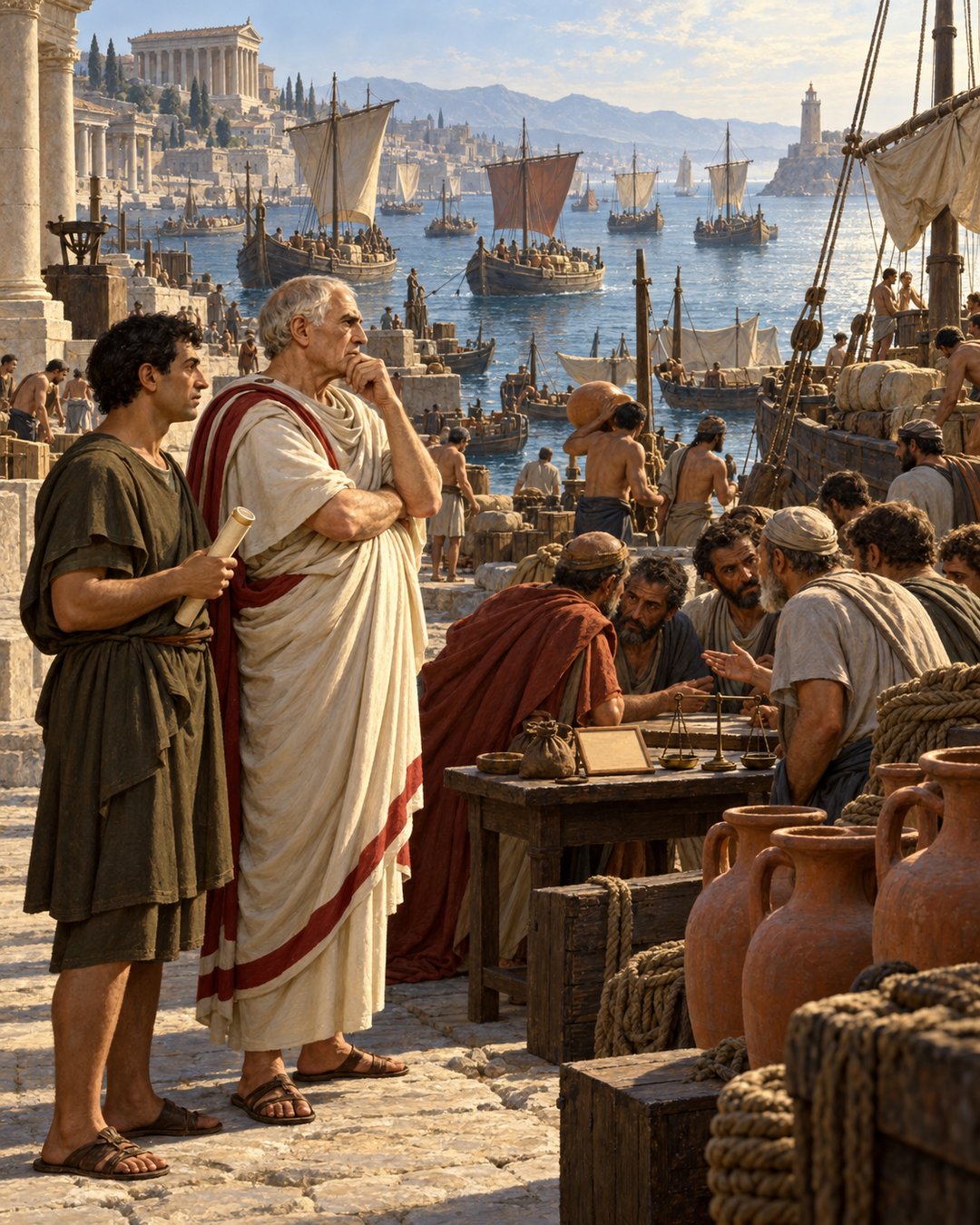
Cato did not trust one ship with the fate of his whole loan.
He required fifty borrowers and fifty vessels to stand inside one company, took a share himself, and sent his freedman Quintio with the ventures.
Sea risk remained. What changed was the amount of Cato’s capital that any one disaster could reach.
The Farmer’s Reputation Hid a Wider Portfolio
Plutarch places the maritime scheme late in a deliberately uncomfortable portrait of Cato the Elder. The Roman had built a public identity around discipline, farming, old customs and resistance to luxury. His private search for return ranged much farther.
As Cato applied himself more intensely to making money, Plutarch says, he came to regard agriculture as entertaining rather than profitable. The remark reverses the image associated with his agricultural writing. Land remained culturally honorable, but it was not enough for the returns he wanted.
He bought fish ponds, hot springs and districts occupied by fullers. Plutarch says these assets produced large profits and quotes Cato boasting that even Jupiter could not ruin them. The list spread income among services and property that did not all fail for the same reason.
That appetite for dependable yield helps explain why Cato’s next arrangement was so carefully divided. Lending against a single vessel could offer a rich return, but ship, cargo and borrower were exposed to weather, navigation, piracy and commercial failure together.
Roman maritime activity needed capital before cargo could earn anything. Hulls had to be supplied, crews maintained and goods acquired. A lender advanced resources while repayment depended on a voyage that remained beyond his direct control.
Rhodian general-average rules distributed an emergency sacrifice across surviving interests. Cato’s pool worked earlier in the chain. It distributed a lender’s exposure before a particular ship left port.
Plutarch calls the method disreputable. He does not invite readers to admire a neutral financial invention. The mechanism must be separated from the biographer’s moral verdict without erasing it.
Cato pursued safety and profit through an occupation his source treats as unworthy. The contradiction is part of the evidence, not an inconvenience to remove.
Fifty Borrowers Brought Fifty Hulls into One Company
The arrangement began with a condition imposed on borrowers. They had to form a large company rather than approach Cato as isolated captains or merchants.
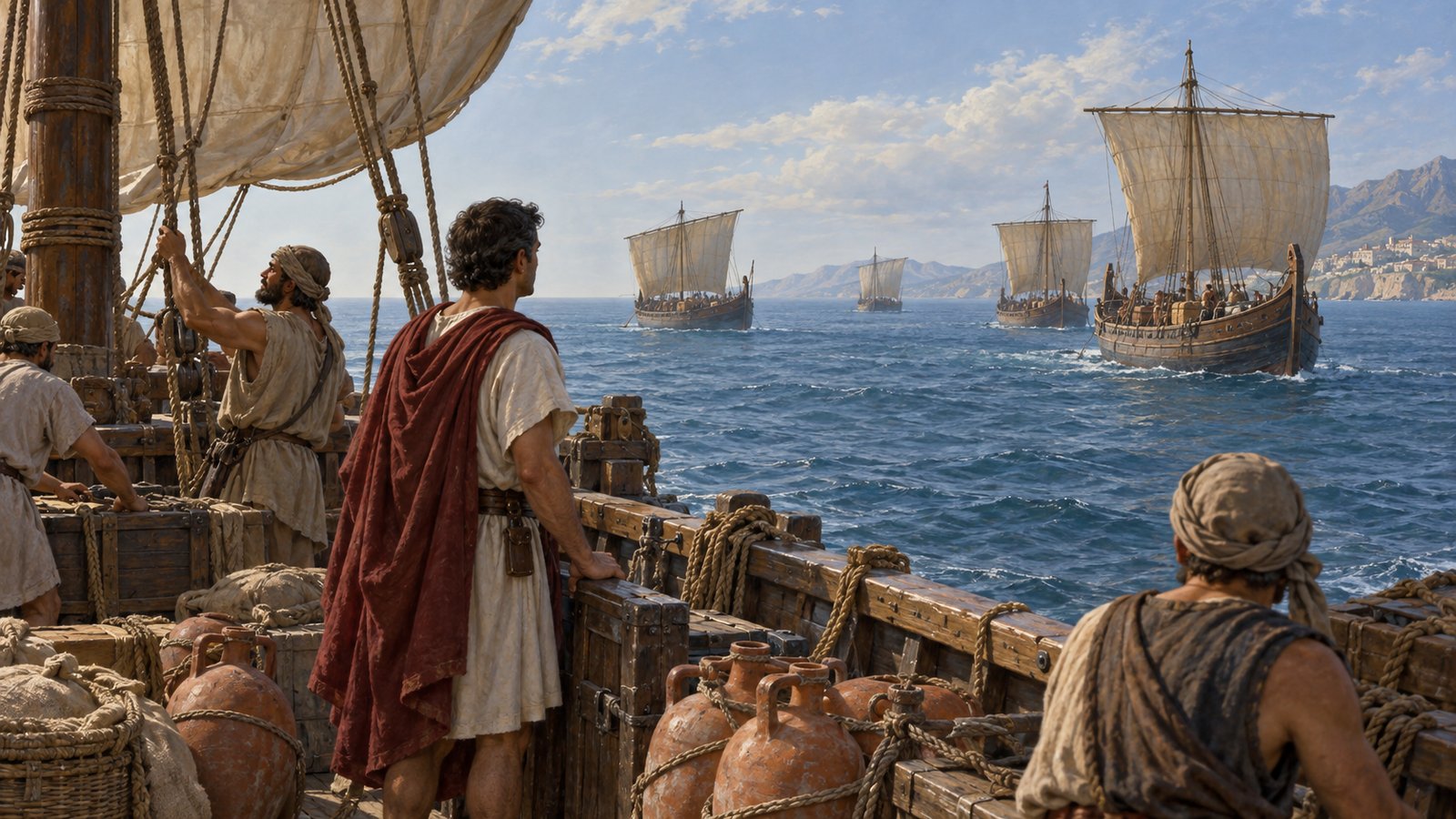
Plutarch gives an exact scale: fifty partners and the same number of ships. Those paired figures created the pool on which everything else depended.
If each partner was associated with a vessel, the lender no longer faced one borrower whose entire repayment capacity rode in one hull. Many ventures supported the combined security. A loss could be severe for its owner and crew without automatically becoming total for Cato.
The source does not preserve a contract, interest rate, cargo list or route. It would be wrong to invent equal loan sizes or claim that all ships always sailed as one visible convoy. “Company” and “security” are the secure terms; the exact legal paperwork is not.
The number fifty also matters because it was far beyond the scale of a casual partnership. Recruiting that many participants required social connections, compatible commercial plans, and confidence that the organizer would account for obligations across separate voyages. The pool was therefore an institution assembled for access to credit, not merely a lender dividing one loan on paper.
What the passage does state is the desired effect. Cato’s whole security was not imperilled. Only a small part was at risk.
The distinction becomes clearer beside ordinary cargo concentration. One large shipment can be efficient, but it lets one accident destroy a large fraction of value. Fifty separate hulls create many points of failure while reducing dependence on any single point.
That did not make the pool invulnerable. A regional war, port closure, shared route, seasonal storm pattern or dishonest management could affect several vessels. Diversification reduces specific risk; it cannot promise that every danger is independent.
Plutarch’s wording offers no modern probability calculation. Cato did not need a spreadsheet to recognize concentration. He needed enough separate security that one wreck ceased to equal the whole position.
The company also shifted organization onto the borrowers. Cato would lend only after they assembled the scale he demanded. Access to his money required collective structure.
One Share Kept Cato inside the Arrangement
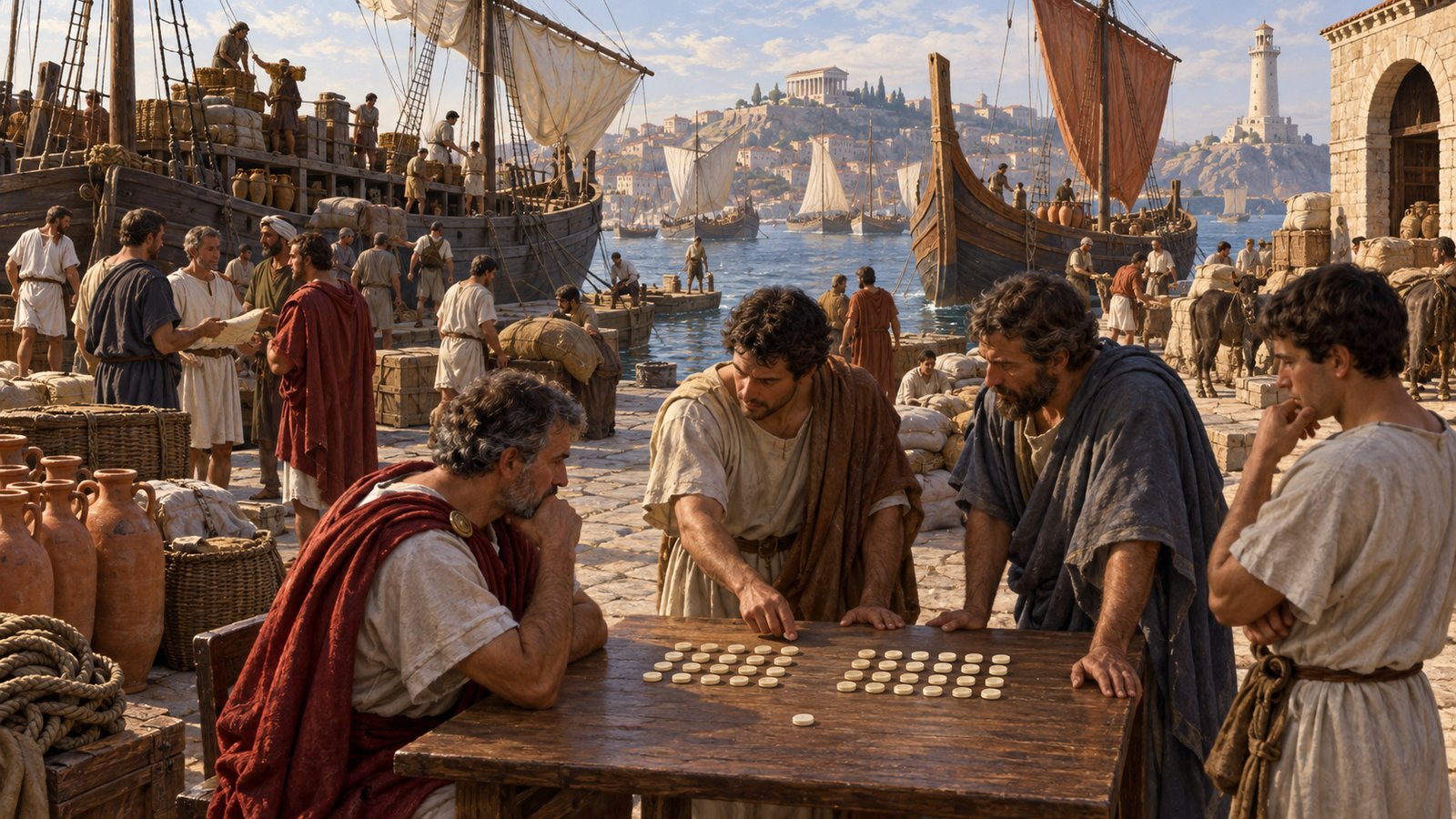
Cato was not merely an outside creditor. Plutarch says he took one share in the company himself.
That detail aligned him with part of the venture’s result while keeping his participation limited. The source does not specify whether the share matched each borrower’s contribution, but it clearly distinguishes one share from the fifty-partner whole.
Participation could improve information. An owner inside a company has reason to know what ships, clients and voyages compose it. Cato’s representative supplied a human connection between that interest and activity at sea.
Quintio was a freedman. He accompanied Cato’s clients in all their ventures, according to Plutarch. His presence made supervision mobile.
The word “all” emphasizes the breadth of the assignment, though it does not explain whether Quintio physically boarded every vessel or traveled with the organized enterprise. The safe conclusion is that he represented Cato alongside the clients rather than waiting only for reports at Rome.
A freedman could occupy a position both trusted and subordinate. Quintio carried Cato’s interest, observed borrowers and moved through a commercial world that exposed him to the very travel risks the investor was distributing.
That labor complicates the elegant arithmetic. Fifty ships look like units in a pool from the financier’s perspective. Each depended on crews, agents, port workers and merchants whose bodies could not be diversified away.
Cato’s single share and Quintio’s mission also discouraged a false separation between finance and operations. The loan was structured on land, but its performance had to be watched where ships and clients actually moved.
Roman commerce often relied on people who crossed legal and social boundaries for elite households. The movement of tablets and bankers’ promises across ports similarly depended on agents who made distant obligations credible.
Reduced Exposure Did Not Erase the Moral Cost
Plutarch closes the description with the outcome Cato wanted: only a small part of his security was imperilled, and his profits were large.
The two results belonged together. The pool limited damage from a single failure while letting Cato participate in a broad set of voyages. Repetition across many ventures could turn individual uncertainty into a steady stream of opportunities.
Yet Plutarch frames the loans as the most disreputable way of lending. His judgment may reflect hostility to profiting from dangerous sea credit, disappointment in Cato’s professed austerity, or both. The passage offers criticism, not a compliance manual.
Cato’s risk control protected the lender first. It did not necessarily lower the borrowers’ interest, improve sailors’ safety or share losses equally. A robust creditor can still sit above vulnerable participants.
The method also rested on bargaining power. Borrowers had to form the company Cato required. A small merchant who needed capital could not choose a simpler bilateral deal on the same terms.
That imbalance explains why technical cleverness should not become automatic praise. Financial structures answer the question “who bears what risk?” before they answer whether the distribution is fair.
Cato recognized that one ship was a dangerous container for too much of his security. His solution was fifty ships, fifty partners, one personal share and one trusted representative.
The sea remained unpredictable. Cato made unpredictability arrive in smaller pieces spread across many separately vulnerable hulls.
Sources
Plutarch, Life of Cato the Elder, chapter 21.