
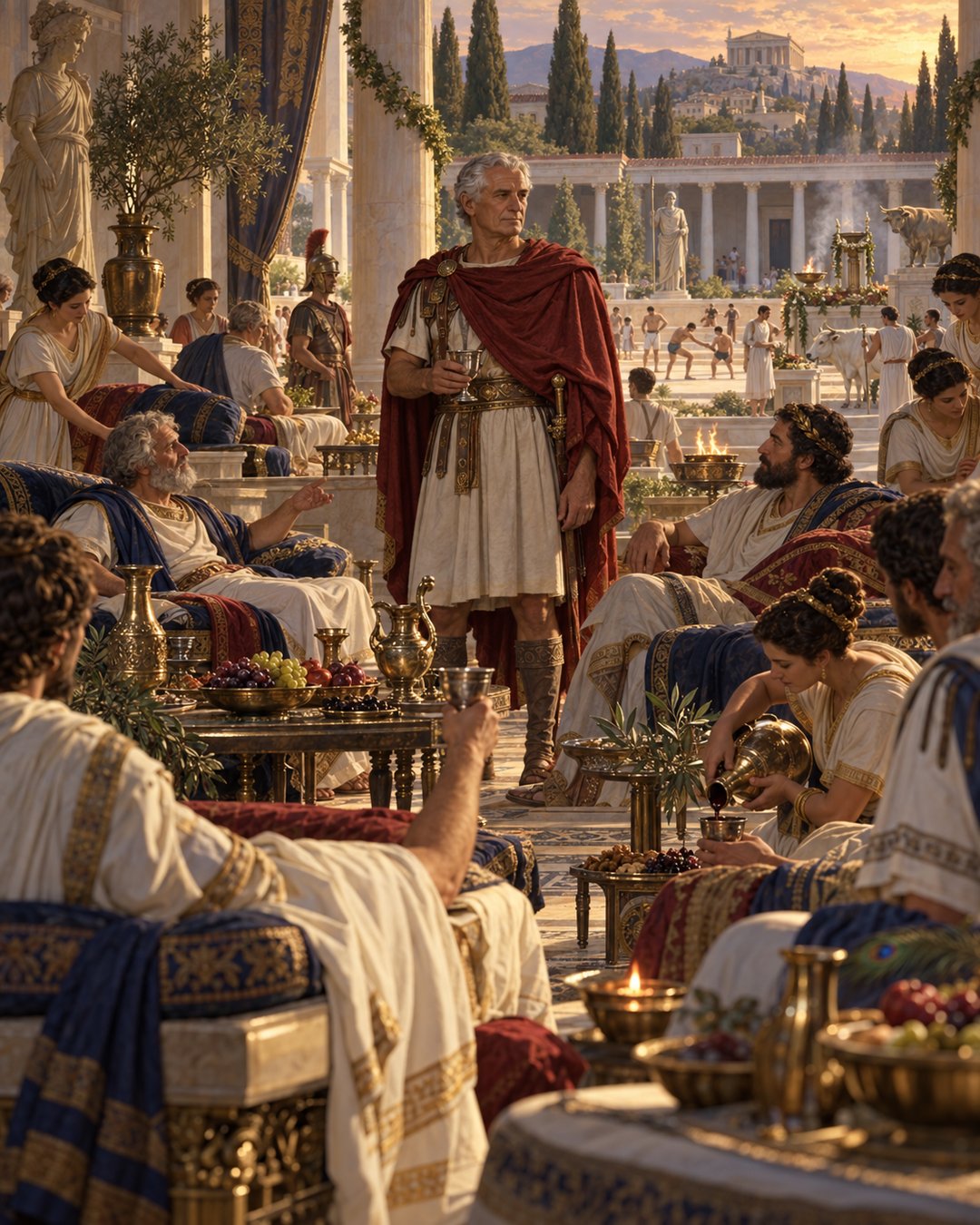
Aemilius Paullus did not hand the victory banquet to chance.
He watched greetings, couches, precedence and personal attention closely enough to astonish Greek guests who knew he had just reorganized a kingdom.
His explanation was sharper than a dinner joke: a battle line and a banquet both revealed whether a commander could put people in the right place for the intended effect.
Victory Had to Become a Settlement
Plutarch’s scene belongs after the defeat of King Perseus, not inside the battle that decided Macedonia. Aemilius now faced abundance, diplomacy and public expectation.
Royal stores contained grain and oil. He distributed gifts to cities, and Plutarch claims the supplies were so extensive that petitioners and recipients gave out before the stock did. The conqueror had become an allocator.
Ten commissioners arrived from Rome. Macedonia’s cities were to house free and independent residents while paying Rome one hundred talents, less than half the tribute formerly paid to their kings.
Those terms needed more than proclamation. A postwar order had to be seen, interpreted and carried into relationships among Roman officials, Macedonian communities and Greek observers.
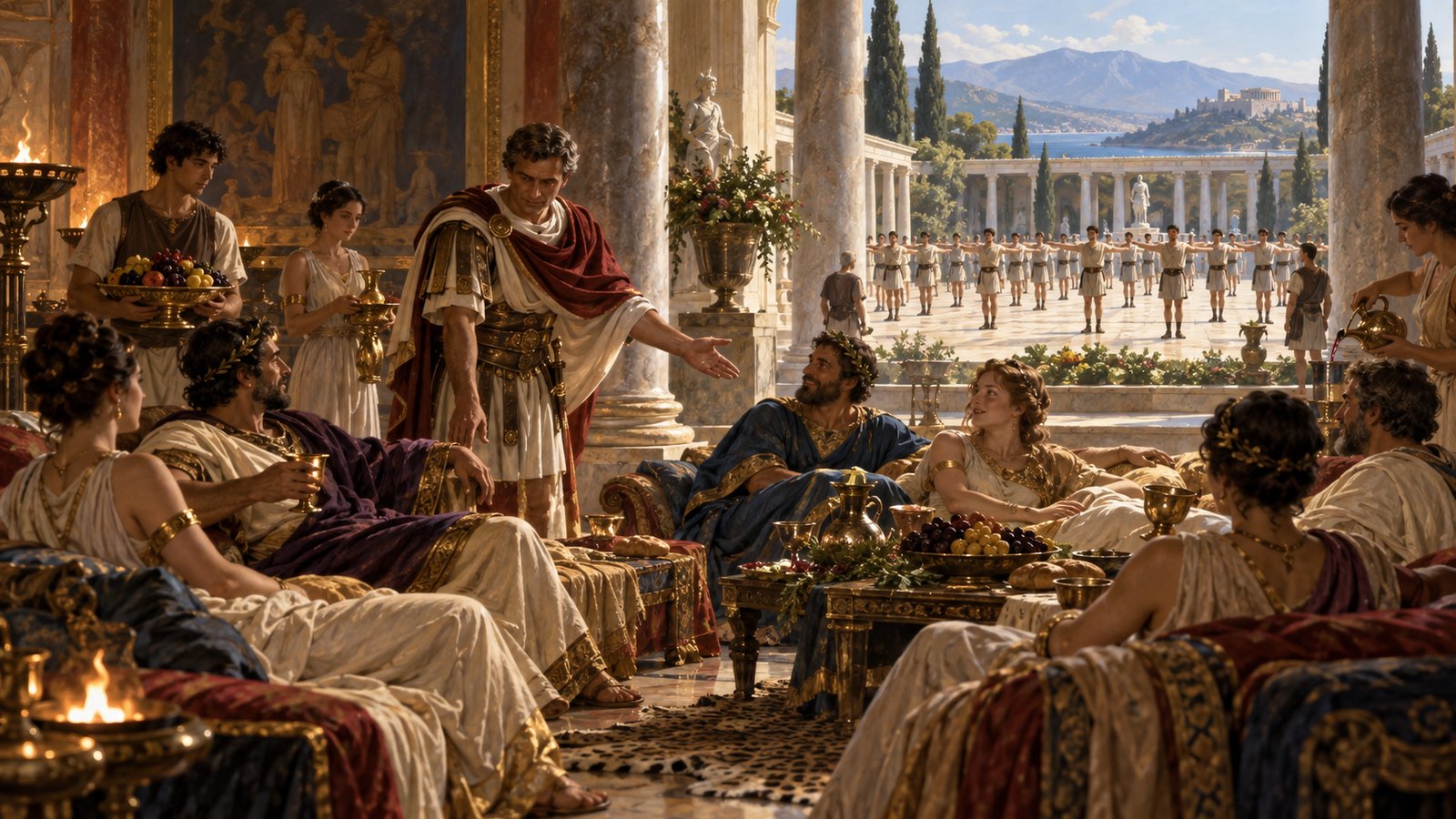
Aemilius staged games and contests, performed sacrifices, and provided feasts and banquets from the royal treasury. Public pleasure occupied the same settlement landscape as tribute and constitutional change.
The sequence matters. Celebration was not simply a private reward after administrative work. It was one medium through which Roman victory appeared generous, controlled and socially intelligible.
Plutarch does not give menus, guest totals or a complete seating chart. He instead records the operations Aemilius considered important: arrangement, greeting, seating, degrees of honor and attention.
Roman public meals could announce hierarchy as clearly as a speech. The triclinium’s seating order made rank visible inside a domestic room. Aemilius was handling that visibility among a much broader postwar company.
A misplaced guest could turn generosity into insult. A neglected delegation might remember the slight longer than the food. The feast required political perception at human scale.
Each Guest Received a Deliberate Place
Plutarch says Aemilius displayed fine and thoughtful perception while arranging and ordering the events. The praise rests on distinctions rather than lavishness alone.
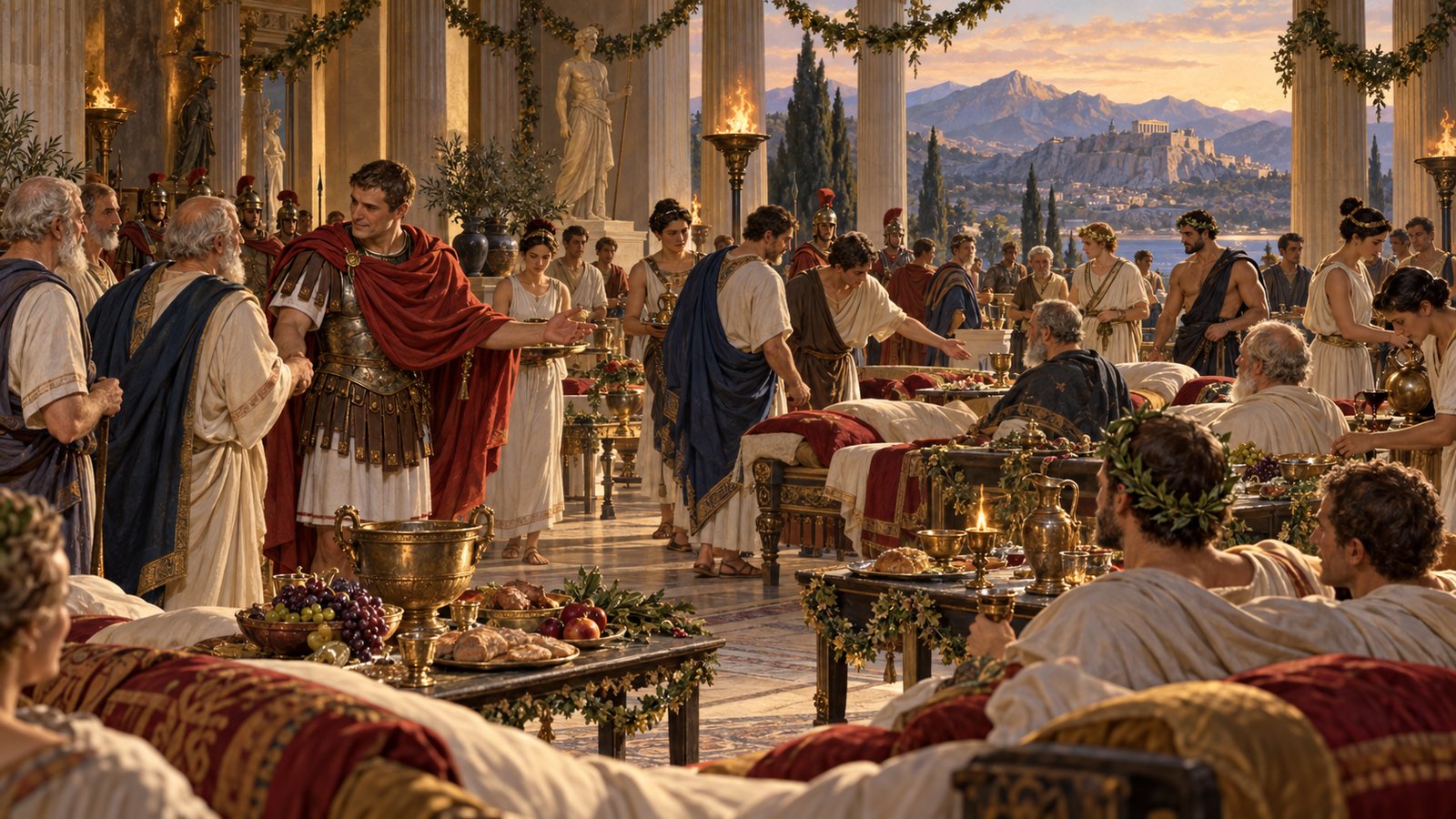
He saluted guests. He seated them. He paid each person the degree of honor and kindly attention considered due.
Those actions formed a chain. Recognition began at arrival, became spatial in the placement of couches or seats, and continued through personal treatment once the banquet was underway.
A host could not maximize every person’s precedence. Honor is relational. Moving one delegate forward changes where another sits; lingering over one greeting may leave someone else waiting.
The task therefore demanded memory and judgment. The host needed to know offices, ages, achievements, civic standing, friendships and rivalries well enough to avoid accidental messages.
Greek spectators were amazed that a man occupied with great affairs did not neglect what they called pastimes. Plutarch sharpens the contrast by describing details as trifling, then showing why they were not trivial to those experiencing them.
The guests were also witnesses to Rome’s new position in Macedonia. Every correctly judged greeting could reassure a city that its standing had been noticed; every error could suggest that the settlement’s promises of ordered freedom concealed carelessness. The banquet carried no statute, but it made the conqueror’s way of ranking people immediately visible.
Aemilius also understood that equipment could not replace presence. The preparations were many and splendid, but he enjoyed believing that he himself was the most pleasing sight to his guests.
That claim contains vanity. It also names a practical truth about hospitality: expenditure creates conditions, while the host’s behavior decides whether guests feel displayed or welcomed.
The cost of Pliny’s empty dinner couch shows another side of elite hospitality, where an absent invitee turned prepared food and entertainment into a pointed account. Aemilius aimed to prevent abundance from becoming impersonal.
Attention was the scarce resource. Royal stores could finance a feast; only the host could distribute recognition moment by moment. That personal distribution made protocol feel like care rather than a diagram imposed on strangers.
A Battle Line and Banquet Needed Opposite Effects
When observers wondered at his care, Aemilius compared presiding over a banquet with marshalling a line of battle.
He did not say the guests were enemies or that dinner should feel military. He defined opposite goals. A battle array should cause the greatest terror in the enemy; a banquet should give the greatest pleasure to the company.
The common element was “the same spirit”: an ability to arrange people and details so the intended response emerged.
On a battlefield, position affects strength, visibility, confidence and exposure. At a feast, position affects dignity, conversation, access to the host and the feeling of being properly known.
Both systems can fail through small errors. A gap in a line invites pressure. A gap in etiquette becomes humiliation. The consequences differ radically, but neither is repaired by claiming the detail was beneath the organizer.
The analogy also exposes a commander’s work before action. Soldiers do not become an effective line merely by being brave, just as food and couches do not become hospitality merely by being expensive.
Order is not valuable by itself. A rigid banquet could be miserable; a beautiful formation could be tactically useless. Aemilius attached arrangement to outcome.
Plutarch makes that outcome emotional. Terror and pleasure are states in other people. The commander or host must imagine how the design will be received from across the field or around the room.
This is why the scene belongs to biography rather than a manual. It presents Aemilius as someone whose attention moved intact between war and peace.
The comparison is flattering, but it is not empty praise. Its concrete parts—saluting, seating, honoring, attending—let us see what “attention to detail” meant in practice.
Treasure, Books, and a Carefully Built Moral Image
Plutarch follows the banquet with captured wealth. Aemilius would not even look at the heaps of royal silver and gold. He handed them to the quaestors for the public treasury.
The refusal makes a moral frame around the hospitality. He spent from royal resources on civic display but did not convert the conquered king’s treasure into private possession.
Only books were made available to his sons, who loved learning. Plutarch turns selection into character: knowledge could enter the family where bullion could not.
A reward for valor provides a further measure. Aelius Tubero, Aemilius’s son-in-law, received a silver bowl of five pounds. Plutarch says this was the first silver to enter a household of sixteen relatives supported by one small farm.
The details are crafted to magnify old-fashioned restraint. We should read them as Plutarch’s moral portrait, not as audited proof that no wealth ever touched Aemilius’s interests.
That portrait also sits beside conquest. The treasury funding celebrations had belonged to a defeated monarchy. Pleasure for guests was produced inside a violent redistribution of power.
Plutarch soon moves to Aemilius’s devastating treatment of Epirus. The neighboring chapters prevent the banquet from becoming a complete definition of the man.
Within chapter 28, however, the design is clear. Aemilius can allocate stores, constitutional status, seats, honor, public treasure and family privilege without appearing mastered by abundance.
The banquet comparison condenses that ideal. Good command was not noise, appetite or improvisation. It was the disciplined placement of people and resources according to purpose.
On one day the purpose was fear. At this table it was pleasure, and Aemilius judged his victory by whether the guests could feel the difference.
Sources
Plutarch, Life of Aemilius, chapter 28.